
On this page
Start here
Quick answer
A Haier dryer may be intentionally running without heat when Rack Dry or Air Dry is selected. Confirm a heat-enabled cycle, identify whether the dryer is gas or electric, and check only the external power and airflow items that are safe to access. For a larger electric dryer, Haier says to verify the proper 220-volt supply; do not open the cabinet or test live wiring. Clean the lint filter before each load, check the accessible exhaust path and outside vent for restriction, and reduce an overloaded drum. If the dryer still runs cold, repeatedly trips a breaker, stops mid-cycle, overheats, smells hot or smoky, or has poor airflow, stop using it and arrange qualified appliance service. Do not bypass a door switch or thermal device, work on gas components, or replace a heater or fuse by guesswork.
Before you begin
Safety first
- This article covers ordinary control, label, filter, load, and externally visible vent or connection checks only. A qualified technician must perform live electrical, gas, internal heating, thermal-protection, wiring, and control diagnosis.
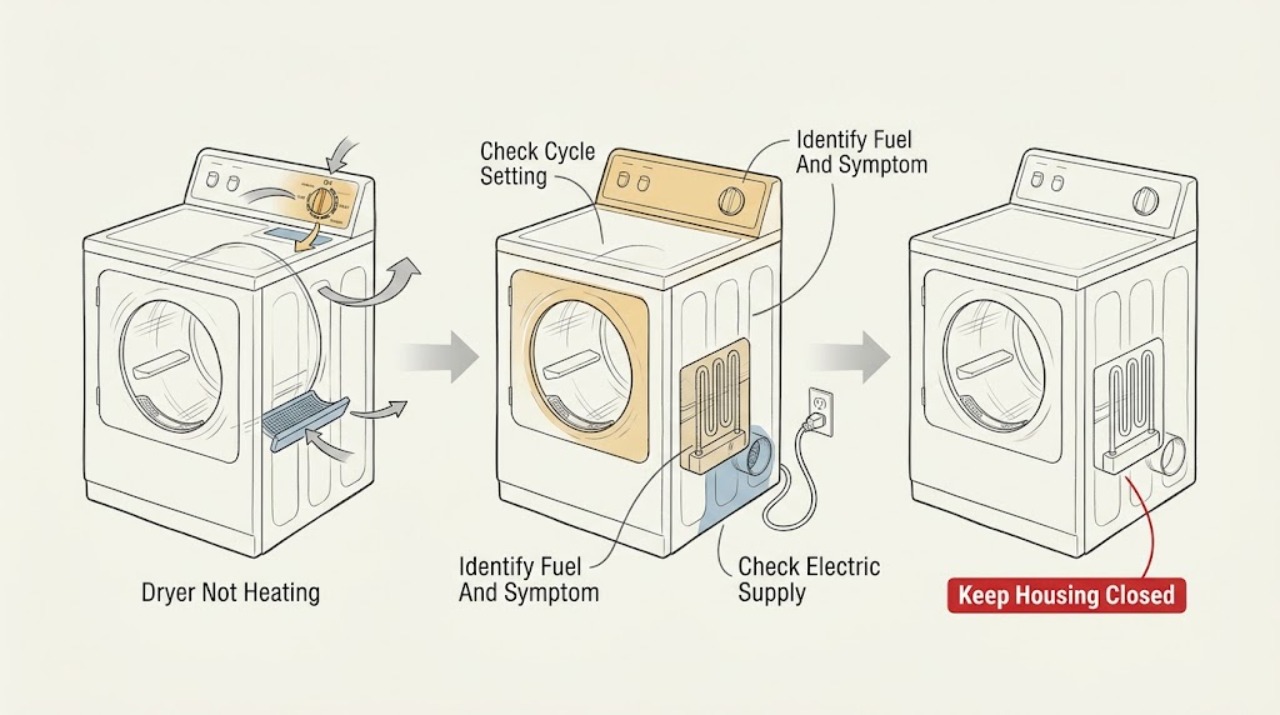
Work through in order
Diagnostic checks
Use only checks that match the exact appliance or system and its official guide.
-
Check 1
With the dryer stopped and the controls visible, record the selected program and heat option; check whether Rack Dry, Air Dry, no-heat, or an air-fluff option is selected.
Expected result: Note whether the drum tumbles with no heat by design, whether a heat-enabled cycle is selected, and whether the display shows an unusual setting or error.
Next step: Select a heat-enabled cycle specified for the load and make one controlled observation only after the lint filter and accessible vent area are safe; record the exact cycle for service if no heat remains.
Stop if: Stop immediately for smoke, a burning smell, abnormal arcing, a damaged control, or a cycle that cannot be selected without forcing the control.
Why this matters
Why: Rack Dry or Air Dry can explain a cold drum without a component failure. A heat-enabled cycle with the same symptom moves the check toward fuel type, power, airflow, thermal protection, or the heating controls.
-
Check 2
From the rating label or installation information, identify whether the Haier dryer is gas or electric and describe the symptom without opening the cabinet.
Expected result: Record whether the drum turns, whether there is no heat at all or intermittent heat, whether the dryer stops early, whether the load is unusually hot, and whether a breaker trips or a gas odor is present.
Next step: Keep the label and symptom record for service and continue only with the matching external checks; do not attempt to access gas fittings, igniters, heater terminals, or internal wiring.
Stop if: Stop using the appliance for a gas smell, smoke, burning odor, sparking, a hot cabinet, repeated breaker trips, or a cord or outlet that is hot, damaged, or discolored.
Why this matters
Why: A running drum with no heat is different from a dryer that loses power, stops mid-cycle, or overheats. Fuel type determines the professional diagnostic path; a gas odor or repeated electrical trip is a safety issue, not a normal no-heat branch.
-
Check 3
For an electric dryer, inspect the plug, cord, receptacle, and household breaker from ordinary access without removing covers; confirm the dryer is connected to its intended dedicated circuit.
Expected result: Record whether the plug is fully seated, the cord or outlet shows heat damage, and the breaker is tripped; do not measure live voltage yourself or repeatedly reset a breaker.
Next step: If the external connection is damaged, hot, discolored, or repeatedly trips, leave the dryer off and use an electrician or appliance technician. If the installation is intact but heat is absent, report the supply history to appliance service rather than opening the dryer.
Stop if: Do not remove the receptacle or dryer terminal cover, probe live wiring, replace fuses with a different rating, or keep resetting a tripped breaker.
Why this matters
Why: A damaged connection or tripped circuit can prevent heating even when the drum runs. Haier notes that larger electric dryers require the proper 220-volt supply and a dedicated 30-amp dual-breaker or two 30-amp fuses; a normal-looking breaker does not prove the supply is correct.
-
Check 4
With the dryer off and cool, clean the lint filter and inspect the accessible vent hose and outdoor hood for lint, a crushed section, visible blockage, or a flap that cannot open during normal operation.
Expected result: Record whether the filter is coated or blocked, the hose is kinked or crushed, lint is accumulating at the rear or hood, and the outdoor cover opens when the dryer is operating normally; do not reach into the duct or dismantle the cabinet.
Next step: Correct only an obvious, safely accessible obstruction according to the installation instructions, then arrange vent cleaning or appliance service if airflow remains weak or the restriction is inside the wall or cabinet.
Stop if: Never operate the dryer without the lint filter. Stop for smoke, a hot rear panel, a blocked or damaged duct that cannot be safely cleared, or lint accumulation requiring disassembly.
Why this matters
Why: Restricted exhaust can reduce drying performance and trigger overheating or protective shutdown even when the heater itself is intact. A clear filter and visible vent path do not rule out a hidden duct or internal fault.
-
Check 5
After the filter and accessible vent check, reduce the load to no more than about half the drum, separate bulky items, and use a suitable heat-enabled cycle for one controlled test.
Expected result: Note whether the exhaust airflow is present, the drum turns, the load warms gradually, drying time improves, or the dryer becomes unusually hot or stops.
Next step: If the symptom persists with a small load, stop repeated testing and provide the cycle, load, airflow, and temperature behavior to service. If the dryer overheats or stops, leave it off until assessed.
Stop if: Do not continue a test for a hot or smoky odor, scorching, a very hot cabinet, poor airflow, repeated shutdown, or any visible lint fire risk.
Why this matters
Why: An overloaded or poorly sorted load can make a working dryer seem ineffective, while weak airflow, a cold drum on a heat cycle, or excessive heat points to a vent, thermal, heating, or control problem that ordinary loading cannot fix.
-
Check 6
Check that the door closes and latches normally, and review whether the dryer has been stopping mid-cycle, restarting, or advancing its timer irregularly; do not bypass the latch.
Expected result: Record a loose or obstructed door, a cycle that stops when the door moves, a sporadic timer, or a normal latch with a dryer that remains cold.
Next step: Remove only an obvious obstruction around the door seal; otherwise report the latch and stop history to service along with fuel type and power or vent observations.
Stop if: Do not tape, defeat, or short the door switch, run the dryer with a damaged seal or loose door, or continue operating after a stop caused by heat, smoke, or electrical symptoms.
Why this matters
Why: A door or latch problem can interrupt operation, while mid-cycle stops can accompany overheating, a power issue, or an internal fault. A normal latch with a cold heat-enabled cycle keeps the heating and airflow diagnosis open.
-
Check 7
After the safe external checks, decide whether the dryer still fails to heat on the correct cycle or shows an unsafe power, gas, airflow, overheating, or stopping symptom.
Expected result: Answer yes if heat remains absent or the hazard symptom persists; answer no only if the issue was clearly explained by an air-only setting or an obvious safe loading or lint correction.
Next step: Leave the appliance off when the answer is yes and arrange qualified appliance service; provide the model, fuel type, selected cycle, drum behavior, power history, filter and vent result, load, and any stop or odor history.
Stop if: Do not open the cabinet, test live parts, work on gas components, bypass safety devices, or substitute a heater, igniter, thermostat, fuse, or control without diagnosis and exact model fitment.
Why this matters
Why: Persistent no heat is not enough evidence to name a failed part. It requires model-specific testing of the heating system, thermal protection, wiring, controls, or gas system by a qualified professional.
Use your observations
Decision map
Find the observation that best matches what you see, then follow the next safe action.
-
PATH 01Safety boundary
What you see
Rack Dry, Air Dry, no-heat, or an air-fluff setting is selected and the dryer otherwise runs normally.
Do this next
Choose a heat-enabled cycle appropriate for the load and make one safe observation after checking the filter; retain the original setting if air drying was intended.
Why this path and its safety boundary
Why it matters: The absence of heat is likely intentional for that program.
Safety stop: Stop for smoke, burning odor, arcing, abnormal heat, or a control that does not operate normally.
-
PATH 02Safety boundary
What you see
An electric dryer has a damaged or hot connection, a tripped or repeatedly tripping breaker, or an uncertain installation supply.
Do this next
Leave the dryer off and request qualified electrical or appliance service to assess the dedicated supply and appliance connection.
Why this path and its safety boundary
Why it matters: The power path may be unsafe or incomplete; a normal drum does not prove the heating supply is correct.
Safety stop: Do not reset repeatedly, change fuse ratings, remove covers, or probe live wiring.
-
PATH 03Safety boundary
What you see
The lint filter is coated, the vent is crushed or restricted, the outdoor flap does not open, or airflow is weak.
Do this next
Stop the dryer, clean only the filter and safely accessible obstruction, and arrange vent or appliance service for hidden, damaged, or persistent restrictions.
Why this path and its safety boundary
Why it matters: Poor exhaust can prolong drying and contribute to overheating or thermal shutdown, even if the heating system is otherwise functional.
Safety stop: Do not run without the filter, reach into a concealed duct, or operate with smoke, scorching, or a hot rear panel.
-
PATH 04Safety boundary
What you see
A small, correctly sorted load on a heat-enabled cycle dries normally after the filter and accessible vent path are corrected.
Do this next
Use the suitable cycle, keep loads within the manufacturer's guidance, clean the filter every load, and monitor for recurrence.
Why this path and its safety boundary
Why it matters: The original symptom may have been caused or amplified by load size, fabric mix, lint, or restricted airflow rather than a confirmed failed part.
Safety stop: Stop and arrange service if no-heat, overheating, poor airflow, smoke, or mid-cycle stopping returns.
-
PATH 05Safety boundary
What you see
A gas dryer has no heat without a gas odor, or an electric dryer remains cold on a heat-enabled cycle after external power and airflow checks.
Do this next
Leave the appliance off and arrange qualified appliance service; provide the full symptom and safe-check record.
Why this path and its safety boundary
Why it matters: A gas ignition or heating-system, thermal-protection, wiring, or control fault remains possible, but the specific part is not established by these observations.
Safety stop: Do not open the gas path, test igniters or heater terminals, bypass thermal protection, or install a part based only on the symptom.
-
PATH 06Safety boundary
What you see
There is a gas odor, smoke, burning smell, scorching, visible sparking, a hot damaged outlet or cord, repeated breaker trips, or a fire-risk lint condition.
Do this next
Stop the dryer, move away from the hazard, and use the appropriate local emergency or qualified gas/electrical response; do not restart it to confirm the symptom.
Why this path and its safety boundary
Why it matters: The situation is a safety event rather than a routine no-heat diagnosis.
Safety stop: Do not operate the appliance, create an ignition source around a gas odor, open electrical covers, or attempt an internal repair.
Helpful context
Understand the symptom
First separate a no-heat setting from a heating fault
A dryer that tumbles and sounds normal can still be on an air-only program. Haier specifically calls out Rack Dry and Air Dry when a dryer is not heating, so record the cycle and heat setting before assuming a component has failed. A small, safe load on a heat-enabled cycle is a useful observation only after the lint filter and vent area are clear; it is not a reason to keep running a dryer that smells hot or smoky.
Use fuel type and airflow to narrow the next safe check
Gas and electric dryers use different heat sources, but both depend on unobstructed airflow and thermal protection. A blocked filter, crushed duct, obstructed outdoor hood, or overloaded drum can produce long drying, overheating, or a protective shutdown instead of useful heat. Haier recommends cleaning the lint filter before each load, keeping the load no more than about half full, and checking the external exhaust path; USFA also says not to operate without the filter and to check for vent damage or restriction.
Know when the check must become service
External checks cannot prove that a heating element, igniter, thermostat, thermal cutoff, wiring connection, or control has failed. Do not defeat the door latch or thermal protection, probe live terminals, open a gas path, or repeatedly reset a tripped breaker. If the correct cycle, external supply, filter, vent, and load do not explain the symptom, give a technician the model, fuel type, cycle, airflow observation, and exact behavior so the heating system can be tested safely.
Safety boundary
Stop conditions
- Do not run the dryer without its lint filter; clean the filter before each load and stop for smoke, scorching, or a burning smell.
- Do not open the cabinet, probe live terminals, remove electrical covers, bypass the door latch or thermal protection, or repeatedly reset a tripped breaker.
- Do not work on gas fittings, gas valves, igniters, or a gas odor; leave the appliance off and obtain qualified gas or appliance service.
- Do not operate with a crushed, damaged, blocked, or inaccessible exhaust path; arrange qualified vent cleaning or service when ordinary access is insufficient.
- Do not name or replace a heater, igniter, thermostat, thermal cutoff, fuse, wiring part, or control by symptom alone; confirm the exact model and diagnosis professionally.
Only after diagnosis
Potential parts
- model-specific heating element or igniter
Consider this category only if qualified testing confirms that the appropriate electric heating element or gas ignition component has failed after the cycle, supply, and airflow checks.
Confirm the exact Haier model, fuel type, revision, and manufacturer fit information before ordering; the symptom alone does not establish compatibility. - thermal cutoff or thermostat
Consider this category only when model-specific diagnosis confirms an open or failed thermal-protection component and the underlying airflow or overheating cause has also been assessed.
Confirm the exact model and rated component with qualified service; never bypass, bridge, or substitute a thermal safety device. - dryer control or wiring assembly
Consider this category only after a technician rules out the selected cycle, supply, vent, heating source, and thermal protection and identifies a model-specific control or wiring fault.
Use the exact model documentation and technician-confirmed fitment; do not replace a control or wiring assembly by symptom alone.
When checks do not resolve it
Need a professional?
Arrange qualified appliance service when a Haier dryer remains cold on a heat-enabled cycle after the safe cycle, external power, filter, vent, and load checks; when it stops mid-cycle, overheats, has weak airflow, or repeatedly trips a breaker; or whenever gas, electrical, smoke, or fire-risk symptoms appear. A gas odor, smoke, visible sparking, scorching, or a hot damaged cord or outlet requires immediate shutdown and the appropriate local emergency or qualified response.
Safety scope: This article covers ordinary control, label, filter, load, and externally visible vent or connection checks only. A qualified technician must perform live electrical, gas, internal heating, thermal-protection, wiring, and control diagnosis.
Common questions
FAQ
Why is my Haier dryer running but not heating?
First check whether Rack Dry, Air Dry, or another no-heat setting is selected. Then identify gas or electric fuel type and check only the external power, lint filter, accessible vent, and load conditions. If a heat-enabled cycle remains cold, qualified service must diagnose the heating, thermal, wiring, control, or gas system.
Can a blocked vent make a dryer stop heating?
Restricted airflow can lengthen drying and contribute to overheating or protective shutdown. Clean the filter, look for a crushed or visibly blocked accessible hose, and check that the outdoor flap opens during normal operation. Do not reach into a concealed duct or operate without the filter; arrange vent or appliance service when the restriction is not safely accessible.
What should I check on an electric Haier dryer?
From ordinary access, inspect the plug, cord, outlet, and breaker for damage or a trip, and verify the dryer is on its intended dedicated circuit. Haier notes that larger electric dryers require the proper 220-volt supply. Do not remove covers, test live wiring, change fuse ratings, or repeatedly reset a breaker.
Should I replace the heating element or fuse when there is no heat?
Not based on the symptom alone. A no-heat complaint can come from cycle selection, power, airflow, thermal protection, wiring, controls, or a gas ignition or heating system. A qualified technician should test the model-specific circuit and confirm the exact part before replacement; never bypass a safety device.
When is a Haier dryer not heating problem urgent?
Stop using it immediately for a gas odor, smoke, burning smell, scorching, visible sparking, a hot or damaged cord or outlet, repeated breaker trips, a hot cabinet, or fire-risk lint buildup. Leave it off and use the appropriate local emergency, gas, electrical, or qualified appliance response.
Read the exact guide
Official sources
- Haier Dryer - Dry Time Too LongHaier Appliances · Haier support guidance used for airflow and load-related observations; exact model instructions take precedence.
- Haier Dryer - Not Heating at AllHaier Appliances · Haier's general support guidance for a dryer that is not heating; exact model instructions take precedence.
- Haier Dryer - Stops Mid-CycleHaier Appliances · Haier support guidance used for door, circuit, ventilation, and stop-history branches; exact model instructions take precedence.
- Clothes Dryer Fire SafetyU.S. Fire Administration · Government fire-safety guidance for household clothes dryers; it does not diagnose a particular Haier model or authorize internal repair.
Community feedback
Share a repair observation
Share a plain-text repair observation. Accepted observations are published automatically; this page may take a moment to update.