
On this page
Start here
Quick answer
Stop using a Haier dryer that is unusually hot, smells scorched, smokes, or trips its protection. After it is off and cool, clean the lint filter, inspect the accessible exhaust outlet and duct for lint or blockage, reduce an overloaded load, and confirm the selected cycle is appropriate. Haier identifies blocked airflow at the front, lint, load and venting conditions, and some cycle or power conditions as checks for dryer problems. Do not open the cabinet or bypass a thermal safety device. If overheating returns after the visible airflow and load checks, arrange Haier service.
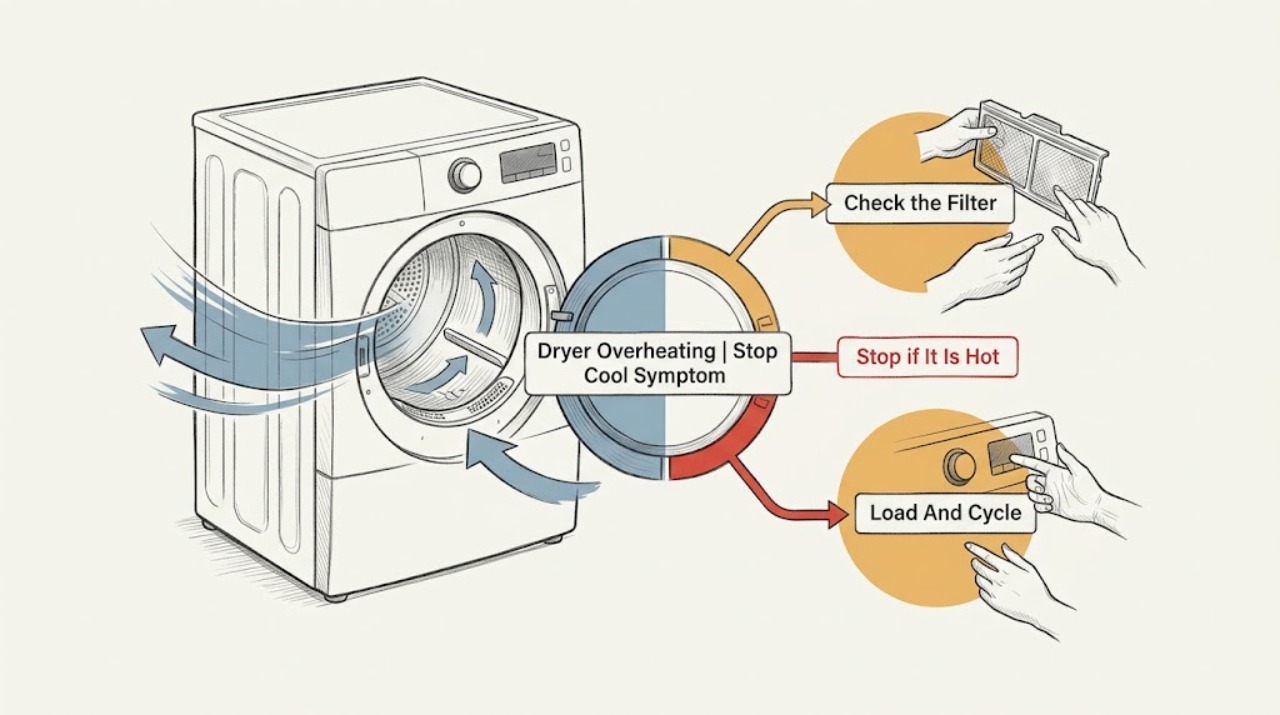
Work through in order
Diagnostic checks
Use only checks that match the exact appliance or system and its official guide.
-
Check 1
Stop the cycle and set the controls Off if the cabinet, controls, load, or nearby wall is unusually hot. If there is smoke, a scorched smell, melting, visible damage, or a breaker trip, disconnect power at the accessible plug or switch only if you can do so safely, and do not restart the dryer while it is hot.
Expected result: The dryer has a burning odor, smoke, scorch marks, melted material, repeated shutdowns, or only feels normally warm at the exhaust during a completed cycle.
Next step: For any smoke, damage, or persistent burning odor, keep the dryer out of service and arrange qualified repair. Otherwise wait until it is cool before the visible lint and vent checks.
Why this matters
Why: Smoke, scorching, melting, or repeated protection indicates a fire or electrical hazard and overrides routine troubleshooting. Normal warmth without an overheating symptom does not prove a fault, so continue by checking airflow and load conditions after cooling.
-
Check 2
With the dryer cool and unplugged when the model instructions require it, clean the lint filter and inspect it for a waxy film or damage. Look at the accessible external exhaust outlet for lint or an obstruction and check the visible duct path for crushing, kinks, or a disconnected section. Do not insert tools deep into the duct or dismantle the dryer.
Expected result: The filter is coated or blocked, the outside vent has little or no airflow, the duct is crushed or obstructed, or the lint path is clean and open.
Next step: Clean the filter as the Haier manual specifies and have an inaccessible or damaged exhaust duct professionally cleared or corrected. If airflow is normal but overheating persists, stop using the dryer and request service.
Why this matters
Why: A restricted lint path prevents warm moist air from leaving and can make the dryer run hot or stop early. A clean, open visible path makes an internal blower, heater, sensor, or control problem more likely, but cannot identify the failed part by itself.
-
Check 3
After the dryer has cooled, check whether the load filled the drum beyond the model's guidance, contains a single bulky item, or uses a high-heat setting that does not match the fabric. Confirm the selected cycle in the exact Haier manual, and run only a small, appropriate load for observation after the airflow path is known to be clear.
Expected result: The drum was overfilled, the load was bulky or tightly packed, the cycle or heat selection was inappropriate, or the load and cycle were within the model guidance.
Next step: Resort or reduce the load and select the model-recommended cycle. Stop immediately if the small test load again produces unusual heat, odor, or a shutdown.
Why this matters
Why: Overloading and poor load distribution can restrict air movement and extend heating time, while an unsuitable high-heat cycle can make normal heat feel excessive. If a correct small load still overheats, the cause is less likely to be load selection.
-
Check 4
With the dryer off, inspect the front intake and the space around the appliance for stored items, lint, or a covering that blocks ventilation. Confirm the door latches and that the dryer is installed as described in the Haier installation instructions; do not run it unattended or with the front or rear cabinet opened.
Expected result: The front is blocked, the door does not latch, the installation has changed, or the accessible clearance and door operation are normal.
Next step: Remove only loose, external obstructions and correct a clearly mispositioned load or door obstruction. If the front is clear and the dryer still overheats, leave it Off and arrange service.
Why this matters
Why: Haier specifically warns that a blocked front can cause a dryer to overheat, and a door or installation problem can interrupt normal operation. Normal clearance does not rule out an internal airflow or temperature-control fault.
-
Check 5
Record the model number, cycle, load type, when the excess heat appears, filter and external airflow condition, any error or shutdown, and whether the breaker moved. Do not remove panels, bypass a thermal cutoff, test energized wiring, or probe a heater, motor, sensor, or gas component.
Expected result: Overheating returns with a clean airflow path and suitable load, the dryer stops mid-cycle, a protection device trips, the heater stays on too long, or there is an electrical or gas safety symptom.
Next step: Keep the dryer out of service and schedule Haier repair. Give the technician the model number and recorded observations; if there is smoke or an active burning smell, treat it as urgent and do not restore power.
Why this matters
Why: The remaining possibilities include internal temperature control, blower, heater or burner, motor, wiring, or a model-specific control fault. These require qualified diagnosis and cannot be safely confirmed from an external inspection.
Use your observations
Decision map
Find the observation that best matches what you see, then follow the next safe action.
-
PATH 01Next step
What you see
There is smoke, a burning smell, melting, scorch damage, or a repeated breaker trip.
Do this next
Stop using the dryer, disconnect power only if safe, keep the area clear, and arrange urgent qualified service. Do not run another cycle to reproduce the symptom.
-
PATH 02Next step
What you see
The lint filter or accessible exhaust path is blocked, coated, crushed, or has weak outside airflow.
Do this next
Clean the filter and have the inaccessible or damaged duct path serviced according to the Haier installation instructions before using the dryer again.
-
PATH 03Next step
What you see
The dryer was overloaded or a high-heat cycle did not match the load.
Do this next
Reduce or resort the load and use the model-appropriate cycle. Stop if a small suitable load still causes unusual heat or a shutdown.
-
PATH 04Next step
What you see
The front is blocked or the door does not latch correctly.
Do this next
Clear loose external obstructions and correct only an obvious door obstruction. If the front is clear but the issue remains, request service.
-
PATH 05Next step
What you see
Airflow, load, cycle, front clearance, and door checks are normal but overheating returns.
Do this next
Keep the dryer Off and book Haier service for internal temperature-control, blower, heating, motor, wiring, or control diagnosis.
Helpful context
Understand the symptom
Treat excess heat as a safety symptom
A warm exhaust stream during a normal cycle is expected; a cabinet, control area, laundry load, or surrounding wall that becomes unusually hot is not something to chase with repeated cycles. Stop first when there is smoke, a burning smell, discoloration, melting, or a breaker trip. Let the dryer cool before inspecting the lint path.
Airflow is the first user-safe branch
Haier connects dryer performance with lint removal and exhaust vent condition. A lint filter that looks clean can still have a film from dryer sheets, and the external vent can be blocked even when the filter is empty. Inspect only accessible areas and use the model's installation instructions for duct requirements.
Do not defeat temperature protection
Thermal cutoffs, thermostats, sensors, and other internal parts require model-specific diagnosis. A dryer that overheats again after its lint path and load are corrected should remain out of service; removing a cover or bypassing a safety part can create a fire or shock hazard.
Only after diagnosis
Potential parts
- thermal cutoff or temperature sensor
Consider this category only when qualified service confirms a temperature-control fault after airflow and load causes have been excluded.
Confirm the exact Haier model and approved parts information; do not bypass a safety device or infer fit from a similar part. - blower wheel or drive motor
Consider this category only when service confirms inadequate internal airflow or a motor/blower fault despite a clear external exhaust path.
Internal dryer components require model-specific fitment and safe power isolation by a qualified technician. - heating element or gas heating assembly
Consider this category only when qualified diagnosis shows the heater or gas heating assembly remains on or produces abnormal heat after controls and airflow are checked.
Electric and gas heating systems differ by model; do not select or install a heating component from overheating symptoms alone.
When checks do not resolve it
Need a professional?
Request Haier service when the dryer overheats again after visible airflow and load checks, stops unexpectedly, trips a breaker, or shows smoke, burning odor, melting, or damage.
Have this ready
- Provide the model number, cycle and load, when the heat rises, filter and vent observations, whether the front was blocked, any shutdown or error, and the presence of odor, smoke, or breaker activity.
Common questions
FAQ
Why is my Haier dryer getting too hot?
Start with restricted airflow: clean the lint filter, inspect the accessible external vent, and check that the front is not blocked. Also check load size and cycle selection. If the dryer still overheats after it cools and those visible checks are normal, stop using it and request service.
Can a blocked dryer vent make a Haier dryer overheat?
Yes. Haier says lint-filter and external-vent obstructions reduce airflow and can lengthen drying; its support guidance also identifies a blocked front as a cause of overheating. Have inaccessible ductwork cleared or corrected rather than inserting tools into the dryer.
Should I keep running the dryer to see whether the overheating stops?
No. Stop immediately for smoke, a burning smell, melting, scorch marks, or a breaker trip. For less severe warmth, let the dryer cool, perform only the visible filter, vent, load, and clearance checks, and stop if the symptom returns.
Is it safe to replace a Haier dryer thermal fuse myself?
Do not choose or bypass a thermal part from overheating symptoms alone. Have qualified service identify why the dryer overheated and verify the exact model-specific part and safe repair procedure.
Read the exact guide
Official sources
- Haier Dryer - Dry Time Too LongHaier Appliances · Haier dryers
- Haier Dryer - Stops Mid-CycleHaier Appliances · Haier dryers
- Product Support for DryersHaier Appliances · Haier dryer support and manuals
- Schedule ServiceHaier Appliances · Haier major appliance service
- Haier Dryer - Not Heating at AllHaier Appliances · Haier dryers
- Haier Appliances Customer SupportHaier Appliances · Haier appliance support, safety notices, parts, and repairs
Community feedback
Share a repair observation
Share a plain-text repair observation. Accepted observations are published automatically; this page may take a moment to update.