
On this page
Start here
Quick answer
Frost in a Haier freezer usually means moisture entered and froze, but the right response depends on whether the unit is a manual-defrost chest freezer, a frost-free upright, or a refrigerator freezer compartment. First check the door gasket, lid or door closure, opening frequency, hot or uncovered food, and blocked airflow. Haier says manual-defrost chest freezers generally need defrosting when frost reaches about 1/4 inch, and it specifically warns against sharp or metallic tools that can damage cooling coils. Use only the exact model's defrost procedure; unplug or switch off the thermostat from a dry, safe position, protect food, and keep water away from electrical parts. If frost returns quickly, covers vents, prevents the door from sealing, or appears with food warming, a leak, burning smell, or electrical symptom, stop and arrange qualified service rather than removing panels or forcing the ice away.
Before you begin
Safety first
- This article covers model identification, visible gasket and loading checks, frost mapping, food protection, and a model-approved manual defrost for applicable chest freezers only. Do not chip ice, use a heater, remove hidden panels, touch wet electrical parts, move a heavy appliance, or open sealed refrigeration components.
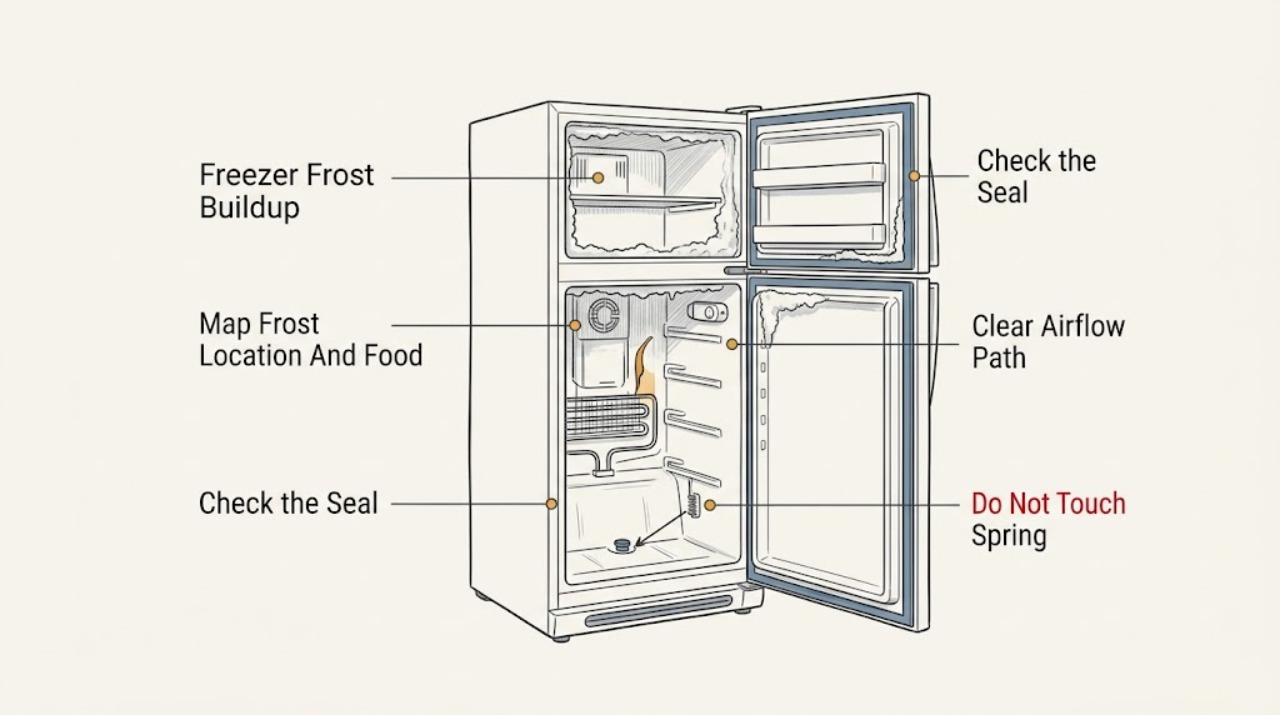
Work through in order
Diagnostic checks
Use only checks that match the exact appliance or system and its official guide.
-
Check 1
With the door open only briefly, photograph and describe where frost is concentrated: at the door edge, on front packages or drawers, on a rear wall or vent, across the entire compartment, or around a drain or lid. Record whether food is still hard frozen and whether the door or lid closes fully.
Expected result: Frost is limited to the front or door edge, thick on a rear wall or vent, spread across the cabinet, or paired with soft or thawing food and a door that does not seal.
Next step: Record the frost pattern, model, door or gasket condition, loading, and food temperature before choosing the model-specific defrost or service path.
Stop if: Stop opening the freezer if food is rapidly warming, water is near electrical parts, the door or lid is structurally damaged, or the frost cannot be accessed without force or panel removal.
Why this matters
Why: Haier associates front-of-freezer frost with moisture from frequent or extended door openings, while a door-edge pattern suggests a seal or closure path. Frost across a rear wall or vent can restrict airflow or point to a defrost problem; frost with warming food is an appliance-performance issue, not just a cosmetic layer.
-
Check 2
Inspect the gasket and cabinet contact area for dirt, folds, tears, gaps, crushed sections, or a package, basket, or drawer holding the door or lid open. Remove only a plainly accessible obstruction and close the door without forcing it.
Expected result: The seal contacts evenly, a gap or obstruction is visible, the gasket is damaged, or the door closes but frost quickly returns at the same edge.
Next step: Restore only the gasket's position or remove an accessible obstruction, then limit door openings and monitor the frost pattern. Arrange service for a torn gasket, door or lid alignment, cabinet damage, or frost that returns despite a good seal.
Stop if: Do not cut, glue, stretch, heat, or force the gasket; do not move the freezer or remove panels to adjust the door as a user test.
Why this matters
Why: An incomplete seal lets warm humid air enter and can create localized frost. A clean, even seal makes repeated door opening, loading, ambient humidity, defrost design, or a hidden fault more likely; it does not justify scraping frost or changing a gasket without model confirmation.
-
Check 3
From a safe, brief access, move only plainly accessible food away from the model's visible vents and avoid placing hot, uncovered, or very moist food against cold walls. Note whether the freezer is packed so tightly that air cannot circulate or is opened frequently in humid conditions.
Expected result: A vent or cold-air path is blocked, hot or uncovered food was recently added, frost is mainly on exposed packages near the door, or loading and airflow look normal.
Next step: Reposition accessible items, cover or cool food before storage, limit openings, and monitor the freezer without repeated door opening. If frost blocks a vent or the freezer cannot maintain temperature, follow the exact manual or arrange service.
Stop if: Do not pack food against an evaporator cover, remove a vent or panel, or use a sharp tool to make an airflow opening through ice.
Why this matters
Why: Haier links frost and ice crystals to moisture, frequent or extended openings, and food position near the door; its guidance also notes that hot or moist contents and overloading can affect circulation and condensation. A clear airflow path with thick returning frost needs defrost or service assessment.
-
Check 4
Read the Haier model and serial information and the owner's manual to determine whether the freezer is manual-defrost, frost-free, or a refrigerator freezer compartment. For a manual-defrost chest model, estimate visible wall frost without scraping; Haier's U.S. guidance uses about 1/4 inch as a point to defrost.
Expected result: The model is a manual-defrost chest freezer with frost near or above the guidance point, a frost-free model with heavy frost, or a style and procedure that cannot be identified.
Next step: Use only the model-approved defrost procedure for a manual-defrost unit; request service for heavy frost in a frost-free or hidden system, or whenever the exact procedure is unclear.
Stop if: Do not assume that an upright is manual-defrost, remove an evaporator cover, chip ice, use a metallic scraper, or improvise a heater or drain.
Why this matters
Why: A manual-defrost chest freezer can need a planned defrost as part of normal care. Heavy frost in a frost-free model, frost that returns rapidly, or an unidentified design can indicate a defrost, seal, control, or airflow problem and may require service.
-
Check 5
Only for a model whose manual permits user defrosting, move food safely, set the thermostat to Off or disconnect power from a dry, accessible position, place the model-specified shallow pan under the drain plug if present, and let frost melt naturally. Wipe all moisture dry before restoring the plug, power, and food.
Expected result: Frost melts and the freezer resumes normal operation, the drain overflows or cannot be identified, frost remains inaccessible, or the same heavy frost returns soon after defrosting.
Next step: Restore operation only as the manual directs and monitor the door seal, temperature, and frost pattern. Arrange qualified service if frost returns quickly, food warms, the drain is hidden, or the freezer does not cool normally after defrosting.
Stop if: Do not scrape or chip ice, use a sharp or metallic instrument, use a heater or boiling water, pour substances into a drain, or restore power while water can reach electrical parts.
Why this matters
Why: A complete manual defrost can restore a normally cared-for chest freezer, but an overflowing or missing drain, inaccessible frost, or rapid recurrence suggests a model-specific drainage, door-seal, defrost, control, or refrigeration fault.
Use your observations
Decision map
Find the observation that best matches what you see, then follow the next safe action.
-
PATH 01Safety boundary
What you see
Frost is mainly on food near the door or around the door edge, and the freezer is otherwise holding temperature.
Do this next
Check the gasket and closure, remove accessible obstructions, cover or cool moist food, and reduce opening time while monitoring the pattern.
Why this path and its safety boundary
Why it matters: Moisture from door openings, humidity, a gasket gap, or an obstruction is more likely than a confirmed internal defrost fault.
Safety stop: Arrange service for a damaged seal, misaligned door, frost that returns despite an even seal, or any cooling loss.
-
PATH 02Safety boundary
What you see
The exact Haier model is a manual-defrost chest freezer and wall frost is approximately 1/4 inch or thicker, with no electrical or water hazard.
Do this next
Follow the model-approved defrost and drain-plug procedure, protect food, collect meltwater, wipe the cabinet dry, and restore operation only after the plug or cap is correctly installed.
Why this path and its safety boundary
Why it matters: Haier identifies this as a normal point to schedule defrosting for chest freezers; it is not a reason to chip the frost away.
Safety stop: Do not use sharp or metallic tools, heaters, boiling water, or a drain arrangement not identified in the manual.
-
PATH 03Safety boundary
What you see
A frost-free upright or refrigerator freezer develops thick frost on a rear wall or vent, or the evaporator and defrost path are behind a cover.
Do this next
Keep the door closed as much as practical and arrange qualified service if the frost blocks airflow, returns, or affects temperature; use only a visible model-approved control.
Why this path and its safety boundary
Why it matters: A defrost, fan, airflow, door-seal, or control problem is plausible, and a manual chest-freezer procedure may be unsafe or incorrect.
Safety stop: Do not remove the evaporator cover, puncture the liner, chip ice, use a heater, or pour water into a hidden drain.
-
PATH 04Safety boundary
What you see
Packages block vents, hot or uncovered food was added, or frequent humid-air entry matches frost on exposed food and shelves.
Do this next
Reposition accessible items, cover or cool food before storage, keep the door closed, and monitor temperature and frost without repeated openings.
Why this path and its safety boundary
Why it matters: Loading and moisture conditions can create frost or reduce circulation without proving a failed component.
Safety stop: Request service if frost blocks a vent, the door cannot seal, food warms, or the pattern continues after safe loading changes.
-
PATH 05Safety boundary
What you see
Heavy frost returns soon after a complete model-approved defrost, or the freezer is not maintaining temperature, has abnormal sounds, leaks, or a hidden drain issue.
Do this next
Protect food, preserve the model and frost timeline, keep the door closed, and arrange qualified Haier appliance service.
Why this path and its safety boundary
Why it matters: The cause may be a gasket, defrost system, drain, fan, control, or refrigeration fault that cannot be identified safely from the frost layer alone.
Safety stop: Do not keep defrosting repeatedly, run the freezer with blocked airflow, open panels, or work on sealed refrigeration components.
-
PATH 06Safety boundary
What you see
Meltwater reaches an outlet, cord, control, compressor wiring, or the floor is flooded, or there is smoke, sparking, a burning smell, or a hot damaged cord.
Do this next
Keep away from the water and damaged area, use a safe accessible power shutoff only if it can be reached without contact with the hazard, and arrange urgent qualified service.
Why this path and its safety boundary
Why it matters: The defrost problem has become an electrical or physical safety hazard.
Safety stop: Do not step into water, touch wet electrical parts, unplug through a puddle, move the freezer, or restart it to locate the source.
Helpful context
Understand the symptom
Frost is a moisture path, not automatically a failed freezer
Warm, humid room air can enter every time a freezer door or lid opens, and that moisture can freeze on a cold wall, drawer, evaporator, or food package. Haier says frequent or extended door openings commonly create frost, especially near the front of frozen food. A thin localized layer may improve when the door seals and the loading pattern are corrected. Thick frost that returns quickly, covers the back wall, blocks vents, or prevents closure needs a more careful defrost and service decision.
Chest and frost-free models do not share one defrost method
Haier's U.S. guidance says chest freezers are not self-defrosting and may need periodic defrosting, while other freezer styles use a different design. A manual-defrost chest model may have an outer drain plug and a user defrost procedure. A frost-free upright or refrigerator freezer may hide the evaporator and defrost path behind a cover. Identify the exact model before opening a drain, and never assume a chest-freezer instruction applies to an upright.
Protect food and electrical parts during defrosting
Move food to another working freezer or an insulated container only when it can be done safely, and follow official food-safety guidance for anything that has thawed. Before a user-approved defrost, switch the thermostat to Off or disconnect power only from a dry, accessible position. Use a shallow container for a model-approved drain plug, monitor meltwater, wipe the interior dry, and restore the plug before power is restored. Do not chip ice, use a heater, pour boiling water into the freezer, or work near a wet outlet, cord, compressor, or wiring.
Safety boundary
Stop conditions
- Stop for water near an outlet, cord, control, compressor wiring, or other electrical part; also stop for smoke, sparks, a burning smell, a hot damaged cord, or flooding.
- Do not use a sharp or metallic instrument, heater, boiling water, or force to remove frost; do not puncture the liner or remove hidden panels.
- Disconnect power before a model-approved manual defrost only when the plug, outlet, floor, and drain area are dry and safely accessible.
- Do not move a heavy or built-in freezer, improvise a drain, open sealed refrigeration components, or repeatedly defrost a frost-free unit.
- Arrange qualified Haier service when frost returns rapidly, blocks airflow or door closure, food warms, the drain is hidden or overflows, or safe gasket, loading, and manual-defrost checks do not resolve the buildup.
Only after diagnosis
Potential parts
- Haier-compatible freezer door or lid gasket
Consider this category only if inspection and diagnosis confirm a torn, deformed, or non-sealing gasket is admitting humid air and causing recurring frost.
Confirm the exact Haier model, gasket profile, hinge or lid alignment, and manufacturer fit information before ordering or replacing a seal. - Haier-compatible defrost sensor or control
Consider this category only when a qualified diagnosis links returning frost in a frost-free model to a failed defrost sensor or control rather than a door seal or airflow issue.
Confirm the exact Haier model, control design, wiring, and approved service procedure; do not bypass a defrost safety device. - Haier-compatible evaporator fan assembly
Consider this category only if diagnosis confirms a fan or motor fault after frost, vent blockage, and door sealing are assessed.
Confirm the exact Haier model, fan location, connector, blade, and manufacturer fit information; access may require panel removal. - Haier-compatible drain plug or defrost drain component
Consider this category only when the exact manual identifies a damaged or missing drain plug or a qualified diagnosis confirms a drain fault after defrosting.
Confirm the exact Haier model and drain design; do not substitute a plug or open a hidden drain without model-specific guidance.
When checks do not resolve it
Need a professional?
Arrange qualified Haier appliance service when heavy frost returns quickly, covers a frost-free evaporator or vent, prevents the door from sealing, accompanies food warming or unusual sounds, or requires drain, defrost, fan, control, or sealed-system diagnosis. Stop immediately for water near electrical parts, smoke, sparks, burning odor, a hot damaged cord, or flooding, and use qualified electrical service for a circuit or wiring concern.
Safety scope: This article covers model identification, visible gasket and loading checks, frost mapping, food protection, and a model-approved manual defrost for applicable chest freezers only. Do not chip ice, use a heater, remove hidden panels, touch wet electrical parts, move a heavy appliance, or open sealed refrigeration components.
Common questions
FAQ
Why does my Haier freezer keep building up frost?
Warm humid air can enter through frequent or extended door openings, a gasket gap, an obstruction, or a door that does not close. Haier also points to food moisture and placement. Check the seal, closure, loading, and frost pattern before choosing a model-specific defrost or service path.
How much frost is too much in a Haier chest freezer?
Haier's chest-freezer guidance uses about 1/4 inch of wall frost as a point to defrost. This applies to manual-defrost chest models, not automatically to frost-free uprights or refrigerator freezer compartments. Use the exact owner's manual and never scrape with a sharp or metallic tool.
Can a bad Haier freezer gasket cause frost?
Yes. A gap or damaged gasket can admit humid air and create frost at the door edge or front of the cabinet. Remove only accessible obstructions and restore the seal's position without tools; arrange service for a torn gasket, misaligned door, or frost that returns.
Can I use a knife or hair dryer to remove Haier freezer ice?
No. Haier warns against sharp or metallic instruments because they can damage cooling coils. Do not use a heater or boiling water either. Follow the exact model's natural defrost procedure, with power isolated safely and meltwater controlled, or arrange service.
Why is frost on the back wall of my Haier frost-free freezer?
Heavy frost on a rear wall or vent can restrict airflow or indicate a defrost, fan, control, or door-seal problem. Do not remove the evaporator cover or chip the frost. Keep the door closed as much as practical and arrange qualified service if it returns or food warms.
Is food safe after defrosting a Haier freezer?
Keep the door closed and use FoodSafety.gov guidance. Food that still has ice crystals or is at or below 40°F (4°C) may be refrozen or cooked, while thawed food must be evaluated item by item. Never taste food to test safety.
When should I call Haier freezer service for frost buildup?
Arrange service when frost returns quickly after a complete approved defrost, blocks vents or the door, appears in a frost-free model, accompanies food warming or leaks, or requires a hidden drain, panel, fan, control, or sealed-system diagnosis. Stop immediately for water near electrical parts, smoke, sparks, or a burning smell.
Read the exact guide
Official sources
- Haier - Chest Freezer Defrost and DrainingHaier Appliances · Directly applies to Haier manual-defrost chest freezers; do not apply the chest procedure to a frost-free upright or hidden refrigerator freezer without its manual.
- Haier - Defrosting Chest or Upright FreezerHaier Appliances · Applies to Haier chest or upright freezer frost and defrost decisions; the exact model manual controls whether the listed procedure is appropriate.
- Food Safety During Power OutageFoodSafety.gov · Applies when defrosting or frost buildup leaves Haier freezer food partially or completely thawed.
- Haier - Refrigerator Frost on FoodHaier Appliances · Applies to Haier refrigerator freezer compartments and frost on frozen food; exact model settings and defrost design control the final action.
Community feedback
Share a repair observation
Share a plain-text repair observation. Accepted observations are published automatically; this page may take a moment to update.