
On this page
Start here
Quick answer
Some Haier freezer sounds are normal: compressor operation and clicking at start or stop, refrigerant moving through the cooling system, fan operation, cooling-system rumble, and expansion or contraction of parts. A hard floor, wall, or cabinet can make a normal sound seem louder. First record whether the sound is a hum, click, gurgle, crack, vibration, whistle, scraping, or impact, and whether it changes with door opening or compressor cycling. Check from outside that the freezer is level, not touching a wall, and not vibrating against a container or nearby surface. If the noise is a new loud vibration, pipe rattle, whistle, compressor impact, fan-blade scrape, or is accompanied by poor cooling, leak, burning smell, or electrical symptoms, stop disturbing the appliance and arrange qualified Haier service; do not open the sealed system or electrical covers.
Before you begin
Safety first
- This article covers listening and ordinary-access external checks only. Leave fan, compressor, electrical, refrigerant, evaporator, tubing, and sealed-system work to qualified appliance service.
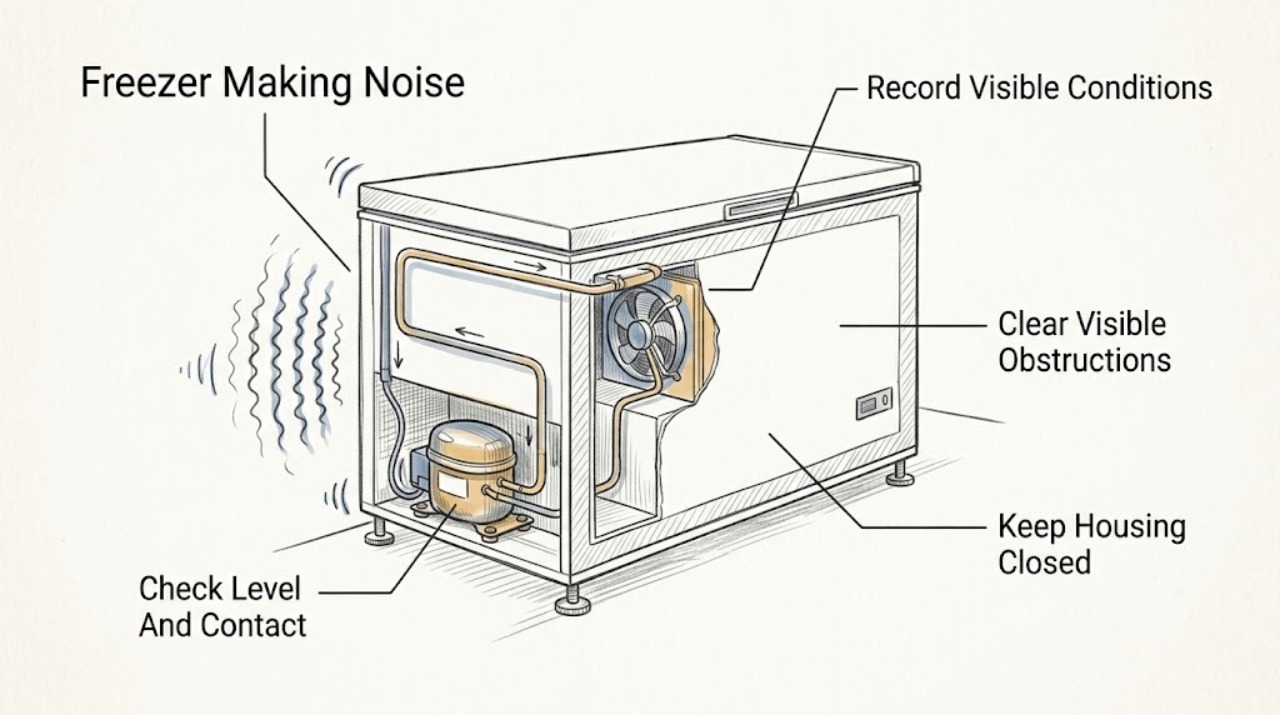
Work through in order
Diagnostic checks
Use only checks that match the exact appliance or system and its official guide.
-
Check 1
From a safe position with the freezer closed, listen briefly and record the sound type, its location, and when it occurs. Note whether it appears at compressor start or stop, during cooling, during a door opening, or continuously.
Expected result: Classify the sound as a steady hum, click, gurgle or liquid movement, fan sound, crack or pop, vibration or rattle, whistle, scraping, grinding, or impact. Record whether it stops or changes when the compressor or fan cycle changes.
Next step: Use the sound classification to select the next check and capture a short audio note if safe. Do not remove a cover to locate the sound.
Stop if: Stop listening tests for scraping, grinding, impact, smoke, burning smell, sparking, shock, or an appliance that is rapidly warming or leaking.
Why this matters
Why: Haier describes compressor, refrigerant, fan, cooling-system, clicking, and thermal-expansion sounds as potentially normal. A new impact, whistle, pipeline rattle, fan-blade collision, or persistent mechanical noise is an abnormal branch.
-
Check 2
Inspect from outside whether the freezer stands level and stable and whether its cabinet, rear, side, door, or nearby containers touch a wall, cabinet, pipe, or another vibrating object. Check the visible floor and feet without moving a loaded appliance.
Expected result: Record whether the cabinet rocks, a foot is unsupported, the rear or side touches a surface, or a loose container or object is vibrating against it.
Next step: Remove only a loose nearby object and restore clear, stable contact if the model installation instructions allow a minor external adjustment. If levelling needs cabinet movement, floor work, or service access, arrange qualified help.
Stop if: Do not pull the freezer by its door, tilt it while loaded, force the feet, touch rear tubing or wiring, or continue if the floor or cabinet is damaged.
Why this matters
Why: Haier says hard surfaces can amplify sound and that an unstable or poorly positioned freezer can create vibration and noise. A stable freezer with clear contact points makes a fan, compressor, refrigerant, or other internal branch more likely.
-
Check 3
Without removing panels, inspect the visible air openings and the space around the freezer for lint, packaging, loose objects, or ice that could contact an accessible fan path. Keep hands, tools, and objects away from any moving fan and do not reach behind guards.
Expected result: Record whether a visible obstruction or loose object is present, the noise sounds like fan vibration or blade contact, or the outside path is clear while the noise remains.
Next step: Remove only a loose external object with the freezer safely stopped; follow the exact model manual for any defrost or cleaning procedure. Arrange service for internal ice, fan contact, or a noise that persists.
Stop if: Do not insert tools, hands, or cleaners into fan openings, chip ice from an evaporator, use a heat source, or remove an internal cover.
Why this matters
Why: Haier identifies fan-motor vibration and fan-blade collision as abnormal sound types. A clear external path does not rule out an internal fan or frost fault and is not permission to remove a guard.
-
Check 4
Check the freezer's actual food condition and any accessible temperature display or alarm without repeatedly opening the door. Look for water, oil-like residue, frost changes, or a door that no longer seals, but do not touch refrigerant lines or electrical parts.
Expected result: Record whether food remains properly frozen, temperature is rising, a high-temperature alarm is active, frost is unusual, water is present, or the noise occurs with repeated start attempts.
Next step: Protect food and arrange service promptly for a warm cabinet, persistent alarm, leak, or repeated restart noise. Keep the door closed while waiting.
Stop if: Stop use for smoke, burning smell, electrical trip, shock, visible oil or refrigerant residue, water near electrical parts, or a rapidly warming freezer.
Why this matters
Why: A normal temperature with a normal hum or click supports normal operation or installation amplification. Noise combined with warming, repeated start attempts, a leak, or abnormal frost indicates a cooling, fan, compressor, or sealed-system fault.
-
Check 5
After the external contact and obstruction checks, observe one normal cooling cycle from outside without changing internal settings, moving the appliance, or opening panels. Note the sound before, during, and after the cycle.
Expected result: Record whether the sound is a normal hum, click, refrigerant or fan sound that changes with the cycle, or a continuous vibration, whistle, scrape, impact, or motor noise that remains abnormal.
Next step: Provide the technician with the sound description, location, cycle timing, temperature result, level and contact observations, and any recording; stop further tests if the sound worsens.
Stop if: Do not continue operating after impact, scraping, smoke, burning smell, sparking, shock, leak, or a significant loss of cooling.
Why this matters
Why: Cycle-linked sounds listed by Haier can be normal when cooling and temperature are normal. A persistent abnormal sound or a noise that affects use requires a service technician rather than repeated home tests.
Use your observations
Decision map
Find the observation that best matches what you see, then follow the next safe action.
-
PATH 01Safety boundary
What you see
The sound is a steady compressor or fan hum, a start-stop click, refrigerant movement, cooling rumble, or occasional thermal crack, and the freezer holds temperature.
Do this next
Monitor temperature and keep the freezer stable and clear of contact points; use the model manual if the sound changes.
Why this path and its safety boundary
Why it matters: Haier identifies these sound types as potentially normal operating noises.
Safety stop: Arrange service if the sound becomes impact-like, metallic, scraping, unusually loud, or is joined by warming or a leak.
-
PATH 02Safety boundary
What you see
The cabinet rocks, is not level, touches a wall or nearby object, or a loose container vibrates against it.
Do this next
Remove a loose external object and restore stable, clear positioning only as the model installation instructions allow; arrange help for loaded or difficult movement.
Why this path and its safety boundary
Why it matters: Installation contact or a hard surface may be amplifying otherwise ordinary vibration.
Safety stop: Do not tilt, drag by the door, force feet, or disturb rear tubing and wiring.
-
PATH 03Safety boundary
What you see
The noise sounds like fan vibration or blade contact, and an accessible external object or frost concern is present.
Do this next
Remove only a loose external object and follow the exact manual for approved defrost or cleaning; request service for internal ice or persistent fan noise.
Why this path and its safety boundary
Why it matters: Haier identifies fan-motor vibration and fan-blade collision as abnormal; an obstruction may be involved but the internal cause is not proven.
Safety stop: Do not reach into fan openings, chip ice, remove guards, or force a fan to turn.
-
PATH 04Safety boundary
What you see
The noise is a pipeline rattle, whistle, compressor impact, fan-motor vibration, fan-blade collision, scraping, or another new sound that affects use.
Do this next
Stop home diagnosis, keep the freezer closed, and arrange qualified Haier appliance service with the sound recording and timing.
Why this path and its safety boundary
Why it matters: Haier classifies these as abnormal sound patterns that require service.
Safety stop: Do not remove panels, touch the compressor or refrigerant circuit, or continue if cooling or electrical safety is affected.
-
PATH 05Safety boundary
What you see
Noise is accompanied by warming food, an alarm, a leak, unusual frost, repeated restart attempts, smoke, burning smell, or an electrical symptom.
Do this next
Protect food, isolate the appliance only when safe, and arrange prompt qualified service; do not restart repeatedly.
Why this path and its safety boundary
Why it matters: The sound is part of a possible cooling, electrical, fan, compressor, or sealed-system fault rather than an isolated normal noise.
Safety stop: Stop immediately for smoke, burning smell, sparking, shock, water near electrics, visible residue, or a damaged power cord.
Helpful context
Understand the symptom
Classify the sound before calling it a failure
A low compressor hum, a click as the compressor starts or stops, refrigerant movement, fan operation, and occasional cracking as parts change temperature can be normal. The same sound can seem louder when the freezer touches a wall or sits on a hard or uneven surface. The useful distinction is whether the noise is new, metallic, rubbing, impact-like, or linked to a loss of cooling.
Start with installation and contact points
A freezer that is not level or is touching a wall, cabinet, pipe, or loose container can transmit vibration through the floor and cabinet. Check only visible contact points from outside. Do not pull a loaded freezer, move it by its door, or disturb refrigerant tubing and electrical connections.
Noise plus a performance or safety symptom needs service
Noise alone is not enough to identify a compressor, fan, or sealed-system fault. If the freezer is warming, leaking, repeatedly clicking without cooling, scraping, sparking, or producing a burning smell, protect the food and stop using the appliance until a qualified technician assesses it.
Safety boundary
Stop conditions
- Stop immediately for smoke, burning smell, sparking, shock, a damaged or hot power cord, water near electrical parts, or a repeated electrical trip.
- Protect food and stop relying on the freezer if it is warming, an alarm persists, frost changes sharply, or a leak or oil-like residue appears.
- Do not remove rear or interior covers, access the compressor or fan, touch wiring, chip evaporator ice, or open the sealed refrigerant system.
- Do not tilt, drag by the door, or force a loaded freezer, feet, wall contact, fan, pipe, or electrical connection.
- Stop after one supervised external observation when the noise is abnormal, worsening, or affecting normal use; arrange qualified service.
Only after diagnosis
Potential parts
- freezer leveling foot or mounting hardware
Consider this category only if inspection confirms unstable external support or damaged mounting hardware and the exact model installation guidance supports replacement.
Confirm the exact Haier model and safe adjustment or replacement procedure; do not tilt or move a loaded freezer by force. - freezer fan assembly
Consider this internal part only after qualified diagnosis confirms fan-motor or blade damage after external obstructions and installation contact are ruled out.
Confirm the exact model, fan location, electrical specification, and safe fitment with the manufacturer or technician; do not access or test the fan while energized.
When checks do not resolve it
Need a professional?
Arrange qualified Haier service when a new vibration, whistle, pipeline rattle, compressor impact, fan collision, scraping, or other abnormal noise persists; when the noise affects normal use; or when it is accompanied by warming, alarm, leak, unusual frost, smoke, burning smell, sparking, shock, or repeated electrical trips.
Safety scope: This article covers listening and ordinary-access external checks only. Leave fan, compressor, electrical, refrigerant, evaporator, tubing, and sealed-system work to qualified appliance service.
Common questions
FAQ
What noises are normal for a Haier freezer?
Haier identifies compressor running and clicking, refrigerant movement, fan operation, cooling-system rumble, and expansion or contraction sounds as potentially normal. A hard floor or wall can make them seem louder, so also check stable level placement.
Why is my Haier freezer vibrating or rattling?
Check whether the cabinet rocks, touches a wall or cabinet, or has a loose container or object vibrating against it. Haier recommends a strong, level surface and clear contact points. Do not move a loaded freezer by force.
Is a clicking sound from a Haier freezer a problem?
A click when the compressor starts or stops can be normal. Repeated clicking without cooling, impact-like noise, or clicking with warming, an alarm, or a burning smell needs qualified service.
What if my Haier freezer sounds like a fan is scraping?
Fan-motor vibration and fan-blade collision are abnormal sound types in Haier's guidance. Check only for a loose external object; do not reach through guards or chip internal ice. Arrange service if the noise persists.
When should a Haier freezer noise be serviced?
Arrange service for a new whistle, pipeline rattle, compressor impact, fan collision, scraping, or noise that affects use, especially with poor cooling, a leak, unusual frost, smoke, burning smell, sparking, or an electrical trip.
Read the exact guide
Official sources
- Noisy(noise,sound)Haier Algérie · Haier troubleshooting guidance for freezer noise; exact model and installation manual details vary by product.
- 冷凍庫から異音がするHaier Japan · Haier Japan support guidance for freezer abnormal sound; use the exact model's local manual for installation and service details.
- Noisy(noise,sound)Haier India · Haier India troubleshooting guidance for freezer noise; model-specific installation and service instructions remain controlling.
Community feedback
Share a repair observation
Share a plain-text repair observation. Accepted observations are published automatically; this page may take a moment to update.