
On this page
Start here
Quick answer
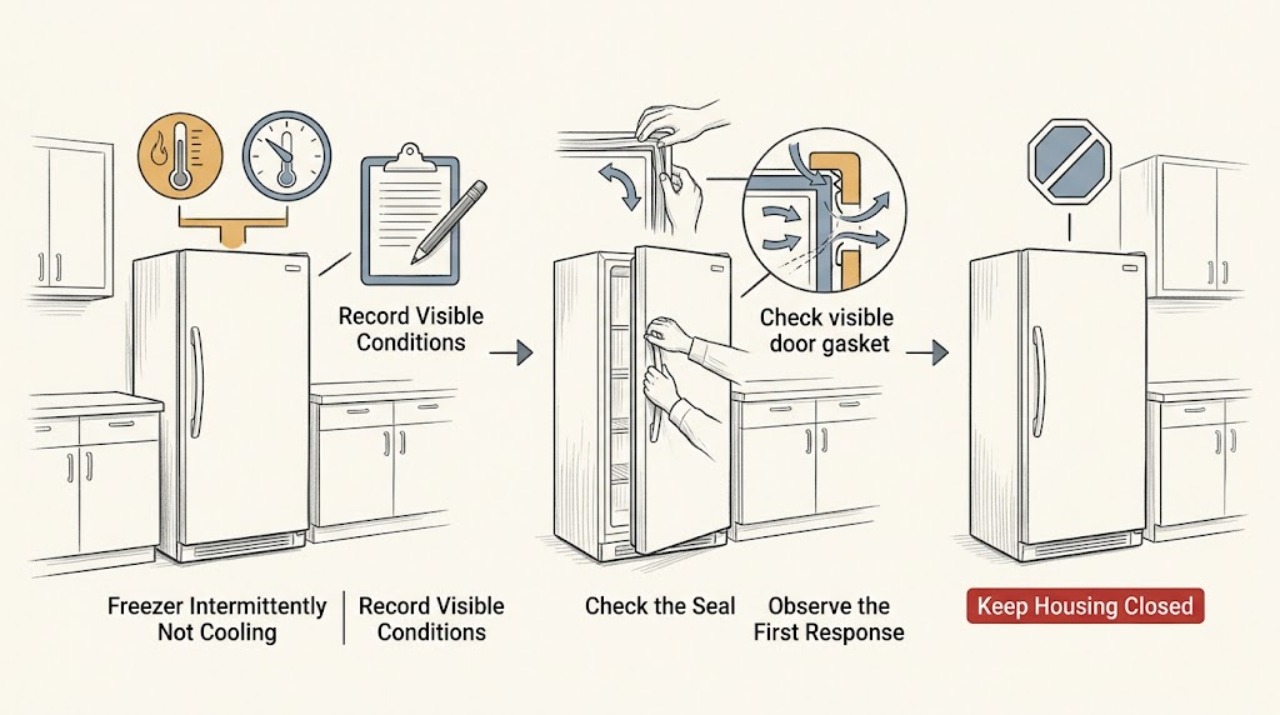
The Haier HRF15N3AGS is a French-door refrigerator with a bottom freezer, so an intermittently warm freezer should be diagnosed as a temperature-and-recovery problem rather than as a standalone freezer with a generic part list. Keep the freezer door closed as much as practical, move food to a known-safe cold location if it is thawing, and record the actual freezer temperature with an appliance thermometer. Then confirm the freezer setting and any Quick Freeze or Sabbath state, check that doors close and visible vents are not blocked, and note whether the compressor or fans cycle normally. Haier's model manual says the freezer setting should be allowed to stabilize for 24 hours after an adjustment and points to doors, rear clearance, and blocked vents as warm-temperature checks. If the freezer stays warm with normal power, repeatedly clicks, runs without recovering, or develops heavy returning frost, arrange qualified Haier service; do not open panels, test live circuits, handle refrigerant tubing, or name a compressor, fan, relay, or control from an intermittent symptom alone.
Before you begin
Safety first
- Do not open the cabinet, remove evaporator or rear covers, probe live wiring, handle refrigerant tubing, force the compressor, bypass controls, or select a fan, relay, compressor, defrost part, or control solely from intermittent warming. Stop for smoke, sparks, burning odor, a hot or damaged cord, flooding, or water near electrical parts.
Work through in order
Diagnostic checks
Use only checks that match the exact appliance or system and its official guide.
-
Check 1
Keep both refrigerator doors and the freezer drawers closed as much as practical. From a safe, dry position, read an appliance thermometer if one is present or place one where it can remain without repeatedly opening the drawer, and record the freezer temperature, time, and whether food is hard-frozen, partly frozen, or thawing.
Expected result: The freezer temperature is stable, rises and later recovers, remains warm, or food has lost its frozen state.
Next step: Move vulnerable food to a known-safe cold location if needed and continue only brief external checks. Use FoodSafety.gov guidance for ice crystals and temperature history; do not taste food to test it.
Stop if: Do not repeatedly open the freezer, rely on touch or odor alone, or keep food in the unit while it is clearly warming beyond safe limits.
Why this matters
Why: A repeatable temperature rise establishes an intermittent cooling concern even if the compressor later sounds normal. Food condition determines immediate protection, while the temperature trend helps separate a transient warm load or door event from a recurring appliance fault.
-
Check 2
Check the freezer control and the display state without changing several settings at once: confirm the freezer zone is selected, the control is not in an unintended state, and note whether Quick Freeze or Sabbath is active. If you make a model-supported temperature adjustment, record it and wait for the manual's stabilization period before judging recovery.
Expected result: The freezer setting is warmer than intended, Quick Freeze is active or has just ended, the panel is locked or in Sabbath mode, or the setting appears normal while the temperature remains high.
Next step: Correct only an obvious setting using the exact manual, make one change, and log the temperature over the stabilization period. If the freezer remains warm or the setting cannot be changed normally, arrange service.
Stop if: Do not repeatedly toggle modes, enter an undocumented service routine, or infer a control-board failure from a display state.
Why this matters
Why: A control state can make cooling appear intermittent or change the recovery pattern without proving a failed control. Haier says not to adjust more than one setting at a time and to allow 24 hours between adjustments for stabilization; a normal setting with persistent warmth leaves an airflow, defrost, fan, power, or sealed-system possibility.
-
Check 3
Open the refrigerator and freezer compartments briefly and check that every door or drawer closes fully, no package holds a seal open, the gasket has no obvious fold or gap, and accessible food is not pressed against visible rear or top vents. Do not remove panels or force the drawers.
Expected result: A package blocks closure, the gasket has a visible gap or damage, food blocks a vent, doors are opened frequently, or the visible door and airflow path are normal.
Next step: Remove only an accessible obstruction, restore the gasket's position without tools, keep the doors closed, and continue the temperature log. Request service for a damaged seal, returning frost, or no recovery after the correction.
Stop if: Do not cut, glue, or remove a gasket, dismantle an air duct, move a heavy refrigerator as a test, or keep operating with a door that cannot seal.
Why this matters
Why: Haier lists ajar doors, frequent openings, recently added warm food, and blocked vents as causes of a warm refrigerator or freezer. Correcting one visible cause may allow recovery, but a normal door and vent path do not rule out an internal cooling or defrost fault.
-
Check 4
Inspect only visible frost and installation conditions. Note whether frost is localized at a drawer or door edge, covers a visible vent or rear wall, or is absent; also note whether the kitchen installation leaves the manual's rear and side clearance and whether the unit is exposed to an unusual heat source. Do not scrape ice or remove an evaporator cover.
Expected result: There is heavy or rapidly returning frost, frost only at a door edge, no significant frost, insufficient visible clearance, or a normal indoor installation.
Next step: Use only the exact manual for any permitted defrost or installation correction. Keep the unit off and protect food if ice blocks the drawer or airflow; arrange qualified service for a frost-free system with returning frost or any hidden access.
Stop if: Do not chip ice, use a knife or heater, puncture the liner, remove covers, or handle refrigerant tubing.
Why this matters
Why: Door-edge frost supports humid-air entry, while frost over airflow openings can restrict circulation or indicate a defrost problem. Haier's manual identifies rear clearance and blocked vents as warm-temperature checks, but frost and location observations cannot select a defrost part, fan, or sealed-system repair.
-
Check 5
From outside the cabinet, listen during the logged warm period and later recovery without touching components: note whether the compressor or fans run, click and stop, run continuously without lowering the temperature, or remain silent. Check the plug and outlet only from a dry position for visible damage and note any breaker event.
Expected result: Cooling returns after a visible correction, the appliance stays warm with normal power, repeated clicking occurs, the compressor runs continuously, or smoke, burning odor, water, or cord damage is present.
Next step: Keep the door closed, preserve the temperature/frost/sound record, protect food, and arrange qualified Haier diagnosis. For smoke, burning odor, water near electrics, a hot or damaged cord, or a repeated breaker trip, stop using the appliance and obtain urgent qualified help.
Stop if: Do not touch the compressor, fan, wiring, or tubing, test live voltage, repeatedly reset a breaker, or force the compressor to run.
Why this matters
Why: Recovery after a setting, door, load, or vent correction makes an external cause more plausible. Persistent warmth with normal power or repeated clicking can involve a fan, control, relay, compressor, defrost system, wiring, or sealed system, but the sound alone cannot identify one. A safety symptom overrides all cooling checks.
Use your observations
Decision map
Find the observation that best matches what you see, then follow the next safe action.
-
PATH 01Next step
What you see
The freezer warms after a door, loading, setting, or large-warm-food event, then returns toward its normal temperature after the visible condition is corrected and the door stays closed.
Do this next
Continue the temperature log through the Haier manual's stabilization period and avoid repeated adjustments. Escalate if the same warming pattern recurs without the trigger.
Why this path and its safety boundary
Why it matters: A recovery pattern makes warm-air entry, load recovery, or a control setting more plausible than an immediately failed sealed-system component, but it does not prove the appliance is healthy.
-
PATH 02Next step
What you see
The freezer remains warm or repeatedly cycles warm despite normal power, a closed door, clear visible vents, an apparently correct setting, and an indoor installation with appropriate clearance.
Do this next
Keep food protected and arrange qualified Haier appliance service with the temperature timeline, frost pattern, settings, and sound observations. Do not order a part from the symptom alone.
Why this path and its safety boundary
Why it matters: An internal fan, defrost, control, relay, compressor, wiring, or sealed-system problem is possible, but intermittent behavior and a normal sound do not identify the failed component.
-
PATH 03Next step
What you see
Frost rapidly returns, covers an airflow opening, prevents a drawer from sealing, or the unit is a frost-free refrigerator that needs hidden defrost or evaporator access.
Do this next
Do not scrape or heat the ice. Follow only the exact manual's permitted user procedure and arrange service when the frost is hidden, persistent, or accompanied by food warming.
Why this path and its safety boundary
Why it matters: Airflow or defrost performance may be involved, but the visible frost pattern cannot distinguish a gasket, drain, fan, sensor, heater, or control fault.
-
PATH 04Safety boundary
What you see
Food is thawing or has been above safe cold conditions, or the appliance shows smoke, sparks, a burning odor, a hot/damaged cord, active water, or water near electrical parts.
Do this next
Keep the door closed as practical, transfer or discard food according to FoodSafety.gov guidance, keep clear of electrical hazards, and obtain qualified appliance or emergency help as appropriate.
Why this path and its safety boundary
Why it matters: Food safety and immediate electrical or fire safety take priority over intermittent-cooling diagnosis. Food appearance, smell, or taste alone is not a safe test.
Safety stop: Do not taste questionable food, touch wet electrical parts, unplug through water, restart to reproduce the symptom, or open the cabinet.
Helpful context
Understand the symptom
Before troubleshooting the cooling system, confirm what the model is. HRF15N3AGS is a Haier French-door refrigerator with a bottom freezer, not a separate chest or upright freezer. The freezer has its own temperature zone and Quick Freeze function, while the refrigerator is intended for indoor household use with clearance around the cabinet. That identity matters because a warm freezer can reflect settings, airflow, door sealing, load recovery, or a refrigerator-wide cooling fault; the symptom alone does not identify a freezer fan or compressor part.
Intermittent cooling needs a time-stamped temperature record rather than a single feel of the drawer or one compressor sound. Keep the door closed, measure from a stable position, and log whether the freezer recovers after a setting or loading correction. If food is thawing, the food-safety decision is separate from the appliance diagnosis: use the official temperature and ice-crystal guidance, never taste a questionable item, and transfer or discard food as appropriate.
When checks do not resolve it
Need a professional?
Arrange qualified Haier appliance service when the freezer remains warm after safe setting, door, loading, vent, frost, and installation checks; the temperature repeatedly rises without a clear trigger; clicking or continuous running occurs without recovery; frost returns rapidly; the door cannot seal; or diagnosis requires panels, wiring, refrigeration, or sealed-system access. Obtain urgent electrical or emergency help for smoke, fire, sparking, or a dangerous power condition.
Safety scope: Do not open the cabinet, remove evaporator or rear covers, probe live wiring, handle refrigerant tubing, force the compressor, bypass controls, or select a fan, relay, compressor, defrost part, or control solely from intermittent warming. Stop for smoke, sparks, burning odor, a hot or damaged cord, flooding, or water near electrical parts.
Have this ready
- Provide the exact HRF15N3AGS model and serial information if safely available, the kitchen installation context, freezer temperature readings with times, food condition, control and Quick Freeze state, door/gasket and vent observations, frost pattern, recent power or loading events, compressor/fan sound pattern, and any breaker or water event.
Common questions
FAQ
Is the Haier HRF15N3AGS a standalone freezer?
No. Haier identifies it as a French-door refrigerator with a bottom freezer. Use the model's separate freezer control and matching refrigerator documentation; do not apply a generic standalone-freezer part diagnosis.
How long should I wait after changing the freezer setting?
The HRF15N3AGS manual says to change only one control setting at a time and allow 24 hours for the temperature to stabilize. Log the actual temperature during that period rather than repeatedly changing the setting.
Can thawed food from the freezer be refrozen?
FoodSafety.gov says frozen food may be safely refrozen when it still contains ice crystals or is at or below 40°F, although quality may suffer. Never taste food to decide whether it is safe; use the official chart and discard items held above the stated limit.
Read the exact guide
Official sources
- Installation and User Manual HRF15N3AGSHaier · Official Haier manual opened for the exact model family, indoor installation, controls, temperature stabilization, warm-freezer checks, and safety limits; it does not identify an intermittent cooling component.
- 15.3 Cu. Ft. French Door Refrigerator - HRF15N3AGS - Haier AppliancesHaier Appliances · Exact Haier product page opened for model identity and product category; it confirms the bottom-freezer refrigerator identity but does not diagnose the intermittent cooling symptom.
- Food Safety During Power OutageFoodSafety.gov · Government food-safety guidance applicable to food warming during an intermittent freezer failure; it does not diagnose the Haier appliance.
Community feedback
Share a repair observation
Share a plain-text repair observation. Accepted observations are published automatically; this page may take a moment to update.