
On this page
Start here
Quick answer
When a Haier freezer is not cooling, protect the food first and separate a control or power issue from blocked airflow, a door-seal problem, heavy frost, or an internal refrigeration fault. Check that the unit is on and the temperature control is not OFF, verify power from a dry and safe position, inspect the gasket and vents, and record the actual freezer temperature if a thermometer is available. Haier identifies blocked air vents, door openings, gasket sealing, loading, installation conditions, and temperature settings as common checks; its guidance gives 0°F (-18°C) as an ideal storage temperature for many freezers. If the freezer remains warm, food is thawing, frost returns after an approved defrost, the compressor clicks repeatedly, or there is smoke, a burning smell, water near wiring, or a damaged cord, stop using it and arrange qualified appliance or electrical service.
Before you begin
Safety first
- This article covers model identification, dry-access power and control observations, visible loading, door, vent, frost, and installation checks, and a model-approved manual defrost for applicable models only. Do not work near wet electrical parts, open panels, puncture the liner, move a heavy unit, or open sealed refrigeration components.
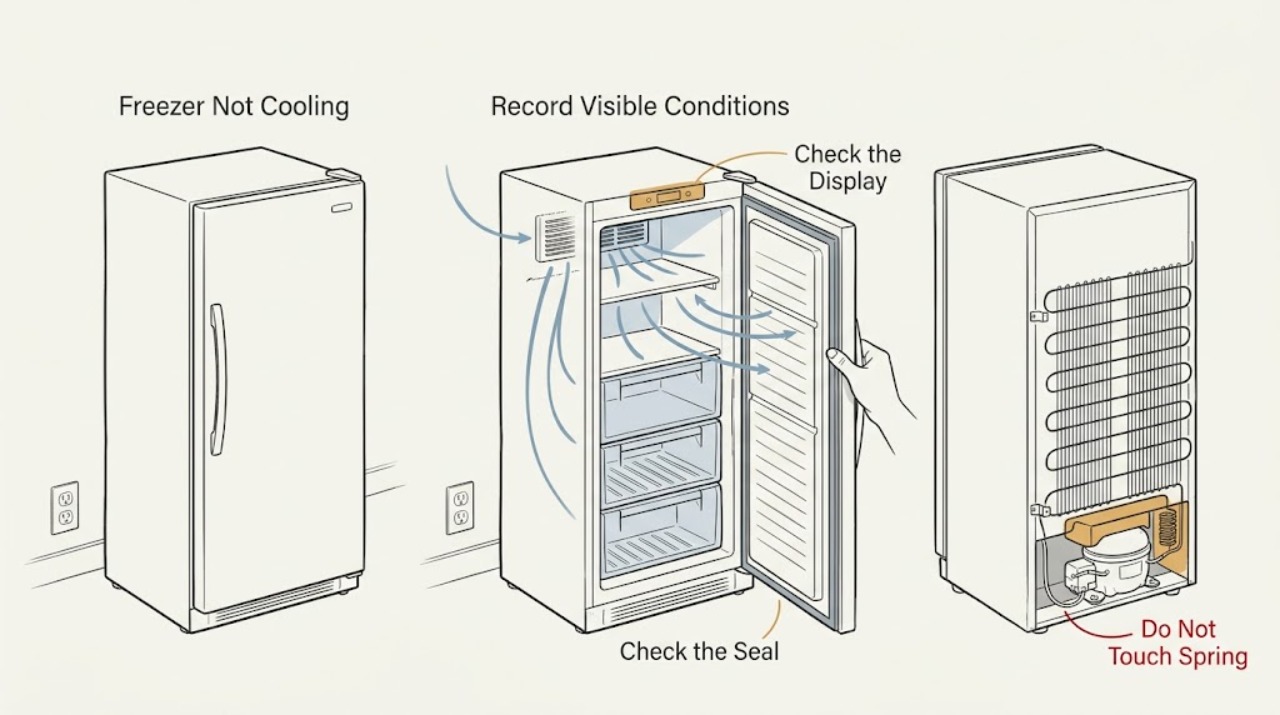
Work through in order
Diagnostic checks
Use only checks that match the exact appliance or system and its official guide.
-
Check 1
Keep the door closed as much as practical. From a dry, stable position, read an appliance thermometer if available, note whether food is frozen or thawing, and record any recent outage, unplugging, move, installation, or large warm load.
Expected result: The freezer is near its normal temperature, is warmer than expected, has no reliable reading, or food is soft or thawing.
Next step: Keep the door shut and use FoodSafety.gov guidance for thawed items. Continue appliance checks only if the freezer and floor are safe to access.
Stop if: Do not repeatedly open the freezer or taste food to test safety when food is warming.
Why this matters
Why: A normal temperature suggests the complaint may be local airflow or food placement rather than total loss of cooling. A warm reading or thawing food confirms a cooling or power concern; an outage or recent warm load may explain it without proving an appliance failure.
-
Check 2
Read the Haier model and serial information, confirm the unit is turned on, and check that the temperature control is not OFF. From a dry position, inspect the plug, outlet, and normal household breaker or isolator without touching exposed wiring.
Expected result: The control is OFF, the outlet or breaker is not supplying power, the breaker trips again, or power and the control appear normal while the freezer stays warm.
Next step: Correct only an obvious control setting or safe breaker state once, then monitor temperature with the door closed. Arrange qualified service if power is absent, trips again, or the freezer remains warm.
Stop if: Do not reset a wet or damaged circuit, bypass a breaker, use a damaged cord, or reach through water to unplug the freezer.
Why this matters
Why: Haier identifies the on state, thermostat setting, and working outlet as first checks. A repeat breaker trip indicates a circuit or appliance fault; normal power with a warm cabinet leaves airflow, frost, control, compressor, or sealed-system causes in consideration.
-
Check 3
With the door open only briefly, check that no package, basket, or drawer is holding the door ajar, inspect the gasket for folds, tears, dirt, or gaps, and move only accessible food away from visible air vents.
Expected result: The gasket does not seal evenly, an item blocks closure or a vent, the door is opened frequently, or the door and air path look normal.
Next step: Remove an accessible obstruction, restore the gasket's position without tools, cover or cool food before storage, and monitor temperature without repeated openings.
Stop if: Do not force the door, cut or glue the gasket, remove a vent or panel, or move the freezer to reach the rear as a user test.
Why this matters
Why: Haier links frequent openings, warm or moist contents, poor gasket sealing, and obstructed vents with poor cooling or frost. A clear door and vent path make an internal airflow, defrost, fan, control, or refrigeration fault more likely.
-
Check 4
Identify whether the Haier freezer is a manual-defrost chest model, frost-free upright, or refrigerator freezer compartment. Inspect the visible back wall, vents, door edge, and food for thick or uneven frost without scraping or removing covers.
Expected result: Frost covers a vent or rear wall, frost is localized at the door edge, the model is a manual-defrost chest freezer, or no significant frost is visible.
Next step: Use only the exact owner's manual procedure. For an applicable manual-defrost chest freezer, plan a natural defrost with power isolated safely and food protected; arrange service for hidden frost, a frost-free model, or rapidly returning frost.
Stop if: Do not chip ice, use a knife or heater, puncture the liner, remove an evaporator cover, or pour unknown substances into a drain.
Why this matters
Why: Frost at the door edge supports warm-air entry, while heavy frost over vents can restrict circulation or indicate a defrost problem. Haier says manual-defrost chest freezers require periodic defrosting and warns against sharp or metallic tools; a frost-free model with heavy frost needs model-specific service guidance.
-
Check 5
After the safe external checks, note whether the compressor or fan seems to run normally, clicks and stops, runs continuously without lowering the temperature, or stays silent. Listen from outside only; do not touch the compressor, fan, wiring, tubing, or panels.
Expected result: Cooling returns after a setting, door, loading, or vent correction; the freezer remains warm with normal power; clicking repeats; or there is smoke, burning odor, water near electrical parts, or cord damage.
Next step: Leave the appliance accessible for qualified Haier diagnosis and provide the model, temperature history, frost pattern, sound, and food condition. Protect or discard food according to official food-safety guidance.
Stop if: Stop using the freezer for smoke, sparks, burning odor, a hot or damaged cord, active water near wiring, or any need to open the sealed system or test live circuits.
Why this matters
Why: Recovery after a safe correction supports a setting, load, door, or airflow cause. Persistent warmth, repeated clicking, or continuous running can involve a control, fan, relay, compressor, defrost, or sealed-system fault; safety symptoms are an immediate stop condition.
Use your observations
Decision map
Find the observation that best matches what you see, then follow the next safe action.
-
PATH 01Safety boundary
What you see
The thermostat was OFF, the unit was unplugged, or a recent outage or breaker trip is confirmed and the cord and outlet are dry and undamaged.
Do this next
Use the normal model-specific setting and safe power steps, keep the door closed, and monitor the temperature during the manual's stabilization period.
Why this path and its safety boundary
Why it matters: A control or power interruption may explain the warm cabinet, but restoring a setting does not prove the cooling system is healthy.
Safety stop: Arrange service if the breaker trips again, power drops, or the freezer stays warm after safe power is restored.
-
PATH 02Safety boundary
What you see
A package blocks a vent or door, the gasket has a gap, or repeated humid-air entry matches the warming symptom.
Do this next
Remove only accessible obstructions, restore the gasket position, adjust loading, and monitor temperature with the door closed.
Why this path and its safety boundary
Why it matters: Warm air entry or restricted circulation can raise the temperature without proving a failed component.
Safety stop: Request service for a damaged seal, misaligned door, returning frost, or cooling that does not recover after the safe correction.
-
PATH 03Safety boundary
What you see
Thick frost covers vents or a rear wall, blocks the door, or returns rapidly after an approved defrost.
Do this next
Use the exact manual's defrost instructions only for an applicable model; arrange service for frost-free or hidden systems, persistent frost, or food warming.
Why this path and its safety boundary
Why it matters: The cause may be a door seal, airflow restriction, defrost control, fan, or hidden drain; frost alone does not identify the failed part.
Safety stop: Do not chip or heat ice, puncture the liner, remove covers, or repeatedly defrost a frost-free model.
-
PATH 04Safety boundary
What you see
The freezer is in direct sunlight, next to a heat source, recessed or built in, or in a location below the model's permitted ambient range.
Do this next
Restore only model-approved clearance and installation conditions without lifting or moving a heavy unit, then monitor temperature.
Why this path and its safety boundary
Why it matters: Haier says freezers need proper clearance and a suitable freestanding location; unsuitable conditions can reduce efficiency or cause improper operation.
Safety stop: Arrange service if correcting the location requires disconnection or lifting, or if the freezer remains warm in the approved installation conditions.
-
PATH 05Safety boundary
What you see
The freezer has normal power and clear vents and door sealing but remains warm, clicks repeatedly, runs continuously without cooling, or stays silent.
Do this next
Keep the door closed as practical, protect food, preserve the symptom record, and arrange qualified Haier appliance service.
Why this path and its safety boundary
Why it matters: A fan, control, relay, compressor, defrost, wiring, or sealed-system fault is plausible and needs qualified diagnosis.
Safety stop: Do not open panels, test live voltage, handle refrigerant tubing, or keep forcing the compressor to run.
-
PATH 06Safety boundary
What you see
Food is thawing, or there is smoke, sparking, burning odor, a hot damaged cord, active water, or water near an outlet or electrical component.
Do this next
Keep the door closed when possible, use a safe accessible shutoff only if it can be reached without contact with the hazard, protect food according to FoodSafety.gov, and arrange prompt qualified service.
Why this path and its safety boundary
Why it matters: Food protection and immediate electrical or fire safety take priority over more troubleshooting.
Safety stop: Do not step into water, touch wet electrical parts, unplug through a puddle, taste thawed food, or restart the freezer to reproduce the symptom.
Helpful context
Understand the symptom
Start with the actual temperature and food condition
A control setting is not proof that the cabinet is cold. Use an appliance thermometer if one is already available, note whether food is hard frozen or soft, and record whether the problem followed a power interruption, installation, move, or large warm load. Haier gives 0°F (-18°C) as an ideal storage temperature for many freezers, but the exact model manual controls the display and setting behavior.
A warm freezer can still be running
If only the freezer compartment is warm while the appliance has power, Haier specifically recommends checking that its air vents are not obstructed. A running compressor does not rule out a blocked vent, door-seal leak, frost restriction, unsuitable installation, or a refrigeration fault. Do not open an evaporator cover or touch the compressor to diagnose the problem.
Protect food and stop at the electrical boundary
Keep the freezer door closed as much as practical while deciding what to do with thawing food. FoodSafety.gov says food with ice crystals or at or below 40°F (4°C) may be refrozen or cooked, but safety should be evaluated item by item and never by tasting. Disconnect power before any model-approved maintenance only when the plug and outlet are dry and safely accessible; stop for smoke, sparking, burning odor, water near electrical parts, or a hot damaged cord.
Safety boundary
Stop conditions
- Stop for smoke, sparks, a burning smell, a hot or damaged cord, active flooding, or water near an outlet, control, compressor wiring, or another electrical part.
- Do not chip, scrape, puncture, or heat frost; do not remove evaporator covers, open sealed refrigeration components, or test live circuits.
- Disconnect power before a model-approved maintenance or manual defrost only when the plug, outlet, floor, and drain area are dry and safely accessible.
- Do not move a heavy or built-in freezer, bypass a breaker, or use an installation or defrost procedure from another model.
- Arrange qualified Haier service when the freezer remains warm, food thaws, frost returns rapidly, abnormal clicking or continuous running persists, or a hidden fan, control, compressor, defrost, or sealed-system diagnosis is needed.
Only after diagnosis
Potential parts
- Haier-compatible freezer door gasket
Consider this category only if inspection and diagnosis confirm a torn, deformed, or non-sealing gasket is admitting warm air and causing poor cooling or frost.
Confirm the exact Haier model, gasket profile, door alignment, and manufacturer fit information before ordering or replacing a seal. - Haier-compatible evaporator fan assembly
Consider this category only if qualified diagnosis confirms a failed fan after vents, frost, loading, and door sealing are assessed.
Confirm the exact Haier model, fan location, connector, blade, and manufacturer fit information; access may require panel removal. - Haier-compatible temperature or defrost control
Consider this category only when diagnosis links a persistent warm cabinet or returning frost to a failed control rather than a setting, gasket, or airflow issue.
Confirm the exact Haier model, control design, wiring, and approved service procedure; do not bypass a safety control. - Haier-compatible start relay or compressor component
Consider this category only when qualified testing confirms a starting or compressor fault; clicking or warmth alone does not identify a part.
Confirm the exact Haier model and electrical diagnosis; compressor and start-device work belongs to qualified service.
When checks do not resolve it
Need a professional?
Arrange qualified Haier appliance service when safe control, power, door, loading, vent, frost, and installation checks do not restore cooling, or when the freezer clicks repeatedly, runs continuously without cooling, stays silent, has returning frost, or needs panel or sealed-system access. Stop immediately for smoke, sparks, burning odor, a hot cord, flooding, or water near electrical parts, and use qualified electrical service for a circuit or wiring concern.
Safety scope: This article covers model identification, dry-access power and control observations, visible loading, door, vent, frost, and installation checks, and a model-approved manual defrost for applicable models only. Do not work near wet electrical parts, open panels, puncture the liner, move a heavy unit, or open sealed refrigeration components.
Common questions
FAQ
Why is my Haier freezer not cooling even though it runs?
Check the temperature setting, door gasket, blocked vents, loading, frost, and installation conditions. A compressor that runs does not prove air is circulating or the sealed system is working. Persistent warmth, clicking, or food thawing needs qualified service.
What temperature should a Haier freezer be?
Haier identifies 0°F (-18°C) as an ideal storage temperature for many freezers. Use an appliance thermometer when available and follow the exact model manual for the setting and stabilization period.
Can a blocked vent cause a Haier freezer to warm up?
Yes. Haier specifically recommends checking that freezer air vents are not obstructed. Move only accessible food away from visible vents; do not remove a vent or panel or chip ice to create an opening.
Can frost make a Haier freezer stop cooling?
Heavy frost can restrict airflow, block the door, or indicate a door-seal or defrost problem. Identify the model before defrosting. Manual-defrost chest freezers may need planned defrosting, while frost-free or hidden systems should be handled through model-specific service guidance.
What should I do with food if my Haier freezer is warm?
Keep the door closed and use FoodSafety.gov guidance. Food with ice crystals or at or below 40°F (4°C) may be refrozen or cooked, while thawed food must be evaluated item by item. Never taste food to test safety.
When should I stop troubleshooting a Haier freezer?
Stop when safe control, power, door, loading, vent, frost, and installation checks do not restore cooling, or when the freezer clicks, runs continuously without cooling, or needs panel access. Stop immediately for smoke, sparks, burning odor, water near electrical parts, or a hot damaged cord.
Read the exact guide
Official sources
- Haier - Freezer Temperature SettingHaier Appliances · Applies to Haier freezer temperature-setting and warm-food decisions; exact model controls the dial or display behavior.
- Food Safety During Power OutageFoodSafety.gov · Applies when a Haier freezer is not cooling and food may have partially or completely thawed.
- Haier - Defrosting Chest or Upright FreezerHaier Appliances · Applies to Haier chest or upright freezer frost and defrost decisions; the exact model manual controls whether the listed procedure is appropriate.
- Haier - Chest Freezer Defrost and DrainingHaier Appliances · Directly applies to Haier manual-defrost chest freezers; do not apply the chest procedure to a frost-free upright or hidden refrigerator freezer without its manual.
- Haier - Refrigerator Frost on FoodHaier Appliances · Applies to Haier refrigerator freezer compartments and frost on frozen food; exact model settings and defrost design control the final action.
- Haier - Freezer Installation Location and ClearanceHaier Appliances · Applies to Haier freezer placement and clearance checks when cooling performance is poor; exact model instructions control specific spacing.
- Haier - Refrigerator Running but Not CoolingHaier Appliances · Applies to a Haier refrigerator freezer compartment or related freezer cooling symptom; exact model instructions control the final setting and service path.
- Product Support for FreezersHaier Appliances · Applies to locating the exact Haier freezer manual and support content when the model or freezer style is unknown.
Community feedback
Share a repair observation
Share a plain-text repair observation. Accepted observations are published automatically; this page may take a moment to update.