
On this page
Start here
Quick answer
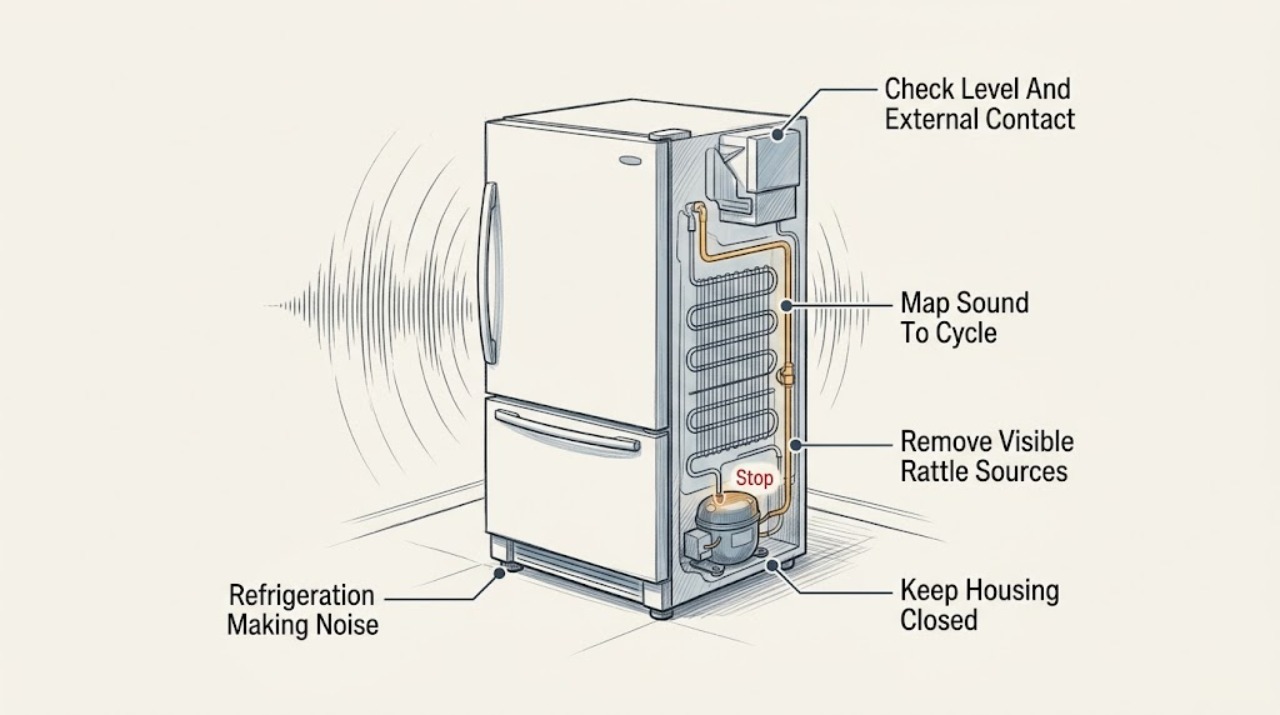
Some Haier refrigerator sounds are expected: a compressor hum, fan whoosh, refrigerant gurgle, defrost drips or sizzle, control clicks, and brief cracking as parts change temperature. First record whether the sound follows compressor or fan cycles, door opening, icemaker operation, defrost, or loading. Then, with power disconnected when inspecting, check that the cabinet is level and not touching a wall or cabinet, and that bottles, shelves, trays, or items on top are not rattling. On models with an icemaker, a buzz while the icemaker is on but not connected to water is a reason to switch that icemaker off. A new grinding, scraping, whistling, repeated hard impact, vibrating pipe or fan, sound accompanied by poor cooling, or any electrical odor or heat should be stopped and referred to qualified Haier service; the noise alone does not identify a replaceable part.
Before you begin
Safety first
- The user may document the sound and cycle, inspect visible loading and contact, use the exact manual for accessible leveling, and switch off an unconnected icemaker when the model provides that control. Qualified personnel must handle panels, fans, compressor and start devices, wiring, controls, defrost components, valves, live testing, and sealed-system work.
Work through in order
Diagnostic checks
Use only checks that match the exact appliance or system and its official guide.
-
Check 1
From a safe position, record the sound type, approximate location, duration, and trigger: compressor start or stop, fan operation, door opening or closing, defrost, icemaker fill or harvest, or no obvious cycle. Note whether cooling, display operation, and temperatures remain normal. Do not put hands near moving fans or the rear compressor area.
Expected result: The sound is a brief hum, click, gurgle, whoosh, drip, sizzle, or crack tied to a documented cycle; it is a continuous grind, whistle, impact, or scrape; or it occurs with poor cooling or an alarm.
Next step: Continue with the external installation and load checks only for a normal-pattern sound. For a new harsh sound or a sound with cooling loss, stop the refrigerator if safe and arrange qualified service.
Stop if: Stop immediately for smoke, sparks, burning odor, a hot cord or cabinet, water near electrical parts, repeated breaker trips, or loud impact or grinding that may involve a moving or energized component.
Why this matters
Why: A brief cycle-linked sound matches Haier's normal operating descriptions more closely. A persistent or harsh sound, especially with a cooling change, is not identified by sound alone and makes professional diagnosis more appropriate.
-
Check 2
With the refrigerator unplugged if you need to move it or inspect behind it, check that it stands firmly and is not touching a wall, cabinet, pipe, or nearby appliance. Use the exact Owner's Manual before adjusting leveling feet; do not tilt a loaded unit or reach into the rear machinery area.
Expected result: The cabinet rocks, a foot is not supporting it, the case or pipe touches a surface, or the installation is stable with clearance.
Next step: Correct only the visible placement or leveling condition described by the manual, then listen during the same cycle. If the sound remains or leveling requires moving a built-in or loaded refrigerator, use qualified service.
Stop if: Stop for a damaged floor, unstable cabinet, trapped cord, exposed pipe or wiring, or any need to remove panels or reach the compressor or fan.
Why this matters
Why: An unstable cabinet or external contact can transmit normal compressor or fan vibration as rattling. A stable, isolated cabinet makes an internal vibration or component issue more likely if the sound persists.
-
Check 3
With the door closed and power off if cleaning or repositioning is needed, remove or separate bottles, cans, shelves, drawers, trays, and items on top that can touch one another or the cabinet. Confirm that removable interior equipment is seated as the model manual shows; do not dismantle fixed panels.
Expected result: The sound changes when a bottle, shelf, tray, or top item is moved; the noise continues with all visible items separated; or a loose or broken component is visible.
Next step: Reposition the visible item and retest once. If a shelf, tray, or mounting piece is broken or the noise continues without an accessible source, stop and arrange model-matched service.
Stop if: Stop for broken glass, a sharp or loose fixed part, a damaged liner, or any need to remove internal covers or reach a fan.
Why this matters
Why: A sound that follows a movable item is an external resonance or loading issue. A persistent sound with no visible rattle source shifts concern toward the fan, pipe, compressor, or another internal component.
-
Check 4
If the model has an icemaker, check whether the switch is on while the refrigerator has no connected water supply; switch it off only if the exact model provides that control. Otherwise note whether the noise is a normal cube drop or water-fill event. For a drip or sizzle, note whether the model documents self-defrost and whether the sound ends with the cycle.
Expected result: Buzzing occurs with an unconnected icemaker, a click and water rush occurs during fill, cubes drop, a drip or sizzle occurs during defrost, or the noise is unrelated to those features.
Next step: Turn off the unconnected icemaker and use the exact manual for water connection or feature settings. Let a normal defrost or harvest event finish; escalate a continued buzz, leak, abnormal impact, or sound without the feature.
Stop if: Stop for a water leak, a hot valve or wire, exposed electrical parts, or any need to access the icemaker, valve, heater, or wiring.
Why this matters
Why: Haier identifies the unconnected-on icemaker as a correctable model-specific buzzing condition and describes fill, cube-drop, and self-defrost sounds as expected on applicable models. An unrelated or persistent sound needs a different branch.
-
Check 5
After the safe external checks, compare the sound with the refrigerator's cooling behavior: normal compartment temperatures, frequent or continuous running, fan air movement if externally observable, frost, water, alarms, or a change after the door opens. Do not remove a cover or touch an energized fan, compressor, relay, or control.
Expected result: The sound is brief and cooling is normal; cooling is worsening or uneven; the sound is a continuous grind, scrape, whistle, impact, or vibrating fan or pipe; or electrical heat, odor, smoke, or repeated tripping is present.
Next step: For normal operation, monitor the pattern and keep the installation stable. For cooling loss or an abnormal mechanical sound, transfer perishable food as needed and arrange authorized Haier service; for electrical danger, disconnect power when safe and use qualified electrical service.
Stop if: Stop immediately for smoke, burning odor, sparks, a hot or damaged cord, abnormal cabinet or compressor heat, water near electrical parts, gas odor, or repeated breaker trips.
Why this matters
Why: A cycle-linked sound with normal cooling remains consistent with normal operation or external resonance. A new abnormal sound with cooling loss makes a fan, compressor, defrost, control, or sealed-system fault more likely; electrical warning signs require immediate stop rather than further diagnosis.
Use your observations
Decision map
Find the observation that best matches what you see, then follow the next safe action.
-
PATH 01Safety boundary
What you see
The sound is a brief hum, fan whir, gurgle, whoosh, click, drip, sizzle, or crack that follows compressor, fan, refrigerant, defrost, door, or temperature changes and cooling is normal.
Do this next
Keep the refrigerator level and clear of contact, and monitor whether the sound changes in duration, volume, or relation to cooling.
Why this path and its safety boundary
Why it matters: The pattern matches Haier's listed normal operating sounds more closely than a failure.
Safety stop: Escalate if the sound becomes continuous, harsh, or is joined by cooling loss, water, heat, odor, smoke, or power trips.
-
PATH 02Safety boundary
What you see
Rattling changes when the cabinet is leveled or separated from a wall, cabinet, pipe, floor, bottle, shelf, tray, or item on top.
Do this next
Correct only the accessible placement or load condition allowed by the exact manual and retest during the same operating cycle. Use service for broken mounts or persistent vibration.
Why this path and its safety boundary
Why it matters: Resonance or a visible loose item is more likely than an internal compressor or fan fault.
Safety stop: Do not reach behind the refrigerator, bend tubing, tighten hidden mounts, or move an unstable built-in unit without qualified help.
-
PATH 03Safety boundary
What you see
The sound is linked to an icemaker fill or cube drop, self-defrost water or sizzle, or a buzz while an icemaker is on without a connected water supply.
Do this next
Switch off an unconnected icemaker and follow the exact model instructions for water and feature settings. Allow normal defrost or harvest sounds to finish; call service for continued buzzing, leaks, or abnormal impact.
Why this path and its safety boundary
Why it matters: A feature cycle or the model-specific unconnected-icemaker condition is more likely than a general refrigerator failure.
Safety stop: Stop for a leak, hot valve or wiring, electrical odor, or any need to access the icemaker or water valve.
-
PATH 04Safety boundary
What you see
The sound is new or loud and resembles grinding, scraping, whistling, compressor impact, a vibrating pipe, fan-motor vibration, or fan-blade contact, especially if it continues after visible external checks.
Do this next
Stop using the refrigerator if the sound is severe or cooling is affected, protect perishable food, and arrange qualified Haier service with the sound recording and model details.
Why this path and its safety boundary
Why it matters: Haier categorizes these patterns as abnormal and routes them to a service technician; sound alone cannot safely identify the failed component.
Safety stop: Do not remove panels, touch fans or compressor parts, bend refrigeration tubing, or perform energized testing.
-
PATH 05Safety boundary
What you see
Noise occurs with poor or uneven cooling, repeated cycling, a hot cord or cabinet, burning odor, smoke, sparks, water near electrical parts, or repeated breaker trips.
Do this next
Disconnect power when safe, turn off an accessible water supply if a leak is present, move food to safe cold storage, and arrange qualified electrical or Haier service.
Why this path and its safety boundary
Why it matters: An internal electrical, fan, compressor, defrost, control, or sealed-system problem is possible, and the immediate risk outweighs further user diagnosis.
Safety stop: Do not repeatedly reset power, continue operation to listen, open panels, or handle refrigerant, wiring, compressor, fan, heater, or control parts.
Helpful context
Understand the symptom
Identify the event that triggers the sound
A short hum or click when the compressor starts, a fan change after the door has been open, a gurgle while refrigerant moves, a drip or sizzle during defrost, and a crack as materials contract can be normal. The useful distinction is a new sound with a repeatable trigger versus an abnormal sound that is continuous, harsh, or accompanied by cooling or electrical symptoms.
Resonance can make a normal source sound alarming
Haier notes that hard floors, walls, and cabinets can amplify sound. A cabinet that is not level, touches surrounding furniture, or has a loose shelf, bottle, tray, or item on top can rattle even when the refrigeration system is operating normally. Correct only visible, external conditions allowed by the model's installation instructions.
Icemaker and defrost sounds need model context
An icemaker can click, buzz, fill, or drop cubes, and a self-defrost refrigerator can drip or sizzle. Those clues matter only if the model has the feature and the sound occurs in the expected cycle. An icemaker left on without a water connection is a special exception: Haier says to switch it off rather than let the valve continue buzzing.
Grinding and electrical symptoms change the decision
A vibrating pipe, fan-blade contact, whistling, compressor impact, or fan-motor vibration is not something to diagnose by removing panels. If the sound comes with a hot cord, burning odor, smoke, sparks, repeated breaker trips, water near electrical parts, or worsening cooling, stop using the refrigerator and arrange qualified service.
Safety boundary
Stop conditions
- Stop immediately for smoke, burning odor, sparks, scorching, a hot or damaged cord, plug or receptacle, exposed wiring, water near electrical parts, gas odor, abnormal heat, or repeated breaker trips.
- Disconnect power before moving, cleaning, or inspecting accessible external areas. Do not repeatedly reset a breaker or continue operating a refrigerator with an electrical warning sign.
- Do not remove covers, reach into fans or compressor areas, bend refrigeration tubing, handle refrigerant, or perform live electrical testing.
- Do not slam doors, force leveling hardware, move an unstable built-in refrigerator, or use sharp tools around ice, tubing, wiring, or the liner.
- If the exact model's external checks do not explain a persistent abnormal sound, stop the appliance as appropriate and arrange qualified service.
Only after diagnosis
Potential parts
- model-matched leveling foot or vibration isolation hardware
Consider only when the exact installation inspection confirms a damaged foot or isolation component and the noise changes with proper leveling or external contact correction.
Confirm the complete Haier model and installation design; do not infer fit from cabinet dimensions or a generic anti-vibration part. - model-matched evaporator or condenser fan assembly
Consider only after qualified diagnosis confirms fan-blade contact, fan-motor vibration, or a fan fault following the safe external checks.
Fan location, connector, blade, and electrical rating vary by exact Haier model; do not order from a noise description alone. - model-matched compressor, start device, control, defrost, or icemaker valve component
These parts are relevant only after qualified diagnosis of a persistent abnormal compressor, control, defrost, or icemaker-related sound; the normal hum, click, gurgle, or buzz pattern alone is not proof of a failed part.
Confirm the exact Haier model, feature set, electrical rating, and service diagnosis before selecting any internal component; sealed-system and electrical work require qualified personnel.
When checks do not resolve it
Need a professional?
Arrange qualified Haier refrigerator service when a new grinding, scraping, whistling, compressor-impact, vibrating-pipe, vibrating-fan, or fan-blade sound persists after the accessible level, contact, and load checks; when the sound accompanies poor cooling, frost, water, a persistent alarm, or repeated cycling; or when an icemaker buzz continues after the exact model's accessible switch is turned off. Use qualified electrical service for a hot, damaged, or hardwired supply. Stop immediately for smoke, sparks, burning odor, abnormal heat, water near electrical parts, a damaged cord, gas odor, or repeated breaker trips. Give the technician the exact model and serial information, a recording or description of the sound and its location, timing relative to doors, compressor, fan, icemaker, and defrost, cooling symptoms, installation and loading observations, and what safe checks changed the sound.
Safety scope: The user may document the sound and cycle, inspect visible loading and contact, use the exact manual for accessible leveling, and switch off an unconnected icemaker when the model provides that control. Qualified personnel must handle panels, fans, compressor and start devices, wiring, controls, defrost components, valves, live testing, and sealed-system work.
Common questions
FAQ
Is a humming Haier refrigerator normal?
A steady or cycling hum can come from the compressor, and fan or refrigerant sounds can be normal. Pay attention to a new or harsh change, continuous impact or grinding, cooling loss, abnormal heat, odor, or power symptoms; those require service.
Why does my Haier refrigerator rattle?
Check whether the cabinet is level or touching a wall, cabinet, pipe, or nearby appliance, and separate bottles, shelves, trays, and items on top. If the rattle persists with stable placement and no visible source, arrange service rather than removing panels.
Why is my Haier refrigerator buzzing when the icemaker is not connected?
On selected models, Haier says an icemaker left on without a connected water supply can buzz and damage the water valve. Switch the icemaker off using its documented control; use service for a continuing buzz, leak, or inaccessible control.
Are gurgling, clicking, dripping, or cracking sounds a failure?
Not necessarily. Haier describes refrigerant gurgle, control or defrost clicks, defrost drips or sizzle, and temperature-related cracking as normal on applicable designs. The exact model and whether the sound is brief and cycle-linked matter; a persistent abnormal sound or cooling change needs service.
When should a Haier refrigerator noise be treated as urgent?
Stop and disconnect power when safe for smoke, sparks, burning odor, a hot or damaged cord, water near electrical parts, abnormal heat, repeated breaker trips, or a loud sound with worsening cooling. A new grinding, whistling, compressor-impact, vibrating-pipe, or fan-blade sound should be referred to qualified service.
Read the exact guide
Official sources
- Haier - Dual Drawer Refrigerator SoundsHaier Appliances · Applies specifically to Haier dual-drawer refrigerator models; use only as conditional context for other refrigerator designs.
- What to do if the compressor does not work?Haier Saudi Arabia · Applies to the Haier refrigerator troubleshooting page; exact compressor restart and defrost behavior varies by model.
- Haier Refrigerator - Noises and SoundsHaier Appliances · Applies to Haier refrigerators covered by the support article; fan, icemaker, defrost, and control behavior varies by exact model.
- Noisy(noise,sound)Haier Philippines · Applies to Haier refrigerators described by the Philippines troubleshooting page; exact sound and component configuration varies by model and market.
Community feedback
Share a repair observation
Share a plain-text repair observation. Accepted observations are published automatically; this page may take a moment to update.