
On this page
Start here
Quick answer
If a Haier refrigerator is not cooling, first determine whether both compartments are warm or only the fresh-food or freezer section is affected. Verify that the refrigerator is on a working outlet, powered on, and set to a cold temperature; then check that food is not blocking interior air vents, doors are not being opened excessively, and the door gaskets close with a continuous seal. Haier says temperatures vary by product, but its general fresh-food range is about 34–41°F and freezer range about -10–20°F; after changing a setting, allow the appliance to stabilize rather than making repeated adjustments. Check the outside clearance around the cabinet—Haier recommends about one inch all around so air can reach the condenser. Frost on a back wall, a hot cabinet with poor airflow, or a refrigerator that runs but never recovers after these external checks points to a defrost, fan, compressor, control, or sealed-system issue. Do not remove panels, test live wiring, or handle refrigerant; stop for a burning smell, smoke, sparks, a hot cord, water near electrical parts, or repeated breaker trips and arrange qualified service.
Before you begin
Safety first
- Do not remove rear or electrical covers, probe live wiring, chip or heat frost, bypass door or temperature controls, handle the compressor or start components, open the sealed refrigeration circuit, or add refrigerant. Disconnect power only from a dry, safe, accessible point.
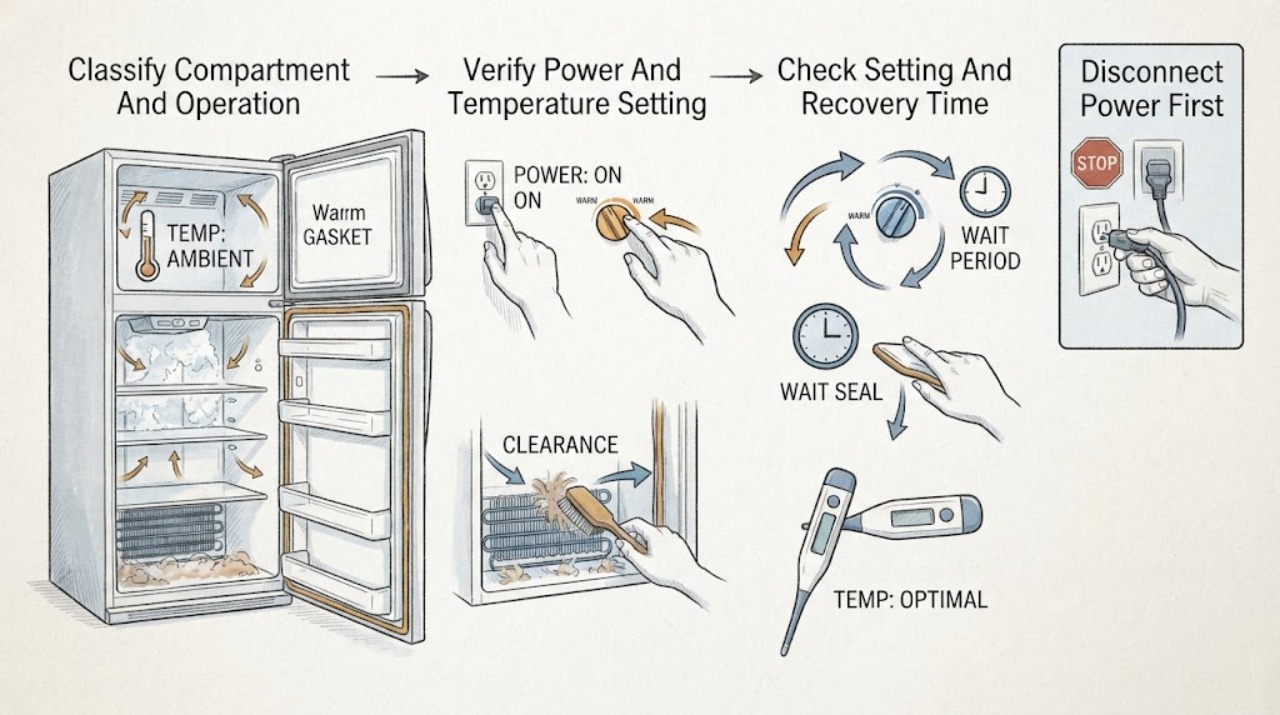
Work through in order
Diagnostic checks
Use only checks that match the exact appliance or system and its official guide.
-
Check 1
Check both the fresh-food and freezer compartments without leaving the doors open. Note which compartment is warm, whether interior lights and control displays work, and whether you hear a normal fan or compressor cycle. Measure temperature with the doors closed between checks rather than relying only on a warm shelf or one item of food.
Expected result: Both sections are warm; only the fresh-food section is warm; only the freezer is warm; the panel is blank; or the panel works and the refrigerator is running.
Next step: Follow the supply and control checks for a blank panel; follow vent, gasket, clearance, and temperature checks for a powered unit. Do not run the refrigerator merely to reproduce an abnormal sound or odor.
Stop if: Stop for smoke, burning odor, sparks, a hot cord, water near electrical parts, or a repeated breaker trip.
Why this matters
Why: Both sections warm suggests a power, control, airflow, or sealed-system problem. One-section cooling points more toward a blocked vent, compartment airflow, door seal, or frost pattern. A blank panel starts with the supply; a powered refrigerator moves the check toward settings, loading, airflow, and temperature recovery.
-
Check 2
From a dry, safe position, verify the plug is fully seated in a working outlet, the refrigerator is turned on, and the thermostat or electronic control is set to a cold setting. Check the breaker once if needed; do not use a damaged cord or an improvised power connection.
Expected result: The outlet is dead or breaker is tripped; the outlet works but the display and light remain off; or the refrigerator has power and the control responds.
Next step: Have an electrician assess a dead, wet, loose, hot, or repeatedly tripping outlet. Arrange refrigerator service for a proven-good outlet with no response; otherwise continue with temperature and airflow checks.
Stop if: Do not repeatedly reset a breaker, touch wet electrical parts, remove electrical covers, or perform live voltage tests.
Why this matters
Why: A dead outlet or unstable breaker is an electrical-supply problem. A known-good outlet with no display suggests an internal power or control fault. A responsive control makes a setting, airflow, door-seal, loading, or refrigeration-performance cause more likely.
-
Check 3
Read the exact model's temperature control and set it to the model-recommended cold range or a modestly colder setting. If you changed the setting, loaded warm food, or recently restarted the refrigerator, close the doors and allow recovery; Haier's general guidance says to allow at least three days after starting at a middle setting and one day between later adjustments.
Expected result: The control was set warm or off; the refrigerator recently received warm food or was restarted; the temperature improves after recovery; or it remains warm after the allowed stabilization period.
Next step: Keep the doors closed and recheck with a reliable thermometer after stabilization. Do not keep turning the control colder in rapid succession; move to door, vent, clearance, and frost checks if the temperature does not recover.
Stop if: Do not use the refrigerator for perishable food if safe storage temperature cannot be maintained, and do not alter a sealed thermostat or control.
Why this matters
Why: A warm setting, warm load, or insufficient recovery time can explain a temporary temperature complaint. Persistent warmth after a model-appropriate setting and recovery period is less likely to be a simple control adjustment.
-
Check 4
Inspect the perimeter of each door gasket for splits, gaps, dirt, or sections pulled out of the channel. Check that packages, shelves, or drawers are not holding a door open and that frequent openings are not allowing warm air in. Clean a gasket only with a gentle method supported by the model instructions; do not pry, tape, or replace it from appearance alone.
Expected result: A package holds the door open; the gasket has a gap, tear, or misalignment; the door seals continuously; or only one compartment has frost near the gasket or rear wall.
Next step: Remove the obstruction and correct only a visible gasket seating issue allowed by the exact manual. If the gasket is torn, the door is misaligned, or frost returns, arrange service rather than ordering a gasket by symptom alone.
Stop if: Do not force the door, puncture or chip frost, bypass a door switch, or run with a door that cannot seal.
Why this matters
Why: A poor seal or repeated warm-air entry can raise temperature and create frost that blocks circulation. A sound seal makes a vent, clearance, temperature, defrost, fan, or sealed-system issue more likely.
-
Check 5
With doors open only briefly, move food away from the interior supply and return vents and look for a heavy frost pattern on a rear wall. Outside the cabinet, check that the refrigerator is not flush against a wall or boxed in; Haier recommends about one inch of clearance around it for air circulation to the condenser.
Expected result: An interior vent is blocked; frost or ice covers a rear wall or airflow area; the refrigerator lacks outside clearance; or vents, frost, and clearance appear normal.
Next step: Restore only safe food spacing and external clearance. If heavy frost is present, do not scrape or heat it; follow the exact model's defrost procedure or arrange service. Recheck temperature after airflow is restored.
Stop if: Do not use a knife, hair dryer, heat gun, water spray, or cabinet-panel removal to clear frost; stop for a hot cabinet, odor, sparks, or water near electrics.
Why this matters
Why: Blocked internal airflow, frost, or poor condenser airflow can keep one or both compartments from reaching temperature. Normal external conditions make a fan, defrost, compressor, control, or sealed-system fault more likely.
-
Check 6
After the safe external checks, document whether the compressor or fan runs, whether either compartment ever reaches the model range, and whether frost or warmth returns. Do not remove the rear cover or test refrigerant pressure, start components, defrost heaters, sensors, or wiring.
Expected result: Cooling returns after an external correction; the refrigerator runs continuously but remains warm; it cycles briefly and stops; heavy frost returns; or an electrical or water hazard appears.
Next step: Keep food and appliance safety in mind and arrange qualified refrigerator service for persistent or recurring symptoms. Provide the model, compartment temperatures, run behavior, frost pattern, settings, gasket/vent/clearance results, and any hazard history.
Stop if: Stop immediately for smoke, burning or refrigerant-like odor, sparks, a hot cord or cabinet, water near electrical parts, or repeated breaker trips.
Why this matters
Why: A successful recovery supports a setting, loading, gasket, vent, frost, or clearance cause but does not prove an internal repair. Persistent warm operation or recurring frost can involve the fan, defrost system, compressor, control, or sealed circuit and requires model-specific diagnosis.
Use your observations
Decision map
Find the observation that best matches what you see, then follow the next safe action.
-
PATH 01Safety boundary
What you see
The Haier refrigerator is plugged in, the outlet is proven good, but the display and interior light remain off or a breaker repeatedly trips.
Do this next
Leave the refrigerator off and have an electrician assess the outlet/circuit or qualified appliance service assess the appliance. Protect perishable food by moving it to safe refrigeration as needed.
Why this path and its safety boundary
Why it matters: An internal power, control, cord, or electrical-supply fault is more likely than a temperature setting or blocked vent.
Safety stop: Do not repeatedly reset protection, use a hot or damaged cord, or remove the electrical cover.
-
PATH 02Safety boundary
What you see
The controls and power work, one compartment is warm, and a vent is blocked or frost is concentrated around an airflow path.
Do this next
Restore safe food spacing and follow the exact model's frost/defrost instructions without scraping or heating. Arrange service if airflow does not recover or frost returns.
Why this path and its safety boundary
Why it matters: Compartment airflow or frost is more likely than a complete loss of refrigeration, although a fan or defrost fault may remain if the obstruction is cleared and the pattern returns.
Safety stop: Do not puncture ice, remove panels, or use tools or heat to force defrost.
-
PATH 03Safety boundary
What you see
Both sections are only mildly warm after warm food or frequent door openings, or a package/gasket gap prevents a continuous door seal.
Do this next
Remove the obstruction, correct only a model-approved visible gasket seating issue, close the doors, and allow the refrigerator to stabilize before judging the result.
Why this path and its safety boundary
Why it matters: Warm-air entry or recovery time is more likely than an immediate compressor failure.
Safety stop: Do not keep perishable food in an appliance that cannot maintain safe temperature, and do not force or tape the gasket.
-
PATH 04Safety boundary
What you see
The refrigerator is powered and running, but the temperature setting is warm or changing rapidly, or the cabinet is installed with inadequate condenser clearance.
Do this next
Set the model-appropriate target, restore safe outside clearance, and allow the stated stabilization period. Do not make repeated adjustments while waiting.
Why this path and its safety boundary
Why it matters: Control setting and heat rejection may be limiting recovery; Haier identifies airflow around the condenser as important for cooling efficiency.
Safety stop: Do not move a heavy plumbed refrigerator through water, block required ventilation, or operate an abnormally hot cabinet.
-
PATH 05Safety boundary
What you see
Power, settings, recovery time, gaskets, vents, frost observations, and outside clearance are normal, but one or both compartments remain warm or the problem repeatedly returns.
Do this next
Arrange qualified refrigerator service and provide the model, temperatures, run pattern, frost pattern, and all completed external checks. Do not dismantle the refrigerator.
Why this path and its safety boundary
Why it matters: A fan, defrost, sensor, control, compressor, or sealed-system problem may be involved; external checks cannot identify a compatible part or refrigerant fault.
Safety stop: Stop for smoke, burning or refrigerant-like odor, sparks, hot cord/cabinet, water near electrical parts, or repeated trips; do not restore power after a hazard.
Helpful context
Understand the symptom
Map the temperature problem before changing settings
Record the exact Haier model, the measured temperature in each compartment, whether lights and fans respond, whether the compressor runs, and whether the problem began after loading warm food, a power interruption, moving the refrigerator, or changing a setting. A warm fresh-food section with a cold freezer is a different decision from both sections being warm. Use the model manual for control labels and the product-specific temperature range; the ranges on this page are Haier's general guidance, not a substitute for the model specification.
External airflow and sealing come before internal parts
Warm food, frequent door openings, a door that is held open by a package, a torn gasket, blocked interior vents, or insufficient outside clearance can make a working refrigerator seem not to cool. Frost on a back wall can also reduce circulation. These observations narrow the cause but do not identify a compatible fan, thermostat, control board, defrost heater, compressor, or refrigerant repair.
Stop for electrical, water, or sealed-system danger
Stop using the refrigerator for smoke, a burning or refrigerant-like odor, sparks, a hot or damaged cord, water near an outlet or wiring, repeated breaker trips, or a cabinet that is abnormally hot. Disconnect power only from a dry, accessible point when safe and keep food safety in mind while the unit is off. Do not remove covers, probe live circuits, chip ice with a sharp tool, bypass a door or temperature control, open the sealed refrigeration circuit, or add refrigerant yourself.
When checks do not resolve it
Need a professional?
Call qualified refrigerator service for persistent or recurring warm compartments after the safe external checks, repeated frost, continuous running without cooling, or suspected fan, defrost, sensor, control, compressor, or sealed-system failure. Call an electrician for a dead, wet, loose, hot, or repeatedly tripping outlet. Stop immediately for smoke, burning or refrigerant-like odor, sparks, a hot cord/cabinet, or water near electrical parts.
Safety scope: Do not remove rear or electrical covers, probe live wiring, chip or heat frost, bypass door or temperature controls, handle the compressor or start components, open the sealed refrigeration circuit, or add refrigerant. Disconnect power only from a dry, safe, accessible point.
Have this ready
- Provide the exact model and serial information, fresh-food and freezer temperatures, whether one or both sections are affected, panel/light and run behavior, temperature setting and time since adjustment, warm-load or door-opening history, gasket and vent results, frost location, outside clearance, and any odor, heat, water, spark, or breaker history.
Common questions
FAQ
Why is my Haier refrigerator running but not cooling?
Check the setting and recovery time, warm food and frequent door openings, door-gasket sealing, blocked interior vents, frost on a rear wall, and outside condenser clearance. If both compartments remain warm after those checks, an internal fan, defrost, control, compressor, or sealed-system fault may require service.
What temperature should a Haier refrigerator be?
Haier says the range varies by product, but gives general averages of 34–41°F for the fresh-food section and -10–20°F for the freezer. Confirm the exact model guidance and use a thermometer rather than judging by one shelf or item.
How long should I wait after changing a Haier refrigerator setting?
Haier's general temperature guidance says to start at a middle setting and allow at least three days, then allow one day between subsequent adjustments. Warm food, frequent door openings, and a recent restart can extend recovery.
Can blocked vents or frost make only one Haier refrigerator section warm?
Yes. Haier specifically directs owners to check compartment air vents when only the fresh-food or freezer section is not cold. Its frost guidance also lists blocked circulation, doors left open, and door gaskets that do not seal as possible contributors.
How much clearance does a Haier refrigerator need?
Haier recommends about one inch of clearance all around the refrigerator so air can circulate, especially around the condenser. Follow the exact model installation instructions if they specify a different clearance.
When should I stop troubleshooting a Haier refrigerator?
Stop for smoke, burning or refrigerant-like odor, sparks, a hot or damaged cord, water near electrical parts, repeated breaker trips, or an abnormally hot cabinet. Do not open the sealed system, test live wiring, or chip frost; arrange qualified service.
Read the exact guide
Official sources
- Haier - Refrigerator Air ClearanceHaier Appliances · Haier Appliances refrigerator installation guidance; exact model installation requirements take precedence.
- Haier - Temperature Control SettingsHaier Appliances · Haier Appliances general temperature-control guidance; confirm the target and control sequence for the exact model.
- Haier Refrigerator - Ice or Frost Forming on Back WallHaier Appliances · Haier Appliances frost guidance; frost behavior and defrost procedure depend on the exact refrigerator model.
- Haier - Cleaning Inside the RefrigeratorHaier Appliances · Haier Appliances cleaning guidance including compact models; use the exact model manual for removable components.
- Haier - Refrigerator Running but Not CoolingHaier Appliances · Haier Appliances support guidance for refrigerators; temperature ranges and control labels vary by model.
Community feedback
Share a repair observation
Share a plain-text repair observation. Accepted observations are published automatically; this page may take a moment to update.