
On this page
Start here
Quick answer
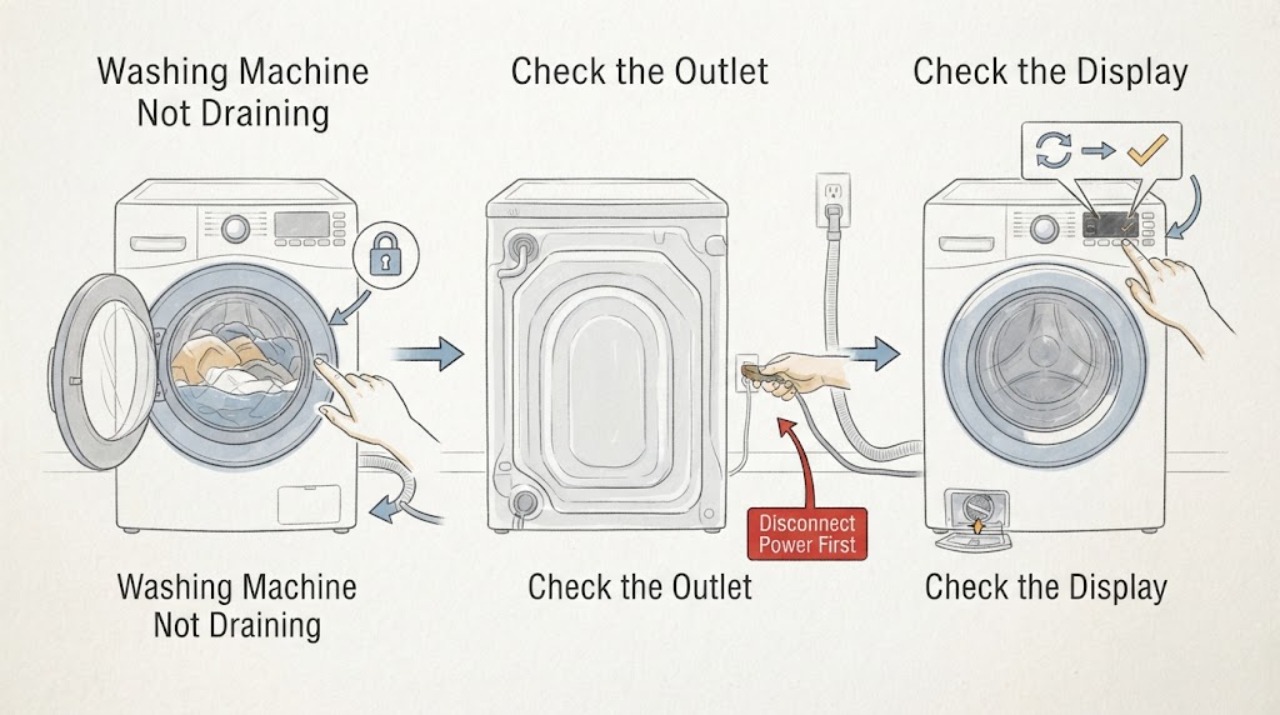
If a Haier washer leaves water in the drum, pause the cycle and keep people away from any water near electricity. Read the display and identify whether the wash or dry side is affected, then check the drain hose for kinks, crushing, blockage, excessive insertion, or incorrect height. If your model has an accessible pump filter or button trap, unplug the machine, release water slowly into a shallow container, clear only visible debris, and refit the filter securely. Reduce an overloaded or heavily sudsing load and use the model manual for door-lock or error-code instructions. Stop for active leakage, water near electrical parts, burning odor, sparks, repeated trips, or a blockage that requires internal access; arrange qualified service.
Work through in order
Diagnostic checks
Use only checks that match the exact appliance or system and its official guide.
-
Check 1
Pause the washer, keep the door or lid closed, and check the room for active water, a wet cord or outlet, water near controls, a burning odor, sparks, unusual heat, or a breaker that has tripped.
Expected result: Contained water away from electricity allows a careful external check. Active leakage, water near electrical parts, smoke, odor, heat, sparks, or a repeated trip is an unsafe condition.
Next step: Stop using the machine. From a dry position isolate water or power if safe, do not touch wet electrical parts, and request qualified appliance or electrical service. If safe, record the displayed code and whether the water is in the drum or on the floor.
Why this matters
Why: Standing water and electrical energy can create shock or fire risk. The safety state comes before identifying a filter or hose blockage.
-
Check 2
Read the display and identify the affected function: check for a drain code such as LD or the model's equivalent, a door or lid indication, a foam or load message, and whether the water remains after wash, rinse, or a combined wash-dry cycle.
Expected result: A drain code with water remaining points to the drain path; a door or lid message can prevent a cycle from completing; foam or load behavior can stop spin or leave water; no code requires external hose and filter checks.
Next step: Follow the exact model manual for the displayed code. Do not bypass a door lock or repeatedly start a cycle with standing water; continue only with safe, model-supported checks.
Why this matters
Why: The same symptom can be caused by a blocked drain or by a cycle interlock. Haier notes that LD indicates a drain issue on applicable models and that door, load, water-level, and control errors vary by model.
-
Check 3
With the machine switched off and unplugged, inspect the visible drain hose from the appliance to the standpipe or drain for kinks, crushing, rubbing damage, blockage, or an end pushed too far into the drain.
Expected result: A pinched or blocked hose can restrict flow. A hose inserted too deeply or positioned contrary to the model's installation diagram can create siphoning, while a clear and correctly supported hose shifts suspicion inward or to the household drain.
Next step: Restore only an obvious external bend or installation error using the exact manual, and check that the household standpipe is not blocked. Do not pull the machine out aggressively or alter a concealed connection; request service if the hose is damaged or the problem remains.
Why this matters
Why: Haier specifically identifies hose kinks, blockage, excessive standpipe insertion, and incorrect drain height as causes of poor or failed drainage. The permitted height and support differ by model and drain design.
-
Check 4
If the model has an accessible pump filter, emergency drain hose, or button trap, place towels and a shallow container, unplug the washer, release water slowly, and remove only the filter or trap described by the model manual.
Expected result: Lint, hair, coins, or other visible debris can restrict the filter or trap. A filter that is clear but produces no drain flow, an impeller that cannot move as designed, or water that keeps escaping points to a pump, hose, seal, or internal fault.
Next step: Clear only loose visible debris, refit and lock the filter or plug securely, and close the access panel before any test. Stop if the filter is inaccessible, damaged, jammed, or requires force, and request service.
Why this matters
Why: Haier says applicable units may have a filter or button trap accessible at the lower front and warns that a small amount of water will escape; an incorrectly seated filter or plug can itself cause a leak.
-
Check 5
Check the load and detergent condition after water is safely contained: remove obvious overload, redistribute laundry, and look for unusually thick foam or detergent residue without adding unapproved chemicals.
Expected result: An overloaded or uneven load can prevent a proper spin; thick foam can be repeatedly agitated and interfere with drainage. A normal load with no excess foam and persistent water suggests the drain path or pump still has a fault.
Next step: Use the model's normal rinse or drain option only after the hose and filter are safely restored and no leak or electrical hazard exists. Use the manual's detergent guidance; do not keep retrying if the drum remains full.
Why this matters
Why: Haier links excessive detergent or foam and poor drainage with spin and discharge problems. A load correction may help only when the machine is otherwise safe and the model permits a rinse or drain cycle.
-
Check 6
Check the household drain opening and hose termination without pouring more water into the washer: look for a backed-up standpipe, a submerged or unsupported hose end, or water returning from the household drain.
Expected result: Water backing up in the standpipe or returning outside the appliance indicates a plumbing restriction or installation issue. A clear household drain with water retained inside the washer points back to the appliance drain path.
Next step: Arrange plumbing service for a blocked household drain. Correct only the visible hose support according to the model manual; do not dismantle the wall drain or run repeated cycles into an overflowing standpipe.
Why this matters
Why: A washer pump cannot overcome a blocked household drain, and a hose position that allows siphoning can make the washer appear unable to hold or remove water.
-
Check 7
After a safe external correction, run only the shortest model-supported drain or rinse test while watching the hose, filter area, door seal, and floor; stop immediately if water escapes or the machine trips power.
Expected result: A steady discharge with no water returning supports an external blockage or installation correction. No discharge, a recurring drain code, a new leak at the filter or door, unusual pump noise, or repeated power interruption indicates an unresolved fault.
Next step: Stop using the washer, keep water contained, and request qualified service for a persistent no-drain condition, pump or sensor diagnosis, internal hose, door-lock, or control work. Document the model, code, water level, and first leak location.
Why this matters
Why: A dry test floor does not prove the pump or internal hose is healthy. Haier directs recurring problems and unresolved codes to service rather than continued user repair.
Use your observations
Decision map
Find the observation that best matches what you see, then follow the next safe action.
-
PATH 01Next step
What you see
The drain hose is kinked, crushed, blocked, inserted too deeply, or positioned contrary to the model manual.
Do this next
Unplug the washer and correct only the visible installation issue, then perform a short model-supported drain test. Request service if the hose is damaged or drainage remains poor.
-
PATH 02Next step
What you see
The model has an accessible pump filter or button trap and it contains visible debris.
Do this next
Release standing water slowly into a container, clear loose debris, and refit the filter, plug, and panel securely. Stop if access is not model-approved or the part is jammed or damaged.
-
PATH 03Next step
What you see
The load is overloaded or produces unusually thick foam, but there is no leak or electrical hazard.
Do this next
Reduce or redistribute the load and follow the model's detergent and rinse guidance. Do not keep restarting a full drum when the drainage restriction remains.
-
PATH 04Next step
What you see
The household standpipe backs up or the hose end is unsupported or submerged.
Do this next
Stop feeding water into the drain and arrange plumbing service or a manual-approved hose installation correction. Do not dismantle the wall drain.
-
PATH 05Next step
What you see
A drain, door/lid, foam, water-level, or communication code returns after safe external checks.
Do this next
Keep the washer off and use the exact model manual to identify the code. Request qualified service for a recurring code or any component diagnosis.
-
PATH 06Next step
What you see
Water is near electrical parts, leakage is continuous, or there is a burning odor, smoke, spark, heat damage, or repeated breaker trip.
Do this next
Stop immediately, isolate power or water only from a dry safe position, and obtain qualified electrical, plumbing, or appliance service. Do not touch wet wiring or restart the machine.
Helpful context
Understand the symptom
A Haier washer that will not drain may have a simple external hose problem, a siphoning installation, a blocked filter or button trap, excess suds, a load that stopped the cycle, or a pump or control fault. Start by treating the standing water as real: keep the door or lid closed if possible and prevent water from reaching a plug, outlet, or controls.
Haier uses different drain arrangements for top-load, front-load, and washer-dryer models. A filter or emergency drain hose may be present on one model and absent on another. Use the exact model manual before opening an access panel or changing drain-hose height.
Separate a drain failure from a cycle or load problem
Note whether the water remains after wash, rinse, or dry preparation; whether the machine shows a drain code; and whether it stopped after excess foam or an unbalanced load. Do not keep restarting a machine that is leaking or repeatedly trips power.
Safety boundary
Stop conditions
- Stop immediately if standing or flowing water reaches the plug, cord, outlet, controls, wiring, or another electrical part.
- Stop if leakage is continuous, the filter or hose connection cannot contain water, the door glass or seal is damaged, or the household drain is overflowing.
- Stop for burning odor, smoke, sparks, abnormal heat, a damaged cord, or a breaker or GFCI that trips again.
- Do not bypass a door or lid lock, probe wiring, remove sealed covers, force a jammed pump, or use sharp tools to clear internal obstructions.
- Request qualified service when the washer still will not drain after the model-approved hose and filter checks, when a code recurs, or when pump, sensor, control, internal hose, or condenser-drain work is required.
When checks do not resolve it
Need a professional?
Call qualified Haier appliance service when the drain hose and any model-approved filter or button trap are clear but water remains, a drain or door code returns, the pump does not discharge, the door lock prevents safe access, or diagnosis requires internal panels, wiring, pump, sensor, or condenser access. Call a plumber for a blocked household standpipe. Stop immediately for water near electricity, active uncontrolled leakage, burning odor, smoke, sparks, abnormal heat, or repeated power trips.
Common questions
FAQ
Why is my Haier washing machine leaving water in the drum?
Check the visible drain hose for kinks, blockage, siphoning, or incorrect installation, then check any model-approved pump filter or button trap with the machine unplugged and water released slowly. A clear path with persistent water needs service.
Can the drain hose height or position stop a Haier washer from draining?
Yes. Haier identifies kinks, blockage, excessive insertion, siphoning, and incorrect drain height as possible causes. Use the exact model installation diagram because top-load and front-load arrangements differ.
Can too much detergent cause a Haier washer to stop draining?
Excess foam can interfere with spinning and discharge, especially when drainage is already restricted. Use the detergent amount and rinse or drain procedure in the model manual; do not keep restarting a full or leaking drum.
When should I stop troubleshooting a Haier washer that will not drain?
Stop for water near electricity, continuous leakage, a wet or damaged cord, burning odor, smoke, sparks, abnormal heat, or repeated breaker trips. Keep the machine off and obtain qualified appliance, electrical, or plumbing service.
Read the exact guide
Official sources
- Much foam during the spin cycle of washing machineHaier India · Haier washer excess foam, detergent use, drain pipe, filter, and service diagnosis
- Common problem trouble shooting for top load washing machineHaier India · Haier top-load drain, hose height, lid, load, water-level, and error-code troubleshooting
- Step-by-Step Guide: How to drain washing machine manuallyHaier Europe · Haier washing machine manual draining, filter checks, safe water containment, and recurring drainage service boundary
- Haier - Washer Does Not Drain and/or Displays LDHaier Appliances · Haier washer drain error, drain pump filter, hose kink, siphoning, and service escalation
- Haier - Washer/Dryer Combo Button Trap / Lint FilterHaier Appliances · Haier washer-dryer combo button trap, emergency drain handling, filter reseating, and leak prevention
- Stops during drain cycleHaier Pakistan · Haier washer drain-cycle safety, hose path, power check, error-code review, and service escalation
Community feedback
Share a repair observation
Share a plain-text repair observation. Accepted observations are published automatically; this page may take a moment to update.