
On this page
Start here
Quick answer
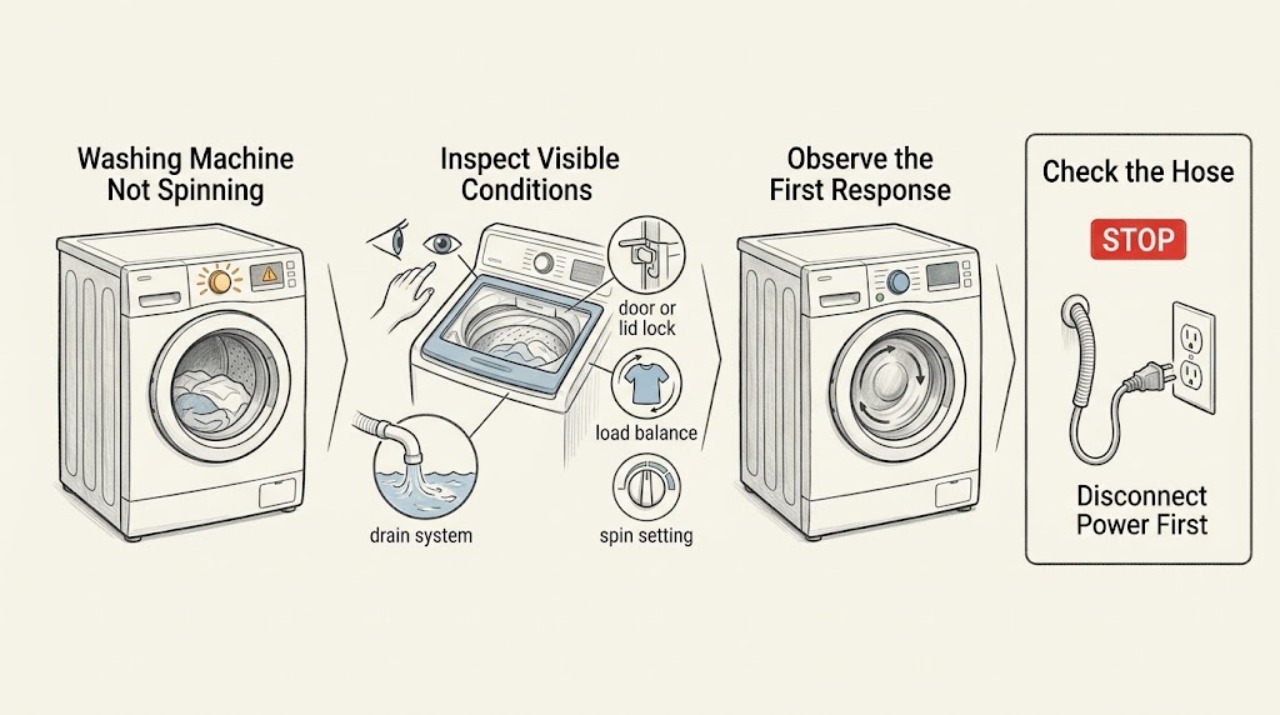
A Haier washer may refuse or reduce spin because it has not drained, the load is unbalanced or too large, the door or lid is not locked, the selected spin speed is low, or excess foam is preventing the cycle from completing. Pause the machine, check for water near electrical parts, then use the exact model manual to read any code. With the washer off and unplugged, inspect the visible drain hose and any model-approved pump filter, correct only an obvious load or hose issue, and retry a short spin only when safe. Stop for violent vibration, metal scraping, active leakage, burning odor, sparks, abnormal heat, or repeated breaker trips; arrange qualified service for a pump, lock, sensor, motor, belt, or control diagnosis.
Work through in order
Diagnostic checks
Use only checks that match the exact appliance or system and its official guide.
-
Check 1
Pause the washer and check the safety state: look for water on the floor or near electrical parts, an active leak, violent movement, metal scraping, burning odor, smoke, sparks, abnormal heat, or a breaker that has tripped.
Expected result: A stable machine with contained water away from electricity can proceed to external checks. Active leakage, wet electrical parts, violent vibration, scraping, odor, smoke, sparks, heat, or a repeated trip is an unsafe condition.
Next step: Stop using the washer, keep people away, and isolate power or water only from a dry safe position. Request qualified appliance, electrical, or plumbing service. If safe, note the cycle stage and displayed code.
Why this matters
Why: The stop condition comes before diagnosing a belt, pump, or lock. Continued spinning can spread water or turn a mechanical or electrical fault into a larger hazard.
-
Check 2
Observe what the washer did before stopping: determine whether the drum never moved, moved at low speed, stopped with water inside, stopped at the door or lid stage, or displayed a drain, unbalance, lid, or other code.
Expected result: Water remaining with a drain indication points to drainage; low-speed movement or an UNB indication points to balance; a door or lid indication points to the interlock; a completed drain with no rotation points toward spin selection or a drive/control fault.
Next step: Follow the exact model manual for the code or lock behavior. Do not bypass a door or lid lock, and do not keep restarting a drum that is full of water.
Why this matters
Why: Haier describes separate causes for drain, lock, load, and communication or sensor conditions, so the symptom sequence is more useful than the phrase not spinning alone.
-
Check 3
With the washer off and unplugged, inspect the visible drain hose and household standpipe for kinks, crushing, blockage, an unsupported end, or installation that allows siphoning; check the hose height against the model manual.
Expected result: A kinked or crushed hose, blocked standpipe, excessive insertion, or wrong height can leave water in the tub and prevent spin. A clear, correctly routed drain with no retained water shifts the next check toward load, lock, setting, or drive.
Next step: Correct only an obvious external bend or hose-position error according to the manual, and do not dismantle a wall drain. Request plumbing or appliance service if the hose is damaged or the washer still retains water.
Why this matters
Why: Haier states that incomplete drainage blocks spin on applicable washers and identifies hose kinks, pump-filter blockage, siphoning, and drain height as relevant checks.
-
Check 4
If the exact model provides an accessible pump filter, emergency drain hose, or button trap, unplug the washer, place towels and a shallow container, release water slowly, and clear only loose visible debris before securely refitting the part.
Expected result: Lint, hair, coins, or other debris can restrict the filter or trap. A clear filter with no drain flow, an impeller that cannot move as designed, or a filter area that leaks after refitting indicates a pump, seal, or internal fault.
Next step: Close and lock the filter, plug, and panel before a test. Stop if the filter is hidden, jammed, damaged, or requires force, and request service rather than opening internal panels.
Why this matters
Why: Haier describes an applicable filter or button trap as a possible cause of no spin and warns that water may escape during cleaning. Access and procedure vary by model.
-
Check 5
Check the load and spin setting with the machine safe and stopped: redistribute a single sheet or tangled load around the drum, remove an obvious overload, and confirm the selected programme permits spin at a useful speed.
Expected result: A single bulky item, tangled wet load, or excessive load can remain unbalanced and cause low speed or no full spin. A low selected speed can leave clothes wet even when the drum operates.
Next step: Use a model-supported spin programme only after the load is balanced and the drain path is clear. Do not add weight or reach into a moving drum; stop if the washer bangs, walks, or scrapes.
Why this matters
Why: Haier says the washer may reduce speed or avoid full spin to control abnormal vibration, and its guidance identifies an improper spin setting as a cause of poor dehydration.
-
Check 6
Inspect the detergent condition and cycle history for unusually thick foam, residue, or an overflow, then follow the model's detergent and rinse guidance without adding unapproved chemicals.
Expected result: Excess foam can be repeatedly agitated during spin and interfere with discharge; normal suds with no retained water makes foam less likely. Foam reaching the floor is also a leak and slip hazard.
Next step: If the machine is stable and dry, use only the model-approved rinse or spin option after correcting the load and drainage. Stop if foam overflows, water escapes, or the condition repeats.
Why this matters
Why: Haier links excessive detergent or foam and poor drainage with spin and discharge problems. Foam control will not repair a blocked hose, pump, sensor, or drive.
-
Check 7
Run one short, model-supported spin or rinse-and-spin test while watching the drain hose, filter area, door or lid, drum movement, and floor; stop immediately for abnormal noise or movement.
Expected result: A normal drain followed by a smooth spin supports a hose, filter, load, or setting correction. No rotation after drainage, a recurring code, a lock that will not engage, weak or absent pump discharge, metal noise, or repeated trips indicates an unresolved fault.
Next step: Stop using the washer and request qualified service for a persistent no-spin fault, pump or lock problem, drive symptom, code, or internal leak. Record the model, code, water level, load, and first abnormal sound.
Why this matters
Why: Haier directs persistent no-spin or pump conditions to qualified diagnosis. A test result cannot safely identify a motor, belt, control, sensor, or lock without model-specific service measurements.
Use your observations
Decision map
Find the observation that best matches what you see, then follow the next safe action.
-
PATH 01Next step
What you see
Water remains in the tub or a drain indication appears before spin.
Do this next
Unplug the washer and check the visible hose, standpipe, and any model-approved pump filter or button trap. Request appliance or plumbing service if water remains after safe external checks.
-
PATH 02Next step
What you see
The drum moves slowly, shows UNB, or the machine tries to balance and then skips full spin.
Do this next
Stop the drum, redistribute or reduce the load, and use the model-supported spin programme. Request service if the washer remains unbalanced, vibrates violently, or fails with a normal load.
-
PATH 03Next step
What you see
A door or lid message appears or the lock never engages.
Do this next
Close the door or lid without forcing it and follow the model manual. Do not bypass the interlock; request service if the lock, latch, seal, or control remains faulty.
-
PATH 04Next step
What you see
The selected programme completes little or no spin but the tub is drained and there is no error.
Do this next
Confirm the model's spin setting and select a supported spin programme once. If the drum still does not rotate smoothly, arrange service for drive, motor, sensor, or control diagnosis.
-
PATH 05Next step
What you see
Thick foam appears during spin or foam overflows.
Do this next
Pause and contain the foam, follow the model's rinse guidance, and correct detergent use. Stop if overflow continues or drainage remains poor; request service for a recurring foam or sensor condition.
-
PATH 06Next step
What you see
The washer makes metal scraping, bangs violently, walks, leaks, smells burnt, sparks, overheats, or trips power again.
Do this next
Stop immediately and isolate power only from a dry safe position. Do not restart or open the cabinet; obtain qualified appliance or electrical service.
Helpful context
Understand the symptom
Not spinning does not always mean the motor has failed. Haier washers can deliberately slow or skip high-speed spin when water remains, the load cannot balance, the door or lid is not locked, or foam is interfering with the cycle. Start by separating a washer that never rotates from one that drains but spins slowly.
Top-load, front-load, and washer-dryer models use different locks, filters, drain heights, and cycle controls. The model manual determines which filter or emergency drain is user-accessible. Do not open covers or test live components.
Make the situation safe before a spin test
Pause the cycle and keep hands away from a moving drum. If water is near the plug, cord, outlet, or controls, or if the washer is smoking, sparking, overheating, or violently walking, stop using it and isolate power only from a dry, safe position.
Safety boundary
Stop conditions
- Stop immediately if water reaches the plug, cord, outlet, controls, wiring, or another electrical part, or if leakage is active or uncontrolled.
- Stop for violent vibration, walking, metal scraping, burning odor, smoke, sparks, abnormal heat, a damaged cord, or a breaker or GFCI that trips again.
- Do not bypass a door or lid lock, reach into a moving drum, probe live wiring, remove sealed covers, or force a jammed filter or pump.
- Do not keep restarting a machine with standing water, overflowing foam, a recurring error, or a household drain that is backing up.
- Request qualified service when drainage and load checks do not restore spin, or when pump, lock, sensor, motor, belt, control, bearing, or internal hose diagnosis is required.
When checks do not resolve it
Need a professional?
Call qualified Haier appliance service when the washer remains unable to spin after the model-approved drain-hose, filter, load, lock, and setting checks, when a code returns, or when a pump, lock, sensor, motor, belt, control, bearing, or internal hose needs diagnosis. Call a plumber for a blocked household standpipe. Stop immediately for active leakage near electricity, violent vibration, metal scraping, burning odor, smoke, sparks, abnormal heat, or repeated trips.
Common questions
FAQ
Why will my Haier washing machine not spin?
First check whether water remains. A drain restriction or clogged applicable pump filter can block spin; an unbalanced load, door or lid lock, low spin setting, or excess foam can also stop or reduce it. Use the model manual and request service for a persistent fault.
Why does my Haier washer spin slowly or show UNB?
Haier uses low or skipped high-speed spin to limit vibration when a load cannot balance. Stop the drum, redistribute or reduce the load, and retry only with a stable machine. Persistent imbalance or violent vibration needs service.
Can a blocked drain stop a Haier washer from spinning?
Yes. Check the visible drain hose for kinks, crushing, blockage, siphoning, or incorrect height, then inspect a model-approved pump filter with the washer unplugged. If water remains after safe checks, request service.
When should I stop testing a Haier washer that will not spin?
Stop for water near electricity, active leakage, violent vibration, metal scraping, burning odor, smoke, sparks, abnormal heat, or repeated breaker trips. Keep the washer off and obtain qualified appliance, electrical, or plumbing service.
Read the exact guide
Official sources
- Spin does not work immediatelyHaier India · Haier washer spin start, door lock, overload, power, drainage, and service checks
- Poor dehydration performance, remain water in clothes after washingHaier India · Haier washer spin setting, unbalanced load, drainage blockage, pump filter, and pump service diagnosis
- Much foam during the spin cycle of washing machineHaier India · Haier washer excess foam, detergent, drainage, filter, rinse, and sensor service diagnosis
- No spin or washer machine does not spin at a high speed(Display UNB)Haier India · Haier washer unbalanced-load detection, reduced spin speed, and redistribution
- Haier - Top Load and Compact Washer Does Not SpinHaier Appliances · Haier washer no-spin, drain pump filter, drain hose siphoning, hose kinks, and service escalation
- Common problem trouble shooting for top load washing machineHaier India · Haier top-load washer drain, lid, load, and error-code troubleshooting
- Haier - Washer/Dryer Combo Button Trap / Lint FilterHaier Appliances · Haier washer-dryer button trap, emergency drain, filter refitting, and leak prevention
- Strong vibration while spinningHaier India · Haier washer vibration, uneven installation, overload, and safe load correction
- Stops during drain cycleHaier Pakistan · Haier washer drain-cycle hose, power, error-code, and service checks
Community feedback
Share a repair observation
Share a plain-text repair observation. Accepted observations are published automatically; this page may take a moment to update.