
On this page
Start here
Quick answer
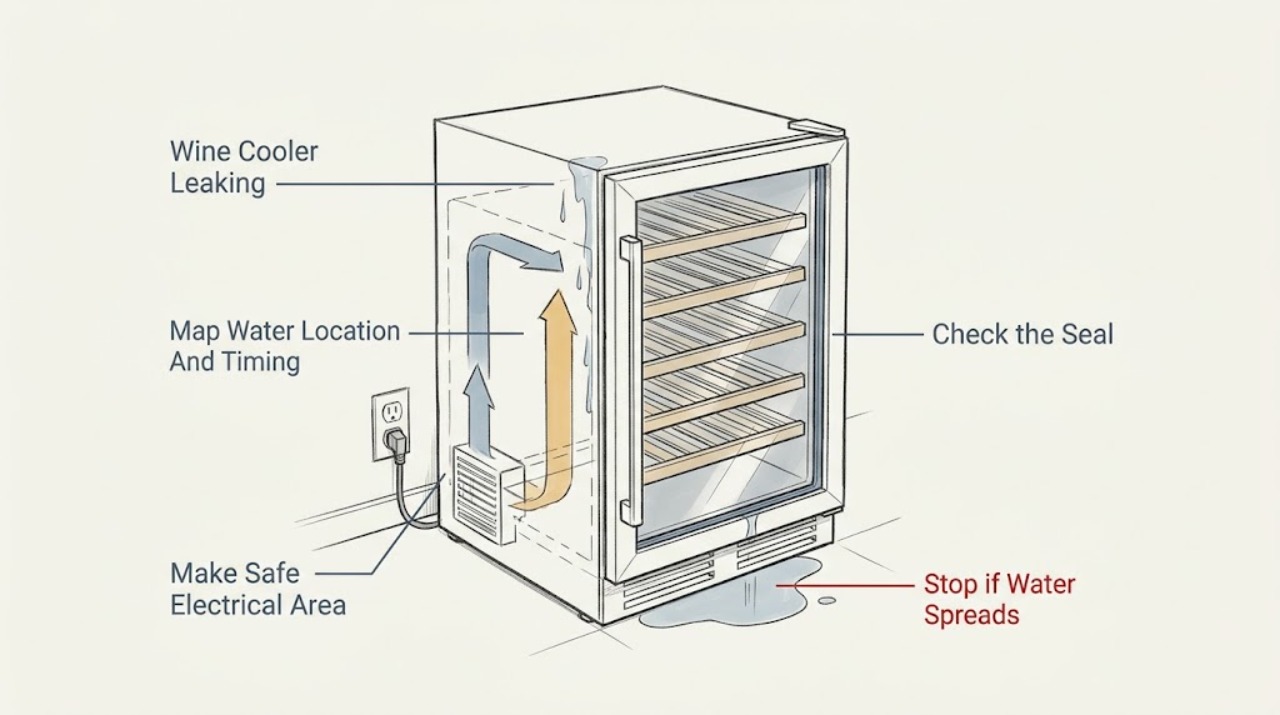
Start by deciding whether the water is condensation or a true cabinet leak. Haier says moisture inside a wine cellar can occur during high humidity or prolonged/frequent door opening, and directs owners to make sure the door seals properly and clean it if necessary. Check the glass and gasket, room humidity, door closure, level, and the floor around the unit without opening panels. Haier's current wine-center product information says its triple-pane glass door is designed to reduce condensation, so recurring pooling or water coming from underneath is not explained by normal glass fog alone. Stop using the cooler if water reaches the plug, outlet, cord, controls, or wiring; do not tilt it, remove covers, or perform live electrical tests. Persistent pooling, a damaged gasket, water from the cabinet base, or an error code requires qualified Haier service.
Before you begin
Safety first
- The owner may inspect dry visible surfaces, the door closure and gasket, and the documented external installation conditions. Qualified personnel must access the cabinet base, internal condensation/cooling paths, electrical parts, controls, sealed system, or any hidden leak source.
Work through in order
Diagnostic checks
Use only checks that match the exact appliance or system and its official guide.
-
Check 1
Record the complete Haier model and photograph where the water first appears: on the glass or interior wall, around the door gasket, on the cabinet exterior, under the base, or on the floor nearby. Note room humidity or recent weather, door-open time, whether bottles were recently loaded, and whether water returns after the area is dried.
Expected result: Moisture is a film or droplets inside; water is concentrated at the door; the base or floor is wet; or water returns without another door event.
Next step: Use the moisture/door branch for droplets and the leak/service branch for water under the cabinet or a recurring puddle. Keep the model information for the Owner's Manual and technician.
Stop if: Stop immediately if water is near the outlet, plug, cord, controls, rear electrical area, smoke, burning odor, sparks, or abnormal heat.
Why this matters
Why: Interior or door-area moisture after humid-air exposure fits Haier's wine-cellar moisture guidance. A returning puddle or water from the base is a different symptom and cannot be assigned to condensation without identifying the path.
-
Check 2
Before touching the gasket or wiping anything, check from a dry position whether the outlet, plug, power cord, and visible controls are dry. If water is approaching them, stop using the cooler and isolate power only through a dry, safely reachable disconnect; do not move the appliance through water.
Expected result: The electrical connection and surrounding floor are dry; water is touching or approaching them; or the safe disconnect cannot be reached without contact with water.
Next step: For a wet electrical area or inaccessible disconnect, leave the cooler off and obtain qualified appliance/electrical help. If everything is dry, continue with the door and environment checks.
Stop if: Do not touch wet electrical parts, unplug a wet connection, open rear covers, take live measurements, or restore power to test.
Why this matters
Why: Dry external inspection can continue only when the electrical hazard is separated from the work area. Water at the connection changes the job to safe isolation and service rather than leak tracing.
-
Check 3
Open the door briefly and inspect the visible gasket around its full perimeter for dirt, a split, deformation, or a section that fails to contact the cabinet. Check that a bottle, shelf, or handle is not preventing closure; wipe the accessible gasket with a clean, damp cloth and dry it. Do not remove or heat the seal.
Expected result: The door is ajar or obstructed; the gasket is dirty but intact; the gasket has a tear or gap; or the door and gasket appear to seal while water pools below.
Next step: Remove only the closure obstruction or clean and dry the seal, then monitor one normal cooling period. A torn or still-gapped gasket needs model-matched service; use the floor-puddle branch if the seal is intact.
Stop if: Do not pry out the gasket, reshape it with heat, or continue if water has reached electrical parts.
Why this matters
Why: Haier links interior moisture and long run time with frequent door openings, an ajar door, or a gasket that does not seal properly. A damaged seal can admit humid air, but an intact seal does not explain water emerging from the base.
-
Check 4
Inspect the room and installation from outside the cabinet. Confirm the cooler is on a hard, level surface, is not exposed to heavy moisture, and—where the model follows Haier's wine-cellar guidance—is freestanding rather than recessed. Note a hot, humid room, direct heat, or recent placement in a damp location.
Expected result: The cooler is in a damp or hot room; it is recessed or tightly enclosed; it is unlevel; or the location is dry, level, and consistent with the model instructions.
Next step: Correct only a plainly safe environmental or closure issue according to the exact manual, then monitor. If water continues or the installation cannot be changed safely, arrange service rather than opening the cabinet.
Stop if: Do not lift, tilt, or slide a loaded cooler, alter built-in cabinetry, or handle a wet appliance to change its location.
Why this matters
Why: Haier says high humidity can contribute to interior moisture, heavy moisture raises leakage and insulation risk, and its wine cellar is designed for freestanding installation. Installation conditions can explain condensation load but do not prove an internal water leak.
-
Check 5
If the exact Owner's Manual identifies a user-accessible fan filter, inspect it only after safely unplugging from a dry position and only as the manual directs. Keep the filter completely dry before reinstalling. Do not treat a filter as a drain, remove cooling panels, or probe inside the cabinet.
Expected result: The model has the documented removable fan filter and it is dusty; the model has no documented owner-accessible filter; or water is coming from inside/under the cabinet.
Next step: Clean and reinstall only the documented filter, then monitor. For water under or inside the cabinet, skip further user checks and arrange service.
Stop if: Do not remove fan covers, touch wiring, spray liquid into the cabinet, or power the cooler with a wet filter.
Why this matters
Why: Haier documents fan-filter cleaning for some wine-cellar guidance, beginning with unplugging and requiring a fully dry filter before replacement. This can affect airflow and run time, but the official guidance does not make a dirty filter a universal explanation for a water leak.
-
Check 6
Read and photograph any displayed code or alarm without repeatedly cycling the unit. Record whether the cooler still controls temperature, whether the compressor or fan runs unusually long, and whether water returns after one safe observation period.
Expected result: There is no code and moisture stops after the door/environment issue is addressed; water returns; the cooler leaks from the base; or a code such as EE, ER, F1, F2, F3, or F4 is displayed.
Next step: Keep the cooler stopped if the leak is active or near electrics and arrange qualified Haier service. Provide the model, code, photos, location, timing, gasket result, and installation conditions.
Stop if: Do not bypass a sensor, remove panels, test internal wiring live, handle refrigerant or sealed-system parts, or continue operation with an active leak.
Why this matters
Why: Haier's wine-cellar error guidance treats EE/ER sensor faults and F1/F4 long compressor operation as service conditions, while F2/F3 indicate sensor faults requiring service. A code or recurring base leak is not a reason to open the cooler.
Use your observations
Decision map
Find the observation that best matches what you see, then follow the next safe action.
-
PATH 01Next step
What you see
Moisture is on the glass or interior surfaces after frequent/prolonged door opening or during a hot, humid period, with no pooling below the cabinet.
Do this next
Reduce door-open time, make sure the door closes and seals, and clean/dry the visible gasket. Escalate if moisture becomes a puddle, returns despite a sound seal, or appears under the cooler.
Why this path and its safety boundary
Why it matters: This pattern matches Haier's documented interior-moisture explanation and is more consistent with humid air entering than with an established cabinet leak.
-
PATH 02Next step
What you see
Water or moisture is concentrated around the door and a bottle, shelf, dirty seal, tear, or gap prevents a consistent gasket contact.
Do this next
Remove only an obstruction or clean the visible gasket. A tear, deformation, or persistent gap requires a model-specific gasket/service assessment; do not heat or remove the seal.
Why this path and its safety boundary
Why it matters: An ajar or damaged seal can admit humid room air; Haier identifies proper sealing as the relevant check for wine-cellar moisture and longer run time.
-
PATH 03Next step
What you see
The cooler is in a damp room, near a heat source, recessed despite freestanding guidance, or on an unstable/uneven surface, and moisture is mainly on accessible exterior or glass surfaces.
Do this next
Follow the exact manual and Haier installation guidance; do not lift or modify a loaded unit. Arrange service if water persists or comes from the base.
Why this path and its safety boundary
Why it matters: The environment can raise condensation and leakage/insulation risk. It is a contributing condition, not proof that the internal cabinet is intact.
-
PATH 04Next step
What you see
Water pools beneath the cooler, emerges from a cabinet seam or inaccessible interior, or returns after the gasket and environment are dry and correct.
Do this next
Stop use if the leak is active or approaching electrics and arrange qualified Haier service. Do not tilt, open, drill, or probe the cabinet.
Why this path and its safety boundary
Why it matters: This is not explained by the official interior-condensation guidance alone. A hidden condensation path, cabinet/insulation issue, or internal component may be involved, and the exact model architecture is unknown.
-
PATH 05Next step
What you see
Water reaches the plug, outlet, cord, controls, rear electrical area, or an error code/alarm appears with the leak.
Do this next
Stop handling the appliance, isolate power only from a dry safe position, and obtain qualified appliance/electrical service. Do not restore power to test.
Why this path and its safety boundary
Why it matters: The priority is safe isolation and service. Haier's wine-cellar code guidance identifies sensor and prolonged-compressor codes that require service; a code does not identify a safe owner repair.
Helpful context
Understand the symptom
A wine cooler is not automatically a refrigerator water system
For this Haier topic, begin with the exact model number. The official wine-cellar pages describe humidity, door sealing, glass-door condensation, installation, and service codes; they do not support assuming that every wine cooler has a refrigerator-style water line, ice maker, or user-accessible defrost drain. A damp glass or gasket area is a condensation branch, while water emerging from the base or a returning puddle is a service branch.
Use the location and timing to separate condensation from leakage
Moisture on the interior or glass after frequent door openings or in a humid room is consistent with Haier's moisture guidance. Water that collects below the unit, follows no door event, or returns after the floor is dried is not proven to be ordinary condensation. Do not add a drain-hose or water-line repair to the diagnosis unless the exact manual for the model documents that architecture.
Door seal and installation affect moisture load
A door that is ajar, obstructed, or poorly sealed admits humid air. Haier also says wine cellars are designed for freestanding installation and should not be placed in heavy moisture; the current wine-center page describes a triple-pane door that reduces condensation. These facts support checking closure, gasket contact, room conditions, and installation before considering internal repair.
Water near the electrical connection ends user troubleshooting
Keep the floor and hands dry. If water reaches the outlet, plug, cord, controls, rear cabinet, or wiring, stop using the wine cooler and isolate power only from a dry, safe position. Do not touch a wet plug or outlet, pull the unit through water, remove a cover, use a live meter, or restore power to reproduce the leak. The owner may wipe accessible dry surfaces and inspect the gasket; internal cooling, electrical, and sealed-system work belongs to qualified service.
Safety boundary
Stop conditions
- Stop immediately if water reaches the outlet, plug, power cord, controls, rear electrical area, or any visible wiring; isolate power only from a dry and safe position.
- Do not pull, tilt, lift, or slide a loaded wine cooler through water, and do not alter cabinetry or installation to expose the underside.
- Do not remove covers, probe a drain or cooling path, bypass sensors, perform live electrical tests, or restore power to reproduce a leak.
- Do not use a wine-cellar condensation article to assume a refrigerator-style water line, ice maker, or drain exists on the exact model; verify the Owner's Manual first.
- Arrange qualified Haier service for water from the base or hidden cabinet, a recurring puddle, a torn gasket that cannot seal, an error code, or any leak near electrical parts.
Only after diagnosis
Potential parts
- door gasket
Consider only when the complete model's gasket is confirmed to have a tear, deformation, or persistent sealing gap after safe cleaning and closure checks.
Gasket profiles and installation differ by Haier wine-cellar model; confirm the complete model before ordering.
When checks do not resolve it
Need a professional?
Arrange qualified Haier wine-cooler service when water pools under the cabinet, returns after the door-seal and environment checks, comes from an inaccessible interior or cabinet seam, accompanies an error code, or reaches electrical parts. Keep the unit stopped for an active leak and do not open the cabinet or restore power to test.
Safety scope: The owner may inspect dry visible surfaces, the door closure and gasket, and the documented external installation conditions. Qualified personnel must access the cabinet base, internal condensation/cooling paths, electrical parts, controls, sealed system, or any hidden leak source.
Common questions
FAQ
Is water inside a Haier wine cooler always a leak?
No. Haier says interior moisture can occur in high humidity or after prolonged or frequent door openings. Check the door seal and room conditions, but treat recurring pooling, water from the base, or water near electrical parts as a service symptom.
Can a Haier wine cooler's glass door cause condensation?
Moisture can form when humid air enters through frequent openings or a door that does not seal properly. Haier's current wine-center page says its triple-pane door reduces condensation, but that product detail does not apply automatically to every Haier wine-cellar model.
Does a Haier wine cooler have a refrigerator-style drain or water line?
Do not assume so. The official wine-cellar guidance supports moisture, gasket, installation, and service-code checks but does not establish one universal water-line or drain layout. Use the exact model manual before looking for an internal drain or ordering a part.
What should I do if my Haier wine cooler leaks onto the floor?
Dry observation is limited to locating the water and checking the visible door seal and installation conditions. If water returns, comes from under the cabinet, or cannot be traced without opening the unit, stop use and arrange qualified Haier service.
Can I keep running the wine cooler if water is near the plug?
No. Stop using it and isolate power only from a dry, safe position. Do not touch a wet plug or outlet, remove a cover, or restore power to reproduce the leak; obtain qualified appliance or electrical assistance.
Does a Haier wine-cellar error code explain a leak?
A code can identify a service condition but does not safely identify the leak path. Haier lists EE/ER, F1/F4, F2, and F3 as sensor or prolonged-compressor conditions requiring service on models using that code system; photograph the code and do not open the cabinet.
Read the exact guide
Official sources
- Haier Wine Cellar - Runs Too MuchHaier Appliances · General Haier wine-cellar support guidance; filter access and cooling architecture are model-specific.
- Haier Wine Cellar - Installation Location and ClearanceHaier Appliances · General Haier wine-cellar installation guidance; the exact model manual controls clearances and placement details.
- Haier Refrigeration - Wine CentersHaier Appliances · Haier wine-center product-family information; do not transfer its triple-pane construction to another Haier wine-cellar model without model confirmation.
- Haier - Wine Cellar Error CodesHaier Appliances · Only Haier wine-cellar models using the listed code system; do not transfer codes across model families.
- Haier - Wine Cellar Moisture on InteriorHaier Appliances · General Haier wine-cellar guidance; the exact model controls gasket design and any internal drainage or component access.
Community feedback
Share a repair observation
Share a plain-text repair observation. Accepted observations are published automatically; this page may take a moment to update.