
On this page
Start here
Quick answer
First determine whether the water is a spill, light condensation inside the Samsung wine cooler, or a continuing pool coming from the cabinet or floor. Wipe up the water, keep the door closed, and do not spray water into the unit. If water has entered the appliance, reached the plug, pooled under the cabinet, or continues after the moisture and door check, switch the wine cooler off if safe and request Samsung service; do not open the sealed refrigeration system or try to clear an inaccessible drain.
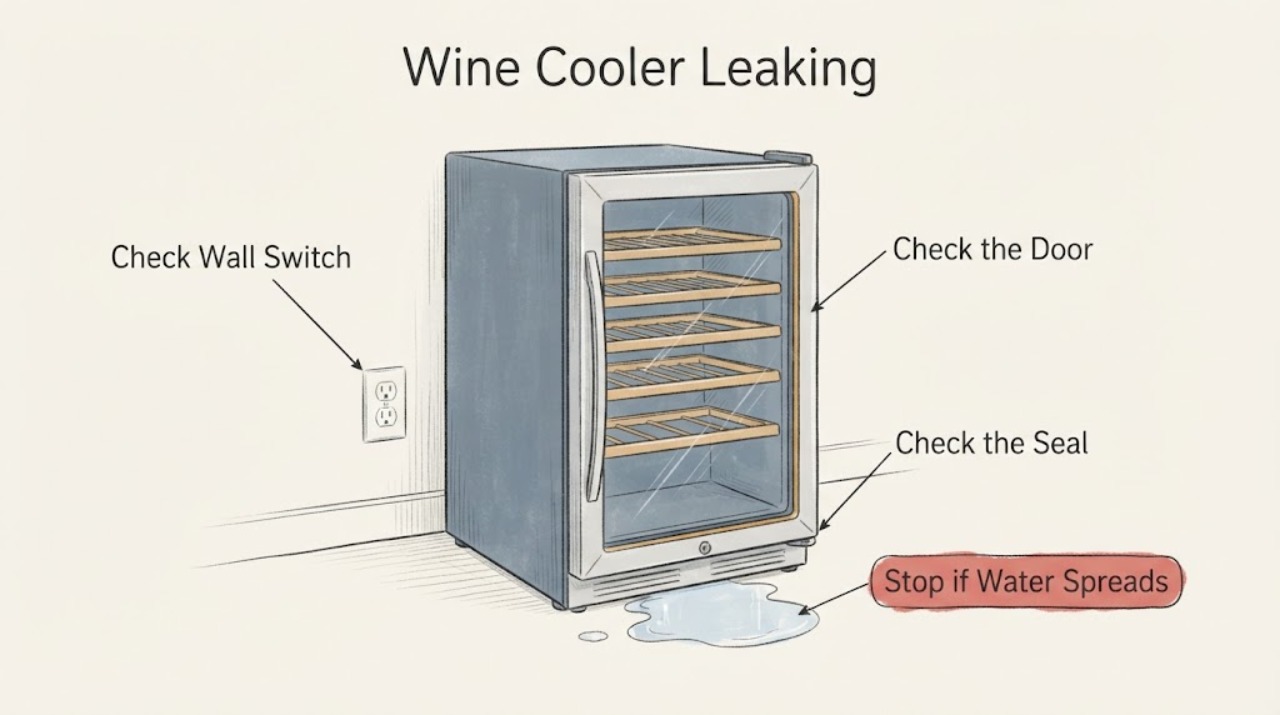
Work through in order
Diagnostic checks
Use only checks that match the exact appliance or system and its official guide.
-
Check 1
Unplug the wine cooler or turn off its power switch if water is near the plug, power cord, display, or electrical compartment; keep hands and the floor dry while doing so.
Expected result: The water is only a small amount on a dry shelf or door frame, or it has reached the cabinet interior, plug, cord, or floor around the unit.
Next step: For water inside the cabinet, around the plug, or a flooded area, leave the wine cooler disconnected and request Samsung service. Do not spray water, use a hair dryer, remove the rear cover, or probe the refrigeration circuit.
Why this matters
Why: Water that has entered the appliance or reached electrical parts is a safety condition, not a routine wipe-down. A small isolated wet spot still needs source identification before the unit is returned to normal use.
-
Check 2
Dry the visible water with a soft cloth, then trace its first location without pulling on the cabinet: inspect the interior wall and door frame, the bottom of the cabinet, the front edge, and the floor directly underneath.
Expected result: The wetness matches a tipped bottle or wipeable spill, beads on the interior wall or frame, or returns from beneath/inside the cabinet after the surface is dry.
Next step: If it is a spill, clean and monitor. If it is wall or frame condensation, continue with the closed-door check. If water reappears at the base, underneath, or from an enclosed panel, stop household diagnosis and arrange service.
Why this matters
Why: A one-time spill does not demonstrate an appliance leak. Beading on an interior wall is consistent with the manual's condensation path, while water that returns from underneath or from inside the cabinet is not explained by that simple check.
-
Check 3
For moisture on the interior walls or door frame, wipe the moisture away, confirm the door closes fully, remove anything preventing the seal from meeting, and keep the door closed while the cabinet returns to normal operation.
Expected result: The moisture stops after the door remains closed, or it continues to form even though the door closes fully and the cabinet is not being opened for long periods.
Next step: If the moisture stops, keep the door closed and monitor it. If it returns as drops or a pool, photograph the location and request model-specific service rather than adjusting refrigerant or removing panels.
Why this matters
Why: Samsung's wine-cellar troubleshooting table links interior-wall condensation to a door left open and says to remove the moisture and avoid leaving the door open. Persistence with a closed door means the symptom is not resolved by that documented check.
-
Check 4
If the water collects on the floor, under the front edge, or behind the wine cooler, inspect only what is visible from outside for a spill, a wet floor, a damaged power cord, or a cabinet that was recently moved; do not tilt the unit or reach beneath it.
Expected result: The floor remains dry after cleanup and the water does not return, or a fresh pool forms again from under the cabinet or a rear area.
Next step: If the pool returns, disconnect power if safe, protect the floor and stored wine, and request Samsung service. Do not puncture insulation, clear a hidden tube with a tool, or open the sealed system.
Why this matters
Why: A dry floor after removing an external spill does not confirm a component failure. Recurrent water from an enclosed base or rear area is outside the user-level condensation check and may involve drainage or the sealed system, which cannot be identified safely without the exact model and service procedure.
-
Check 5
Before service, record the complete model number, where the water first appeared, whether the door had been left open, whether cooling or the display changed, and whether the leak is intermittent or continuous.
Expected result: The model label and a dry photograph or short description show a condensation-only pattern, a one-time spill, or a recurring leak with cooling or electrical symptoms.
Next step: Give Samsung the model number, location and timing of the water, power state, temperature behavior, and any safety symptom. Keep the wine cooler disconnected when water or electrical damage is present.
Why this matters
Why: These observations narrow the service report without assuming a drain, valve, or other part that Samsung has not identified for the specific model. The official support pages route unresolved wine-cooler issues to service.
Use your observations
Decision map
Find the observation that best matches what you see, then follow the next safe action.
-
PATH 01Next step
What you see
The only moisture was a spilled bottle or a one-time wipeable spot, and no water returns after the cabinet and floor are dry.
Do this next
Clean the area and monitor the same locations during normal use; request service if water returns without another spill.
Why this path and its safety boundary
Why it matters: The observed pattern does not establish an appliance leak.
-
PATH 02Next step
What you see
Moisture beads on the interior wall or door frame and stops after the moisture is wiped away and the door stays fully closed.
Do this next
Keep the door closed and continue monitoring. If drops become a pool or reappear with the door closed, arrange service.
Why this path and its safety boundary
Why it matters: This matches Samsung's documented condensation check associated with a door being left open.
-
PATH 03Next step
What you see
Water repeatedly appears under the cabinet, from the rear, inside an enclosed panel, or near the power connection.
Do this next
Disconnect power if safe, avoid moving or disassembling the cooler, and request Samsung service.
Why this path and its safety boundary
Why it matters: The recurrence is not resolved by the documented condensation check and may involve an internal or electrical fault that cannot be diagnosed safely from outside.
-
PATH 04Next step
What you see
There is a damaged cord, burning smell, smoke, a large amount of water inside, flooding, or water on electrical parts.
Do this next
Leave the unit disconnected, keep people away from wet electrical areas, and contact Samsung service; if there is smoke or fire, leave the area and call emergency services.
Why this path and its safety boundary
Why it matters: This is an immediate electrical or appliance safety boundary.
Helpful context
Understand the symptom
A Samsung wine cooler has a refrigerated cabinet and defrost cycle, but it is not a water-dispenser appliance. A wet shelf or door frame can be condensation or a spilled bottle; water that reappears at the base or enters the cabinet needs a different response. Identify where the water first appears before moving the unit or removing panels.
The RW51TS338SR product materials identify a Samsung wine cooler with a sealed refrigeration system, airflow, and a cool-tight door. The owner's troubleshooting table says moisture on the interior walls can follow a door being left open and advises removing the moisture and keeping the door closed. This does not establish that every leak is condensation, so a recurring pool should be treated as unresolved.
Keep the investigation external and dry. Samsung's wine-cellar safety instructions say to disconnect power and contact service when water enters the appliance or it is flooded, and they prohibit spraying water, using a hair dryer, or attempting a self-repair.
Only after diagnosis
Potential parts
- door gasket or door-seal assembly
Consider this only if Samsung or a qualified technician confirms that the exact model's door seal is damaged and is allowing persistent moisture.
Match the complete model number and the manufacturer's parts documentation; do not infer fit from the cabinet's appearance. - drain or sealed-refrigeration service component
A recurring pool from the cabinet or rear area may require an internal diagnosis, but the exact failed component cannot be identified from the symptom alone.
Do not order or install a drain, tubing, refrigerant, or sealed-system part without model-specific service confirmation.
When checks do not resolve it
Need a professional?
Provide the complete Samsung model number, the first location of the water, whether it was condensation or a pool, whether the door had been left open, whether the water returned after drying, and any cooling or electrical symptoms. Keep the appliance disconnected if water reached electrical parts.
Common questions
FAQ
Is a little moisture inside a Samsung wine cooler always a leak?
No. Samsung's wine-cellar troubleshooting table says interior-wall condensation can occur when the door is left open. Wipe it away, close the door fully, and monitor. Water that returns as a pool or comes from under the cabinet needs service evaluation.
What should I do if water is under my Samsung wine cooler?
Dry the floor and confirm it was not a nearby spill. If water returns from under or behind the cabinet, disconnect power if safe and request Samsung service. Do not tilt the unit, remove sealed-system covers, or probe an enclosed drain.
Can I spray water or use a hair dryer to dry the wine cooler?
No. Samsung's safety instructions prohibit spraying water onto the wine cooler and using a hair dryer inside it. Use a soft cloth for accessible moisture, disconnect power for water intrusion, and contact service when the appliance is wet internally.
Should I buy a door gasket or drain part first?
No. A gasket or internal drain component is model-specific, and the symptom alone does not prove which part has failed. Record the model number and water location, then wait for Samsung or a qualified technician to confirm the repair path.
Read the exact guide
Official sources
- Wine Cellar User Manual RW51TS338SR/AASamsung · Official Samsung manual for the RW51TS338SR 51-bottle wine cooler; use the symptom-level condensation and safety guidance only when it matches the appliance and observed symptom.
- RW51TS338SR 51-Bottle Capacity Wine CoolerSamsung · Official Samsung product sheet identifying the RW51TS338SR as a 51-bottle wine cooler with dual temperature zones, airflow, and a sealed refrigeration-system warranty category.
- Samsung Wine Cooler has no powerSamsung · Official Samsung US support page explicitly titled for Samsung Wine Cooler and directs unresolved appliance problems to Samsung support.
Community feedback
Share a repair observation
Share a plain-text repair observation. Accepted observations are published automatically; this page may take a moment to update.