
On this page
Start here
Quick answer
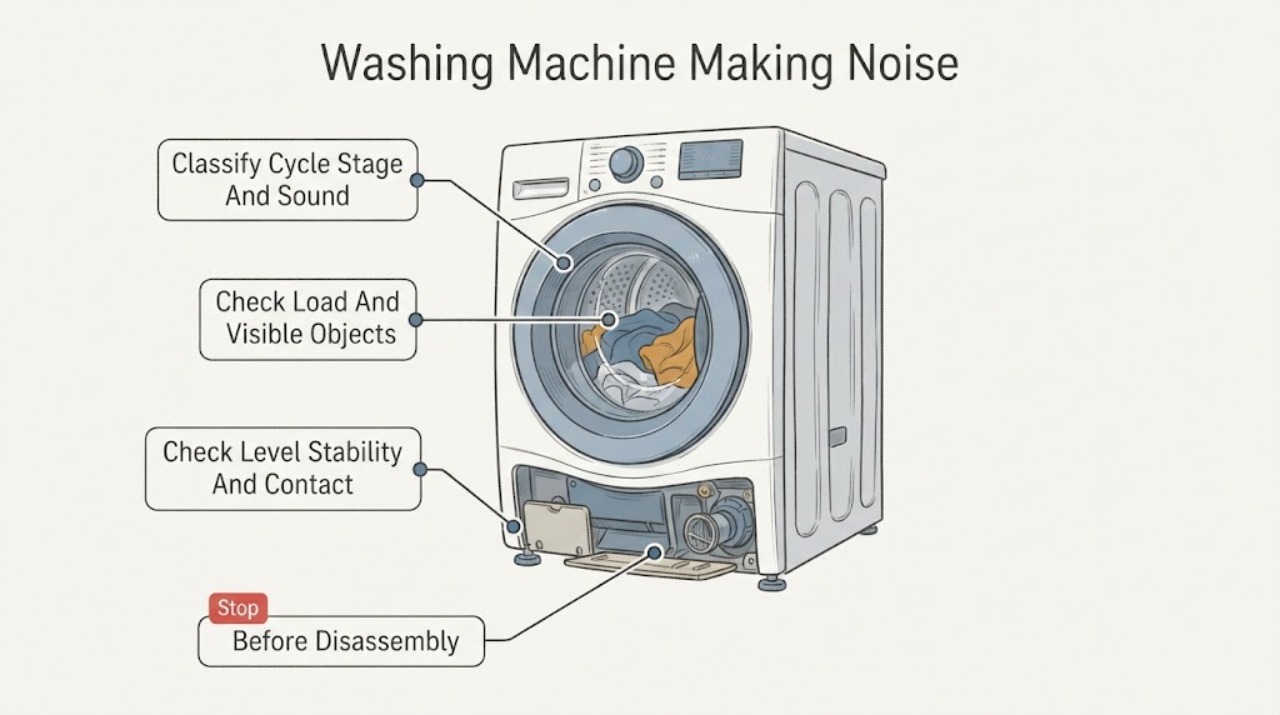
A Hisense washing machine noise is easier to diagnose when you note whether it occurs during filling, washing, draining, or spinning. Hisense support identifies foreign objects, an unstable or unlevel floor, a drain hose touching the cabinet, an unsuitable load, a blocked pump filter, and transport restraints left on a new machine as different noise checks. With the washer stopped and safe to approach, first note the cycle stage, then check the load and visible objects, confirm the washer is stable and not touching nearby items, and inspect only the drain path or pump filter procedure allowed by the exact model manual. Violent movement, metal-on-metal grinding, a leak, burning smell, smoke, sparks, electrical damage, or a repeat breaker trip is a stop-use condition. Do not run repeated tests, reach into a moving drum, tilt the washer, remove panels, or work on energized parts.
Work through in order
Diagnostic checks
Use only checks that match the exact appliance or system and its official guide.
-
Check 1
From a safe position, observe one already-running cycle only long enough to identify when the noise begins: filling, washing or agitation, draining, or spinning. Record whether it sounds like a click, rattle, hum, scrape, squeal, or heavy bang, and then stop the cycle if the sound is severe.
Expected result: The noise is limited to one stage and is repeatable, occurs throughout the cycle, or is accompanied by walking, violent impact, a leak, smoke, burning smell, sparks, or a breaker trip.
Next step: Continue only when the washer is stable, dry, and free of immediate hazards. For violent movement, metal grinding, water near electrics, smoke, burning smell, sparks, or a repeat breaker trip, turn it Off, keep it out of service, and call qualified help.
Stop if: Do not reach into the drum, hold the cabinet while it spins, or run another cycle solely to reproduce a dangerous noise.
Why this matters
Why: A stage-specific pattern narrows the next observation; a severe or hazardous symptom is not a normal diagnostic opportunity. Hisense guidance treats unusual noise as a reason to check installation, load, hose, and pump-filter conditions before arranging service.
-
Check 2
With the cycle Off and the drum stopped, remove laundry only when the door or lid unlocks normally. Check the visible drum, door area, and load for coins, buckles, buttons, zippers, shoes, a single heavy item, an overloaded drum, or a very small load that could strike or unbalance the machine.
Expected result: A foreign object or unsuitable load is visible; the load is distributed normally and no visible object is present; or the door will not unlock, water remains, or the drum does not stop.
Next step: Remove only loose visible objects and redistribute the load according to the exact manual, then use one lower-risk cycle if the washer remains stable. If the drum cannot stop or the door remains locked, do not force it; arrange service.
Stop if: Do not pull against a locked door, reach through a moving drum, or insert tools into the drum or door seal.
Why this matters
Why: Hisense identifies objects striking the drum or door, large textiles, and too much or too little laundry as possible contributors to noise or imbalance. A door that remains locked or a drum that does not stop is a control, water-level, or mechanical safety boundary rather than a loading problem.
-
Check 3
With the washer Off and empty, observe it from the front and sides without tipping it. Check whether it stands level and stable, whether the adjustable feet and lock nuts are secure, whether the floor flexes, and whether the cabinet or a nearby basket, wall, or pipe is being contacted.
Expected result: The cabinet rocks, feet are loose or uneven, the floor is unstable, or an object or wall touches the washer; or the cabinet remains stable with clear space around it.
Next step: If the model manual permits user leveling, adjust the feet on a stable dry floor and secure the lock nuts, then leave clearance from nearby objects. If leveling would require lifting or tilting a heavy washer, request assistance or service.
Stop if: Do not work under a washer, tilt or move it alone, place hands near feet while it can move, or use leveling as a remedy for grinding, leaks, or electrical symptoms.
Why this matters
Why: Hisense says incorrect leveling can cause vibration, sliding, and loud operation, and that contact with the surrounding area can transmit noise. A stable, isolated cabinet makes an installation cause less likely but does not rule out an internal fault.
-
Check 4
If the noise began on the first cycles after installation or relocation, compare the rear installation to the exact Hisense manual and confirm from a safe view whether the specified transport bolts or bars were removed. Do not move the washer to reach them.
Expected result: The washer is newly installed or relocated and transport restraints may still be fitted; or the manual and installation record confirm they were removed.
Next step: If the restraint status is uncertain, stop using the washer and have the installer or qualified service provider verify it using the exact model procedure. If the restraints are confirmed removed, continue to the drain and pump-path check.
Stop if: Do not remove bolts by guesswork, reach behind the washer, or pull the appliance forward to inspect a gas, water, or electrical connection.
Why this matters
Why: Hisense support warns that a new washer can bang when transport protection remains installed and directs owners to the manual for removal. A machine that has already been used or moved can still have an installation issue, but the restraint must not be guessed from a generic diagram.
-
Check 5
If the noise occurs during draining or the washer leaves water behind, turn the appliance Off and follow the exact model manual before checking the visible drain hose route or user-accessible pump-filter area. Keep a shallow container and towels ready only if the manual describes that access, and do not remove a filter while water is hot or the drum is moving.
Expected result: The drain hose is pinched or touching the cabinet, the filter area contains a visible foreign object, draining is normal with no debris, or access is unclear and water remains.
Next step: Correct only an accessible hose position or remove only the debris procedure explicitly allowed by the model manual. If the noise remains, water does not drain, the filter will not release, or a leak appears, stop and arrange service.
Stop if: Do not reach into the pump, remove panels, force a filter, place hands in standing water near a connected appliance, or run the washer with a leaking drain path.
Why this matters
Why: Hisense support identifies a drain hose touching the cabinet and foreign objects in the pump filter as noise or drainage checks. A blocked path can create a stage-specific hum or rattle, but unclear access, trapped water, or a suspected pump fault needs model-specific service.
-
Check 6
After the load, stability, installation, and accessible drain checks are complete, run one short, low-risk confirmation cycle only if the washer is dry, stable, and free of visible damage. Observe from outside the moving area and stop if the original noise returns.
Expected result: The noise disappears, returns only at the same stage, becomes louder or changes to metal scraping, or the washer begins to walk, leak, overheat, spark, or trip the breaker.
Next step: If the sound returns, record the stage, sound, load, and visible movement and arrange Hisense or qualified appliance service. Do not keep running cycles to obtain a more dramatic failure.
Stop if: Stop immediately for violent impact, metal-on-metal grinding, a leak, burning smell, smoke, sparks, hot electrical odor, or a repeat breaker trip.
Why this matters
Why: A quiet confirmation after correcting a load or installation issue supports that user-level cause, while a repeat stage-specific noise or any worsening symptom requires professional diagnosis of suspension, drum, motor, pump, or control components.
Use your observations
Decision map
Find the observation that best matches what you see, then follow the next safe action.
-
PATH 01Next step
What you see
The noise occurs only while water enters the washer.
Do this next
Note whether it is a brief click or a harsh vibration, check for cabinet or hose contact from a safe position, and use the exact model manual for inlet and installation guidance. Escalate for repeated harsh noise, leaks, or electrical symptoms.
-
PATH 02Next step
What you see
The noise occurs during washing or agitation and changes with the load or drum contents.
Do this next
Stop and inspect the visible load and drum area for loose objects or an unsuitable load. If the drum scrapes when empty or the noise persists with a normal load, arrange service.
-
PATH 03Next step
What you see
The noise occurs during draining or water remains in the washer.
Do this next
Check the visible drain hose route and the model-approved pump-filter procedure. Do not force access; arrange service for trapped water, a leaking hose, a locked filter, or persistent noise.
-
PATH 04Next step
What you see
The noise is a heavy bang or vibration during spin and the cabinet moves or the load collects to one side.
Do this next
Stop the cycle, redistribute the load when safe, and check level, feet, lock nuts, floor stability, and nearby contact. If it still walks or bangs, keep it out of service.
-
PATH 05Next step
What you see
The washer is new or was recently moved and the noise began immediately afterward.
Do this next
Have the exact model installation instructions used to verify transport restraints, leveling, and clearance. Do not move the appliance yourself to inspect connections.
-
PATH 06Next step
What you see
The noise is metal-on-metal, violent, worsening, or accompanied by a leak, burning smell, smoke, sparks, water near electrics, or a repeat breaker trip.
Do this next
Turn the washer Off, keep people away, and arrange qualified appliance or electrical service. Do not run another confirmation cycle.
Helpful context
Understand the symptom
The cycle stage changes the next check
A brief valve or motor sound during one stage is not diagnosed the same way as a repeated bang during spin. Watch from a safe position and write down whether the noise begins during filling, agitation or washing, draining, or high-speed spin. Also record whether it is a click, rattle, scrape, hum, squeal, or a heavy bang. The timing and sound quality are observations for the service decision, not permission to open the washer.
Hisense's own checks focus on installation and accessible causes
Hisense washing-machine support calls out objects that strike the drum or door, an unstable or flexible floor, incorrectly adjusted feet, a drain hose touching the cabinet, items pressing against the housing, an unsuitable load, and debris in the pump filter. For a new installation, it also says to check that transport restraints were removed according to the model manual. These checks can separate a load or installation issue from a service fault without diagnosing internal bearings, motor electronics, or suspension parts by guesswork.
Stop when noise becomes a safety symptom
A washer that walks, bangs violently, leaks, smells of overheated material, sparks, trips the breaker, or produces metal-on-metal grinding should not be kept in service to collect more evidence. Turn it off, keep people away from moving or wet parts, and arrange qualified service. If water is near electrical equipment, do not touch the appliance while it remains connected.
Safety boundary
Stop conditions
- Stop using the washer for violent banging, cabinet movement that cannot be controlled, metal-on-metal scraping, a leak, water near electrical equipment, burning smell, smoke, sparks, a damaged cord or plug, overheating, or a breaker that trips again. Do not reach into a moving drum, force a locked door or filter, tilt or move the appliance alone, remove panels or transport restraints by guesswork, or work on energized wiring.
When checks do not resolve it
Need a professional?
Arrange Hisense or qualified appliance service when the noise remains after the exact model's accessible load, leveling, clearance, installation, and drain checks; when the source is inside the cabinet or drum; when transport restraints are uncertain; or when the washer leaks, walks, grinds, overheats, sparks, or trips power.
Common questions
FAQ
Why does my Hisense washer make noise only during spin?
Spin-only noise points first to load distribution, level and stability, loose feet or lock nuts, a flexible floor, or cabinet contact. Stop if the washer walks or bangs violently; redistribute the load only when the drum is stopped, then use the exact model installation instructions or service route.
Could a coin or other object cause a Hisense washing-machine noise?
Yes. Hisense support specifically recommends checking for foreign objects that strike the drum or door and for objects in the pump-filter area. Stop the washer before any user-level inspection, and do not force the door or reach into a moving drum.
What should I do if a new Hisense washer bangs?
Have the exact model installation instructions used to verify that transport restraints were removed and that the washer is level and stable. Do not move the appliance yourself to inspect its connections; ask the installer or a qualified service provider when restraint status is uncertain.
Read the exact guide
Official sources
- Hisense HWFS8514E and HWFS1015E Washing Machine User ManualHisense Australia Pty Ltd. · Hisense HWFS8514E and HWFS1015E front-loading washing machines; installation and noise guidance is model-specific
- De wasmachine maakt een vreemd geluidHisense Support · Hisense washing-machine unusual-noise support guidance
Community feedback
Share a repair observation
Share a plain-text repair observation. Accepted observations are published automatically; this page may take a moment to update.