
On this page
Start here
Quick answer
First locate the frost and identify the exact Hitachi model and defrost architecture. Frost on frozen food or freezer walls after frequent or prolonged door opening, high humidity, a trapped package, or a dirty or distorted gasket usually points to humid air entering; frost around an air channel can also be worsened by blocked airflow. Hitachi explains that some larger forced-air refrigerators automatically defrost the concealed cooler, while smaller direct-cool models may require manual defrosting according to their manual. Check the door closes fully, move food away from vents and the door seal, and wipe accessible frost only as the model instructions allow. Do not chip ice with a sharp object, use a heater or hair dryer, open sealed panels, or attempt a live electrical test. If thick frost returns after a complete model-approved defrost, covers vents, affects cooling, or is accompanied by water, abnormal noise, smoke, or a damaged gasket, stop and arrange qualified service.
Before you begin
Safety first
- This article covers model identification, frost mapping, door and gasket observation, normal loading, accessible airflow, and model-approved defrost guidance. Do not chip ice, puncture the liner, use heaters or electrical appliances inside the cabinet, remove sealed panels, test live wiring, or work on refrigerant or internal defrost parts.
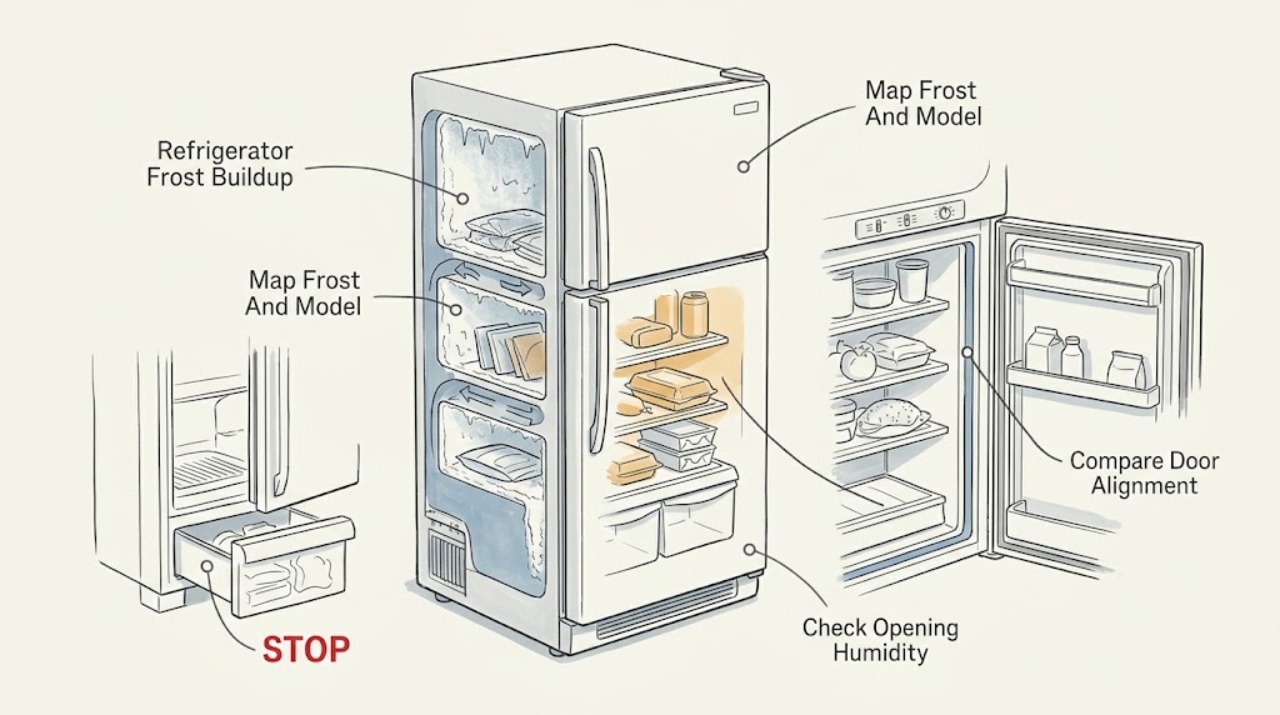
Work through in order
Diagnostic checks
Use only checks that match the exact appliance or system and its official guide.
-
Check 1
Record the complete Hitachi model and map where frost is visible: freezer wall, frozen food, door edge or gasket, rear air channel, refrigerator compartment, or a concealed area that cannot be reached safely. Note whether it is a light patch or a rapidly returning sheet.
Expected result: Frost is localized near the door, spread over food and walls, concentrated at a vent, limited to a small direct-cool evaporator, or recurring throughout an automatic-defrost cabinet.
Next step: Use the matching branch below and the exact Hitachi manual. Do not remove an internal cover to identify the evaporator or heater.
Stop if: Stop if frost is hiding damaged wiring, water is near electrical parts, the cord is damaged, or the compartment cannot be closed safely.
Why this matters
Why: Location separates humid-air entry and loading problems from an architecture-specific defrost or airflow problem. The exact model determines whether owner defrosting is expected.
-
Check 2
Inspect the closed door from the outside for a trapped package, overfilled shelf or drawer, a gasket that is dirty or pulled out of its groove, and an uneven gap. Wipe the accessible gasket with a soft, well-wrung cloth and remove only an obvious obstruction.
Expected result: The door closes on food or a bag, the gasket is dirty or displaced, the seal is visibly torn or warped, or the door closes evenly with no visible gap.
Next step: Reposition the item, seat only a gasket that is plainly loose and the manual allows you to reseat, then observe whether the frost stops returning. Arrange service for a torn gasket, persistent gap, or door that needs force.
Stop if: Do not heat, glue, stretch, or remove the gasket, adjust hinges, or force a warped door into alignment.
Why this matters
Why: A closure gap admits humid air and is a common frost trigger. A damaged gasket or hinge alignment is not the same as a loading mistake and may need replacement or service.
-
Check 3
For the next normal use period, minimize unnecessary or prolonged door opening and note whether frost began after humid weather, a large loading event, or uncovered liquid or warm food was added. Keep containers covered and dry accessible moisture.
Expected result: Frost is thin and follows heavy use or humid conditions, or it continues to build quickly despite normal short openings and covered food.
Next step: Correct the moisture source and monitor the same location. If frost rapidly returns or cooling changes, continue to the airflow and service branches rather than repeatedly scraping it.
Stop if: Do not leave the door open to accelerate an unknown defrost, use an electrical heater inside the cabinet, or keep food in an unsafe temperature condition.
Why this matters
Why: Humid air and evaporating liquid can create temporary frost; rapid recurrence under ordinary use makes a sealing, airflow, or defrost issue more likely.
-
Check 4
Look at the model's accessible air outlets and rear-wall clearance without removing panels. Move packages away from vents, avoid pressing food against the liner, and confirm drawers and shelves close fully.
Expected result: Food blocks a vent or rear channel, a drawer cannot close, frost is concentrated around one outlet, or airflow paths are clear.
Next step: Rearrange the load and allow the refrigerator to stabilize according to the manual. If the same vent ices over again or cooling is poor, arrange qualified service.
Stop if: Do not insert tools into vents, remove the rear liner, or test a fan with the appliance energized.
Why this matters
Why: Blocked airflow can create local cold spots and frost while making the compartment temperature uneven. Clear paths with normal loading do not rule out a concealed fan or defrost fault if the frost persists.
-
Check 5
Check the exact Hitachi manual to determine whether the cabinet is direct-cool/manual-defrost or automatic-defrost. Only if manual defrost is explicitly documented, follow that procedure with the appliance stopped, food removed, meltwater contained, and the compartment dried before restart.
Expected result: The manual documents owner defrosting, the manual says the model automatically defrosts, or the model identity and defrost type are unknown.
Next step: Perform only the exact manual's user procedure. If the type is unknown or frost returns after the documented defrost, stop repeating the process and arrange model-specific service.
Stop if: Never chip frost, puncture the liner, use a knife, heat gun, hair dryer, or electrical appliance inside the cabinet, or open sealed refrigeration panels.
Why this matters
Why: Hitachi's defrost instructions differ by cooling method. A manual-defrost cabinet may need a complete safe defrost, whereas recurring frost in an automatic model points toward a service diagnosis.
-
Check 6
After correcting the visible door, moisture, and loading conditions and completing any model-approved defrost, document how quickly frost returns, whether cooling is affected, and whether the fan, drain, or cabinet makes an abnormal sound. Do not open sealed panels or perform live tests.
Expected result: Frost returns rapidly, forms a solid sheet, blocks airflow, appears in an automatic-defrost cabinet, or is accompanied by water, poor cooling, smoke, burning odor, sparking, or repeated breaker activity.
Next step: Arrange qualified Hitachi refrigerator service and provide the model, frost location, return time, door-seal findings, and cooling symptoms. Stop the appliance and use qualified electrical service for an electrical hazard.
Stop if: Stop immediately for smoke, burning odor, sparking, water near electrical parts, a hot plug or outlet, damaged cord, or repeated breaker trips. Do not continue operation while removing covers.
Why this matters
Why: A recurring pattern can involve a concealed evaporator, defrost heater or sensor, fan, drain, control, refrigerant circuit, or a damaged seal. A safety hazard overrides frost troubleshooting.
Use your observations
Decision map
Find the observation that best matches what you see, then follow the next safe action.
-
PATH 01Safety boundary
What you see
Frost follows frequent or long openings, humid weather, a trapped package, an overfilled drawer, or a dirty, displaced, or damaged gasket.
Do this next
Correct the accessible obstruction or clean the gasket, keep openings brief, and monitor the same area. Arrange service if the seal remains damaged or frost returns quickly.
Why this path and its safety boundary
Why it matters: Humid air entering through a closure gap is more likely than an internal defrost failure.
Safety stop: Do not heat, stretch, glue, or remove the gasket, and do not force the door closed.
-
PATH 02Safety boundary
What you see
Frost is concentrated around a vent or rear wall and food, drawers, or containers are obstructing the documented airflow path.
Do this next
Move food away from outlets and confirm drawers close fully, then allow the model to stabilize. Escalate if the vent ices again with clear paths.
Why this path and its safety boundary
Why it matters: Loading and airflow restriction are more likely than a universal need for a replacement fan or sensor.
Safety stop: Do not insert tools into vents or remove the liner to inspect a fan.
-
PATH 03Safety boundary
What you see
The exact manual identifies a direct-cool or manual-defrost cabinet and frost is on the accessible cooling surface or inner wall.
Do this next
Follow the exact manual's stopped-appliance defrost, meltwater collection, drying, and restart steps. Arrange service if the frost returns unusually soon or the procedure is unclear.
Why this path and its safety boundary
Why it matters: Periodic manual defrost may be normal for this architecture; continuing operation with a thick ice layer reduces cooling performance.
Safety stop: Do not scrape, puncture, accelerate defrost with heat, or use an electrical appliance inside the refrigerator.
-
PATH 04Safety boundary
What you see
The model uses automatic forced-air defrost and thick frost returns after door, humidity, load, and model-approved checks.
Do this next
Keep the cabinet closed as much as practical and arrange qualified Hitachi service with the return pattern and cooling observations.
Why this path and its safety boundary
Why it matters: A concealed defrost, airflow, drain, sensor, control, or refrigeration issue is more likely than normal surface moisture.
Safety stop: Do not remove internal covers, test live parts, add a heater, or keep operating if frost blocks cooling or a hazard appears.
-
PATH 05Safety boundary
What you see
Meltwater reaches electrical parts, the cord or outlet is hot or damaged, smoke or burning odor appears, sparking occurs, or the breaker trips.
Do this next
Stop using the refrigerator and isolate power only from a safe accessible point; arrange qualified appliance or electrical service.
Why this path and its safety boundary
Why it matters: This is an electrical or appliance safety event, not a routine frost-removal task.
Safety stop: Do not touch wet electrical parts, repeatedly reset the breaker, open panels, or use a heat source to melt ice.
Helpful context
Understand the symptom
Identify where frost is forming before defrosting
A thin patch on a freezer wall, frost on food, ice around an air channel, and a refrigerator compartment covered in frost are not the same pattern. Record the exact model and whether the frost returns after wiping or a full model-approved defrost. Hitachi's support material also distinguishes automatic forced-air cooling from direct-cool designs, so do not assume that every Hitachi cabinet uses the same defrost cycle.
Start with air entering through the door
Frequent or long openings introduce humid air that can freeze on cold surfaces. A package caught between the door and frame, an overfilled drawer, or a gasket that is dirty, lifted, warped, or damaged can leave a gap even when the door alarm is silent. Remove only an obvious obstruction, clean the accessible seal with a soft cloth, and check that the door closes evenly without force.
Protect the cold-air path
Food pressed against vents or packed tightly around the rear wall can create local temperature differences and let frost accumulate around an air channel. Keep packages inside the shelf or drawer boundaries and leave the model's vents unobstructed. Frost concentrated at one vent is a reason to check loading and the door seal first; it is not proof that an internal fan or sensor should be replaced.
Use the correct defrost boundary
Hitachi explains that some forced-air refrigerators automatically defrost the concealed cooler, while small direct-cool refrigerators may need manual defrosting. If the exact manual calls for owner defrosting, remove food, stop the appliance as instructed, collect meltwater, and dry the compartment before restarting. If the manual describes automatic defrost, do not remove covers or try to heat the evaporator; recurring thick frost needs model-specific service.
Separate normal moisture from a recurring cooling fault
A small amount of frost after humid weather or an extended door opening may clear after the cause is corrected. Frost that rapidly returns, forms a solid sheet, blocks a vent, or appears with poor cooling is different. On an automatic-defrost model, that pattern can involve a concealed defrost, fan, drain, sensor, or control problem and requires qualified diagnosis rather than a generic part.
When checks do not resolve it
Need a professional?
Arrange qualified Hitachi refrigerator service when frost returns rapidly after a complete model-approved defrost, forms in an automatic-defrost cabinet, blocks vents or cooling, or follows a damaged gasket or door that cannot close correctly. Internal fan, drain, defrost, sensor, control, sealed-system, and refrigerant work is not an ordinary user repair. Stop immediately for smoke, burning odor, sparking, water near electrical parts, a hot or damaged connection, or repeated breaker trips.
Safety scope: This article covers model identification, frost mapping, door and gasket observation, normal loading, accessible airflow, and model-approved defrost guidance. Do not chip ice, puncture the liner, use heaters or electrical appliances inside the cabinet, remove sealed panels, test live wiring, or work on refrigerant or internal defrost parts.
Common questions
FAQ
Why does my Hitachi freezer keep building up frost?
Check for frequent or long door openings, a package preventing closure, overloading, and a dirty, distorted, or damaged gasket. If the frost rapidly returns after those conditions are corrected, use the exact model's defrost instructions and arrange service if it persists.
Do all Hitachi refrigerators defrost automatically?
No. Hitachi distinguishes forced-air models that automatically defrost the concealed cooler from smaller direct-cool models that may require manual defrosting. Check the exact model manual before choosing a defrost procedure.
Can I scrape frost off a Hitachi refrigerator with a knife?
No. A sharp tool can damage the liner or concealed refrigeration circuit. Follow only the model's documented defrost procedure and do not use a heater, hair dryer, or electrical appliance inside the cabinet.
Why is frost concentrated around one Hitachi freezer vent?
First move food away from the vent and rear wall and confirm the door and gasket seal fully. If the same area ices over again with clear airflow, an internal airflow or defrost issue needs model-specific service.
Read the exact guide
Official sources
- Hitachi Refrigerator Support FAQsArçelik Hitachi Home Appliances Sales Middle East · Hitachi refrigerator support for the regional product range; exact settings and components vary by model.
- Should frost inside a refrigerator be removed?Hitachi Appliances Japan · Hitachi refrigerator support guidance; the exact procedure depends on the cabinet's cooling method and model manual.
- Frost forms inside the freezer or on frozen foodHitachi Appliances Japan · Hitachi refrigerator freezer support guidance; the page is not a substitute for a model-specific repair manual.
- Hitachi Multi-Door Refrigerator Instruction Manual R-G420KHHitachi Home Appliances · R-G420KH model; safety warnings are cited for boundaries and must not be treated as universal operating instructions.
Community feedback
Share a repair observation
Share a plain-text repair observation. Accepted observations are published automatically; this page may take a moment to update.