
On this page
Start here
Quick answer
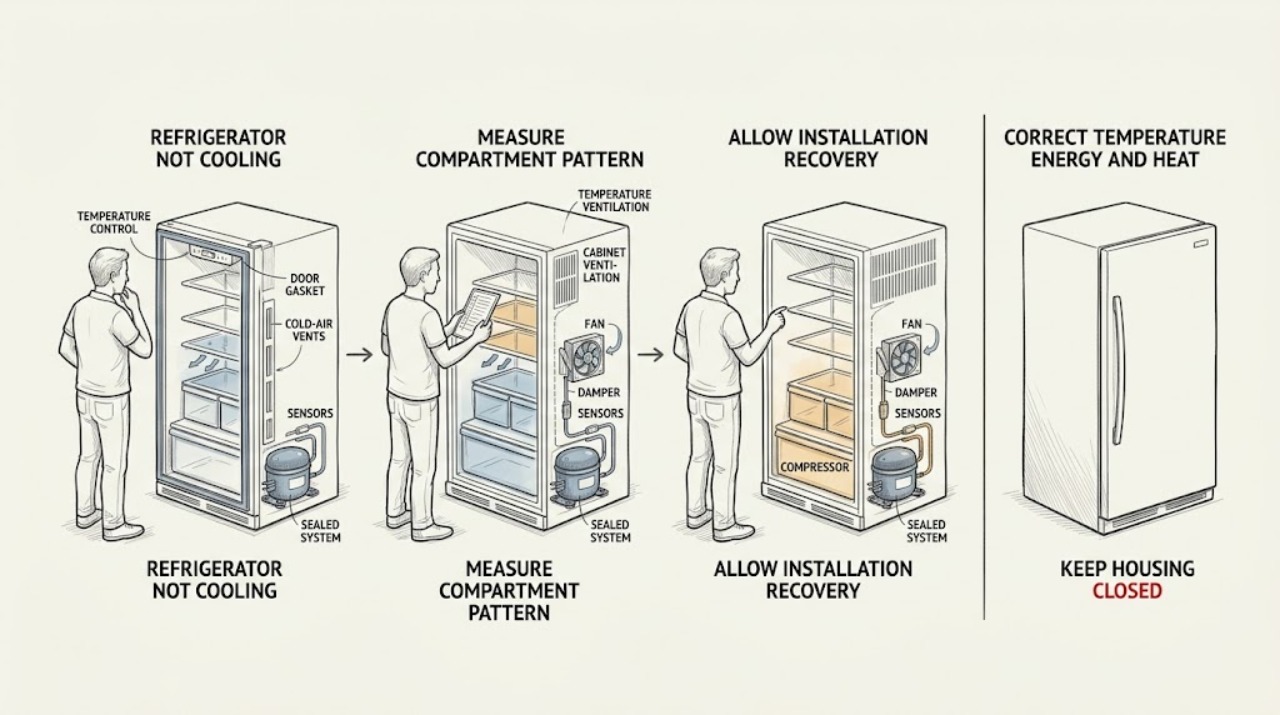
Start by deciding whether the whole appliance is warm, the refrigerator compartment is warm while the freezer is cold, or the unit is newly installed and still pulling down temperature. Hitachi's official refrigerator support pages direct owners to check the temperature setting, deactivate Energy Saving when applicable, fully close the door, leave space in front of rear cold-air vents, avoid direct sunlight and heat sources, and reduce excessive door opening. They also warn that layouts and required ventilation space vary by model. If the freezer is cold but the refrigerator compartment remains warm after those checks, Hitachi lists a damper, sensor, or PCB issue as possible and recommends service rather than a guessed part. A new refrigerator may take roughly 4–24 hours to cool according to Hitachi support, but use the exact manual for your model. Protect food and stop immediately for a burning odor, smoke, sparks, water near electrical parts, a hot or damaged cord or outlet, or repeated breaker trips; do not remove panels or work on the compressor or refrigerant circuit.
Before you begin
Safety first
- The owner may identify the model, measure temperatures, check documented controls, clear accessible loading obstructions, and inspect visible door closure and vents. Qualified personnel must handle panels, fans, dampers, sensors, control boards, wiring, compressors, refrigerant, defrost components, and live diagnosis.
Work through in order
Diagnostic checks
Use only checks that match the exact appliance or system and its official guide.
-
Check 1
Measure or otherwise compare the refrigerator and freezer compartments, and record whether the unit is newly installed, recently moved, recovering from an outage, or loaded with warm food. Note any display, alarm, compressor, or fan response without opening panels.
Expected result: Both compartments are warm; the freezer is cold but the refrigerator section is warm; only one shelf is affected; or the appliance has just been installed or restarted.
Next step: Use the corresponding branch below and protect food if temperatures are unsafe. Do not call a cold-freezer/warm-refrigerator symptom a compressor failure before checking the external air path.
Stop if: Stop for smoke, sparks, burning odor, water near electrical parts, a hot or damaged cord or outlet, or repeated breaker trips.
Why this matters
Why: Whole-appliance warming points first to power, settings, heat load, ventilation, or a broad cooling fault. A cold freezer with a warm refrigerator section points toward that compartment's setting, door seal, airflow path, damper, sensor, or control. A recent installation or restart may simply require recovery time.
-
Check 2
If the refrigerator is new, has been unplugged, or has received a large warm load, keep doors closed as much as practical and allow the exact manual's initial-cooling or recovery period. Keep food spaced while monitoring both compartments.
Expected result: Cooling improves during the recovery period; the unit remains warm after the period; doors are being opened frequently; or food temperatures cannot be kept safe.
Next step: Hitachi support describes about 4–24 hours after installation for some markets and models; use the matching manual rather than applying that range universally. Continue with setting and airflow checks if recovery is inadequate.
Stop if: Do not leave perishable food in an unsafe compartment simply to complete a waiting period, and do not restart repeatedly to force cooling.
Why this matters
Why: Improvement supports a temporary heat load or initial pull-down condition. No improvement after the model's period makes settings, airflow, installation, or a fault more likely. Unsafe food temperature overrides waiting.
-
Check 3
Using the exact Hitachi manual, verify the refrigerator temperature setting and check whether an Energy Saving or other reduced-cooling mode is active. Inspect the external location for direct sun, nearby cooking heat, a covered cabinet top, or inadequate clearance; correct only accessible placement conditions.
Expected result: The setting is warmer than intended; Energy Saving is active; the cabinet is exposed to heat or lacks the model's clearance; or settings and location are already appropriate.
Next step: Apply only the documented setting or mode change and allow stabilization. Move or ventilate the appliance only if it can be done safely without stressing the cord or water connections; otherwise arrange service.
Stop if: Do not cover ventilation areas, use an extension or improvised supply, move a loaded refrigerator, or access compressor or wiring compartments.
Why this matters
Why: A setting or environmental heat load can reduce cooling without a failed part. A correct setting and suitable location make airflow, door closure, sensing, damper, fan, or cooling-system faults more likely.
-
Check 4
Remove accessible packages that stop a door or drawer from closing, check the gasket perimeter for gaps or damage, and leave space in front of rear cold-air outlets. Do not remove a vent, shelf support, fan cover, or damper. Reduce prolonged or repeated door opening while the refrigerator stabilizes.
Expected result: A door was ajar; the gasket has a gap or damage; food blocks a rear outlet; the cabinet is overcrowded; or closure and airflow are normal.
Next step: Correct a safe obstruction, close the door, and monitor the same compartments. If a gasket, hinge, fan, damper, or duct needs adjustment or access, schedule model-specific service.
Stop if: Do not stretch, heat, glue, or remove the gasket; do not pry ice, reach into a fan, or dismantle the cold-air path.
Why this matters
Why: An incomplete seal or blocked vent can explain poor circulation and a warm compartment. If closure and the visible airflow path are normal, persistent warming is less likely to be a simple loading issue.
-
Check 5
After the model-appropriate stabilization period and external checks, record the compartment pattern, temperature settings, mode indicators, door and gasket condition, vent clearance, installation environment, frost, unusual sounds, and any error indication. Do not recreate an intermittent or hazardous fault.
Expected result: Cooling returns; the freezer remains cold while the refrigerator compartment stays warm; both compartments remain warm; a code appears; or frost, leak, electrical odor, heat, or repeated trips are present.
Next step: Arrange authorized or qualified Hitachi appliance service and provide the model, measurements, timing, and observations. Use electrical service for a household supply hazard; keep the appliance off when continued operation is unsafe.
Stop if: Do not remove panels, bypass a sensor or damper, test live wiring, handle refrigerant, or continue operation with smoke, sparks, burning odor, water near electrical parts, a hot cord or outlet, or repeated breaker trips.
Why this matters
Why: A restored result supports an external setting, heat, closure, airflow, or recovery condition. Persistent cold-freezer/warm-refrigerator symptoms make damper, sensor, fan, or PCB service more plausible; broad warming or a hazard requires a wider professional diagnosis.
Use your observations
Decision map
Find the observation that best matches what you see, then follow the next safe action.
-
PATH 01Safety boundary
What you see
The Hitachi refrigerator was installed, moved, unplugged, or loaded with a large amount of warm food recently, and both compartments are gradually getting colder without a hazard.
Do this next
Keep doors closed as much as practical, leave spaces between items, and use the exact manual's recovery guidance. Hitachi support gives about 4–24 hours for some newly installed units, not a universal guarantee.
Why this path and its safety boundary
Why it matters: Initial pull-down or recovery is more likely than an immediate component failure.
Safety stop: Protect or relocate perishable food if safe temperatures cannot be maintained; arrange service if the model's recovery period passes without cooling.
-
PATH 02Safety boundary
What you see
Both compartments are warm, the temperature setting is appropriate, and the cabinet is exposed to direct sun, a heat source, blocked vents, overcrowding, or insufficient model-required clearance.
Do this next
Remove accessible blockage, restore safe ventilation and spacing, reduce door opening, and allow stabilization. Use the exact manual for clearance requirements.
Why this path and its safety boundary
Why it matters: Environmental heat load or restricted air circulation is more likely than a refrigerator-compartment-only damper fault.
Safety stop: Do not move a loaded or connected unit unsafely, cover the top or vents, or access the compressor compartment.
-
PATH 03Safety boundary
What you see
The freezer is cold but the refrigerator compartment is warm, with the temperature setting, Energy Saving state, door closure, gasket, and visible rear vent clearance checked.
Do this next
Arrange model-specific service if the refrigerator compartment does not recover after the manual's stabilization period. Provide the exact temperature pattern and control observations.
Why this path and its safety boundary
Why it matters: A compartment-specific airflow or control problem is more likely. Hitachi specifically lists a damper, sensor, or PCB issue as possible, but the symptom does not identify which one.
Safety stop: Do not remove the damper or fan cover, bypass a sensor, or order a part based only on this symptom.
-
PATH 04Safety boundary
What you see
Warmth is accompanied by a package preventing full closure, a visible gasket gap, overcrowding, or food directly blocking a rear cold-air outlet.
Do this next
Remove only the accessible obstruction, close the door fully, keep the vent path open, and monitor. Arrange service for gasket, hinge, duct, or fan work.
Why this path and its safety boundary
Why it matters: A closure or circulation condition is more likely than a failed sealed system, although a damaged gasket or inaccessible blockage still needs service.
Safety stop: Do not reshape or remove the gasket, pry ice, dismantle a vent, or continue if water or electrical damage is present.
-
PATH 05Safety boundary
What you see
Both compartments remain warm after the model-specific checks, or warming is accompanied by heavy frost, abnormal cycling, an error indication, smoke, sparks, burning odor, water near electrical parts, a hot cord or outlet, or repeated breaker trips.
Do this next
Stop using the refrigerator, protect food, and obtain qualified Hitachi appliance service; obtain electrical service for a household supply hazard. Disconnect power only when safe.
Why this path and its safety boundary
Why it matters: The condition exceeds owner-level adjustment and may involve fan, defrost, controls, compressor, sealed cooling, or an electrical fault.
Safety stop: Do not reconnect to reproduce the fault, repeatedly reset protection, remove panels, test live wiring, or handle refrigerant.
Helpful context
Understand the symptom
Separate whole-appliance warming from a refrigerator-compartment problem
Check a glass of water or a refrigerator thermometer in each compartment rather than relying only on a display or the feel of one item. If both compartments are warm, begin with power, temperature, installation heat, airflow, and door-opening conditions. If the freezer is cold but the refrigerator compartment is warm, focus on the refrigerator setting, Energy Saving state, door seal, rear vents, and the air path between compartments. Hitachi's support identifies damper, sensor, and PCB faults only as possibilities after these external checks, not as a diagnosis from the symptom alone.
Give a new or recently moved refrigerator time
After installation, a large warm load, or a long power interruption, cooling is not instantaneous. Hitachi support describes approximately 4–24 hours for a newly installed refrigerator to become fully cool, with longer recovery when there is a lot of food or frequent door opening. Keep the doors closed as much as practical and leave spaces between items while the model's manual-defined recovery period runs. Do not use that range as a promise for every model or as a reason to ignore unsafe food temperatures.
Restore airflow and reduce heat load
Do not pack food against the rear cold-air outlets or block the circulation path with containers. Check that the cabinet has the model's required top, rear, and side clearance, that nothing covers the top, and that the appliance is away from direct sun and cooking heat. Hitachi explains that blocked vents reduce cooling performance and that clearance requirements differ between models. Correct only an accessible loading or placement issue; do not remove a fan cover or duct to improve airflow.
Check closure, gasket, and model controls
Look around the door edge for a package or drawer preventing full closure, then inspect the gasket for a visible gap, dirt, or damage without removing it. Confirm the compartment temperature setting and, where the model provides it, turn off Energy Saving only as the manual directs. A touch controller, a dial, a dual-sensor layout, and a special mode are not interchangeable across Hitachi families. If the display shows an error or cannot be matched to the manual, record it and use service rather than guessing a reset.
Know when airflow checks have ended
If the freezer is cold but the refrigerator compartment stays warm after a closed-door recovery period, a blocked or failed air path, damper, fan, sensor, PCB, or other cooling control becomes more plausible. Hitachi support specifically names damper, sensor, and PCB issues for this pattern and directs owners to service. A refrigerator that remains warm in both compartments, cycles abnormally, or develops heavy frost also needs model-specific diagnosis. Protect food and keep the cabinet closed; do not test live wiring, compressor terminals, refrigerant, or control boards.
Safety boundary
Stop conditions
- Stop and disconnect power only when safe for smoke, sparks, burning odor, a hot or damaged cord or outlet, water near electrical parts, or repeated breaker trips.
- Do not repeatedly reset a breaker, reconnect an appliance that trips protection, or bypass a household or refrigerator safety device.
- Do not remove panels, defeat a door switch, bypass a sensor or damper, perform live electrical tests, handle refrigerant, or work on compressor terminals.
- Use only the exact Hitachi model manual for temperature ranges, Energy Saving or special-mode controls, clearance, recovery time, and error-code interpretation; do not combine instructions from different markets or series.
- Protect or relocate perishable food when either compartment is unsafe, unstable, or outside the model's guidance; do not wait for cooling while food is already at an unsafe temperature.
When checks do not resolve it
Need a professional?
Arrange qualified Hitachi refrigerator service when the appliance remains warm after the exact model's recovery, setting, ventilation, door, gasket, and airflow checks; when the freezer is cold but the refrigerator compartment stays warm; when a damper, fan, sensor, PCB, defrost component, compressor, or sealed system needs diagnosis; or when an error indication persists. Use qualified electrical service for a dead, hot, damaged, wet, sparking, or repeatedly tripping outlet or circuit. Stop immediately for smoke, sparks, burning odor, water near electrical parts, a hot or damaged cord or outlet, repeated protective-device trips, or unsafe food temperatures. The owner may measure compartments, identify the model, adjust documented settings, remove accessible loading obstructions, and check closure and visible vents. Internal panels, wiring, fans, dampers, sensors, control boards, compressors, refrigerant, and live testing require qualified service.
Safety scope: The owner may identify the model, measure temperatures, check documented controls, clear accessible loading obstructions, and inspect visible door closure and vents. Qualified personnel must handle panels, fans, dampers, sensors, control boards, wiring, compressors, refrigerant, defrost components, and live diagnosis.
Common questions
FAQ
Why is my Hitachi freezer cold but the refrigerator compartment warm?
Check the refrigerator compartment setting, Energy Saving state where applicable, full door closure, gasket gaps, overcrowding, and blocked rear cold-air vents. Hitachi lists a damper, sensor, or PCB issue as possible when those checks do not resolve the pattern; arrange model-specific service rather than choosing a part from the symptom alone.
How long should a newly installed Hitachi refrigerator take to cool?
Hitachi regional support describes roughly 4–24 hours for some refrigerators to become fully cool after installation, with longer recovery when heavily loaded or frequently opened. Use the exact manual for your model, keep doors closed as much as practical, and protect food if safe temperatures cannot be maintained.
Can blocked vents make a Hitachi refrigerator stop cooling?
Yes, restricted circulation can reduce cooling performance. Leave space in front of the rear cold-air outlets and avoid overcrowding, then allow the model's stabilization period. Do not remove a vent, fan cover, or duct; inaccessible airflow faults require service.
Should I turn off Energy Saving when my Hitachi refrigerator is warm?
If your model has that function, check the exact manual and deactivate it only as documented. Hitachi support lists Energy Saving as a check for a refrigerator compartment that is warm while the freezer is cold, but not every model uses the same control or mode.
When should I stop troubleshooting a Hitachi refrigerator that is not cooling?
Stop at the external checks when cooling remains abnormal after the model-specific recovery period, the freezer is cold but the refrigerator compartment stays warm, an error indication persists, or heavy frost or abnormal cycling appears. Stop immediately for smoke, sparks, burning odor, water near electrical parts, a hot or damaged cord or outlet, repeated breaker trips, or unsafe food temperatures. Internal fans, dampers, sensors, boards, compressors, refrigerant, and live electrical tests require qualified service.
Read the exact guide
Official sources
- Refrigerators : Arçelik Hitachi Home Appliances Sales (Singapore) Pte. Ltd.Arçelik Hitachi Home Appliances Sales (Singapore) Pte. Ltd. · Official Hitachi regional FAQ; used to cross-check general cooling behavior while preserving model and market differences.
- HRSN9552DDXMYArçelik Hitachi Home Appliances Sales Malaysia Sdn. Bhd. · Official product page for one Hitachi side-by-side model; used only to demonstrate that model architecture and controls vary, not to assign its features to every Hitachi refrigerator.
- Refrigerators : Arçelik Hitachi Home Appliances Sales Middle East FzeArçelik Hitachi Home Appliances Sales Middle East Fze · Official Hitachi regional FAQ; used for generic cooling checks and not for assigning a control, code, or part to an unidentified model.
- Refrigerators : Arçelik Hitachi Home Appliances Sales Vietnam Co., Ltd.Arçelik Hitachi Home Appliances Sales Vietnam Co., Ltd. · Official Hitachi regional FAQ; the named components are treated as possibilities requiring service, not as a diagnosis or universal part mapping.
- Refrigerators : Thailand : Arçelik Hitachi Home Appliances Sales (Thailand) Ltd.Arçelik Hitachi Home Appliances Sales (Thailand) Ltd. · Official Hitachi regional support page; general owner checks are applicable as a first screen, while controls, clearances, and timing remain model-specific.
Community feedback
Share a repair observation
Share a plain-text repair observation. Accepted observations are published automatically; this page may take a moment to update.