
On this page
Start here
Quick answer
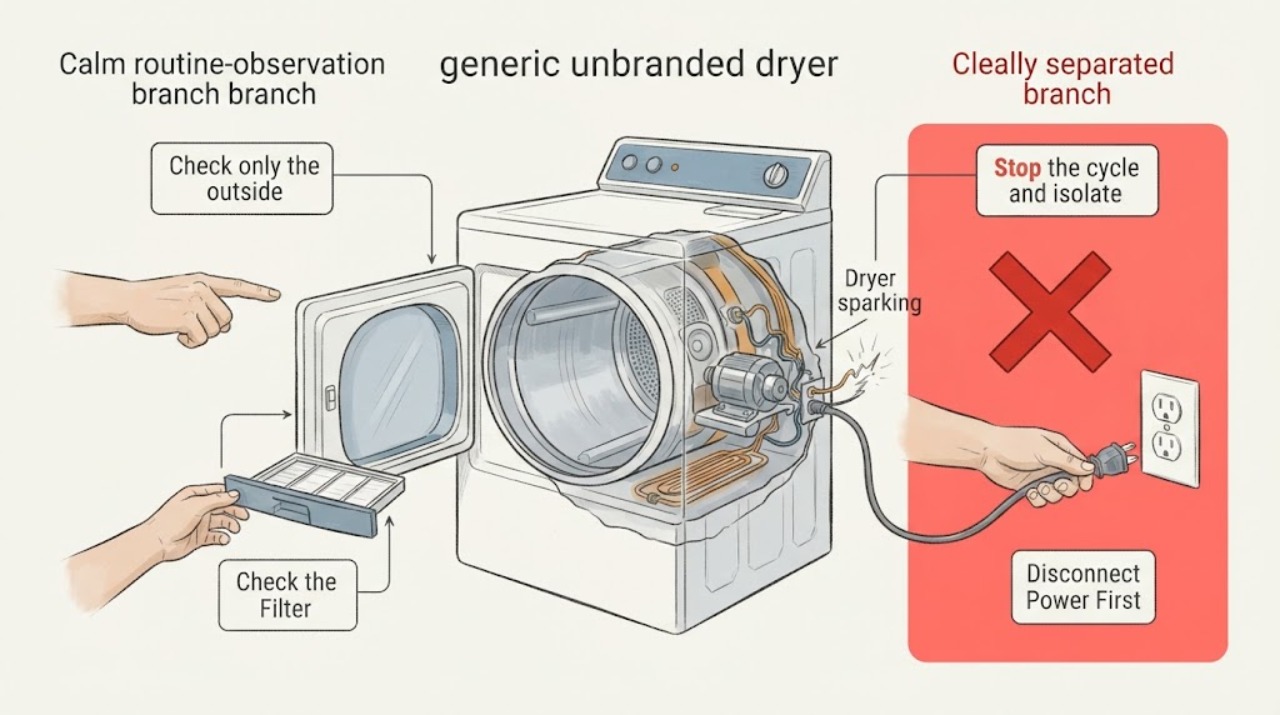
Visible sparks, flashes, arcing, or a crackling sound from a Hoover dryer are an electrical and fire hazard, not a normal part of drying. Stop the cycle immediately, keep clear of smoke or fire, and disconnect the mains only if the plug and route are safe to reach. Do not restart the dryer, use an extension lead, open the cabinet, or touch internal parts. Once the appliance is cool and isolated, look only for safe external clues such as a damaged cord or plug, scorch marks, a loose filter, or a load containing an unsafe item. Keep the dryer out of use and arrange qualified Hoover service; if there is active fire or smoke, leave and contact emergency services from a safe location.
Work through in order
Diagnostic checks
Use only checks that match the exact appliance or system and its official guide.
-
Stop the cycle and isolate the immediate hazard
Press stop or cancel only if the control is responding without approaching sparks or smoke. Move people and pets away, keep clear of the drum and rear of the machine, and disconnect the mains at the plug or isolator only if the plug, cord, and route are cool, dry, and safe to reach. If there is active fire, heavy smoke, a burning outlet, or an inaccessible damaged plug, leave the area and call emergency services from outside instead of touching the appliance.
Expected result: The spark may stop when power is isolated, or smoke, heat, odor, or an electrical trip may continue at the outlet, cord, or machine.
Next step: Keep the dryer disconnected and out of use. For active fire or dangerous smoke, evacuate and use emergency help. For an isolated appliance with no continuing hazard, proceed only to a non-invasive external observation.
Why this matters
Why: A quiet appliance after isolation is not proof that it is safe; a stored or recurring fault can arc again when power returns. Continuing fire, smoke, or heat is an emergency and must not be investigated by the user.
-
Check only the outside for damage
After power is isolated and the appliance is cool, look without removing panels for scorch marks, melted plastic, a damaged cord or plug, a loose wall outlet, soot near the control area, or signs that a spark came from the rear or underneath. Do not touch a damaged conductor, push a plug back into a burned outlet, remove the rear cover, or use a meter or test lamp.
Expected result: Visible scorching, melted insulation, soot, a damaged plug or cord, or a loose or burned outlet identifies an electrical stop condition. No visible mark does not rule out an internal arc at the motor, heater, connector, control, or wiring.
Next step: Do not restore power. Photograph or describe the external clue from a safe distance and tell the technician or electrician; keep the circuit isolated if the outlet or supply appears damaged.
Why this matters
Why: A dryer can spark internally without leaving an obvious external mark. The absence of visible damage is therefore not a clearance test, and an outlet or cord problem may require an electrician as well as appliance service.
-
Review the filter, lint, and load without restarting
With the dryer disconnected and cool, check whether the door fluff filter is present, intact, and heavily coated with lint. Look around the outside floor and accessible vents for accumulated fluff, and identify any load item that the Hoover manual excludes, such as foam-rubber material, an item with flammable residue, or a garment not marked suitable for tumble drying. Do not clean a hot filter, reach into the drum for a hidden object, or put the load back for a test cycle.
Expected result: A missing or damaged filter, heavy lint, or an unsafe load provides a plausible fire pathway. A clean filter and ordinary load do not rule out an electrical fault because the spark may be unrelated to lint or fabric.
Next step: Leave unsafe items out of the dryer and do not operate it without an intact filter. If lint is extensive or any item is scorched, keep the machine isolated and arrange service rather than attempting a drying test.
Why this matters
Why: Hoover links lint buildup and filter condition with fire risk and warns not to use the dryer with a missing or damaged filter. These are causes to report or correct only as allowed by the manual; they do not make a sparking dryer safe to run.
-
Record the timing and location of the spark
Do not reproduce the fault. From your memory or a safe observation already made, record whether the flash came from the drum, door area, controls, power cord, wall outlet, rear vent area, or underneath, and whether it happened at start, during rotation, when heat was selected, or as the dryer stopped. Note any scraping, humming, error indicator, odor, or circuit trip.
Expected result: A spark associated with drum movement, heat, a control, or the supply points to different inspection areas, but none can be safely confirmed without de-energised, model-specific testing by a professional.
Next step: Give these observations and the product code to qualified Hoover appliance service. If the wall outlet, plug, or fixed wiring appears involved, use a qualified electrician for that part of the inspection.
Why this matters
Why: Timing and location are useful evidence, not a diagnosis. Treat any uncertainty about where the arc occurred as an internal fault and do not make another cycle just to narrow it down.
-
Use service instead of a powered retest
Keep the dryer unplugged and do not perform a supervised restart after a spark. Do not bypass a fuse, thermal protector, door switch, filter interlock, or earth connection; do not use an extension lead or substitute outlet to see whether the spark disappears. Arrange a qualified technician to inspect the appliance, and arrange electrical inspection if the outlet or supply cord is damaged.
Expected result: The dryer may remain silent while isolated, or the plug, outlet, breaker, cord, or cabinet may show heat or damage over time.
Next step: Leave the appliance out of service until qualified service confirms the cause and safe repair. Do not replace an internal part based solely on the visible spark or a generic online diagram.
Why this matters
Why: Silence without power does not establish that the fault is cleared. A powered retest could recreate an arc, shock hazard, or fire, while bypassing a safety device removes the protection intended by the appliance design.
Use your observations
Decision map
Find the observation that best matches what you see, then follow the next safe action.
-
PATH 01Safety boundary
What you see
There is active fire, heavy smoke, a burning wall outlet, a hot or damaged cord or plug, or the power source cannot be safely isolated.
Do this next
Evacuate, keep clear of the appliance, and contact the appropriate emergency service from a safe location. Do not use water on an energized appliance and do not re-enter to retrieve laundry.
Why this path and its safety boundary
Safety stop: True
-
PATH 02Safety boundary
What you see
Sparks or flashes came from the dryer, but there is no ongoing smoke or fire and the mains has been safely disconnected.
Do this next
Keep the dryer disconnected and arrange qualified Hoover appliance service. Do not restore power to see whether it was static, lint, a heater, a motor, or a connector.
Why this path and its safety boundary
Safety stop: True
-
PATH 03Safety boundary
What you see
The plug, cord, wall outlet, or nearby wiring shows scorching, melting, looseness, or heat damage.
Do this next
Do not use that outlet or cord. Keep the circuit isolated if safe and arrange a qualified electrician for the supply-side inspection, plus appliance service for the Hoover dryer.
Why this path and its safety boundary
Safety stop: True
-
PATH 04Safety boundary
What you see
The fluff filter is missing or damaged, lint is heavily accumulated, or the load contains an item excluded by the manual.
Do this next
Do not run the dryer. Keep the filter and load issue recorded for service; replace a filter only after confirming the exact model and approved part, and have any scorch or lint intrusion assessed before reuse.
Why this path and its safety boundary
Safety stop: True
-
PATH 05Safety boundary
What you see
No external damage is visible after a spark, but the dryer is otherwise cool and isolated.
Do this next
Treat the event as an unresolved internal electrical fault. Provide the product code and spark timing or location to qualified service; do not perform a powered retest or open the cabinet.
Why this path and its safety boundary
Safety stop: True
Helpful context
Understand the symptom
Sparking changes the repair boundary
A brief static snap is not something a user can reliably distinguish from an electrical arc inside a dryer. A flash through the drum, crackling from the plug or controls, sparks behind the cabinet, or a burning odor all warrant the same response: stop, isolate the appliance if safe, and do not test it again. Hoover's manual says not to continue using a product that appears faulty and identifies servicing as authorised-technician work.
Do not turn a spark into a fire
Keep lint, clothing, and combustible items away from a hot or damaged dryer. Do not spray water into an electrical appliance, pull a hot plug by the cord, or open the cabinet to find the source. If a fire is growing, smoke is filling the room, or the cord or outlet is burning, leave immediately and contact the appropriate emergency service from a safe location.
What to record for the technician
From a safe position, note where the spark appeared, whether it occurred at start-up, during tumbling, or when the heater came on, whether the circuit tripped, and whether there was smoke, odor, scraping, or a warning light. Also provide the Hoover product code and the load and programme used. These clues guide a qualified inspection without requiring you to reproduce the arc.
Only after diagnosis
Potential parts
- fluff filter
Consider a replacement only when the exact filter is missing or damaged; a replacement filter does not clear an electrical spark or authorise a powered retest.
Confirm the complete Hoover product code and approved fit information before ordering, and have the appliance assessed after any spark. - electrical or thermal component
A motor, heater, connector, thermal protector, control, wiring, cord, or outlet component is conditional on qualified inspection that identifies the actual arc source.
Do not select or bypass an internal part from the symptom alone; qualified service must verify the exact model and safety requirements.
When checks do not resolve it
Need a professional?
Professional help is required after any visible spark or electrical arc, even if the dryer appears normal after power is removed; emergency help is required for active fire or dangerous smoke.
Common questions
FAQ
What should I do first if my Hoover dryer sparks?
Stop the cycle, keep people away, and disconnect the mains only if the plug and route are safe. For fire, heavy smoke, or a burning outlet, leave and contact emergency services from a safe location. Otherwise keep the dryer disconnected and arrange qualified service; do not restart it to identify the source.
Can a dirty lint filter cause sparks in a Hoover dryer?
Lint buildup can contribute to heat and fire risk, and Hoover directs users to maintain the filter and applicable condenser. A dirty filter does not prove it caused an electrical spark, however. Disconnect and cool the dryer, do not run it without an intact filter, and have any sparking event assessed before reuse.
Should I try another outlet after my Hoover dryer sparks?
No. A different outlet or extension lead is not a safe diagnostic test after an arc. Keep the dryer disconnected and use qualified appliance service; if the original outlet, plug, or fixed wiring shows heat or damage, use a qualified electrician for the supply-side inspection.
Can I replace the heater, motor, or fuse myself after a spark?
Do not open the cabinet or bypass a fuse, thermal protector, interlock, or earth connection. A spark can come from several internal or supply-side faults, so a qualified technician must identify the source and verify the exact model repair before the dryer is used again.
Read the exact guide
Official sources
- Hoover Tumble Dryer Vision HD VHV380-80 Instruction Manual - Product Code 31100232Hoover Service · Official manual safety, load, filter, ventilation, and authorised-service boundaries used as a model example; the exact product manual takes precedence.
- what to do if your hoover dryer is making a burning smellHoover Service · Hoover's official lint, condenser, filter, and disconnect-before-examining advice for applicable models with a burning smell.
- Check the filter is clean | Hoover ServiceHoover Service · Official fluff-filter location and cleaning guidance for applicable Hoover dryer models.
- Hoover Tumble Dryer Vision HD VHC392T Instruction Manual - Product Code 31100255Hoover Service · Official manual example for unobstructed air inlets and outlets, filter care, correct installation, and service boundaries; the exact product manual takes precedence.
Community feedback
Share a repair observation
Share a plain-text repair observation. Accepted observations are published automatically; this page may take a moment to update.