
On this page
Start here
Quick answer
A visible spark or arc from a Maytag dryer is a stop-use event, not a fault to test repeatedly. Stop the cycle immediately; if the power connection is dry, cool, and safely reachable, isolate power without touching damaged parts. If there is smoke, fire, burning smell, abnormal heat, a hot or discolored cord or receptacle, or gas odor, leave the area and use the appropriate emergency, electrical, gas, or appliance service path. Do not restart the dryer to see whether the spark returns, bypass the door, open the cabinet, or reset a breaker repeatedly. After power is safely isolated, record whether the spark came from the wall connection, cord, drum, lint chute, or cabinet, preserve the exact model and any display code, and have the dryer inspected before reuse.
Before you begin
Safety first
- Do not reconnect or retest the dryer after sparking, bypass the door switch or thermal safety, open the cabinet or terminal block, probe live wiring, use an alternate outlet, reset a breaker repeatedly, dismantle the burner or heater, clean inside the chassis, or operate with a restricted or damaged vent.
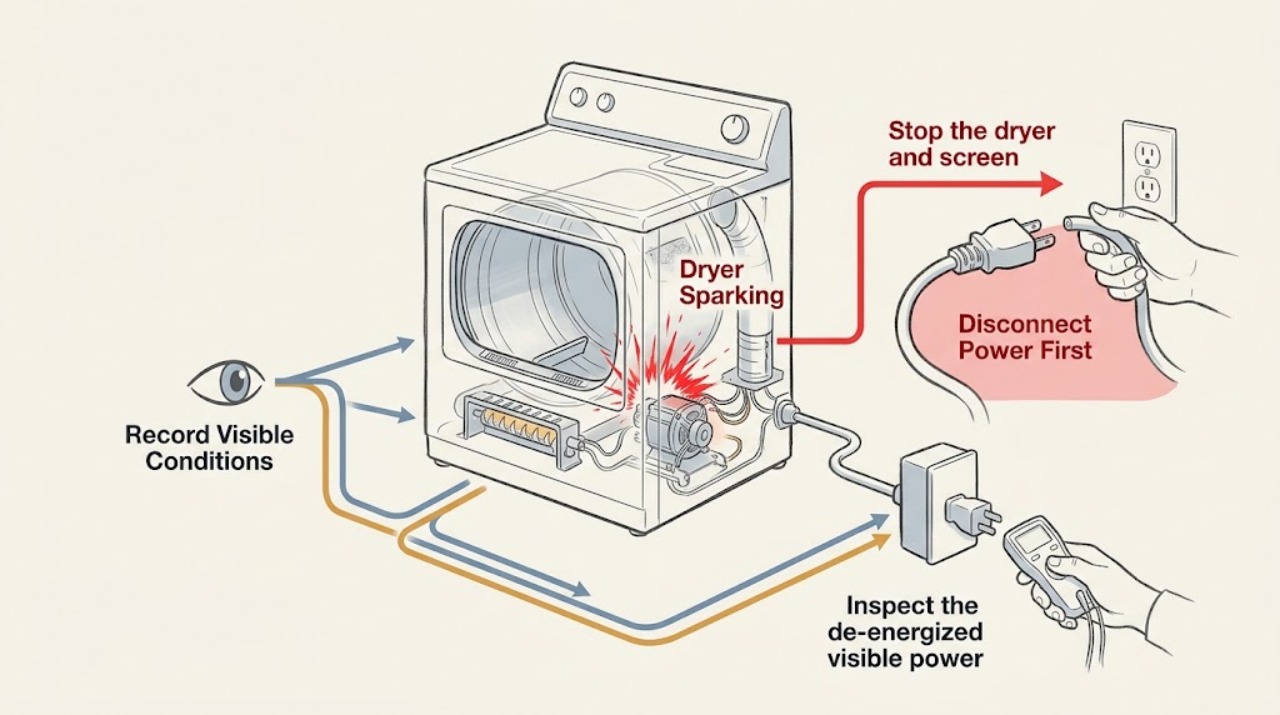
Work through in order
Diagnostic checks
Use only checks that match the exact appliance or system and its official guide.
-
Stop the dryer and screen for immediate danger
Stop using the dryer immediately and keep people away. If no smoke, flame, gas odor, heat damage, or water is present and the plug or disconnect is dry and safely reachable without touching damaged parts, isolate power. If gas odor is present, do not operate electrical switches or create flames; leave the area and use the local emergency or gas-safety path. If there is smoke or fire, leave and call emergency services.
Expected result: Power is safely isolated with no continuing smoke, flame, heat, or odor; or smoke, fire, gas odor, burning smell, abnormal heat, a wet area, or damaged energized connection remains.
Next step: Once the hazard is controlled, do not restart or reproduce the spark. Arrange qualified appliance inspection, with electrical or gas professionals for the corresponding supply concern.
Stop if: Do not touch a hot, wet, smoking, arcing, or discolored cord, plug, receptacle, cabinet, or gas connection. Do not use a breaker or switch if gas may be present.
Why this matters
Why: Sparking can indicate an electrical arc, ignition source, or damaged connection. Continued power or a restart can turn a one-time flash into shock or fire exposure; a gas odor requires a separate evacuation response.
-
Record where and when the spark was seen without testing again
Only after power is safely isolated and the dryer is cool, write down whether the flash was at the wall receptacle, plug, cord, control panel, drum opening, lint-screen or chute area, rear vent, or inside the cabinet. Record whether the drum was turning, whether heat was selected, whether the spark happened once or repeatedly, any sound or smell, the gas or electric model type, and every display code. Do not remove a panel to locate the source.
Expected result: The event was clearly at the receptacle or cord, visible in the drum or lint path, accompanied by a code or hot-air symptom, or its location is uncertain.
Next step: Give the location, timing, code, model, and fuel type to the service professional. Leave the dryer isolated regardless of whether the visible area looks normal.
Stop if: Do not open the cabinet, remove the terminal cover, probe wiring, insert tools, hold the door switch, or reconnect power to locate a hidden arc.
Why this matters
Why: A supply-side arc needs electrical inspection; a drum or lint-path flash can involve metal, lint, a damaged seal, or a hidden internal fault; an uncertain location is not evidence that the appliance is safe. Maytag's code pages also distinguish airflow, power, door, and service conditions by exact display.
-
Inspect the de-energized visible power connection
With the dryer disconnected and the area dry, look at the visible plug, cord jacket, receptacle face, and nearby wall for scorch marks, melting, looseness, cracking, or discoloration. Do not pull on the cord or open the outlet. Leave the household breaker alone if it is hot, damaged, wet, or has already tripped repeatedly.
Expected result: The receptacle or cord is scorched, melted, loose, cracked, wet, or hot; the breaker has tripped; or the visible connection appears normal after the spark.
Next step: Photograph the safe, de-energized damage if useful and arrange qualified electrical inspection before reconnecting the dryer. If no external damage is visible, still leave the appliance off for appliance-service diagnosis.
Stop if: Do not restore power, test another outlet, replace a fuse, reset repeatedly, or touch a hot, wet, arcing, or discolored connection.
Why this matters
Why: Maytag identifies household fuses or breakers and the power connection as no-operation checks, but a normal-looking exterior does not rule out an arc or loose termination. A damaged connection is an electrical service boundary, not a reason to try another outlet or reset.
-
Look for a visible metal object or lint hazard while cold and unplugged
After the dryer is fully cool and disconnected, open the door and look without tools for a coin, buckle, wire, foil, or other loose metal object in the drum opening, lint screen, or lint-chute entrance. Check for a visibly torn seal, scraped drum, loose screen, heavy lint, or lint around the door. Remove only a loose object that is plainly reachable without reaching past guards; do not disassemble the chute or cabinet.
Expected result: A metal object is present, the drum or seal is visibly damaged, lint is packed around the screen or opening, or nothing visible explains the spark.
Next step: Preserve the object or photograph the damage for service and keep the dryer off. Have a qualified technician inspect the drum, seals, blower, heating system, and wiring before reuse.
Stop if: Do not reach into a sharp or damaged area, use metal tools, remove guards, clean inside the chassis yourself, or restart to confirm the object was the cause.
Why this matters
Why: Maytag identifies loose pocket objects and the lint chute as sources of abnormal dryer sounds, while CPSC warns that lint near heat or a restricted exhaust can contribute to fire. A visible object may explain where a flash occurred but does not prove internal electrical parts are undamaged.
-
Record visible lint and vent restriction without running the dryer
With power isolated, record whether the lint screen is heavily loaded, the rear duct is crushed or kinked, the exterior hood is blocked, the dryer cabinet or nearby wall is unusually discolored, or the room contains lint accumulation. Do not use an Air Fluff or heated cycle to measure airflow after sparking, and do not disconnect hidden ducting or clean the chassis unless the exact service procedure is performed by a qualified person.
Expected result: The lint screen or vent is restricted, the cabinet or wall shows heat discoloration, moisture or lint is present, or the visible vent path looks clear.
Next step: Give the observations to an appliance or qualified vent professional and keep the dryer isolated until inspected. Do not resume use merely because the exterior vent looks clear.
Stop if: Do not run with restricted airflow, use a plastic or damaged duct, enter the chassis, vacuum near exposed wiring, or continue after heat damage, smoke, burning smell, or sparks.
Why this matters
Why: Maytag lists long dry times, warmth, moisture, and restricted venting as airflow symptoms; its Check Vent guidance distinguishes a restricted vent from the lint-screen reminder. CPSC warns that lint buildup and blocked exhaust can cause heat buildup and fires. A clear visible duct does not clear the heater or internal lint path after an arc.
-
Preserve the code and arrange inspection instead of resetting
Write down the exact model, serial information if available, gas or electric type, spark location, cycle, drum state, heat state, visible power and vent findings, and any complete code such as AF, F4E3, L2, PF, ERR, or an unfamiliar code. Do not clear the display by restarting and do not perform the normal code reset after a spark unless a qualified professional directs it as part of a safe repair.
Expected result: A code remains visible, the display is blank, the breaker tripped, the dryer previously overheated, or no code was shown.
Next step: Leave the dryer out of service and provide the complete evidence to qualified appliance service; use an electrician for the receptacle, cord, breaker, or supply and qualified gas service for a gas-odor or gas-supply concern.
Stop if: Do not reconnect, reproduce the spark, bypass a safety device, open the cabinet, or keep operating after any arc, smoke, heat damage, burning smell, gas odor, or repeated trip.
Why this matters
Why: Maytag maps supported codes to airflow, power, door, or service conditions, but the code does not certify that the heater, motor, wiring, outlet, or gas system is safe after sparking. The absence of a code is also not a clean bill of health.
Use your observations
Decision map
Find the observation that best matches what you see, then follow the next safe action.
-
PATH 01Next step
What you see
Smoke, flame, gas odor, ongoing arcing, burning smell, abnormal heat, wet electrics, or a hot or damaged power connection is present
Do this next
Do not operate switches or the dryer; leave the area when gas or fire is suspected and use the appropriate emergency, gas, electrical, or fire-service response.
-
PATH 02Next step
What you see
The spark came from the wall receptacle, plug, cord, or visible supply connection, or the breaker tripped
Do this next
Keep the dryer disconnected and have the household supply and appliance connection inspected by a qualified electrician before any reconnection.
-
PATH 03Next step
What you see
The spark was seen inside the drum or lint path, or a metal object, torn seal, heavy lint, or heat discoloration is visible
Do this next
Do not run the dryer. Preserve the observation and arrange qualified appliance and vent inspection; a visible object or lint condition does not prove the internal fault is cleared.
-
PATH 04Next step
What you see
A code appears, the source of the spark is uncertain, or no external cause is visible
Do this next
Preserve the exact code and model information, leave the dryer isolated, and request qualified service rather than selecting another cycle or reproducing the event.
-
PATH 05Next step
What you see
The area looks normal after isolation and no code or visible object explains the single spark
Do this next
Treat the event as unresolved. Do not resume use; have the appliance and its supply inspected before reconnecting.
Helpful context
Understand the symptom
Treat the location of the spark as evidence, not a diagnosis
A flash at the receptacle or cord points to a household connection that must be inspected without reuse. A flash seen through the door or lint opening can involve a loose metal object, a damaged drum or seal, lint, or an internal electrical or heating fault. A gas model adds a separate gas-odor emergency boundary. The location, timing, noise, smell, display, model, and fuel type help a technician; none makes another run safe.
No spark-reproduction test
Maytag's normal troubleshooting pages sometimes suggest a supervised cycle or cycle-power step for ordinary codes, but those are not appropriate after a spark, arc, smoke, or heat-damage event. Do not run a time-dry cycle, switch between outlets, hold the door switch, or clear the code just to observe it again. CPSC identifies lint and blocked exhaust as contributors to dryer heat and fire risk, so a vent and chassis inspection belongs with qualified service when sparking has been reported.
When checks do not resolve it
Need a professional?
Arrange qualified appliance inspection before the Maytag dryer is used again after any spark. Use qualified electrical service for a receptacle, cord, breaker, or household-supply event and qualified gas service for gas odor or gas-supply concerns.
Safety scope: Do not reconnect or retest the dryer after sparking, bypass the door switch or thermal safety, open the cabinet or terminal block, probe live wiring, use an alternate outlet, reset a breaker repeatedly, dismantle the burner or heater, clean inside the chassis, or operate with a restricted or damaged vent.
Have this ready
- Provide the exact model and serial information if available, gas or electric type, spark location, whether the drum was turning or heating, complete display code, breaker behavior, cord or receptacle condition, visible metal or seal damage, lint and vent observations, and any odor, smoke, or heat.
Common questions
FAQ
Is a spark inside a Maytag dryer normal?
No. Do not restart the dryer to see whether it happens again. Isolate power only when it is safe to do so, record whether the flash was at the receptacle, cord, drum, or lint path, and arrange qualified inspection before reuse.
What if the spark came from the plug or wall outlet?
Leave the dryer disconnected and do not try another outlet or reset the breaker repeatedly. Scorching, melting, looseness, heat, or a tripped breaker needs qualified electrical inspection of the household connection and dryer supply before reconnection.
Could a coin or metal object cause a Maytag dryer spark?
A loose metal object can create a visible event in the drum or lint path, but removing a visible object does not prove that seals, wiring, the blower, heater, or controls are undamaged. With the dryer cool and disconnected, look only in accessible areas, preserve the finding, and arrange appliance inspection instead of testing it.
What should I do if my Maytag gas dryer sparks and I smell gas?
Do not operate the dryer, switches, or anything that could create an ignition source. Leave the area and use the local emergency or gas-safety response. Do not return to test the dryer until qualified gas and appliance professionals have cleared it.
Read the exact guide
Official sources
- Overheated Clothes Dryers Can Cause FiresU.S. Consumer Product Safety Commission · Household gas and electric clothes dryers
- Error Codes in Dryers - Product Help | MaytagMaytag Product Help · Maytag dryers; other codes require the exact owner manual
- No Power - Electric Dryer - Product Help | MaytagMaytag Product Help · Maytag electric dryers; use qualified electrical service for supply concerns
- Check Vent Light on Dryer - Product Help | MaytagMaytag Product Help · Maytag models with the Check Vent light; model installation controls
- Dryer Not Starting or No Operation - Product Help | MaytagMaytag Product Help · Maytag dryers; model features and installation vary
- Dryer Vent may be Blocked or Restricted - Product Help | MaytagMaytag Product Help · Maytag dryers; chassis cleaning and complex vent work may require qualified service
- Checking the Gas Supply and the Shutoff ValveMaytag Product Help · Maytag gas dryers; use installation instructions and qualified gas service
- ERR - Error Code - Dryer - Product Help | MaytagMaytag Product Help · Maytag dryer models that display ERR; confirm exact model
- Dryer is Not Heating - Product Help | MaytagMaytag Product Help · Maytag electric and gas dryers; exact model instructions control
- Dryer Sounds and Noises - Product Help | MaytagMaytag Product Help · Maytag dryers; visible-object observations only after safe isolation
Community feedback
Share a repair observation
Share a plain-text repair observation. Accepted observations are published automatically; this page may take a moment to update.