
On this page
Start here
Quick answer
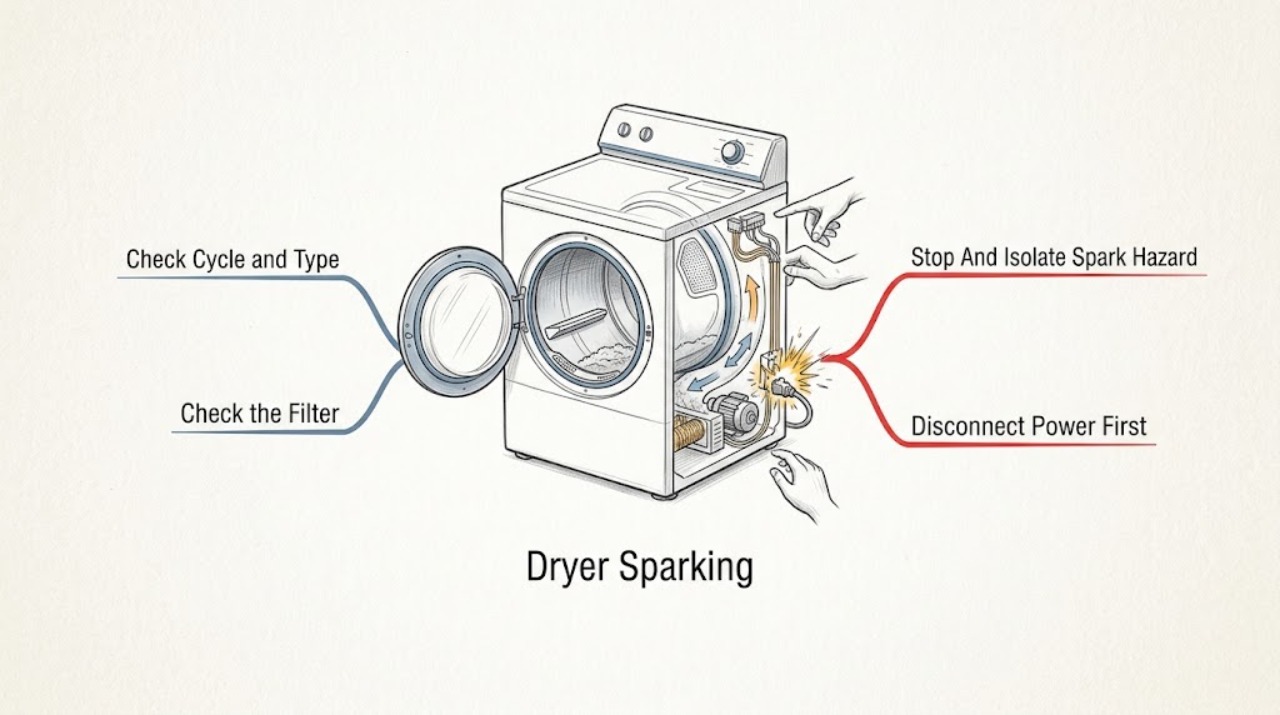
Stop the GE dryer immediately when you see sparks, a flash, smoke, a burning smell, or a hot connection. Remove clothing only if the drum has stopped and it is safe, then disconnect power from a safe accessible control or switch off the dryer circuit without touching a damaged cord or wet area. If you smell gas, do not operate electrical switches or create a flame; leave the area and contact the gas emergency service from a safe location. Do not run the dryer again to locate the spark. Once it is cool and isolated, record where the flash occurred, whether it appeared inside the drum or near the cord or control area, whether the dryer is gas or electric, and whether the breaker opened. GE emphasizes lint-filter and vent maintenance because lint and restricted exhaust increase fire risk, and its owner guidance says gas dryers must be exhausted outdoors. A loose or damaged power connection, heater, motor, drum component, or control fault requires qualified service; do not open the cabinet, handle a capacitor, bridge a fuse, or test live wiring. Arrange service with the exact model and a description or photo of the event.
Before you begin
Safety first
- A user may stop and isolate the dryer safely, inspect the accessible lint filter and visible vent path, and observe the power state from a dry position. Motors, heaters, gas ignition, capacitors, controls, wiring, terminals, drum hardware, and live circuits require qualified service.
Work through in order
Diagnostic checks
Use only checks that match the exact appliance or system and its official guide.
-
Check 1
Stop the cycle and keep the dryer off after any visible spark, flash, smoke, burning smell, hot connection, or melted material; disconnect power only from a safe accessible control, and do not touch a damaged cord, plug, wet area, or energized cabinet.
Expected result: Record whether sparking stops, whether smoke or heat continues, whether the drum has stopped, whether the breaker opened, and whether the event was inside the drum or near the rear or control area.
Next step: Leave the dryer isolated and arrange qualified appliance or electrical service. If a gas odor is present, avoid switches and flames, leave the area, and contact the gas emergency service from a safe location.
Stop if: Stop immediately for gas odor, smoke, uncontrolled flame, arcing, a hot or damaged cord, or a breaker that trips again.
Why this matters
Why: A spark is an electrical or fire hazard until proven otherwise. Continued operation can ignite lint or worsen damage, while the event location helps a qualified technician choose a safe inspection path.
-
Check 2
With the dryer cool and disconnected, identify from the rating label whether it is gas or electric and photograph or describe the spark location without removing panels or restarting the machine.
Expected result: Note whether the flash came from the drum opening, lint-filter area, rear cord or receptacle area, controls, or outside the cabinet, and whether it occurred at start, during tumbling, or when heat began.
Next step: Keep the dryer off and use the observations to guide service. Continue only with safe, external maintenance checks that do not require opening the cabinet.
Stop if: Do not open the rear panel, remove the drum, pull the heater, or probe the controls to find the source.
Why this matters
Why: A location near the supply connection suggests a power or terminal hazard; a flash inside the drum can involve a metal object or internal heater or drum hardware; a gas odor requires a different emergency response. Location alone does not identify a failed part.
-
Check 3
After the dryer is cool and power is isolated, inspect the user-accessible lint filter and the floor and area around the dryer; remove lint, paper, rags, and other loose combustible material without reaching into the cabinet.
Expected result: Record whether the lint filter is loaded, damaged, loose, or missing, whether lint has accumulated beneath or around the dryer, and whether any combustible item was near the appliance when the spark occurred.
Next step: Keep the dryer off and replace a damaged filter only with the exact model-approved type. Have service inspect the interior if lint is present beyond the filter or if sparking occurred.
Stop if: Do not run the dryer without the filter, reach past guards, vacuum inside the cabinet, or use solvents near the appliance.
Why this matters
Why: GE identifies lint accumulation and operation without a proper filter as fire hazards. Clearing visible lint reduces a known risk but does not make a sparking dryer safe to operate or prove lint caused the flash.
-
Check 4
Without running the dryer, inspect the visible exhaust route and outside wall cap for crushed or kinked ducting, lint blockage, or a blocked flap; for a gas model, confirm that the exhaust terminates outdoors according to the installation instructions.
Expected result: Note whether the duct is restricted, the wall cap cannot open freely, lint is visible at the termination, or the dryer is a gas model with a questionable exhaust path.
Next step: Correct only a plainly accessible external obstruction without disturbing the appliance connection. Keep a sparking dryer off and arrange qualified service for internal vent, heat, wiring, or ignition diagnosis.
Stop if: Do not disconnect a gas dryer from its vent to operate it, enter the duct, open the cabinet, or continue if gas odor or heat damage is present.
Why this matters
Why: GE states that proper airflow is important and that a partially clogged exhaust can impair operation; restricted exhaust can increase heat and lint risk. Venting trouble can coexist with, but cannot by itself explain, an electrical spark.
-
Check 5
From a dry position and only if there is no damage or odor, inspect the visible plug, receptacle, cord route, and breaker or disconnect state; do not reset a breaker that trips again or touch a scorched connection.
Expected result: Record whether the plug is loose, the receptacle or cord shows discoloration or melting, the breaker is open, the dryer is completely dead, or the protection opens again after a safe reset.
Next step: Leave the dryer disconnected and arrange qualified appliance or electrical service. Provide photographs from outside the cabinet and the breaker history.
Stop if: Do not repeatedly reset protection, replace a fuse with a different rating, tighten live terminals, or test voltage at the appliance.
Why this matters
Why: A damaged connection or repeat trip supports an electrical fault that requires qualified diagnosis. A dryer that is dead after a spark may have opened protection, but restoring power does not prove the internal fault is safe.
-
Check 6
Keep the GE dryer out of service and request qualified diagnosis when sparking occurred inside or near the cabinet, the symptom returns, the drum or motor behaves abnormally, the heater area is implicated, or any power or gas safety sign is present.
Expected result: Give the technician the model and serial information, gas or electric type, spark location, cycle stage, load details, lint and vent condition, cord and breaker observations, noises, odors, smoke, and photographs.
Next step: Ask for a root-cause inspection and safe repair before reconnecting or operating the dryer. Use the model-specific GE support path for manuals and service routing.
Stop if: Do not open the cabinet, handle a capacitor, bridge a fuse or thermostat, bypass a door switch, or test live circuits.
Why this matters
Why: An internal spark may involve the motor, heater, drum hardware, terminal connection, control, wiring, or accumulated lint. These possibilities cannot be separated safely by repeated operation or a visual check through the door.
Use your observations
Decision map
Find the observation that best matches what you see, then follow the next safe action.
-
PATH 01Safety boundary
What you see
There is gas odor, smoke, uncontrolled flame, sustained arcing, or a hot or damaged power connection.
Do this next
Leave the area or keep away from the appliance, avoid flames and electrical switches when gas odor is present, and contact the appropriate emergency or qualified service provider from a safe location.
Why this path and its safety boundary
Safety stop: Do not operate, relight, reset, or run another cycle.
-
PATH 02Safety boundary
What you see
The flash came from the plug, receptacle, cord, rear terminal area, or a breaker opened.
Do this next
Keep the dryer disconnected and arrange qualified electrical or appliance diagnosis.
Why this path and its safety boundary
Safety stop: Do not touch scorched parts, reset protection repeatedly, or test the connection live.
-
PATH 03Safety boundary
What you see
The flash appeared inside the drum or near the lint-filter opening without a gas odor.
Do this next
Remove clothing only after the drum stops and the dryer is isolated; record any loose metal object visible without reaching behind guards.
Why this path and its safety boundary
Safety stop: Do not run the dryer to reproduce the flash or reach into the cabinet.
-
PATH 04Safety boundary
What you see
The filter is loaded or damaged, lint surrounds the appliance, or the exhaust path is visibly restricted.
Do this next
Clear only loose external lint or an accessible obstruction and replace a damaged filter with the model-approved type while keeping the dryer off.
Why this path and its safety boundary
Safety stop: Do not operate without the filter or with a restricted vent; have a sparking dryer inspected.
-
PATH 05Safety boundary
What you see
Sparking occurred when tumbling or heating began, or the drum, motor, heater, or controls behave abnormally.
Do this next
Keep the appliance off and arrange qualified diagnosis of internal mechanical, heating, electrical, and control components.
Why this path and its safety boundary
Safety stop: Do not open panels, handle capacitors, bypass safety switches, or test live wiring.
-
PATH 06Safety boundary
What you see
The spark location is unclear, the dryer is dead after the event, or sparking returns after a visual maintenance check.
Do this next
Preserve the display and event details and use the GE model support path to arrange qualified service.
Why this path and its safety boundary
Safety stop: Do not keep cycling the dryer to obtain more information.
Helpful context
Understand the symptom
Sparks are a stop condition
A visible spark or flash is different from a normal relay click or a brief static snap. It can involve a power connection, heater, motor, control, metal object, or accumulated lint, and the safe next step is the same: stop the dryer and isolate it without touching a damaged or energized area. Do not keep cycling the machine to see whether the symptom returns.
First distinguish gas, electric, and location
Record whether the GE dryer uses gas or electricity, whether the flash was in the drum, at the rear power area, or near the controls, and whether it occurred at start, during tumbling, or when heat began. A gas odor changes the emergency response; a spark at a cord or outlet changes the electrical boundary. Neither can be safely confirmed by opening the cabinet.
Lint and venting can turn a fault into a fire risk
GE says to clean the lint filter every time and keep lint, paper, rags, and chemicals away from the dryer. Its support guidance also says restricted exhaust can impair operation and that a gas dryer must vent outdoors. These maintenance checks help reduce risk but cannot repair a spark caused by an internal electrical or mechanical fault.
What service needs to know
Give service the model and serial information, gas or electric type, spark location, cycle stage, load and any metal object found outside the drum, breaker behavior, cord or outlet condition, lint-filter and vent observations, and whether there was smoke, odor, heat, or noise. Keep the dryer out of service until the cause is assessed.
Only after diagnosis
Potential parts
- power cord, terminal connection, or receptacle repair
Consider only when the spark or heat is traced by a qualified technician to the supply connection or terminal area.
Cord and connection requirements depend on the exact GE model and installation; electrical work requires qualified service. - drive motor or motor wiring
Consider only when sparking occurs during tumbling and service testing identifies a motor, harness, or related mechanical fault.
Motor and harness fitment is model-specific and not a safe user test. - heating element or heater wiring
Consider only when the event occurs as heat begins and qualified diagnosis identifies the heater or its wiring.
Heater circuits can remain hazardous; confirm the exact model and use qualified service. - gas ignition or burner component
Consider only for a gas model when a qualified technician finds an ignition or burner-path fault without a gas-safety emergency.
Do not manually ignite the burner or open gas fittings; model and fuel type must be confirmed. - drum support, seal, or foreign-object correction
Consider only when a qualified inspection links the flash to metal contact, drum hardware, or a damaged seal.
Do not reach behind guards or remove the drum as a user repair. - control board or safety switch
Consider only after power, lint, vent, and visible mechanical causes are excluded by qualified diagnosis.
Control and safety components are model-specific; never bypass a safety device.
When checks do not resolve it
Need a professional?
Keep the dryer off and arrange qualified GE appliance or electrical service for any visible spark, flash, smoke, burning odor, gas odor, melted or hot connection, repeated breaker trip, abnormal drum or motor behavior, heater-related event, or sparking that returns after safe external checks.
Safety scope: A user may stop and isolate the dryer safely, inspect the accessible lint filter and visible vent path, and observe the power state from a dry position. Motors, heaters, gas ignition, capacitors, controls, wiring, terminals, drum hardware, and live circuits require qualified service.
Have this ready
- Provide the exact model and serial information, gas or electric type, spark location and timing, load details, filter and vent condition, cord and receptacle observations, breaker behavior, noises, odors, smoke, and safe photographs.
Common questions
FAQ
Is it safe to keep using a GE dryer that sparked once?
No. Stop the dryer and isolate it safely. A single visible spark can involve a loose connection, heater, motor, control, metal contact, or lint hazard; do not run another cycle to see whether it repeats.
What should I check first when my GE dryer sparks?
First look for gas odor, smoke, heat damage, or a hot connection and stop immediately. After the dryer is cool and isolated, record the spark location and inspect only the accessible lint filter, surrounding combustibles, and visible vent path.
Can lint cause a GE dryer to spark?
Lint accumulation is a recognized dryer fire hazard and restricted airflow can increase heat, but lint alone does not prove why a dryer sparked. Clean the accessible filter and keep the appliance off while service checks the internal cause.
What if the GE dryer sparked near the plug or breaker?
Keep it disconnected and do not touch scorched or melted parts. A damaged cord, receptacle, terminal, or internal fault requires qualified electrical or appliance diagnosis; do not repeatedly reset the breaker.
Can I open a GE dryer to find the spark source?
Do not open the cabinet, handle a capacitor, bypass a safety switch, manually ignite a gas burner, or test live wiring. Provide the model, spark location, cycle stage, and photos from a safe position to a qualified technician.
Read the exact guide
Official sources
- Dryer - Hot to the Touch or SweatsGE Appliances · The guidance covers GE gas and electric dryers; vent layout and accessible cleaning depend on the installed model and installation.
- Dryers Minimize the Fire HazardGE Appliances · The page provides general GE dryer safety guidance; the installed model's manual controls exact maintenance and service access.
- GE Appliances Spacemaker Dryer Owner's ManualGE Appliances · This is an older GE dryer manual; use it for general safety boundaries and use the installed model manual for exact controls and parts.
- GE Dryer Repair ResourcesGE Appliances Factory Service · Use the repair-resource path for service escalation after a sparking event; it does not authorize internal user repair.
- Support for GE Washers and DryersGE Appliances · Use the model and serial information to locate the correct GE dryer support content and manual before service.
Community feedback
Share a repair observation
Share a plain-text repair observation. Accepted observations are published automatically; this page may take a moment to update.