
On this page
Start here
Quick answer
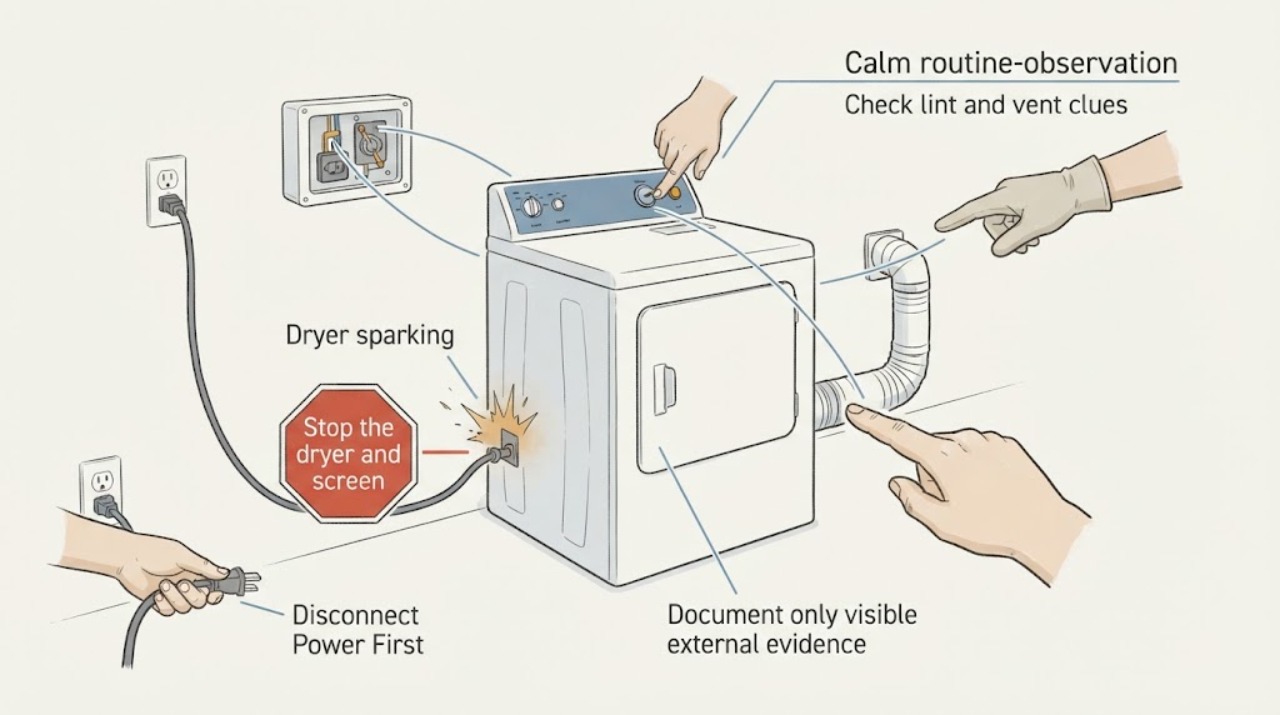
Stop the Kenmore dryer immediately if you see a spark, arc, flash, or glowing electrical connection. Do not run another cycle to reproduce it. If it is safe to do so without reaching through smoke, flame, water, or a gas odor, turn the dryer off and disconnect power using the normal accessible control or breaker; otherwise leave the area and use emergency help. Keep the dryer out of service until a qualified appliance technician or electrician inspects it. From outside the appliance only, you may document whether the cord, plug, outlet, breaker, vent, or lint area shows visible damage, but do not remove panels, probe wiring, bypass a door or thermal switch, or reset a breaker that trips again. If smoke or fire is present, leave and call emergency services. If a gas Kenmore dryer has a gas odor, leave the odor area and call the gas emergency service from a safe location.
Before you begin
Safety first
- Stop immediately for smoke, flame, ongoing arcing, a hot or damaged cord/outlet, repeated breaker trips, water near electricity, or gas odor. Do not restart, open the cabinet, remove panels, probe live wiring, bypass door or thermal protection, or use a disconnected vent. If gas is suspected, leave and call gas emergency service from outside.
Work through in order
Diagnostic checks
Use only checks that match the exact appliance or system and its official guide.
-
Stop the dryer and screen for an emergency
At the first sign of a spark, arc, flash, smoke, flame, burning smell, melted plastic, a hot cord or outlet, water near the dryer, or a gas odor, stop using the Kenmore dryer and move away; do not press Start again.
Expected result: From a safe position, note whether there is active smoke or flame, a persistent gas odor, visible arcing, only a one-time flash with no ongoing hazard, or no safe way to reach the controls or breaker.
Next step: For smoke or fire, leave and call emergency services. For gas odor, leave the area and call the gas emergency service from outside. If no emergency is active and power can be disconnected without entering a hazard, turn the dryer off and isolate power using the normal accessible control or breaker, then arrange qualified service.
Stop if: Do not use a phone in a gas-odor area, touch a hot or damaged cord, open the cabinet, spray water, extinguish an appliance fire yourself, or return to reset or test the dryer.
Why this matters
Why: Smoke, flame, gas odor, or ongoing arcing is an immediate fire, explosion, or shock boundary. Even a one-time spark is an unresolved electrical fault and is not evidence that the next cycle is safe.
-
Document only visible external evidence
With power safely isolated, the floor dry, and no smoke, fire, gas odor, or hot surface, photograph or note the outside of the cord, plug, outlet, breaker status, rear vent, lint filter, and the approximate location and timing of the spark; do not remove covers or reach behind an unstable appliance.
Expected result: Record whether the spark appeared at the plug/outlet, near the control area, from behind the dryer, at the drum opening, or at an unknown location, and whether the cord, outlet, vent, or lint area looks damaged or restricted.
Next step: Give the photos and exact timing to a qualified appliance technician or electrician. Keep the dryer isolated until they determine the cause and verify safe operation.
Stop if: Do not pull the dryer out across a damaged cord, touch scorched conductors, remove the rear panel, clean inside the cabinet, or reconnect power to look for another spark.
Why this matters
Why: A spark at the supply connection points to electrical installation or cord inspection; a spark during operation with normal external connections leaves internal electrical, motor, heater, or control faults possible. The location is a service clue, not a diagnosis.
-
Check lint and vent clues without restarting
Only after the dryer is cool and power is isolated, inspect the removable lint filter and the visible vent path from ordinary access for heavy lint, a crushed or kinked duct, or a blocked outside flap; do not run the dryer to see whether the outside vent opens.
Expected result: Record whether the filter or visible duct is heavily obstructed, the duct is damaged or crushed, the outside vent cannot be seen safely, or the airflow condition is unknown.
Next step: Keep the dryer off and ask a qualified technician or vent professional to inspect the exhaust path and dryer interior before use, especially if the spark followed long dry times, overheating, or lint accumulation.
Stop if: Do not reach into the cabinet, use a sharp tool near wiring, operate without the lint filter, run with a disconnected vent, or reconnect power merely to observe airflow.
Why this matters
Why: CPSC warns that lint buildup can block airflow and create excessive heat, while USFA recommends checking for damaged, crushed, or restricted venting. These findings raise the need for qualified cleaning and inspection but do not prove that lint caused the spark.
-
Give the technician the model and electrical history
From a safe location, record the exact Kenmore model, electric or gas configuration, whether the display was dark or lit, whether the spark occurred at start or mid-cycle, whether the breaker or fuse opened, and any preceding heat, noise, odor, or long-dry symptom.
Expected result: Classify the event as a supply-side flash, a start-time spark, an in-cycle spark, a spark after overheating, or an uncertain event; note any prior breaker trips or cord/outlet changes.
Next step: Use Kenmore's exact manual only for model identification and provide the record to a qualified appliance technician or electrician. Do not select a replacement part from the symptom alone.
Stop if: Do not use a multimeter on an energized dryer, remove a fuse or switch, open the control panel, or rely on a different model's wiring diagram.
Why this matters
Why: The same visible symptom can involve the household supply, power cord, start/control circuit, motor, heater, thermal protection, or vent-related heat. Model and sequence information helps separate those paths without exposing the user to energized parts.
-
Keep it out of service until inspected
Leave the Kenmore dryer disconnected or otherwise isolated as directed by a qualified professional until the spark source, power connection, internal condition, and venting have been inspected and the professional confirms that operation is safe.
Expected result: The service record should identify the observed spark location, the cause found or not found, the repair or cleaning performed, the supply and vent checks, and the condition required before returning the dryer to use.
Next step: Follow the technician's written instructions and supervise the first normal cycle only if they expressly clear the appliance. Stop immediately if sparking, smoke, burning odor, overheating, abnormal noise, gas odor, or a breaker trip returns.
Stop if: Do not bypass door or thermal protection, reconnect a damaged cord, run without the lint filter or vent, reset a tripping breaker, or resume use after an unexplained spark.
Why this matters
Why: A dryer can appear normal when cold or unpowered while still having an intermittent arc, damaged connection, motor/heater fault, or heat-related lint problem. A temporary absence of sparks is not a clearance.
Use your observations
Decision map
Find the observation that best matches what you see, then follow the next safe action.
-
PATH 01Safety boundary
What you see
There is smoke, flame, an ongoing arc, a rapidly heating cord/outlet, or the source cannot be safely observed.
Do this next
Leave the area, keep others away, and call emergency services. Do not re-enter to unplug or inspect the dryer unless responders direct you and the area is safe.
Why this path and its safety boundary
Why it matters: This is an active fire or shock emergency, not a dryer repair check.
Safety stop: Do not use water, open the cabinet, touch the cord, restart the appliance, or attempt to extinguish an electrical or gas-appliance fire yourself.
-
PATH 02Safety boundary
What you see
The Kenmore dryer is gas-fired and a gas odor or hissing is present.
Do this next
Leave the area immediately and call the local gas emergency service or 911 from a safe location; keep the dryer off and do not re-enter until cleared.
Why this path and its safety boundary
Why it matters: A possible gas leak or unburned gas condition overrides no-start or spark troubleshooting.
Safety stop: Do not use switches, phones, flames, appliance controls, plugs, or vehicles in the odor area, and do not attempt a burner or ignition test.
-
PATH 03Safety boundary
What you see
The flash appears at the cord, plug, outlet, or breaker area, or the cord/outlet is scorched, loose, hot, or damaged.
Do this next
Keep the dryer isolated and arrange qualified electrical or appliance inspection of the outlet, cord, connection, and dryer before use.
Why this path and its safety boundary
Why it matters: The household supply or connection may be unsafe and can cause fire or shock independently of an internal dryer fault.
Safety stop: Do not wiggle the plug, replace the cord, use an extension cord, reset the breaker repeatedly, or probe the outlet.
-
PATH 04Safety boundary
What you see
The spark followed long dry times, overheating, heavy lint, a crushed/restricted visible duct, or poor outside airflow.
Do this next
Keep the dryer off and have a qualified professional inspect and clean the exhaust path and interior before any test run, while also diagnosing the spark.
Why this path and its safety boundary
Why it matters: Restricted airflow can increase heat buildup and fire risk, but it does not by itself identify the electrical source of the spark.
Safety stop: Do not run with the vent disconnected, operate without a lint filter, or assume vent cleaning alone repaired an appliance that sparked.
-
PATH 05Safety boundary
What you see
External connections look normal but the dryer sparked at start or during a cycle, or the location is unknown.
Do this next
Leave the dryer isolated and request model-specific qualified appliance service. Provide the model, sequence, sound, display, breaker history, and any heat or odor clues.
Why this path and its safety boundary
Why it matters: An internal start/control, motor, heater, thermal, or wiring fault remains possible and cannot be safely selected from the visible symptom.
Safety stop: Do not open the cabinet, perform live tests, remove a thermal device, bridge a switch, or restart to locate the spark.
Helpful context
Understand the symptom
A spark is a stop condition, not a troubleshooting invitation
A visible spark may come from a loose or damaged connection, a control or motor fault, a heater or wiring problem, an object contacting a moving or energized area, or a fault outside the dryer. The visible flash does not identify the failed part. Repeatedly starting the dryer can add heat and ignition energy, so the useful first step is to remove it from service and preserve what was observed for a qualified inspection.
Look for airflow and lint risk without opening the cabinet
USFA and CPSC both emphasize lint-filter and exhaust-path care because restricted airflow can contribute to heat buildup. After power is safely off and there is no smoke, fire, gas odor, or hot surface, a user may look at the lint filter, the visible rear duct, and the outside vent opening for obvious lint or crushing. Do not reach into the cabinet or disconnect a duct if doing so would move a hot, damaged, or unstable dryer; qualified service should clean the interior and investigate any spark.
Kenmore model details matter
Kenmore provides manuals by exact model number, and dryer controls, power arrangements, and safety circuits vary. Record the model from a safe location and tell the technician whether the dryer is electric or gas, where the spark appeared, whether it happened at start or during a cycle, and whether the breaker opened. Do not use a different model's wiring diagram or a generic continuity test to choose a part.
When checks do not resolve it
Need a professional?
Safety scope: Stop immediately for smoke, flame, ongoing arcing, a hot or damaged cord/outlet, repeated breaker trips, water near electricity, or gas odor. Do not restart, open the cabinet, remove panels, probe live wiring, bypass door or thermal protection, or use a disconnected vent. If gas is suspected, leave and call gas emergency service from outside.
Common questions
FAQ
What should I do immediately if my Kenmore dryer sparks?
Stop the dryer and do not restart it. If it is safe without approaching smoke, fire, water, gas odor, or a hot/damaged connection, isolate power using the normal accessible control or breaker. Otherwise leave and call emergency help. Keep the dryer out of service until qualified inspection.
Can I run the dryer once more to see where the spark comes from?
No. A second run can add heat and ignition energy and may turn an intermittent fault into a fire or shock event. Record what you saw from a safe position and have a qualified professional locate the source.
Could a clogged vent cause a Kenmore dryer to spark?
Restricted airflow can increase heat buildup and fire risk, and CPSC and USFA recommend lint-filter and vent maintenance. That does not prove the vent caused a particular spark. Keep the appliance off and have both the vent and dryer inspected before reuse.
Is it safe to unplug a sparking dryer?
Only if the plug and area are cool, dry, accessible, and free of smoke, flame, gas odor, or visible arcing, and you can do it without touching damaged conductors. If not, leave and use emergency or qualified electrical help. Never pull a damaged or hot plug.
What if the breaker trips after the dryer sparks?
Leave the breaker off and do not keep resetting it. A repeat trip can indicate a defect or unsafe overload. Arrange qualified appliance or electrical inspection of the dryer and household connection.
Can I replace the thermal fuse or door switch myself after a spark?
Do not open the dryer or bypass a thermal or door safety device after a spark. The failed part may not be the fuse or switch, and the underlying heat, wiring, motor, or supply problem could remain. Use the exact Kenmore model information for qualified service.
What if my Kenmore dryer is gas and I smell gas after the spark?
Leave the area immediately, avoid switches, phones, flames, appliance controls, and vehicles in the odor area, and call the local gas emergency service or 911 from outside. Do not re-enter or relight the dryer until trained personnel clear it.
Read the exact guide
Official sources
- Appliance and Electrical Fire SafetyU.S. Fire Administration, FEMA · U.S. government appliance/electrical safety guidance; the exact Kenmore installation instructions and local electrical requirements control.
- CPSC Publication 5022 - Overheated Clothes Dryers Can Cause FiresU.S. Consumer Product Safety Commission · U.S. government clothes-dryer safety alert; it does not diagnose a particular Kenmore spark.
- Pipeline Leak Recognition and What to DoU.S. Department of Transportation, Pipeline and Hazardous Materials Safety Administration · Federal public gas-leak response guidance; local gas-utility and emergency instructions control an incident.
- Kenmore ManualsKenmore · Kenmore's official manual portal; the exact manual and local electrical or gas requirements control the installed model.
- Clothes Dryer Fire SafetyU.S. Fire Administration, FEMA · U.S. government residential clothes-dryer fire-safety guidance; the exact dryer manual and local requirements also apply.
- Dryer Not Starting or No OperationWhirlpool Product Help · Whirlpool's official dryer guidance used only for general external-check categories; Kenmore's exact model manual controls.
Community feedback
Share a repair observation
Share a plain-text repair observation. Accepted observations are published automatically; this page may take a moment to update.