
On this page
Start here
Quick answer
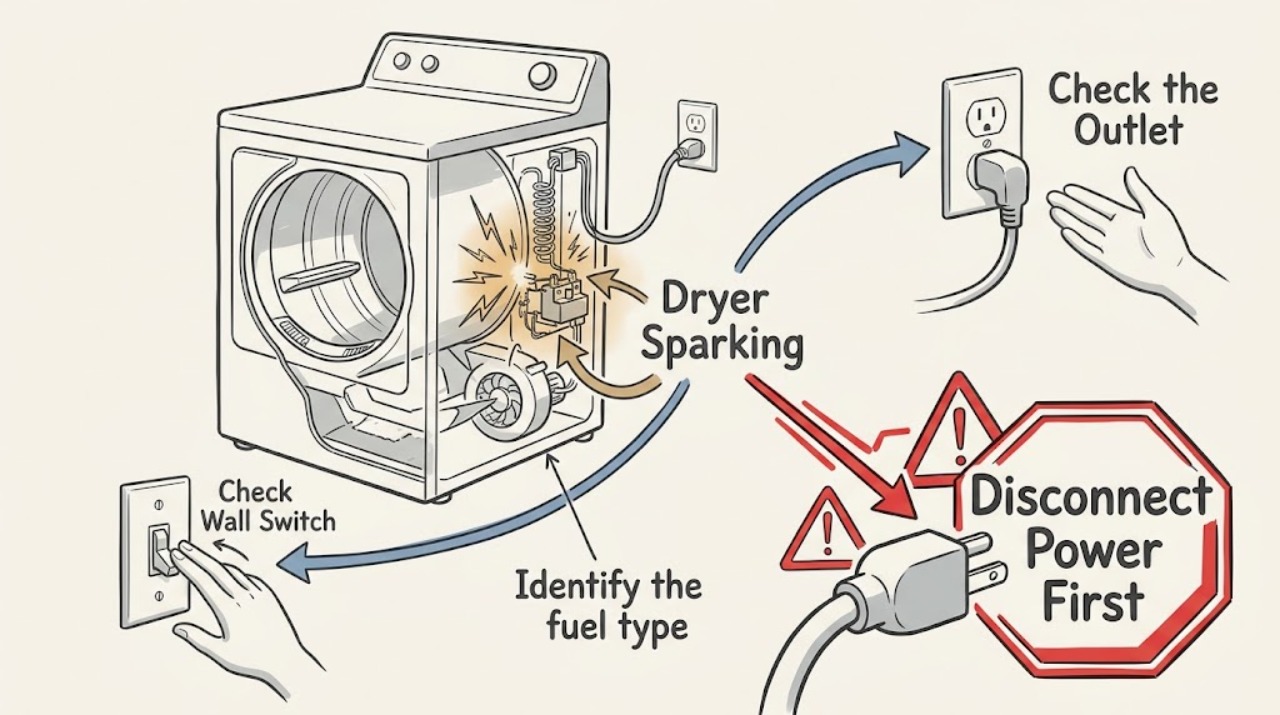
Stop the LG dryer immediately and do not run another test cycle. If the control, plug, and breaker are safely reachable and there is no arcing, heat, smoke, water, or visible damage at the connection, switch the dryer off and isolate its power at the plug or breaker; do not touch a sparking connection. If you smell gas, do not touch electrical switches or use a phone inside the building: leave the area, shut the gas valve only if it is safely reachable, and contact the gas supplier or fire department from outside. Once the area is safe, record where the spark occurred and arrange qualified appliance service; a damaged receptacle or cord may also require a qualified electrician. LG guidance treats burning, discoloration, persistent metallic sounds, and gas odor as reasons for inspection or service rather than continued use.
Work through in order
Diagnostic checks
Use only checks that match the exact appliance or system and its official guide.
-
Check 1
Stop the cycle and create a safe boundary. If there is no active arcing, smoke, water, hot damage, or gas odor at the controls or connection, switch the dryer off and isolate power at the plug or breaker; otherwise move away and leave the isolation to emergency or qualified personnel. Do not restart the dryer or deliberately reproduce the spark.
Expected result: Note whether the event included a flash, repeated crackling, smoke, a burning odor, a hot or discolored connection, a tripped breaker, or water near the appliance.
Next step: Keep the dryer out of service. For fire or smoke use local emergency procedures; for a gas odor follow the gas branch below; for a supply connection issue arrange qualified electrical inspection.
Why this matters
Why: Any active arc, smoke, melting, strong burning odor, water near energized equipment, or repeated breaker trip is a stop condition rather than a normal operating symptom.
-
Check 2
Identify the fuel type from the rating label or installation information without opening panels or moving the appliance. Treat a gas model as both an electrical and gas appliance; do not attempt to light or test its burner after a spark.
Expected result: The label or records identify an electric or gas dryer, and you can state whether a gas smell was present before or after the event.
Next step: If gas is smelled, stop reading the appliance controls, avoid switches and phones inside, clear the area, and contact the gas supplier or fire department from outside. If there is no gas odor, continue only with unpowered visual triage.
Why this matters
Why: Gas equipment can have a separate gas-supply hazard even though its controls use electricity. A gas odor cannot be diagnosed by cycling the dryer.
-
Check 3
From a safe distance after power is isolated, inspect the wall receptacle, plug face, and visible cord for looseness, charring, melted plastic, exposed conductor, or a smell concentrated at the outlet. Do not pull on, bend, unplug, or touch a connection that is hot, wet, damaged, or arcing.
Expected result: The flash was at the receptacle or plug, or the connection shows heat or discoloration; alternatively, the external connection looks undamaged and the spark was elsewhere.
Next step: Leave a damaged or suspicious receptacle and cord isolated and have a qualified electrician inspect it; do not substitute an extension cord or another outlet. Give the appliance technician the event location when the connection is not the source.
Why this matters
Why: A supply-side flash can indicate a receptacle, cord, grounding, or connection fault that an appliance reset cannot correct. An undamaged external connection shifts attention to the dryer or drum while still requiring service because a spark occurred.
-
Check 4
Only after the dryer is disconnected or its circuit is safely isolated and the drum is cool, look inside the drum with a light. Remove only a loose, cool item that is plainly reachable without tools; do not scrape the drum, reach behind panels, or disturb wiring.
Expected result: A coin, key, lighter, zipper piece, or other metal object is loose in the drum, or the drum has a gouge, burn mark, loose seam, or no visible foreign object.
Next step: Keep the dryer out of service and report the object and any mark to the technician; do not run an empty cycle to see whether the flash is gone.
Why this matters
Why: LG notes that pocket items can strike the drum, damage the dryer, and create a fire hazard. A loose item may explain a flash, but a mark, loose seam, or absent object leaves possible internal damage.
-
Check 5
With power still isolated, perform only the user-accessible lint and exhaust inspection described for the model: check the lint filter and the visible duct outlet for heavy lint, blockage, crushing, or a disconnected section. Do not dismantle the cabinet or reach into the heater, motor, terminal block, or burner area.
Expected result: The filter or visible duct is packed, the exhaust is restricted or damaged, or the accessible airflow path appears clear; also note any rear-grill or duct discoloration.
Next step: Leave the machine off and have the duct and dryer inspected if there is discoloration, heat damage, or a spark. Do not use a breaker reset as a substitute for finding the cause.
Why this matters
Why: Restricted exhaust or lint can raise dryer temperatures and may accompany burning or discoloration, but clearing a visible path does not prove that an electrical arc or internal component is safe.
-
Check 6
Classify the sound only from the recorded event; do not operate the dryer to obtain a new sound. Separate a low hum or brief normal mechanical sound from sharp crackling, a flash, or persistent metallic scraping.
Expected result: The report is only a normal low hum or brief belt noise with no flash, or it includes crackling, a visible flash, or persistent sharp metallic scraping.
Next step: Any sound associated with the spark or persistent metallic scraping requires the dryer to remain off for qualified inspection; do not use noise alone to clear the appliance.
Why this matters
Why: Normal operating sounds do not explain a visible spark. LG says persistent sharp metallic scraping can indicate worn or damaged internal parts, while pocket items can damage the drum and create a fire hazard.
-
Check 7
Prepare a service handoff without opening the dryer: provide the model, fuel type, event location, photos taken only from a safe distance, breaker status, gas-odor status, load contents, and any code or discoloration. State that the appliance was sparking and has not been retested.
Expected result: The technician can distinguish a supply-side event, drum-side event, gas-odor event, or an unexplained internal event from the supplied evidence.
Next step: Book qualified service and keep the dryer isolated until the responsible professional declares the installation safe; do not replace a fuse, bypass an interlock, or open energized equipment.
Why this matters
Why: A visible spark is a safety-relevant symptom, not a part diagnosis. The correct inspection may involve an appliance technician, a qualified electrician, or the gas supplier depending on location and fuel type.
Use your observations
Decision map
Find the observation that best matches what you see, then follow the next safe action.
-
PATH 01Next step
What you see
There is smoke, active arcing, melting, water near the appliance, a strong burning smell, or a breaker trips again.
Do this next
Do not approach the connection or restart the dryer. Move clear, use local emergency procedures when needed, and arrange qualified electrical or appliance service.
-
PATH 02Next step
What you see
A gas odor is present, whether or not the visible spark location is known.
Do this next
Do not light an appliance, touch electrical switches, or use a phone inside. Clear the area and contact the gas supplier or fire department from outside; installation and service belong to qualified personnel.
-
PATH 03Next step
What you see
The flash or heat mark is at the plug, receptacle, or visible cord.
Do this next
Keep the circuit and dryer out of service and request qualified electrical inspection; do not move the damaged connection or try another outlet.
-
PATH 04Next step
What you see
The external connection is safe to view but the flash was in the drum or accompanied by a metal object, mark, or scraping.
Do this next
Leave power isolated and arrange qualified appliance inspection. Remove only a loose cool item that is plainly reachable; do not run a confirmation cycle or open the cabinet.
-
PATH 05Next step
What you see
The only finding is lint, a restricted visible duct, or discoloration without a clear spark location.
Do this next
Keep the dryer off and have the airflow path and dryer inspected. A cleaned filter or duct does not clear an appliance that has visibly sparked.
Helpful context
Understand the symptom
What sparking can indicate
A visible flash is different from a normal motor hum, compressor hum, or brief belt-settling sound. The location matters: a flash at the wall receptacle or plug points toward the supply connection; a flash inside the drum may involve a loose metal object or damaged internal part; a flash near a gas burner adds an ignition and gas-safety concern. Lint, restricted exhaust, or a burned connection can also leave heat or discoloration even when no spark is visible after the event. Do not use a second cycle to find out which explanation applies.
Information to give the technician
Record the model label, whether the dryer is electric or gas, the exact location and timing of the flash, any gas odor, smoke, burning smell, discoloration, breaker activity, and whether laundry or a metal object was inside. Take a photo only from a safe, unpowered position; never move a hot, melted, wet, or arcing plug or cord to obtain a better view.
When checks do not resolve it
Need a professional?
Call emergency services for fire, smoke, injury, or an escalating electrical event. For gas odor, leave immediately and contact the gas supplier or fire department from outside. For any other spark, keep the dryer isolated and arrange qualified appliance service; use a qualified electrician when the plug, receptacle, cord, grounding, or house wiring is involved.
Common questions
FAQ
Is a brief spark from an LG dryer normal?
No. A visible spark should be treated as a stop-use symptom even if the dryer still powers on. Normal hums or brief mechanical sounds are not a reason to disregard a flash.
Can I run the dryer empty to see whether it sparks again?
No. Do not reproduce the event. Isolate the dryer safely and arrange inspection based on the spark location, connection condition, fuel type, and any heat or odor evidence.
What if the spark was near a gas LG dryer?
If you smell gas, do not touch switches or use a phone inside. Clear the area, shut the gas valve only if safely reachable, and contact the gas supplier or fire department from outside.
Read the exact guide
Official sources
- LG Dryer - Troubleshooting Burning or DiscolorationLG USA Support · LG dryers; burning, discoloration, drum and duct inspection, lint, load, and service guidance
- Troubleshooting No Power on a DryerLG USA Support · LG dryers; power connection, breaker, outlet, and service troubleshooting
- MFL62512869_en_120926.inddLG USA Support · LG DLGX8001 dryer installation and safety instructions; grounding, electrical, gas, exhaust, and service precautions
- LG Dryer - What to Do If You Smell Gas Around Your LG DryerLG USA Support · LG gas dryers; gas odor emergency precautions and qualified service boundary
- [LG Dryer] Noise From the DryerLG USA Support · LG dryers; normal operating sounds, pocket objects, metallic scraping, and service guidance
Community feedback
Share a repair observation
Share a plain-text repair observation. Accepted observations are published automatically; this page may take a moment to update.