
On this page
Start here
Quick answer
A visible spark or arc from a dryer, its plug, outlet, cord, controls, cabinet, drum, or internal area is abnormal: stop the cycle, keep people away, and do not run the dryer again to see whether it repeats. If the machine is still operating and it is safe to do so from a dry position, turn its control off; isolate power only without touching a hot, wet, scorched, loose, or actively arcing connection. If smoke, flame, a burning odor, a hot or discolored outlet, repeated breaker trips, water near the appliance, or a gas odor is present, leave the area as appropriate and obtain emergency, gas, electrical, or appliance help from a safe location. A brief static discharge from clothing or a person is a different observation only when there was no visible spark from the dryer or connection and no heat, odor, damage, or recurrence; never use that distinction to excuse a machine spark.
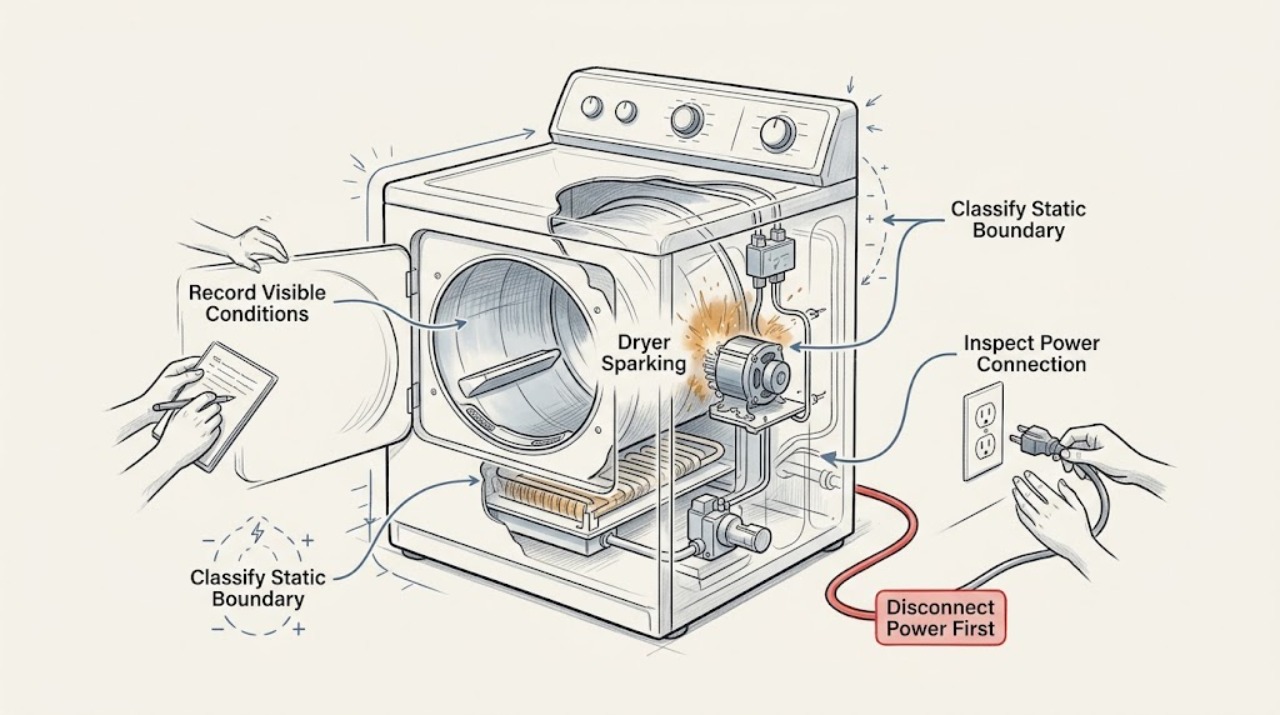
Work through in order
Diagnostic checks
Use only checks that match the exact appliance or system and its official guide.
-
Check 1
Stop the dryer controls and keep people, pets, clothing, and combustibles away; from a safe position, record whether the event was a single snap, a visible flash, repeated crackling, or a shower of sparks, and note the cycle stage and exact location.
Expected result: The spark came only from clothing or a person with no visible machine or connection involvement, or it came from the drum, control area, cabinet, plug, outlet, cord, or nearby wiring; note smoke, odor, heat, discoloration, a tripped breaker, and whether the dryer continued running.
Next step: Photograph the safe-to-view location and preserve the event details for a qualified appliance technician or electrician; do not start another cycle to reproduce it.
Stop if: For active arcing, smoke, flame, strong burning odor, gas odor, a hot surface, or immediate fire risk, leave the area as appropriate and contact emergency or gas/electrical help from a safe location.
Why this matters
Why: A clothing-only static discharge may be a separate low-risk observation when there is no appliance involvement or damage. Any visible machine, plug, outlet, cord, or wiring spark is abnormal and needs the dryer to remain out of service.
-
Check 2
Compare the event description with the static boundary without touching or operating the dryer: identify whether the snap occurred as a garment or person discharged, or whether light, sound, or heat came from the dryer, receptacle, plug, cord, drum, cabinet, or control.
Expected result: There is no visible appliance spark, no odor, no hot or discolored part, no smoke, no damage, and no recurrence, or one of those signs is present or the source cannot be separated from the machine.
Next step: Keep the dryer out of service whenever the source is uncertain or any appliance sign is present, and give the technician the clothing type, load, humidity context, and event location without attempting a confirmation run.
Stop if: Do not restart the dryer, increase the heat, alter grounding, bypass a door or safety switch, or handle a connection to see whether the event returns.
Why this matters
Why: Only the first pattern supports documenting a possible clothing-static event. An uncertain source must be treated as appliance involvement because a harmless static snap cannot be used to rule out an arc.
-
Check 3
With the dryer stopped, inspect the plug, cord, receptacle face, and the accessible route of the cord only from a dry, stable position and without pulling, flexing, opening, or touching a hot, wet, loose, scorched, melted, or actively arcing part.
Expected result: The connection is cool and intact, or the plug or outlet is loose, warm or hot, discolored, melted, smoky, wet, damaged, crackling, or associated with a breaker trip.
Next step: Leave the connection undisturbed and arrange qualified electrical assessment for the outlet or circuit and qualified appliance assessment for the dryer; only isolate power from a dry safe location when doing so does not require contact with the hazard.
Stop if: Do not repeatedly reset a breaker, pull on the cord, bend plug blades, use an extension cord or adapter, touch an energized or wet connection, or take energized electrical readings.
Why this matters
Why: A normal-looking exterior does not clear an appliance after a spark. Any heat, discoloration, damage, looseness, smoke, crackling, or trip can indicate an electrical hazard in the cord, appliance connection, receptacle, or circuit.
-
Check 4
After the dryer is completely stopped, cool, and safely isolated, look through the open door for a loose coin, fastener, zipper part, wire, sharp object, loose drum baffle, scorch mark, or other visible contact evidence; do not reach into a hot, sharp, damaged, or obstructed drum.
Expected result: A loose metal object or visible mark is present, the drum appears damaged or misaligned, or the drum looks ordinary but the spark source was inside or near it.
Next step: Leave sharp, trapped, or inaccessible objects in place and give the technician the location and photos; do not remove panels, reach behind the drum, or turn the drum against resistance.
Stop if: Stop immediately for exposed sharp metal, a hot surface, smoke residue, a damaged drum, a trapped object, or any need to dismantle, force, or move the appliance.
Why this matters
Why: A metal object or damaged rotating surface can create a mechanical contact path, but an ordinary-looking drum does not rule out a motor, heater, wiring, or control fault. Neither result justifies a trial cycle.
-
Check 5
Only while the dryer is off, cool, and safely isolated, make a non-contact note of the lint screen, visible lint around the drum, accessible exhaust route, outdoor flap if visible without running the dryer, surrounding combustibles, and whether any load contacted oil, gasoline, solvent, alcohol, or another flammable substance.
Expected result: The lint screen or visible area is heavily loaded, the exhaust route is visibly restricted or damaged, combustibles are stored nearby, or the load may contain flammable residue; alternatively, no such condition is visible.
Next step: Keep the dryer out of service, keep the area clear, and tell the technician what was observed; do not run the dryer to test the outdoor flap or clean inside the chassis.
Stop if: Do not operate without the lint filter, dry flammable-contaminated items, use a restricted or damaged vent, spray cleaner into the cabinet, or open the chassis to remove lint.
Why this matters
Why: Lint, restricted airflow, nearby combustibles, and flammable-contaminated laundry increase fire concern and are relevant to service. A clean visible area does not clear the electrical or mechanical spark source.
-
Check 6
Read the rating label or manual from ordinary safe access and record the dryer model, whether it is electric, gas, vented, ventless, or heat-pump, the displayed code if any, and whether the spark happened during tumbling, heating, ignition, or connection to power.
Expected result: The type, model, and phase are known, or the label is missing and the type or event phase remains uncertain; note any gas odor or ignition symptom separately from an electrical spark.
Next step: Provide the exact identity and timeline to the appropriate qualified appliance professional; for a gas odor, use the gas-emergency branch instead of diagnosing ignition.
Stop if: Do not remove panels, probe wiring, adjust gas pressure, relight a burner, reconnect a gas line, or interpret an error code across brands or models.
Why this matters
Why: Type and timing determine whether a technician must assess a power connection, motor or heater circuit, gas ignition and connection, or a ventless/heat-pump airflow or condensate path. A generic code or type assumption is unsafe.
-
Check 7
Use the event location, visible condition, appliance type, and safety signs to choose the service handoff, keeping the dryer isolated and clearly marked out of service until it is assessed.
Expected result: The issue is confined to a possible clothing-only static event with no machine signs, or there was any machine/connection spark, uncertain source, damage, heat, smoke, odor, water, gas symptom, or breaker trip.
Next step: Give the professional the model, type, event stage, location, photos, breaker behavior, load details, lint/vent observations, and any odor or heat; do not release the dryer back into service until the cause is cleared.
Stop if: Do not perform a confirmation cycle, bypass a safety device, use an extension or adapter, repair a cord or receptacle as a trial, or work inside the appliance or electrical panel.
Why this matters
Why: A clean static-only history can be documented for monitoring without a restart. Every other result needs professional diagnosis, with electrical or emergency response taking priority when the hazard is at the supply or involves smoke, fire, or gas.
Use your observations
Decision map
Find the observation that best matches what you see, then follow the next safe action.
-
PATH 01Next step
What you see
The only snap was clearly from clothing or a person, with no visible flash from the dryer, drum, controls, cord, plug, or outlet and no heat, odor, smoke, damage, trip, or recurrence.
Do this next
Do not run a test cycle merely to prove the distinction. Document the load and conditions; if the event recurs or the source becomes uncertain, treat it as appliance involvement and arrange service.
-
PATH 02Next step
What you see
The flash, crackle, smoke, heat, discoloration, or damage was at the plug, receptacle, cord, or supply connection, or the breaker tripped.
Do this next
Stop using the dryer and keep away from the connection. Obtain qualified electrical assessment for the receptacle and circuit plus appliance assessment for the dryer; do not touch or repeatedly re-energize a hot, wet, scorched, or active connection.
-
PATH 03Next step
What you see
The spark was seen in or near the drum, or a loose metal object, scorch mark, damaged baffle, sharp edge, or unusual contact sound is visible.
Do this next
Keep the dryer stopped and safely isolated. Do not reach into a hot or damaged drum or remove panels; provide the observation to a qualified appliance technician.
-
PATH 04Next step
What you see
The spark came from behind the cabinet, control area, motor/heater area, or another part that cannot be safely identified externally.
Do this next
Treat it as an internal electrical or component fault. Do not dismantle, take energized electrical readings, bypass an interlock, or run the dryer; arrange qualified appliance service.
-
PATH 05Next step
What you see
A gas dryer has a gas odor, delayed ignition, repeated ignition attempt, abnormal flame, or a spark event associated with gas ignition.
Do this next
Do not ignite, relight, switch electrical controls, or search for the leak. Leave the area when appropriate, avoid flames and electrical switches, and contact gas emergency or fire help from a safe location; a qualified professional must inspect the gas connection and appliance before use.
-
PATH 06Next step
What you see
There is smoke, flame, a strong burning odor, melted or hot material, visible fire damage, a rapidly heating connection, or clothes are scorching.
Do this next
Stop use and evacuate or call emergency services according to the immediate danger. Do not use water on an energized appliance and do not re-enter or restart it until responders or a qualified professional says it is safe.
-
PATH 07Next step
What you see
Water or flooding can contact the dryer, plug, outlet, cord, or floor connection, or a person felt a shock or tingle.
Do this next
Do not touch the appliance or connection. Keep people away and have power isolated by a qualified responder from a safe location, followed by electrical and appliance assessment.
-
PATH 08Next step
What you see
Visible lint accumulation, restricted or damaged exhaust, nearby combustibles, or flammable residue on the load is present after the spark.
Do this next
Keep the dryer out of service and the area clear. Tell the technician; do not run the dryer to test airflow or dry the affected load.
Helpful context
Understand the symptom
Separate clothing static from an appliance spark
Dry air and synthetic clothing can produce a small static snap when a person or garment discharges. That is only a possible static branch when the flash or snap is clearly from clothing or a person, not the dryer, plug, receptacle, cord, control, cabinet, or drum, and there is no burning odor, heat, discoloration, smoke, damage, or repeat event. A bright flash, shower of sparks, visible arc, crackling at a connection, or light coming from the machine is an electrical or mechanical stop-use event regardless of whether the dryer still runs. Do not restart it to classify the event.
The location of the spark changes who should respond
A spark at the receptacle, plug, cord, or supply connection can involve the building wiring or the appliance connection. A spark in the drum can involve a loose metal object or contact with a rotating part, while a flash behind the cabinet can involve wiring, the motor, heater, controls, or another part that is not a user-serviceable inspection. CPSC advises stopping use for hot outlets, arcing, burned odors, and damaged cords; use external observation to record the location, then hand the appliance to a qualified professional.
Lint and fuel hazards remain relevant after the spark
A dryer that sparks should not be run for an airflow test. Once it is off, cool, and safely isolated, record only ordinary visible conditions such as a blocked lint screen, lint around the drum, a crushed or disconnected exhaust path, or items stored against the appliance. DOE and NFPA say not to operate without the lint filter, to maintain airflow, to use the correct connection and grounding, and never to dry items contaminated with flammable substances. These checks help a technician assess fire risk; they do not authorize cabinet cleaning, electrical testing, gas work, or a trial cycle.
Safety boundary
Stop conditions
- Any visible spark or arc from the dryer, drum, controls, cabinet, plug, receptacle, cord, or nearby wiring is a stop-use event; do not run another cycle.
- Smoke, flame, a strong burning odor, scorching, melting, abnormal heat, or visible fire damage requires leaving the area as appropriate and obtaining emergency help.
- A gas odor, delayed ignition, abnormal flame, or repeated ignition attempt requires no flame, no electrical-switch operation, no leak search, and gas or fire emergency help from a safe location.
- Do not repeatedly reset a tripped breaker, touch an active or hot connection, use an extension cord or adapter, alter grounding, or take energized electrical readings.
- Do not remove panels, reach into a hot or damaged drum, repair the cord or receptacle as a trial, bypass a door or safety interlock, adjust gas components, or relight the appliance.
- Water near the appliance or any shock or tingle requires keeping away and arranging safe power isolation and qualified electrical assessment.
- Do not operate without the lint filter, with a restricted or damaged vent, or with laundry contaminated by flammable substances.
Only after diagnosis
Potential parts
- power cord or terminal connection
Only consider this category if a qualified assessment links the spark to a damaged or incorrect appliance-side power connection and the exact model and electrical configuration are confirmed.
A cord or terminal choice must match the exact dryer model, rating, installation instructions, and local electrical requirements; do not select a replacement from the spark symptom alone. - drum support or rotating-contact component
Only consider this category if a qualified technician finds a mechanical contact path or damaged rotating component near the drum.
Confirm the exact model and the technician's diagnosis before any part is considered; a visible drum mark can also reflect a deeper electrical or structural fault. - heater, motor, or control electrical component
Only consider this category after qualified diagnosis identifies the internal source of an arc or abnormal electrical behavior.
Do not infer fit or replace internal electrical parts from a generic sparking symptom; verify exact model documentation and professional installation.
When checks do not resolve it
Need a professional?
Arrange qualified appliance service for any spark that involved the dryer or whose source is uncertain, and qualified electrical service when the plug, outlet, cord, circuit, heat, discoloration, or breaker is involved. Use emergency or gas service from a safe location for smoke, flame, a strong burning odor, a gas odor, water contacting electrical parts, a shock, or an active arc.
Common questions
FAQ
Is a spark from a dryer ever normal?
A visible spark from the dryer, drum, controls, cabinet, cord, plug, or outlet is not a normal operating condition. A brief static snap may be separate only when it clearly came from clothing or a person and there was no machine involvement, odor, heat, damage, smoke, trip, or recurrence. Do not run the dryer to test the distinction.
What should I do if the spark came from the plug or outlet?
Stop using the dryer and do not touch a hot, wet, scorched, loose, smoking, or actively arcing connection. Keep people away and arrange qualified electrical assessment for the receptacle and circuit plus appliance assessment for the dryer. Do not repeatedly reset the breaker or use an adapter or extension cord.
Can a coin or zipper cause a dryer spark?
A loose metal object or damaged rotating surface can be relevant when a spark is seen in or near the drum, but the object should not be used as a reason to restart the dryer. Look only from safe access after the unit is cool and isolated; do not reach into a hot, sharp, obstructed, or damaged drum or remove panels.
Should I test the dryer again after one spark?
No. A test cycle can repeat an arc or turn a connection, component, lint, or gas problem into a fire or shock event. Record the location and timing, isolate the dryer only when it is safe, and arrange the appropriate professional assessment.
What if the dryer smells like gas after sparking?
Do not ignite, relight, switch electrical controls, or search for the leak. Leave the area when appropriate, avoid flames and electrical switches, and contact gas emergency or fire help from a safe location. A qualified professional must inspect the gas connection and appliance before use.
Does cleaning lint fix a sparking dryer?
Cleaning a user-accessible lint filter and documenting visible lint or vent restriction can help a technician assess fire risk, but it does not clear a spark from the appliance or connection. Do not run the dryer to test airflow, open the chassis, or operate without the lint filter.
Who should inspect a dryer that sparks?
Use a qualified appliance technician for a spark from the drum, cabinet, motor, heater, controls, or internal area, and qualified electrical service when the plug, outlet, cord, circuit, hot connection, or breaker is involved. Smoke, flame, active arcing, gas odor, water at electrical parts, or a shock requires emergency or gas/electrical response from a safe location.
Read the exact guide
Official sources
- Clothes Dryer & Washing Machine SafetyU.S. Department of Energy / NFPA Public Education Division · Clothes dryer installation, service, lint filter, airflow, gas connection, plug/outlet, grounding, flammable-load, and surrounding-area safety
- CPSC Guide to Home Wiring HazardsU.S. Consumer Product Safety Commission · Home electrical warning signs, arcs and sparks, hot or discolored outlets and plugs, damaged cords, breaker trips, and qualified service boundaries
- Overheated Clothes Dryers Can Cause FiresU.S. Consumer Product Safety Commission · Clothes dryer overheating, lint, exhaust restriction, and fire-prevention observations
Community feedback
Share a repair observation
Share a plain-text repair observation. Accepted observations are published automatically; this page may take a moment to update.