
On this page
Start here
Quick answer
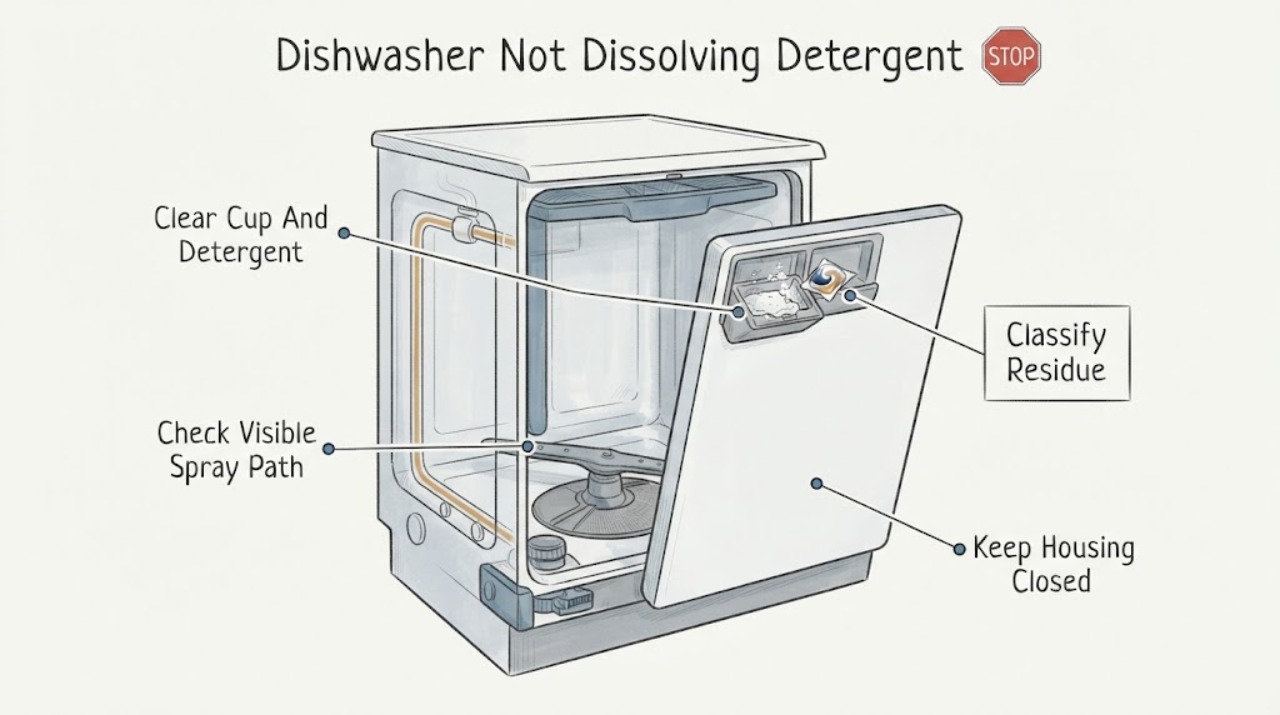
If detergent is not dissolving in a Hotpoint dishwasher, first separate detergent left in the cup from gritty detergent left on the dishes. With the dishwasher idle, remove tall items that could block the cup, wipe away old residue, and use fresh, dry automatic-dishwasher detergent; never use hand dish soap. Then check, without dismantling the appliance, that the visible spray arms can turn and are not blocked by loading or residue, and that the accessible filter area is clean. Check the incoming hot water at the nearest faucet; the opened support guidance uses about 120–140°F for the detergent-cup check and 120–150°F for wash performance. If the cup still will not open, the spray arms do not move, or the problem persists with clear loading, detergent and hot-water checks, stop troubleshooting and arrange model-matched or qualified service rather than guessing a pump, heater, dispenser motor or control-board fault.
Work through in order
Diagnostic checks
Use only checks that match the exact appliance or system and its official guide.
-
Check 1
With the dishwasher stopped and safe to open, record whether detergent is still inside the dispenser cup, on the door or tub, or on the dishes, and whether the dispenser cover opened at all.
Expected result: The cup is closed or contains detergent; the cup opened but detergent remains gritty elsewhere; or the cup is empty and the issue is poor cleaning.
Next step: Follow the matching cup, loading/spray-arm, or hot-water branch below and keep the exact model information for service if the symptom repeats.
Why this matters
Why: A closed or blocked cup points to dispensing access, while an open cup with residue points toward detergent condition, water reaching the cup, spray coverage, or water temperature. The symptom does not identify a failed internal part.
-
Check 2
Before the next cycle, remove any tall item that could touch the dispenser cover, wipe visible old detergent from the cup and cover, and load fresh, dry automatic-dishwasher detergent according to the exact model manual; do not use hand dish soap.
Expected result: The cover moves freely and the detergent is fresh and dry, or the cover is still obstructed, sticky, caked with residue, or unable to open.
Next step: Run only the normal model-documented cycle if the cup is clear. If the cover still will not open after the visible obstruction and residue are removed, stop and arrange service; do not pry the cup or dismantle the door.
Why this matters
Why: A blocked cover or caked/old detergent can keep detergent from entering the wash. A clean, freely moving cover with fresh detergent makes a simple detergent-storage or obstruction explanation less likely, but does not prove a dispenser mechanism is defective.
-
Check 3
With power disconnected before touching accessible parts, inspect the visible spray-arm openings and accessible filter area for food or detergent residue, and reload so racks or tall dishes do not block the spray arms; do not remove the pump or reach into hidden passages.
Expected result: A visible opening or filter area is restricted, a rack or tall item blocks an arm, or the visible path is clear; after a safe normal run, the marked spray arm either changes position or does not appear to move.
Next step: Correct only the visible loading or residue issue and refit accessible filters as the exact manual specifies. If the spray arm does not turn or detergent remains after the visible checks, stop and request model-matched service rather than testing internal components.
Why this matters
Why: A restriction or blocked arm can keep water from reaching the cup and dishes. GE Appliances-hosted guidance uses spray-arm rotation as an observation, but a clear visible path does not prove the internal pump, heater or control is working.
-
Check 4
Check the hot water at the nearest faucet with the dishwasher idle, using a suitable thermometer and the exact model guidance; the opened support pages use about 120–140°F for detergent-cup performance and 120–150°F for general wash performance.
Expected result: The incoming water is below the cited range, or it is within the cited range but detergent still does not dissolve after the cup, detergent, loading and visible spray checks.
Next step: Address a home hot-water or installation issue through the appropriate qualified person without changing dishwasher wiring or opening the appliance. If temperature is adequate and the symptom persists, use the service branch.
Why this matters
Why: Water that is too cool can leave detergent undissolved. A normal faucet temperature does not rule out a dishwasher fault, but it makes low incoming temperature a less supported explanation.
-
Check 5
Stop user troubleshooting when the dispenser repeatedly stays closed, the spray arms do not move, detergent remains after fresh detergent and adequate hot water, the dishwasher leaks, or there is an electrical or burning concern.
Expected result: The problem repeats after the documented external checks, or a leak, burning smell, damaged cord, or other hazard is present.
Next step: Leave the dishwasher off; if there is an active leak, close the water supply only if it is safe to do so. Arrange Hotpoint/model-matched or qualified appliance service and provide the model, detergent type, cycle, residue location and observations. Do not pry the dispenser, open the cabinet, or perform live electrical tests.
Why this matters
Why: The official guidance routes an unopened cup, non-moving spray arms, or unresolved washing problem to service. The available evidence does not support naming the failed internal component for an unknown model.
Use your observations
Decision map
Find the observation that best matches what you see, then follow the next safe action.
-
PATH 01Next step
What you see
The detergent cup is closed, blocked by a tall item, or coated with old/caked detergent.
Do this next
After the dishwasher is idle, remove only the visible loading obstruction, wipe the cup clean, and use fresh dry automatic-dishwasher detergent. If the cover still will not open, request service without prying it.
Why this path and its safety boundary
Why it matters: The dispenser cover cannot release detergent normally, so the remaining detergent does not by itself prove an internal failure.
-
PATH 02Next step
What you see
The cup opens but detergent remains gritty, a visible spray arm is blocked or does not change position during a safe normal run, or water is below the cited incoming-temperature range.
Do this next
Correct visible loading/residue and address a low household hot-water condition through the appropriate qualified person. If the arm or water path remains abnormal, stop and arrange model-matched service.
Why this path and its safety boundary
Why it matters: Water may not be reaching the cup or may not be hot enough for the documented wash guidance; the observation still does not identify a pump, heater or valve failure.
-
PATH 03Next step
What you see
The cup opens and the spray path is clear, but the detergent is old, lumpy, damp, or not labelled for automatic dishwashers.
Do this next
Replace it with fresh, dry automatic-dishwasher detergent stored as directed by the model manual, then reassess one normal cycle. Do not keep experimenting if the cup or wash path remains abnormal.
Why this path and its safety boundary
Why it matters: The detergent itself is a supported explanation for residue or poor dissolving, and hand dish soap can create excessive suds.
-
PATH 04Next step
What you see
The dispenser still will not open, the spray arms do not turn, detergent remains after fresh detergent and adequate hot water, or a leak/electrical hazard is present.
Do this next
Leave the dishwasher off and arrange Hotpoint/model-matched or qualified service. Do not open the cabinet, pry the cup, bypass a control or perform energized tests.
Why this path and its safety boundary
Why it matters: The official Hotpoint/GE-hosted guidance treats the issue as unresolved and needing service; no model-specific internal diagnosis is supported by this task.
Helpful context
Understand the symptom
Identify where the detergent remains
After the cycle, note whether powder or a pod is still in the dispenser cup, whether a pod fell out but remains mostly intact, or whether the cup is empty but detergent is gritty on the dishes. The opened Hotpoint manual treats detergent left in the cup as a different troubleshooting path from poor washing. Do not infer a failed pump or dispenser motor from residue alone.
Keep the detergent and cup compatible
Use only detergent intended for automatic dishwashers. GE Appliances-hosted guidance says powder should be fresh, dry and free-flowing, while the Hotpoint manual says to remove caked detergent and service the appliance if the cup still will not open. A tall item or old residue can obstruct the cover, and a pod or tablet must not bind the cover. Do not add hand-washing liquid soap, which can create excessive suds.
Use the model manual for anything beyond the visible checks
The task has no model number. The opened Hotpoint manual supports the family-level dispenser and wash observations below, but it does not establish a universal dispenser mechanism or replacement part for every Hotpoint dishwasher. Record the model from the rating label before applying a control sequence, removing a component or ordering a part.
When checks do not resolve it
Need a professional?
Arrange service if the detergent cup still does not open, the spray arms do not turn, or the residue persists after the documented external checks., Stop using the dishwasher and seek qualified help for an active leak, burning smell, damaged cord, repeated electrical trip, or any condition that makes the appliance unsafe to approach., Do not pry the dispenser, remove the pump or cabinet, bypass a control, or perform live electrical tests without model-specific qualified service procedures.
Have this ready
- complete model number and serial information
- whether detergent remains in the cup, on the tub, or on the dishes
- detergent form and condition, cycle selected, and whether the cup cover opened
- whether visible spray arms moved and whether accessible filters were clear
- incoming hot-water temperature and any leak, odor, noise or electrical symptom
Common questions
FAQ
Why is detergent still in my Hotpoint dishwasher cup?
The opened Hotpoint manual and official support guidance point first to a blocked or unopened cup, old or caked detergent, water not reaching the cup, spray-arm restrictions, or water that is too cool. Clear only visible obstructions and use fresh automatic-dishwasher detergent; if the cup still will not open, arrange service.
Can I use hand dish soap if my dishwasher detergent is not dissolving?
No. The official detergent guidance says to use detergent intended for automatic dishwashers; hand dish soap can create excessive suds. Use fresh, dry automatic-dishwasher detergent in the amount specified by the exact model manual.
What water temperature should I check?
The opened GE Appliances-hosted support pages use about 120–140°F for the detergent-cup issue and 120–150°F for general wash performance. Check at the nearest faucet rather than assuming an internal dishwasher temperature, and use the exact model manual for any model-specific requirement.
Read the exact guide
Official sources
- Dishwasher - Not Washing ProperlyGE Appliances · Official GE Appliances support page opened directly. Used for external water, detergent, filter/jet, loading and service boundaries; exact Hotpoint model remains controlling.
- Hotpoint Dishwasher Owner ManualHotpoint / GE Appliances · Opened official Hotpoint dishwasher manual hosted by GE Appliances. Used for family-level detergent-cup, wash-path and service guidance; exact model differences remain controlling.
- Dishwasher - Detergent Stuck in CupGE Appliances · Official GE Appliances support page opened directly. Used for water reaching the cup, spray-arm, filter, cup and incoming-temperature observations; it does not identify a part for an unknown model.
- Dishwasher - Detergent Cup Not OpeningGE Appliances · Official GE Appliances support page opened directly. Used for generic dispenser-cover obstruction, residue, detergent and service checks; the exact Hotpoint model manual controls.
- Dishwasher - Detergent and Rinse Agent TipsGE Appliances · Official GE Appliances support page opened directly. Used for automatic-dishwasher detergent, fresh/dry storage and amount guidance; it is not a model-specific repair procedure.
- Dishwasher - Getting the Best Wash PerformanceGE Appliances · Official GE Appliances support page opened directly. Used for spray-arm clearance, water-temperature range, fresh detergent and model-manual boundary; exact Hotpoint model controls.
Community feedback
Share a repair observation
Share a plain-text repair observation. Accepted observations are published automatically; this page may take a moment to update.