
On this page
Start here
Quick answer
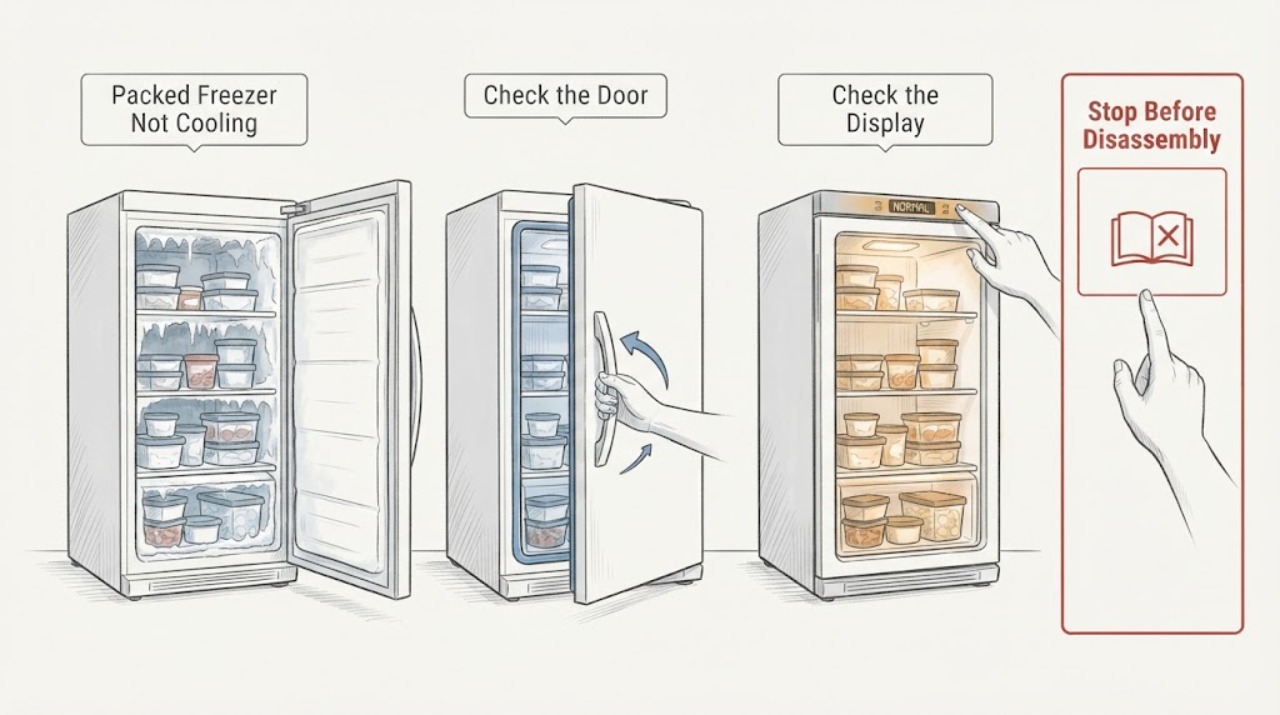
If a Hotpoint HTS18GBSBRWW freezer is packed with food and items thawed, protect the food before repeatedly opening the door or changing controls. Keep the door closed, separate packages, and check each item for ice crystals or a temperature of 40°F/4°C or below; USDA guidance says food meeting either condition may be safely refrozen or cooked, while food above 40°F for more than two hours should be discarded. Once the food is safe, reduce crowding enough to expose the model's air passages without poking through vents or removing panels. Measure the temperature between frozen packages, not just the air, and allow the appliance time to recover. An exact HTS18GBSBRWW report describes a packed freezer whose temperature recovered to 0°F after the load was reduced, so overpacking and blocked airflow can mimic a failed fan or cooling system. If the temperature stays high with clear airflow, a closed door, and proper controls, stop and arrange qualified service.
Work through in order
Diagnostic checks
Use only checks that match the exact appliance or system and its official guide.
-
Check 1
Without leaving the freezer door open, group the food and inspect each package only long enough to triage it. Keep items with ice crystals or a measured temperature of 40°F/4°C or below together in the coldest available location; move them to another working freezer or a cooler with ice if the appliance will not recover. Separate raw meat and poultry so leaking juices cannot contact other food.
Expected result: Food is still hard or has ice crystals; packages are at or below 40°F; some items are soft but cold; or perishable food has been above 40°F for more than two hours or its time/temperature is unknown.
Next step: Refreeze or cook only items that meet the USDA condition, discard items that exceed the time/temperature limit, and keep the door closed while arranging a temporary cold-storage plan. Do not taste food to test it.
Stop if: Stop handling and discard any item contaminated by raw-meat juices or any food whose safety cannot be established from time, temperature, or ice-crystal evidence.
Why this matters
Why: Ice crystals or a refrigerator-cold temperature support refreezing or prompt cooking under USDA guidance. Food held warm beyond the safe time is a food-safety decision, not something a freezer repair can make safe.
-
Check 2
After the food is protected, reduce the packed load only enough to expose the visible rear or shelf air passages and leave space for air to circulate. Move large containers away from vents without moving a loaded refrigerator. Do not insert a utensil into a vent, remove the fan cover, or scrape ice from a panel.
Expected result: The freezer was tightly packed, packages were pressed against an air passage, the passage is now visibly clear, or the interior is blocked by heavy frost rather than food.
Next step: Close the door and allow the appliance to stabilize while monitoring the temperature. If frost blocks the passage, follow only the HTS18GBSBRWW manual's permitted defrost method; stop and arrange service if a panel must be removed or frost rapidly returns.
Stop if: Do not use a knife, hair dryer, heat gun, spoon, or other tool on the vent, fan, evaporator, or ice.
Why this matters
Why: A crowded cabinet or blocked passage can create warm spots even while the compressor runs. A clear passage with heavy frost points to a different airflow/defrost branch and cannot be safely fixed by poking or scraping.
-
Check 3
Place a freezer-capable thermometer between packages on the middle shelf or near the center, close the door, and wait at least three minutes before reading it. Use the exact manual for the control setting; GE Appliances lists 0°F as the recommended freezer setting and a refrigerator-freezer section may measure between -5°F and +8°F under its general guidance.
Expected result: The measured temperature is in the expected range, is rising but improving after the load was reduced, or remains above the safe target after the freezer has had time to stabilize.
Next step: Keep the door closed and monitor recovery after the load is rearranged. If the reading remains high or food continues to soften, protect the food and request service with the measured temperature and timeline.
Stop if: Do not repeatedly open the door to check the thermometer, change the control by several settings at once, or infer a failed component from one air reading taken immediately after opening.
Why this matters
Why: A center reading near the normal range argues against an ongoing cooling failure even if the cabinet felt warm during loading. A persistently warm reading after clear airflow and a closed door means overpacking alone is no longer a sufficient explanation.
-
Check 4
With the door closed, listen from outside for a normal cooling cycle and check the visible door closure and gasket contact. Confirm that the control is not at OFF and that the cabinet has the model-required clearance; do not hold a door switch, reach through a vent, or remove a panel to watch the fan.
Expected result: The door or gasket has a gap, the control is off or warmer than intended, the freezer is near a heat source or has restricted clearance, the compressor runs but temperature does not recover, or the freezer is quiet and remains warm.
Next step: Correct only a visible obstruction or model-approved control setting, then allow stabilization. If the door will not seal, the unit needs moving, the compressor/fan behavior is abnormal, or the measured temperature stays high, arrange qualified appliance service.
Stop if: Stop immediately for smoke, burning odor, sparks, a hot or damaged cord, repeated breaker trips, oil or refrigerant evidence, or any need to access live wiring or the sealed system.
Why this matters
Why: A closure, control, or installation condition can explain warming without an internal part failure. Persistent warmth with those external conditions corrected leaves fan, defrost, compressor, control, or sealed-system diagnosis to a technician.
Use your observations
Decision map
Find the observation that best matches what you see, then follow the next safe action.
-
PATH 01Next step
What you see
The freezer was tightly packed, air passages were covered, and the center temperature returns to the normal range after food is rearranged while the door stays closed.
Do this next
Keep packages below the visible air passages and monitor the temperature. If the same pattern returns with a normal load, arrange service rather than continuing to overload the compartment.
Why this path and its safety boundary
Why it matters: The packed load and restricted airflow were sufficient to explain the temporary thawing; a fan or compressor replacement is not established.
-
PATH 02Next step
What you see
Surface food thawed while lower food stayed frozen, as in the exact HTS18GBSBRWW report, but the freezer later reaches about 0°F after the load is reduced.
Do this next
Record the load arrangement and thermometer result, keep vents clear, and request service if warming recurs with clear space or if the fan/defrost behavior is abnormal.
Why this path and its safety boundary
Why it matters: Uneven airflow or package placement is more likely than complete loss of cooling, although the community report is not a verified diagnosis.
-
PATH 03Next step
What you see
The freezer remains above its normal target after load reduction, the door seals, the control is correct, and there is no obvious frost or installation obstruction.
Do this next
Keep the door closed, transfer or protect food, and arrange qualified Hotpoint/GE appliance service. Leave the symptoms available for diagnosis and do not remove panels or test live components.
Why this path and its safety boundary
Why it matters: The problem is no longer safely explained by overpacking; fan, defrost, control, compressor, or sealed-system faults remain possible.
-
PATH 04Next step
What you see
Food has been above 40°F for more than two hours, contains no ice crystals, or its time and temperature cannot be established.
Do this next
Discard the affected perishable food according to USDA guidance, keep the freezer closed, and then address the appliance fault. Do not taste food to decide.
Why this path and its safety boundary
Why it matters: Food safety takes priority over repair, and refreezing does not make unsafe food safe.
Helpful context
Understand the symptom
A freezer packed with food creates two different decisions: whether the food is still safe, and whether the appliance is actually failing. Do not diagnose the compressor or fan while the door is being opened repeatedly. USDA says food may be refrozen or used if it still contains ice crystals or is at 40°F or below, but perishable food that has been above 40°F for more than two hours should be discarded; appearance and smell are not reliable safety tests.
The exact HTS18GBSBRWW is a Hotpoint 18.2-cubic-foot top-freezer refrigerator supported through the GE Appliances parts and documentation system. A matching user report says the freezer was well packed, surface food thawed while lower food stayed frozen, and the freezer returned to 0°F within a few hours after food was moved out. That is not proof that every warm HTS18GBSBRWW is overpacked, but it makes load and airflow the first reversible branch before fan or sealed-system diagnosis.
GE Appliances' support guidance says large containers can block airflow, and its temperature procedure places a thermometer between packages on the middle shelf for at least three minutes. Use those checks after the food is protected. Do not insert a spoon or tool through a vent, remove the rear panel, or force a fan to turn; those actions can damage the appliance or expose moving and electrical parts.
Only after diagnosis
Potential parts
- evaporator fan or fan-control component
Only after a technician confirms that the freezer remains warm with clear airflow and that the fan is not operating under the exact model's safe diagnostic procedure; do not infer a fan failure from a fan that is not visible with the door open.
- defrost, compressor, control, or sealed-system component
Only after persistent high temperature remains despite a normal load, closed door, correct setting, and no external airflow obstruction; the packed-food symptom alone does not identify a part.
When checks do not resolve it
Need a professional?
Arrange qualified service when the HTS18GBSBRWW remains warm after the load is reduced and visible airflow is clear, when the temperature repeatedly rises, frost returns or blocks an air passage, the door or gasket will not seal, the compressor or fan behaves abnormally, or any panel, live-voltage, defrost, or sealed-system work would be required. Stop immediately for smoke, burning odor, sparks, a hot or damaged cord, repeated breaker trips, or suspected refrigerant leakage.
Common questions
FAQ
Can overpacking make a Hotpoint HTS18GBSBRWW look like it is not cooling?
Yes, it can restrict cold-air movement and create uneven temperatures. An exact HTS18GBSBRWW report describes surface food thawing while lower food stayed frozen and the freezer later returning to 0°F after the load was reduced. Treat that as a useful branch, not a guaranteed diagnosis.
What should I do with food that thawed?
USDA says food may be refrozen or cooked if it still has ice crystals or is at 40°F or below. Discard perishable food that has been above 40°F for more than two hours or whose safety cannot be established, and never taste food to test it.
How can I tell if the freezer actually recovered?
Use a freezer-capable thermometer between packages near the middle, close the door, and wait at least three minutes before reading. GE Appliances lists 0°F as the recommended freezer setting and says a refrigerator-freezer section may measure between -5°F and +8°F under its general guidance. A persistent warm reading after the load is rearranged needs service.
Read the exact guide
Official sources
- Freezer - Measuring TemperatureGE Appliances · The opened manufacturer support article recommends a 0°F freezer setting and placing a freezer-capable thermometer between packages near the middle for at least three minutes; it gives a general refrigerator-freezer range of -5°F to +8°F. Use the exact model manual for control details.
- Everything in my freezer thawed yesterday.Reddit r/appliancerepair · The opened exact-model report identifies Hotpoint HTS18GBSBRWW, describes a heavily packed freezer with surface food thawed while lower food stayed frozen, and later reports a thermometer at 0°F after the load was moved out. It is community evidence without a controlled diagnosis and includes unsafe tool-reaching suggestions that are not used as instructions.
- Model Search: HTS18GBSBRWWGE Appliances / Hotpoint parts support · The opened manufacturer parts/support page identifies HTS18GBSBRWW as a Hotpoint 18.2-cubic-foot top-freezer refrigerator and provides an owner's-manual link. It establishes the exact model identity, not a diagnosis of the cooling fault.
- Refrigerator - Not Cooling EnoughGE Appliances · The opened GE Appliances support article says large containers can block airflow, gives checks for food load, door closure, settings, clearances, and condenser maintenance, and recommends service if the unit remains warm. It is general manufacturer guidance and does not prove a specific HTS18GBSBRWW component fault.
- Freezing and Food SafetyUSDA Food Safety and Inspection Service · The opened USDA guidance says food with ice crystals or at 40°F or below may be refrozen or used, while food above 40°F for more than two hours should be discarded; it also advises keeping a failed freezer closed and not relying on tasting. This is the food-safety branch, not appliance diagnosis.
Community feedback
Share a repair observation
Share a plain-text repair observation. Accepted observations are published automatically; this page may take a moment to update.