
On this page
Start here
Quick answer
If a Hotpoint oven is burning food, first identify whether you are using a fan-assisted setting, a top oven, or a grill setting, then check the shelf position and pan shape. Hotpoint says a change from conventional cooking to fan-assisted cooking may require about 25°C less heat and about 10 minutes less cooking time per hour; it also advises placing food centrally on a shelf rather than on the oven floor, because top-oven grill elements and high-sided pans can change how heat reaches the food. If food continues to burn after those model-appropriate setting and placement checks, stop treating it as a recipe adjustment and use the exact model manual or arrange service. If there is smoke or an oven fire, turn off the heat, keep the door closed, and follow fire-safety guidance.
Before you begin
Safety first
- Keep user checks to cool-oven observations, selected mode, shelf and pan position, manual lookup, and controlled cooking observation. Do not open the oven, perform live electrical tests, adjust gas, bypass controls, or replace an internal part based only on burned food.
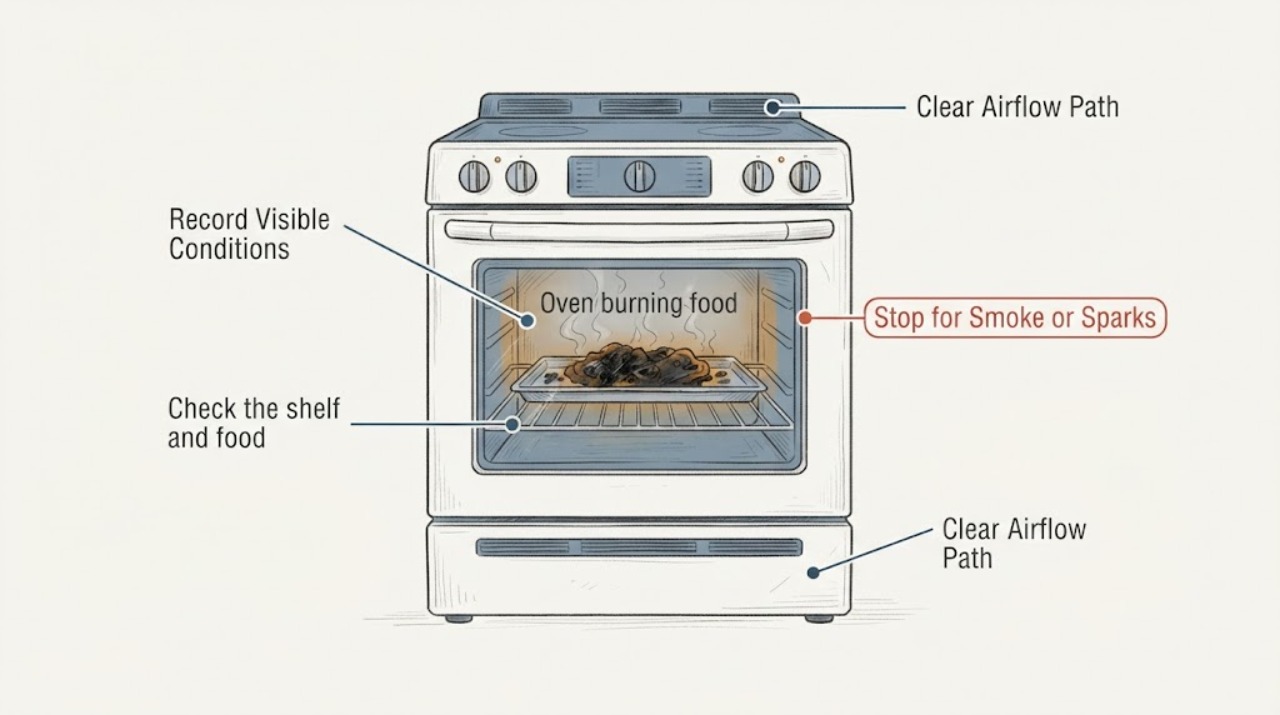
Work through in order
Diagnostic checks
Use only checks that match the exact appliance or system and its official guide.
-
Check 1
Record the selected cooking function and whether the oven is fan-assisted, conventional, a top oven, or using a grill setting before changing anything.
Expected result: The food burns after switching from conventional cooking to fan-assisted cooking, or it is in a top-oven/grill arrangement where heat is supplied from above as well as below.
Next step: Use the exact recipe and model guidance for that function, make one controlled temperature or time change, and watch the food earlier rather than repeating the original setting unchanged.
Stop if: Continue with shelf and pan placement checks; do not infer a failed component just because the food is over-browning.
Why this matters
Why: Hotpoint says fan-assisted cooking may need approximately 25°C less temperature and approximately 10 minutes less cooking time per hour; it also says the top oven uses grill elements with the top-oven apparatus.
-
Check 2
Check the shelf and food position with the oven cool: keep the food centred on a shelf and confirm that the vessel is not sitting directly on the oven base.
Expected result: The dish was on the oven floor, off-centre, or close to a concentrated heat source, and the browning is strongest on the nearest side or underside.
Next step: Repeat the same dish once with the supported shelf and centred position, using a conservative time check; compare the top, bottom, and edges with the original result.
Stop if: Move to the pan and airflow check rather than repeatedly increasing or decreasing heat without recording the mode.
Why this matters
Why: Hotpoint recommends a central position on a shelf so heat can circulate around the cooking vessel; placement can change the result without proving that the oven has an internal failure.
-
Check 3
Inspect the pan or baking vessel and its clearance from the oven walls without touching hot surfaces; note whether it has unusually high sides or blocks the airflow around the food.
Expected result: Only dishes in a high-sided or crowded vessel burn, while a shallower suitable vessel in the same mode cooks more evenly.
Next step: Use a suitable lower-sided vessel or the vessel specified by the recipe/manual and compare one controlled bake; keep the mode and temperature recorded.
Stop if: If different suitable vessels burn in the same area or the whole cavity overheats, use the exact model manual and arrange service rather than guessing a part.
Why this matters
Why: Hotpoint states that pans with high sides may affect cooking performance because of airflow, so a vessel-specific result does not establish a failed element or thermostat.
-
Check 4
Identify the exact Hotpoint model or 12NC and compare the selected symbol, shelf guidance, and cooking limits with its official manual before attempting further diagnosis.
Expected result: The model documentation confirms a different function, shelf arrangement, automatic programme, or temperature/time rule from the one being used.
Next step: Follow the matching manual and retest only under its stated conditions; if the manual does not resolve repeated burning, book qualified service.
Stop if: If the exact manual still cannot explain persistent over-browning, stop changing internal settings or parts and arrange model-specific assessment.
Why this matters
Why: Hotpoint's manual service is model-indexed; brand-level advice cannot establish the functions or settings of an unidentified oven.
Use your observations
Decision map
Find the observation that best matches what you see, then follow the next safe action.
-
PATH 01Next step
What you see
Food burns mainly after a change to fan-assisted cooking, or the same recipe browns much faster than it did in a conventional mode.
Do this next
Apply one controlled reduction for that mode and inspect the food earlier; if it still burns across suitable settings, use the exact model manual and arrange service.
Why this path and its safety boundary
Why it matters: Hotpoint identifies a mode-related adjustment: fan-assisted cooking may need roughly 25°C less temperature and roughly 10 minutes less cooking time per hour.
-
PATH 02Next step
What you see
The underside, one edge, or the area nearest a heat source burns, and the vessel was on the oven base, off-centre, or in an unusual shelf position.
Do this next
Cool the oven, reposition the vessel centrally on a shelf, and run a single controlled comparison using the same mode and recipe.
Why this path and its safety boundary
Why it matters: The observed pattern is consistent with the placement and circulation issue Hotpoint addresses by recommending a centred vessel on a shelf; it does not diagnose an internal component.
-
PATH 03Next step
What you see
Only high-sided or crowded pans burn while a suitable shallower vessel does not, or the result changes with pan clearance.
Do this next
Use the vessel and clearance specified by the recipe or model manual; escalate if different suitable pans still burn in the same area.
Why this path and its safety boundary
Why it matters: Hotpoint says high-sided pans may affect cooking performance through airflow, so the pan and loading pattern are the first supported variables to change.
-
PATH 04Next step
What you see
Smoke continues, flames appear, or the oven has an oven or broiler fire rather than ordinary over-browning.
Do this next
Turn off the heat and keep the door closed; if flames escape or the fire is not controlled, leave the area and contact emergency services. Do not reopen or reuse the oven until it has cooled and been assessed.
Why this path and its safety boundary
Why it matters: This is a cooking-fire safety event, not a normal diagnostic bake. CPSC advises turning off the heat and keeping the oven door shut; USFA advises turning off heat when smoke or excessive heat indicates fire risk.
Helpful context
Understand the symptom
Burning food does not by itself prove that a Hotpoint heating element, thermostat, or control board has failed. The visible result can change when the oven mode, shelf position, pan shape, or cooking time is different. Start with the settings and placement that Hotpoint specifically identifies for poor cooking results, then escalate if the same pattern remains across more than one suitable dish or setting.
Keep the check controlled: use one recipe, note the selected mode and temperature, record which shelf was used, and observe whether the top, bottom, edges, or the whole dish browns too quickly. That pattern tells you which supported branch to follow, but it does not identify an internal part without the exact model manual or a technician's assessment.
If the food produces smoke or flames, stop troubleshooting as a cooking experiment. Turn off the heat and keep the oven door closed for an oven fire. If flames leave the oven or the situation is not controlled, leave the area and contact emergency services.
When checks do not resolve it
Need a professional?
Use the exact Hotpoint model documentation and arrange qualified service for persistent over-browning after the supported setting and placement checks, suspected overheating, an electrical or gas smell, or any fire event.
Safety scope: Keep user checks to cool-oven observations, selected mode, shelf and pan position, manual lookup, and controlled cooking observation. Do not open the oven, perform live electrical tests, adjust gas, bypass controls, or replace an internal part based only on burned food.
Common questions
FAQ
Should I lower the temperature if a Hotpoint fan oven burns food?
Hotpoint says that people moving from a conventional oven to a modern fan-assisted oven may need to reduce the cooking temperature by approximately 25°C and the cooking time by approximately 10 minutes per hour. Confirm the selected mode and make one controlled adjustment rather than applying the same reduction to every function.
Can putting the tray on the oven floor cause burning?
Hotpoint recommends placing food centrally on a shelf rather than directly on the oven base so heat can circulate around the vessel. Reposition the food when the oven is cool and compare the result before assuming an internal fault.
What should I do if the burning turns into smoke or an oven fire?
Turn off the heat and keep the oven door shut. CPSC gives that instruction for an oven or broiler fire; if flames escape the oven or the situation is not controlled, leave the area and contact emergency services. Do not reopen or reuse the oven until it has cooled and been professionally assessed.
Do I need my Hotpoint model number?
Yes for model-specific settings and service. Hotpoint's manual page asks for the first five digits of the model number or the 12NC to locate the matching manual, so use that document before relying on a function-specific instruction.
Read the exact guide
Official sources
- Cooking Fire SafetyU.S. Fire Administration · Opened the U.S. Fire Administration page. It advises staying with cooking, turning off heat if smoke or excessive heat indicates fire risk, and keeping a cover available for a pan fire.
- Hotpoint Appliance ManualsHotpoint UK Appliances Limited · Opened Hotpoint's manual service page. It explicitly includes ovens and directs the user to search using the first five model digits or 12NC before downloading the matching manual.
- Hotpoint Oven Troubleshooting & RepairHotpoint UK Appliances Limited · Opened the Hotpoint oven troubleshooting page. It directly covers poor cooking results for Hotpoint ovens and states the fan-assisted temperature/time adjustment, shelf and central placement, top-oven grill arrangement, and high-sided-pan airflow limitation.
- Hotpoint Service Oven RepairHotpoint UK Appliances Limited · Opened the Hotpoint oven repair page. It identifies poor cooking results as a Hotpoint troubleshooting topic, directs owners to model manuals for detailed information, says appliance parts should only be replaced with the appliance unplugged, and directs unresolved issues to Hotpoint service.
- Recipe for Safer CookingU.S. Consumer Product Safety Commission · Opened the CPSC safety page. It advises keeping the oven door shut and turning off the heat for an oven or broiler fire, and calls for emergency services when appropriate.
Community feedback
Share a repair observation
Share a plain-text repair observation. Accepted observations are published automatically; this page may take a moment to update.