
On this page
Start here
Quick answer
Treat a gas smell from a Hotpoint RGB745-series oven as a possible gas-safety event even if the smell disappeared after a restart. Do not restart it to test the symptom, operate switches, create a flame, adjust a valve, or inspect gas connections. If the odor is present now, leave the room or building and, from outside the affected area, contact the local gas supplier or fire service. Once safe, tell the landlord or property manager and arrange qualified gas-appliance service before any further use. GE says steam or moisture around a range can be normal during cooking, and some clicking or fan sounds can be normal, but those general observations do not clear a reported gas odor or an unexplained hissing sound. RGB745 is a series label rather than a complete model number, so save the exact suffix when it can be read without moving the cooker.
Work through in order
Diagnostic checks
Use only checks that match the exact appliance or system and its official guide.
-
Check 1
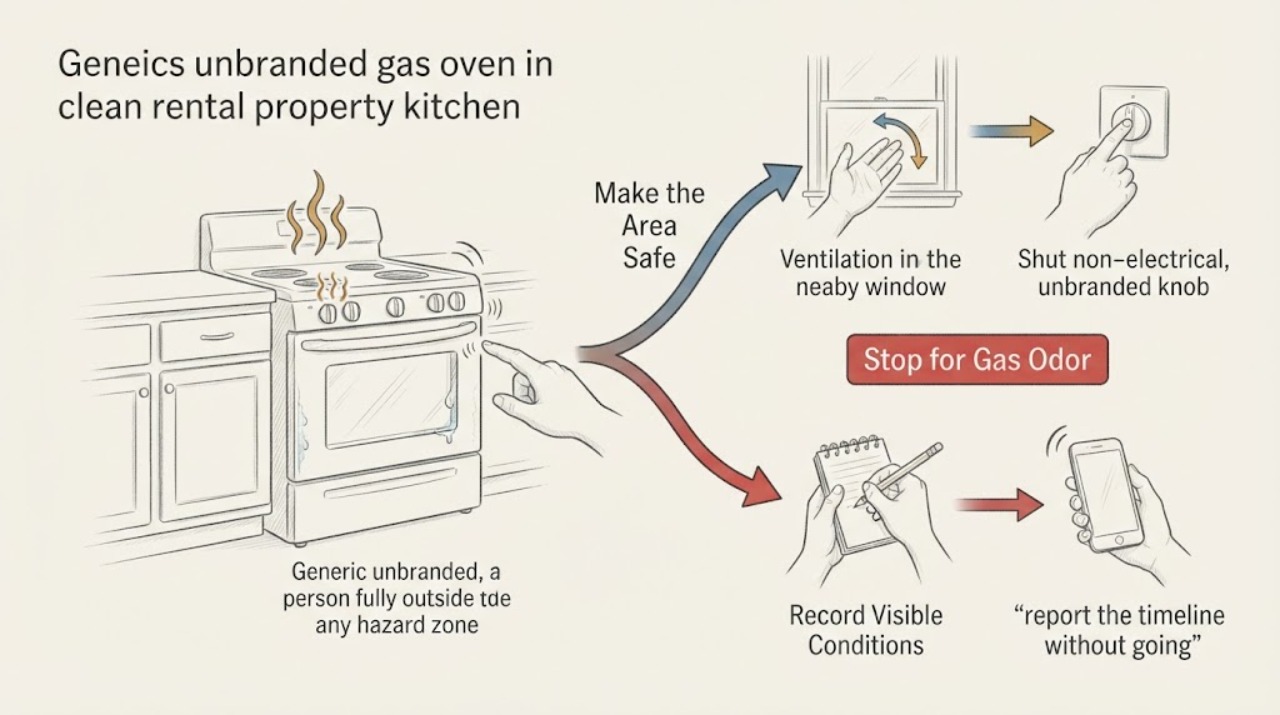
If a gas or rotten-egg odor is present now, stop all troubleshooting, do not light any appliance, do not touch electrical switches or use a phone inside, and leave the room or building by the safest available route.
Expected result: The smell is present with the oven on or off, is strong or spreading, or is accompanied by smoke, flame, a boom, delayed ignition, or a person feeling unwell.
Next step: From outside the affected area, contact the local gas supplier or fire service and follow its instructions. Keep the oven off and do not re-enter to operate it until responders say it is safe.
Stop if: Do not return to smell-check the range, turn a control, relight a burner, or use an electrical device inside the affected area.
Why this matters
Why: This is an active gas-safety symptom, not a normal oven odor to test. Unburned gas can ignite, and unsafe combustion can create additional hazards.
-
Check 2
After everyone is in a safe place, report the timeline without going back to inspect the oven: whether the smell began during ignition, continued after the oven was turned off, appeared while the oven was unused, and whether the restart was performed before the odor disappeared.
Expected result: The odor returned after shutdown, occurred while unused, was associated with a restart, or was noticed only briefly during a cooking event; the exact sequence may be incomplete.
Next step: Give the unedited timeline to the gas supplier, fire responder, or qualified gas-appliance technician. Do not repeat the restart or any ignition attempt to obtain a clearer pattern.
Stop if: Keep the range out of service until qualified personnel assess it, even if the room no longer smells of gas.
Why this matters
Why: Timing helps the gas responder triage a possible leak, delayed ignition, connection issue, or combustion concern, but a faded odor does not prove that the appliance is safe.
-
Check 3
From a safe location and without touching the appliance, write down whether the reported sound was a brief click, a fan sound, a sustained hiss, a delayed whoosh, or a boom; do not return to listen closely or try to reproduce it.
Expected result: The sound was only a brief click or fan sound during known operation, or it was a sustained/unfamiliar hiss, delayed whoosh, boom, or sound heard with the oven off.
Next step: Treat an unfamiliar hiss, delayed whoosh, or boom as a service or gas-emergency detail and include its timing in the report. Do not run another cycle to classify the sound.
Stop if: Do not put a hand near a burner, open a gas compartment, adjust a regulator, or use a recording attempt that requires re-entering an unsafe area.
Why this matters
Why: GE lists temperature-control clicks, burner cycling clicks, and cooling-fan operation as common range sounds. That list does not establish that a hissing or delayed ignition sound is normal, especially when paired with gas odor.
-
Check 4
Separate the moisture observation from the gas report by documenting it only from a safe location: note whether condensation was on the cooktop, around the door, or near the vent, and whether it occurred during cooking with moist food; do not wipe, open, or operate the oven to investigate.
Expected result: Moisture appeared during cooking near the vent, cooktop, or oven door, or it appeared with the oven off, with a gas odor, with soot, or with unusual heat.
Next step: If the moisture was only an ordinary cooking observation and there had never been a gas odor or unfamiliar sound, it can be noted for routine model-specific support. Because this task includes gas odor and hissing, keep the oven off and give both observations to qualified service.
Stop if: Do not use condensation as a reason to restart the oven, and do not touch wet controls or electrical parts.
Why this matters
Why: GE says cooking steam or moisture can collect near a range vent or form around the oven door, but moisture with a gas odor, abnormal heat, smoke, or soot is not cleared by the normal-condensation explanation.
-
Check 5
Only after the area and appliance have been declared safe, read the model and serial label from its normal accessible location without moving the range or opening a gas compartment. Record the complete suffix rather than reporting only RGB745 series.
Expected result: The label supplies a complete RGB745 model suffix, or it is hidden, damaged, or cannot be read without moving the range.
Next step: Send the label photo and the rental property's appliance information to the landlord or qualified service provider. If the label cannot be read safely, let the technician identify it during the visit.
Stop if: Do not pull the range out, kneel behind it, remove a drawer or panel, or open a gas compartment to find the label.
Why this matters
Why: Hotpoint's support pages and manuals are variant-specific. A complete suffix allows the gas professional or property manager to select the correct installation, safety, and service information; an incomplete identity is not permission to dismantle the range.
-
Check 6
Notify the landlord or property manager that the gas range is out of service and provide the exact timeline, odor status, sound description, condensation location, photos taken from a safe position, and any emergency responder instructions.
Expected result: The property manager can arrange gas-supplier or qualified appliance service, or no responsible contact is immediately available while the odor returns or the area cannot be isolated.
Next step: Use the local gas-emergency or fire-service route for a current odor; otherwise keep people away from the appliance and obtain qualified gas-appliance service through the property manager. Do not authorize a tenant-side valve, regulator, leak, or burner adjustment.
Stop if: Keep the appliance off until the qualified professional or gas supplier gives return-to-use clearance; do not re-enter an unsafe area to collect more evidence.
Why this matters
Why: In a rental, the owner or manager needs the safety report and the exact appliance identity to control access and arrange qualified work. Lack of an immediate landlord response does not make user repair or a restart appropriate.
Use your observations
Decision map
Find the observation that best matches what you see, then follow the next safe action.
-
PATH 01Next step
What you see
Gas odor is present now, returns after shutdown, or is accompanied by smoke, a flame, delayed ignition, a boom, or illness symptoms.
Do this next
Leave without operating switches or appliances, and from outside the affected area contact the local gas supplier or fire service. Keep the Hotpoint range off until responders clear it.
Why this path and its safety boundary
Why it matters: The situation is an active gas or combustion safety event; the fact that a restart previously made the odor disappear does not reduce that urgency.
-
PATH 02Next step
What you see
The odor is gone now, but there was an unexplained hiss, delayed whoosh, gas odor while the oven was off, or a restart was needed before the smell faded.
Do this next
Do not restart or reproduce the event. Notify the landlord or property manager and arrange qualified gas-appliance assessment before any further use; escalate to the gas supplier if the odor returns.
Why this path and its safety boundary
Why it matters: An intermittent or unresolved gas, ignition, connection, or combustion condition remains possible. Disappearance after a restart is not a safety clearance and does not identify a valve, igniter, regulator, or burner.
-
PATH 03Next step
What you see
The only moisture was ordinary cooking condensation near a vent, cooktop, or door, with no gas odor, unfamiliar sound, soot, smoke, or abnormal heat.
Do this next
For this reported event, keep the oven off and have the gas professional or property manager review the odor and sound history. Do not run a test bake to prove the moisture explanation.
Why this path and its safety boundary
Why it matters: GE describes steam or moisture during cooking as potentially normal, so moisture alone does not establish a gas fault. That explanation cannot be used to dismiss the separate gas-smell report in this task.
-
PATH 04Next step
What you see
The complete RGB745 suffix is unavailable, the range was recently installed or moved, or the smell source cannot be confirmed safely.
Do this next
Keep the range out of use, tell the landlord or property manager, and let a qualified gas professional identify the appliance and inspect the installation. Do not move the range to find the label.
Why this path and its safety boundary
Why it matters: The model-specific installation and gas connection context is unresolved. A partial series label or an assumption about the source is not enough for a safe user diagnosis.
Helpful context
Understand the symptom
The supplied identity is RGB745 series, not a complete Hotpoint model suffix. GE's support center has separate RGB745 entries, and an older Hotpoint manual covers particular RGB745 variants; do not assume one variant's burner, ignition, or safety information applies to every RGB745 range.
Condensation can be an ordinary by-product of cooking, but it is a separate observation from a gas odor. A restart that makes the smell disappear changes what is observed, not the safety decision: the oven stays out of use until qualified gas service or the gas supplier clears it.
When checks do not resolve it
Need a professional?
Use the local gas-emergency or fire-service route immediately from outside the affected area for an odor present now, a smell that returns, smoke, fire, delayed ignition, a boom, an abnormal flame, or symptoms such as dizziness, headache, breathing difficulty, or nausea. For any unexplained gas odor, hissing sound, or odor that disappeared only after restarting, keep the Hotpoint oven off and arrange qualified gas-appliance service through the landlord or property manager before reuse. Do not operate switches or flames in the affected area, reproduce the symptom, test for leaks, adjust a valve or regulator, open a gas compartment, or dismantle the range.
Common questions
FAQ
If the gas smell disappeared after restarting the oven, is it safe now?
No. A faded odor changes the observation but does not clear a gas, ignition, connection, or combustion concern. Do not restart it again; report the sequence and arrange qualified assessment before use.
Can condensation explain the gas smell?
GE says steam or moisture near a range vent, cooktop, or door can be normal during cooking. That is a separate observation and cannot explain away a gas odor or unfamiliar hiss, particularly when the oven was off or the odor required a restart to disappear.
What should a renter do when the model is only marked RGB745?
Keep the range off, notify the landlord or property manager, and provide the complete label only if it can be read without moving the appliance. Let qualified service identify the exact suffix and inspect the gas installation.
Read the exact guide
Official sources
- Range & Wall Oven - Normal Sounds During UseGE Appliances · GE range normal operating sound examples and their limits
- HotpointHotpoint / GE Appliances · Older Hotpoint gas-range safety manual covering listed RGB745 variants, including gas-odor response and qualified installation/service; not a complete-model match for every RGB745 series appliance
- User Manual & Care for RGB745WEHWW | GE AppliancesGE Appliances · Hotpoint RGB745 series model-identity boundary; this page identifies the exact variant RGB745WEHWW and links its Owner's Manual and service support
- Range & Wall Oven - Steam or Smoke Near Control PanelGE Appliances · GE range vent steam or vapor near the control panel during cooking
- If You Smell Gas in Your HomeGE Appliances · GE gas smell safety boundary for the topic identity gas smell hissing sound condensate: avoid switches and flames, clear the area, and call the gas supplier or fire service from outside
- Range - Moisture Build-Up on Cooktop Surface or Around the DoorGE Appliances · GE range cooking moisture and condensation context, not gas-leak clearance
Community feedback
Share a repair observation
Share a plain-text repair observation. Accepted observations are published automatically; this page may take a moment to update.