
On this page
Start here
Quick answer
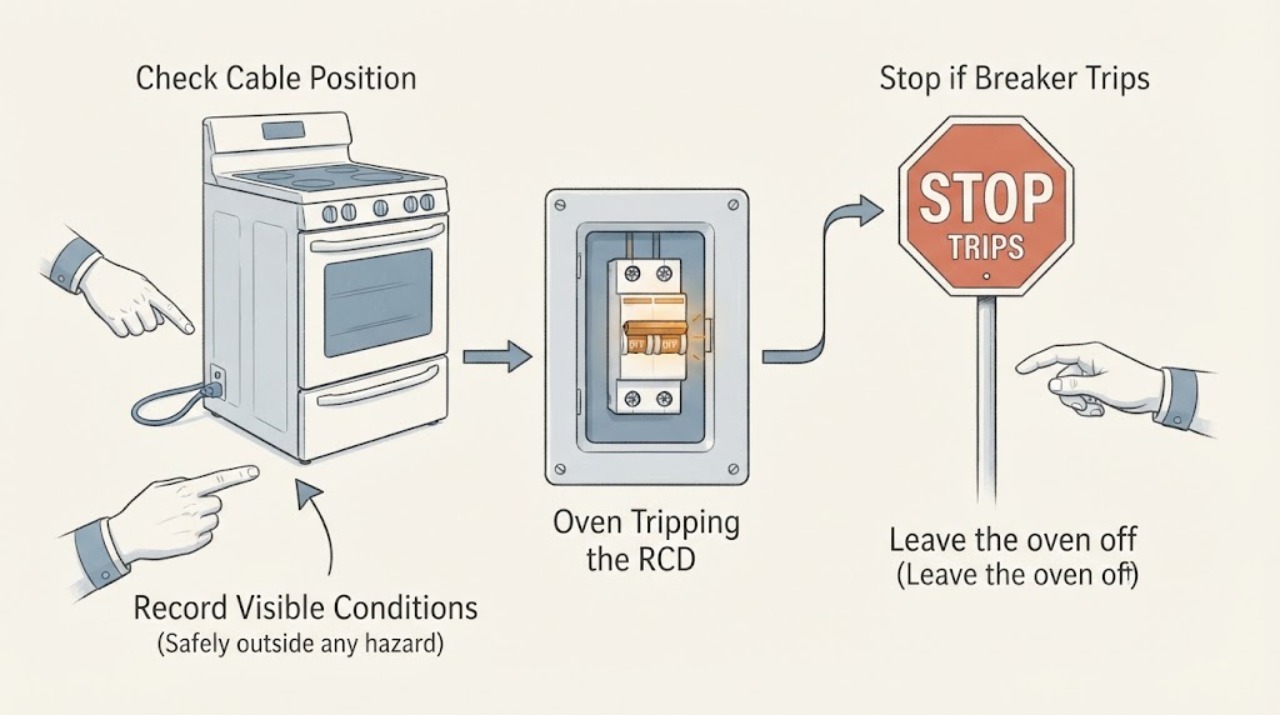
A Hotpoint oven that trips an RCD or circuit breaker should be taken out of use; do not keep resetting the protection, bypass it, or run tests with the cover removed. Electrical Safety First says repeated breaker trips, blown fuses, arcing or a hot plug/socket are reasons to unplug the oven and contact the retailer, manufacturer or a qualified repair technician. HSE says an RCD trip is a sign of a fault and must never be bypassed. From a safe, dry position, isolate a plug-in oven at the plug or a hardwired oven at its cooker switch/breaker only if there is no active hazard, record when the previous trip occurred, check only visible external damage after the unit is cool, and arrange Hotpoint or qualified electrical service with the exact model and installation details.
Before you begin
Safety first
- Do not repeatedly reset the RCD, bypass or up-rate protection, run the oven with panels removed, perform live measurements, pull out a built-in oven, or replace an element, fan, thermostat, control board or cable based only on the trip.
Work through in order
Diagnostic checks
Use only checks that match the exact appliance or system and its official guide.
-
Check 1
Leave the Hotpoint oven off after the RCD or breaker trip; do not reset it just to see whether it will run again.
Expected result: There is smoke, burning odor, arcing, exposed wiring, water near electrics, a hot plug/socket or active fire, or none of these visible hazards.
Next step: For active smoke/fire or danger, move away and call emergency help. Otherwise isolate the oven from a dry, safe position and arrange qualified service.
Why this matters
Why: Any hazard makes this an immediate electrical/fire risk; absence of a visible hazard does not prove the oven is safe because an RCD trip still signals a fault.
-
Check 2
Once cool and safe, isolate a plug-in oven at its plug or a hardwired oven at the cooker switch/breaker; do not pull out a built-in unit or remove covers.
Expected result: The oven is safely isolated, or the isolation point is inaccessible/uncertain.
Next step: If isolation cannot be confirmed without contact with a hazard or live equipment, leave it alone and call a qualified electrician or Hotpoint service.
Why this matters
Why: Isolation prevents another energization while preserving the boundary against user electrical work; uncertainty about the isolation point is itself a reason to use a qualified person.
-
Check 3
Record the last safe operating state: selected function, whether heating had begun, display/light/fan state, and which labelled protective device opened.
Expected result: The previous trip occurred immediately, after heating began, or at an unknown point.
Next step: Give the timeline to service and do not repeat the function to reproduce the trip.
Why this matters
Why: Timing is useful history for a technician but cannot identify an element, fan, wiring, thermostat or control fault without qualified testing.
-
Check 4
With power isolated and the oven cold, inspect only visible exterior areas for burn marks, melted plastic, damaged cord/plug/socket, water, grease or other obvious damage.
Expected result: External damage or heat marks are visible, or the exterior looks normal.
Next step: Keep the oven isolated and provide photographs to Hotpoint/qualified service. Do not open the terminal block, rear panel or control console.
Why this matters
Why: Visible damage strengthens the need for immediate service; a normal exterior does not clear hidden insulation or appliance faults.
-
Check 5
Read the full rating-label model and 12NC without dismantling the oven, then use Hotpoint's manual finder and safety-notice check.
Expected result: The full model/12NC is readable, or it is missing/unreadable.
Next step: If readable, send it with the fault history to service. If not, photograph the label area and ask Hotpoint to recover the product identity; keep the oven isolated.
Why this matters
Why: The exact manual and any model safety notice cannot be selected confidently without the identity; a similar Hotpoint model is not an adequate substitute.
-
Check 6
Arrange Hotpoint service or a qualified electrician for the isolated oven; do not perform live measurements, bypass the RCD, replace a breaker with a larger rating, or substitute a part.
Expected result: The oven remains isolated after a single trip or has tripped repeatedly.
Next step: Provide model/12NC, installation type, protective device, timing and visible signs. Keep the oven out of service until the qualified assessment.
Why this matters
Why: Repeated protection operation is an unresolved electrical fault or installation issue, and public guidance does not support a user component diagnosis.
Use your observations
Decision map
Find the observation that best matches what you see, then follow the next safe action.
-
PATH 01Next step
What you see
Smoke, fire, burning odor, arcing, exposed wiring, water at electrics or a hot plug/socket is present.
Do this next
Move away, do not touch the oven or switchgear in the hazard area, and use emergency help; arrange qualified electrical service afterward.
Why this path and its safety boundary
Why it matters: The oven or installation may present an immediate fire or shock hazard, and the RCD must not be treated as a reset target.
-
PATH 02Next step
What you see
The oven has tripped once, is now isolated, and there is no visible external hazard.
Do this next
Recover the exact model/manual and contact Hotpoint or a qualified technician without re-energizing the oven to test it.
Why this path and its safety boundary
Why it matters: A single event still needs a qualified assessment; a normal-looking exterior cannot rule out an insulation or circuit fault.
-
PATH 03Next step
What you see
The RCD, RCBO or breaker opens again whenever the oven is used or after an earlier reset.
Do this next
Keep the oven isolated, never bypass or up-rate the protective device, and arrange qualified electrical/Hotpoint service.
Why this path and its safety boundary
Why it matters: The recurrence confirms an unresolved fault condition or installation problem; repeated resetting can increase risk and HSE says an RCD trip is a sign of a fault.
-
PATH 04Next step
What you see
The model/12NC is missing or unreadable, so the exact Hotpoint manual and safety status cannot be confirmed.
Do this next
Use the visible rating-label area and Hotpoint contact/manual route to recover identity while keeping the appliance isolated; do not use a similar model's procedure.
Why this path and its safety boundary
Why it matters: Model-specific repair, wiring and component advice would be unsupported.
Helpful context
Understand the symptom
Treat the RCD trip as a safety stop
Do not reset the RCD or breaker and immediately start the Hotpoint oven again. Electrical Safety First lists circuit-breaker trips, blown fuses, arcing and hot plugs or sockets as warning signs and directs the user to unplug the appliance and contact the manufacturer or a qualified repair technician. If there is smoke, fire, exposed wiring, water near electrics or a burning smell, move away and use emergency help; do not touch the appliance or switchgear in the hazard area.
Isolate the appliance without opening it
After the oven is cool and only from a dry, safe position, disconnect a plug-in unit at the plug or switch off the cooker isolation switch/breaker for a hardwired installation. Do not pull out a built-in oven, remove covers, or rely on the front control being off as electrical isolation. HSE says an RCD trip is evidence of a fault and Electrical Safety First advises against repairing an electric oven yourself.
Record the last safe symptom instead of reproducing it
Write down what was selected before the last trip, whether the oven was cold or already heating, whether any light, fan or display was operating, and whether the RCD, RCBO or an overcurrent breaker opened. This history can help a qualified technician, but do not deliberately repeat bake, grill, fan or self-clean cycles to see when the protection trips. A timing pattern is not proof of a failed element or other part.
Make only a visible external check
With power isolated and the oven fully cool, look from outside for burn marks, melted plastic, a damaged cord, heat at the plug/socket, water or grease intrusion, or a loose-looking external connection. Do not remove terminal covers or panels and do not use a meter on the appliance. Electrical Safety First specifically says not to ignore burn marks, arcing, trips or excessive heat; these signs require service, not a user repair.
Recover the exact Hotpoint manual and safety status
Find the full model number and 12NC from the rating label without dismantling the oven. Hotpoint says its manual finder uses the first five model digits or 12NC, and its safety page provides a model-number check for affected appliances. Use the exact manual only for installation and isolation information; do not import a heating-element, wiring or reset procedure from a similar Hotpoint model.
Arrange qualified diagnosis
Give Hotpoint or a qualified electrician the full model/12NC, installation type, country, protective device that opened, the last safe operating sequence and any visible external signs. Hotpoint lists oven support and qualified engineers, while Electrical Safety First advises contacting the retailer, manufacturer or a qualified repair technician for tripping ovens. Do not order an element, fan, thermostat, board or cable from the trip symptom alone.
When checks do not resolve it
Need a professional?
Call Hotpoint or a qualified electrician after any RCD/circuit-breaker trip, and immediately for smoke, arcing, burning odor, damaged wiring, water near electrics or a hot plug/socket. Keep the oven isolated until assessed.
Safety scope: Do not repeatedly reset the RCD, bypass or up-rate protection, run the oven with panels removed, perform live measurements, pull out a built-in oven, or replace an element, fan, thermostat, control board or cable based only on the trip.
Have this ready
- Provide full model and 12NC, country, plug-in or hardwired installation, protective device label, last selected function, trip timing, reset history and photographs of any visible external damage.
Common questions
FAQ
Can I reset the RCD and try the Hotpoint oven again?
No. HSE says an RCD trip is a sign of a fault and must never be bypassed; Electrical Safety First directs users to unplug a tripping oven and contact the manufacturer, retailer or qualified technician. Keep the appliance isolated.
Does the trip prove the heating element is bad?
No. The trip timing is useful history, but without model-specific qualified testing it cannot distinguish an element, wiring, insulation, fan, control, installation or protective-device problem. Do not order a part from the symptom alone.
What if the Hotpoint oven is hardwired?
Do not pull it out or handle the wiring. From a dry, safe position, use only the installed cooker isolation point if its operation is clear and there is no active hazard; otherwise leave it alone and call a qualified electrician or Hotpoint service.
How do I find the right Hotpoint manual without a model?
Hotpoint says its manual finder uses the first five model digits or the 12NC. Recover those from the rating label without dismantling the oven; if they are unreadable, send photographs to Hotpoint service and do not use a similar model manual.
Read the exact guide
Official sources
- Work using electrically powered equipmentUK Health and Safety Executive · Opened UK HSE electrical-safety guidance. It supports treating an RCD trip as a fault indication and never bypassing the device; it is general electrical guidance, not a Hotpoint oven diagnosis or live-test instruction.
- Electrical Safety Advice for Oven and Grills / Oven and Grills SafetyElectrical Safety First · Opened Electrical Safety First oven-safety page. It supports unplugging/isolating a tripping oven, checking only visible plug/socket warning signs and using a qualified repair technician; it does not diagnose a Hotpoint component.
- Hotpoint Appliances Safety NoticesHotpoint UK Appliances Limited · Opened Hotpoint safety-notices page. It says to enter the model number for a safety check and, for an affected safety notice, unplug and refrain from use until resolved. It is cited only for the check itself and its recall-specific stop-use boundary, not as evidence that every tripping oven is recalled.
- Hotpoint Customer Service | Contact Support & AssistanceHotpoint UK Appliances Limited · Opened Hotpoint UK contact page. It directs users to manuals and service/customer-support routes; no phone number or commercial destination is included in the article.
- Hotpoint Appliance ManualsHotpoint UK Appliances Limited · Opened Hotpoint UK manual finder. It says to enter the first five model digits or 12NC and explains that manuals provide product-specific setup and maintenance information; it does not support a universal oven repair procedure.
- Official Hotpoint Appliance Service RepairHotpoint UK Appliances Limited · Opened Hotpoint UK service page. It lists Oven Repair and Gas & Electric Cooker Repair, qualified engineers and service support; used only for escalation, not for diagnosing the trip or selecting a part.
Community feedback
Share a repair observation
Share a plain-text repair observation. Accepted observations are published automatically; this page may take a moment to update.