
On this page
Start here
Quick answer
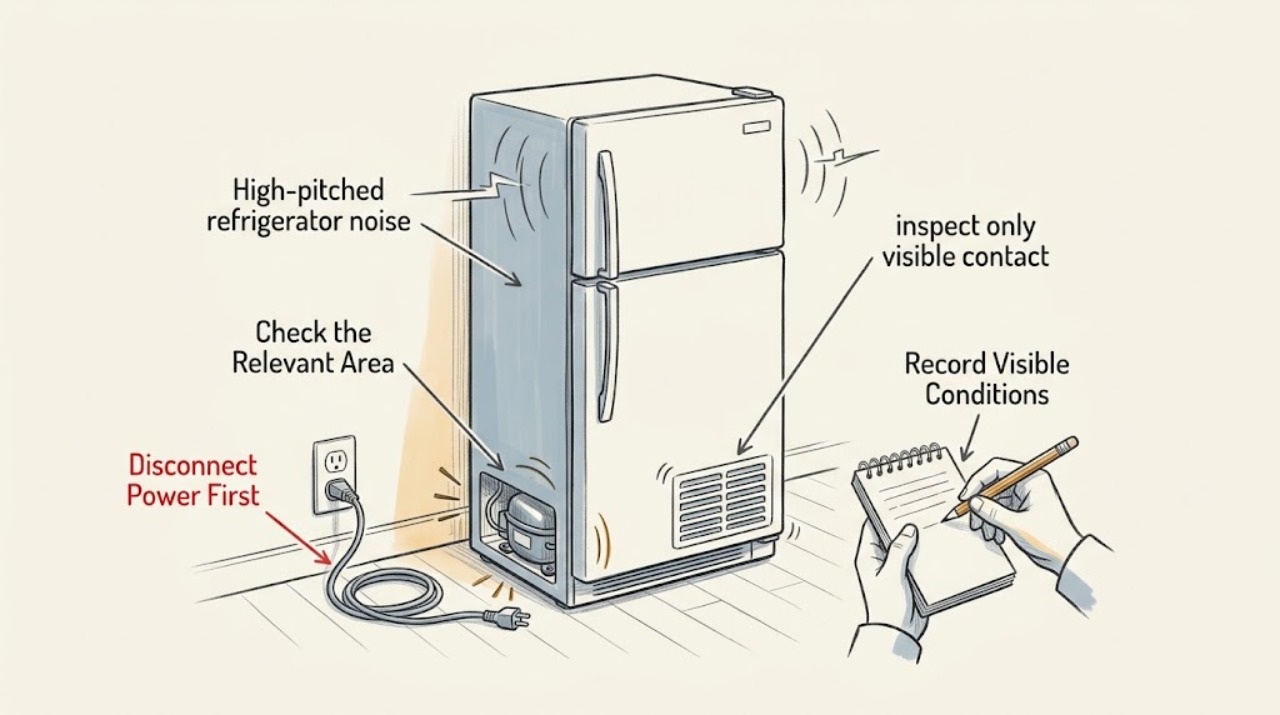
For the Hotpoint HTS17GBSARWW top-freezer refrigerator, a high-pitched hum or pulsating sound can be normal while the high-efficiency compressor operates. Its owner manual also says fans may run at high speed when the refrigerator is first plugged in, doors are opened frequently, or a large amount of food is added. That does not make every high-frequency noise harmless: first record whether it follows cooling, changes with door activity, or comes from a wall or cabinet contact, and check whether temperatures remain normal. If the sound is harsh, scraping, electrical, worsening, or paired with abnormal heat, burning odor, smoke, water, damaged wiring, or repeated trips, stop using the refrigerator and arrange qualified service. Do not identify a compressor or fan from pitch alone.
Work through in order
Diagnostic checks
Use only checks that match the exact appliance or system and its official guide.
-
Check 1
From a safe position, record 20–30 seconds of the sound with the refrigerator doors closed. Describe it as a steady high-pitched hum, pulsation, buzz, whine, click, scrape, or grinding sound, and note whether it comes from the freezer, fresh-food compartment, rear, base, wall, or cabinet.
Expected result: The sound is a steady high-pitched hum or pulsation during cooling, a short click or chirp at restart, a fan-like whine, a rattle that resonates through the wall, or a harsh scrape/grind/electrical sound.
Next step: Keep the recording and continue only with safe timing and visible-contact checks when there is no hazard. Do not order a compressor, fan, or control from the recording alone.
Why this matters
Why: The exact manual lists high-pitched compressor hum/pulsation and fan operation as possible normal sounds, but it does not use pitch alone to diagnose a part. A harsh or electrical character is outside that normal description and needs a safety-first response.
-
Check 2
Compare the recording with the refrigerator's operating context without opening panels: note whether the noise starts during initial cooling, after frequent door openings, or after adding a large load, and whether it fades as cooling settles. Do not repeatedly unplug the appliance to reproduce the sound.
Expected result: The high-pitched sound follows compressor operation, is strongest at startup or after many door openings, or is unchanged and present even when the refrigerator is not actively cooling.
Next step: If cooling is normal and the sound matches the manual, monitor it. If it persists independently of the cycle or changes character, document the timing and arrange model-specific service.
Why this matters
Why: The first two patterns fit the manual's normal compressor or high-speed-fan contexts. A sound unrelated to a documented operating context, especially if it is getting harsher, is not proven normal and may require service; the observation still does not identify a specific part.
-
Check 3
With the refrigerator accessible and no need to move it, inspect only visible contact: a side or back touching a wall or cabinet, a loose bottle or shelf, a rocking cabinet, or a floor/support problem. Do not pull out the refrigerator alone, reach behind it, or touch the compressor, fan, wiring, or tubing.
Expected result: The noise changes when a loose accessible object is removed, the cabinet rocks or visibly contacts a wall, or the installation is clear and stable but the noise is unchanged.
Next step: Remove only loose objects. Ask the landlord, installer, or a second person qualified to handle the appliance to address leveling or clearance; arrange service if the sound remains or the cabinet is unstable.
Why this matters
Why: A change after removing external contact supports vibration transmission rather than proving an internal compressor fault. Hotpoint guidance associates pipework against a wall and an unlevel cabinet with increased noise; unchanged sound after a safe external check keeps internal diagnosis open.
-
Check 4
Check the accessible temperature trend and visible frost/door condition rather than relying on pitch: note whether both compartments are holding their normal cold condition, whether frost is heavy, and whether the door closes fully. Do not scrape frost or remove an evaporator or rear cover.
Expected result: Cooling remains normal with no unusual frost, or the high-frequency sound is accompanied by weak/uneven cooling, heavy frost, prolonged abnormal running, or a door that does not seal.
Next step: Protect perishable food if temperatures are unsafe and arrange qualified service for a cooling or frost change. Do not compensate by setting hidden controls colder or dismantling the cooling system.
Why this matters
Why: A documented compressor/fan sound with stable cooling is more likely normal. Noise combined with cooling or frost change raises the possibility of airflow, fan, defrost, control, compressor, or sealed-system service, but the combination still does not name a replacement part.
-
Check 5
Stop the refrigerator and seek qualified help if the sound is electrical, scraping, grinding, or continuously worsening, or if there is smoke, a burning odor, abnormal cabinet/cord heat, sparking, water near electrical parts, damaged wiring, violent movement, or repeated breaker trips. Isolate power only from a safe, dry, accessible control.
Expected result: No safety symptom is present and the sound fits the manual's normal high-pitched compressor/fan description, or a safety symptom is present.
Next step: For a safety symptom, leave the refrigerator off and arrange qualified service; leave the area and contact emergency help for active smoke or fire. Provide the model, recording, sound location/timing, cooling result, and installation observations.
Why this matters
Why: A normal-sounding cycle with stable cooling can be monitored. Any fire, shock, water, burn, or instability symptom overrides the normal-sound comparison and makes continued operation unsafe.
Use your observations
Decision map
Find the observation that best matches what you see, then follow the next safe action.
-
PATH 01Next step
What you see
A steady high-pitched hum or pulsation occurs during cooling, temperatures remain normal, and it is strongest at startup or after frequent door opening or a large load.
Do this next
Monitor the recording and cooling trend without replacing parts. Escalate if the sound becomes harsh, independent of cooling, or paired with another symptom.
Why this path and its safety boundary
Why it matters: For HTS17GBSARWW, this combination matches the owner's normal-operating-sounds guidance for the high-efficiency compressor or high-speed fans.
-
PATH 02Next step
What you see
The high-frequency noise changes when a visible wall/cabinet contact or loose accessible object is removed, or the cabinet rocks on the floor.
Do this next
Remove only loose objects and have the landlord, installer, or qualified helper address clearance or leveling. Do not pull out the refrigerator alone or reach behind it.
Why this path and its safety boundary
Why it matters: Vibration transmission or support is more likely than a pitch-proven compressor failure. Hotpoint's noise guidance identifies pipework contact and leveling as external noise contributors.
-
PATH 03Next step
What you see
The noise is unchanged by cycle timing and safe external contact checks, or it returns with weak cooling, heavy frost, abnormal running, a fan scrape, or a temperature trend upward.
Do this next
Protect food if temperatures are unsafe, preserve the recording and model information, and arrange qualified refrigerator service. Do not open panels or select a part from pitch alone.
Why this path and its safety boundary
Why it matters: An airflow, fan, defrost, compressor, control, or sealed-system problem is possible, but the pattern does not establish which component has failed.
-
PATH 04Next step
What you see
The sound is harsh, grinding, scraping, electrical, rapidly worsening, or accompanied by smoke, burning odor, sparking, abnormal heat, water near electrics, damaged wiring, violent movement, or repeated trips.
Do this next
Stop using the refrigerator, isolate power only if safe from a dry accessible control, and arrange qualified service; leave for active smoke or fire. Do not perform live tests or touch internal parts.
Why this path and its safety boundary
Why it matters: The event has crossed a fire, shock, water, burn, or stability boundary and should not be normalized as the manual's ordinary high-pitched hum.
Helpful context
Understand the symptom
Pitch is not a component test. The HTS17GBSARWW manual specifically includes high-pitched compressor hum and pulsating sound in its normal-operating-sounds guidance, while also describing high-speed fans during startup, frequent door opening, or a large food load. The useful distinction is the combination of sound timing, location, cooling, and visible installation conditions.
An apartment can make a sound more noticeable through a wall, floor, cabinet, or nearby object, but that context does not prove an internal failure. Check only accessible contact and stability, and involve the landlord or a qualified service person if the refrigerator would need to be moved or leveled.
When checks do not resolve it
Need a professional?
Use model-specific service for persistent or unexplained HTS17GBSARWW noise, cooling or frost change, an unstable cabinet, or any electrical/heat/water symptom. The exact model listing links the owner's manual and service-related support path; the manual recommends qualified servicing and says to unplug before repairs.
Have this ready
- Provide HTS17GBSARWW, the recording, sound description and location, whether it follows compressor/fan/startup/door activity, whether wall or cabinet contact changed it, temperature and frost observations, apartment/installation constraints, and any odor, heat, water, or power-trip history.
Common questions
FAQ
Is a high-pitched sound normal on a Hotpoint HTS17GBSARWW refrigerator?
It can be. The HTS17GBSARWW owner manual says its high-efficiency compressor may produce a high-pitched hum or pulsating sound, and fans may run at high speed in startup or other high-demand conditions. Stable cooling and a documented operating context support monitoring; pitch alone does not identify a part.
Why does the noise seem louder in an apartment?
An apartment wall, cabinet, floor, or nearby loose object can transmit or amplify vibration, but the setting does not prove an internal failure. Check only visible contact and stability, and ask the landlord or a qualified helper to handle leveling or movement.
Should I replace the compressor or fan because of the frequency?
No. The exact manual describes several normal compressor and fan sound contexts, while a change in pitch does not identify a failed component. Use timing, location, cooling, frost, and visible-contact observations to decide whether to monitor or arrange service.
Read the exact guide
Official sources
- Hotpoint SupportHotpoint · Hotpoint Americas support routing and qualified service boundary for Hotpoint appliances registered with GE Appliances
- Owner's Manual and Installation Instructions (Models 16, 17, 18)GE Appliances / Hotpoint · Owner-facing operating, safety, troubleshooting, and normal-operating-sounds guidance linked from the exact Hotpoint HTS17GBSARWW model listing; the manual covers Models 16, 17, and 18 and is not a universal Hotpoint manual
- Model Search | HTS17GBSARWWGE Appliances / Hotpoint Parts · Exact Hotpoint HTS17GBSARWW model identity, top-freezer refrigerator configuration, and its owner-manual link
- Hotpoint Fridge Freezer Troubleshooting & FAQHotpoint UK · Generic Hotpoint refrigeration noise and installation-position guidance only: pipework against a wall and poor leveling can increase noise. This UK page is not used to assign US HTS17GBSARWW code meanings or service terms.
Community feedback
Share a repair observation
Share a plain-text repair observation. Accepted observations are published automatically; this page may take a moment to update.