
On this page
Start here
Quick answer
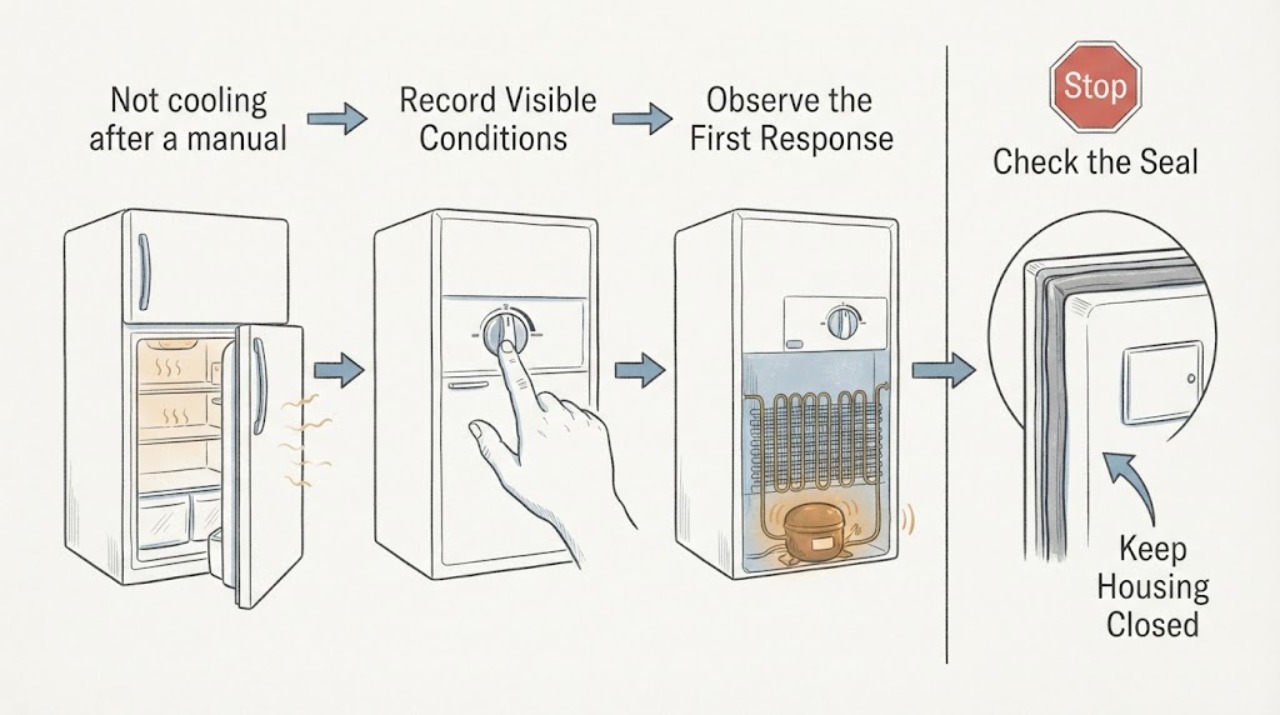
A Hotpoint refrigerator that was manually defrosted three weeks ago and is now not cooling should not be diagnosed by assuming it has a separate mechanical defrost timer. GE's official refrigerator guidance says full-size frost-free refrigerators use automatic defrost, and the control can be either time-based or usage-based adaptive defrost. Confirm the complete appliance model and use its manual to identify the defrost architecture, then record whether the freezer, refrigerator compartment, or both are warm and whether frost has returned. Do not open the rear cabinet or replace a timer, heater, or control from the elapsed time alone; recurring heavy frost, poor cooling, or a defrost system that needs internal access requires qualified service.
Before you begin
Safety first
- Do not open the rear cabinet or evaporator cover, advance or bypass a defrost control, probe energized wiring, access the sealed-system refrigerant circuit, chip ice, use a heat gun, or replace a timer, heater, sensor, or board solely from the three-week timeline. Stop immediately for smoke, burning odor, sparks, a hot or damaged plug, water near electrical parts, or a repeated breaker trip.
Work through in order
Diagnostic checks
Use only checks that match the exact appliance or system and its official guide.
-
Check 1
Read the complete Hotpoint model and serial information without moving the refrigerator. Compare the model exactly with the owner manual or official support record, and note whether the manual calls the defrost system timed, adaptive, Frost Guard, or something else. Do not treat HSS2GFTGBB as proof that a separate timer exists until the model record matches.
Expected result: The full model and a matching manual are available, the manual identifies an automatic-defrost architecture, or the model cannot be matched and the defrost design is unknown.
Next step: Continue with symptom and frost observations using the matching manual. If the model record cannot be matched, stop part searches and arrange model-identification or appliance service rather than looking for a generic timer.
Why this matters
Why: GE explains that automatic defrost can be time-based or usage-based depending on the model. A model number or topic title alone cannot identify the control layout or a compatible part.
-
Check 2
Without moving the refrigerator or opening panels, record the temperature pattern: freezer warm, refrigerator compartment warm, both warm, or one compartment unusually cold. Also note whether the interior light/display works and whether doors close and seal normally. Keep doors closed as much as possible while protecting food.
Expected result: Both compartments are warm, the freezer has returned to heavy frost while the refrigerator side is warm, the refrigerator is excessively cold while the freezer is frosted, or temperatures and door closure appear normal.
Next step: Use the exact manual for temperature settings and any documented recovery period. Protect perishable food and arrange service if cooling remains abnormal after the external checks; do not force a control or remove a cover.
Why this matters
Why: A compartment-specific pattern can point toward airflow, frost, door/seal, setting, or defrost behavior, while both compartments remaining warm raises a broader cooling or power concern. None of these patterns identifies a defrost timer by itself.
-
Check 3
From outside the cabinet, inspect only the accessible door gasket, vents, surrounding clearance, and visible frost or water. Do not chip ice, scrape an evaporator, pour water into the cabinet, use a heat source, pull the appliance forward, or remove the freezer rear panel.
Expected result: The gasket is damaged or a door is held open, accessible airflow is blocked, heavy frost has returned, water is collecting, or the visible door/clearance/frost conditions appear normal.
Next step: Correct only an obvious accessible obstruction or door-setting issue documented by the manual. For recurring frost, water, or warmth, keep food protected and arrange qualified service instead of repeating a manual defrost as a diagnostic.
Why this matters
Why: Door moisture, blocked airflow, and frost can contribute to poor cooling, but GE says heavy frost or ice accumulation is a service-level symptom. A normal exterior does not clear the internal defrost, fan, sensor, control, or sealed system.
-
Check 4
Record the date of the manual defrost, when cooling changed, any abnormal fan or compressor sound, and whether frost returned on the freezer wall or around the evaporator area. Do not energize an opened cabinet or try to advance a timer, force a defrost, or access the sealed-system refrigerant circuit.
Expected result: Cooling recovered and remains stable with no recurring frost, or poor cooling, frost, water, repeated defrost behavior, or abnormal sound returns after the three-week interval.
Next step: If the problem returns, provide the exact model, manual-defrost date, temperature pattern, frost location, and sound history to qualified Hotpoint/GE service. Do not select a timer, heater, sensor, or board solely from the timeline.
Why this matters
Why: Stable cooling after the external correction is different from a recurring symptom. GE's automatic-defrost guidance says a persistent heavy-frost or repeated-defrost condition needs technician diagnosis, and adaptive defrost does not imply a user-accessible timer.
Use your observations
Decision map
Find the observation that best matches what you see, then follow the next safe action.
-
PATH 01Next step
What you see
The model manual confirms an automatic defrost system, cooling is now stable, and no heavy frost, water, abnormal sound, or compartment temperature problem has returned.
Do this next
Monitor temperatures and door closure without changing settings repeatedly. Keep the model manual and defrost date available if the symptom returns.
Why this path and its safety boundary
Why it matters: The three-week history alone does not establish a failed timer or heater; the present symptom is not currently reproducing.
-
PATH 02Next step
What you see
The freezer is developing heavy or localized frost again and the refrigerator compartment is warm after the manual defrost, while power and doors appear normal.
Do this next
Keep food protected, avoid another forced defrost or panel removal, and arrange qualified service with the exact model, frost location, and time since the prior defrost.
Why this path and its safety boundary
Why it matters: This pattern is consistent with a returning airflow or defrost-system problem, but GE's documentation does not allow the visible frost pattern to distinguish a timer, adaptive control, heater, sensor, or drain fault.
-
PATH 03Next step
What you see
Both compartments are warm, the interior light/display is absent, the plug or outlet is hot or damaged, water is near electrical parts, or a breaker trips.
Do this next
Keep the refrigerator off and protect food. From a dry, safe position check only the normal plug seating; obtain qualified electrical or appliance service for a damaged, wet, hot, or repeatedly tripping condition.
Why this path and its safety boundary
Why it matters: The immediate path is power or an electrical hazard rather than a defrost-timer diagnosis.
-
PATH 04Next step
What you see
The model cannot be matched to an official manual, the defrost architecture is unknown, or resolving the issue would require accessing the evaporator, heater, timer/control, wiring, or sealed system.
Do this next
Stop the internal investigation and arrange Hotpoint/GE service. Provide the exact label, manual-defrost date, temperature pattern, frost observations, and any visible safety concern.
Why this path and its safety boundary
Why it matters: The model identity and internal design are not established well enough to recommend a timer or another part, and the condition exceeds safe owner checks.
Helpful context
Understand the symptom
Why three weeks after defrosting is not a timer diagnosis
The time since a manual defrost is useful history, but it does not identify the failed part. GE documents both compressor-runtime timers and usage-based adaptive defrost. Some Frost Guard models also pre-chill the freezer before defrosting. The exact Hotpoint appliance model and manual must establish which design is present before anyone looks for a timer or orders a control.
What the frost pattern can tell you
A return of heavy frost after a manual defrost can support a defrost, airflow, door-seal, or control concern, but the visible frost pattern cannot select a heater, sensor, timer, or electronic board. Record the pattern without removing panels or scraping the evaporator.
When checks do not resolve it
Need a professional?
Arrange qualified Hotpoint/GE appliance service when heavy frost or poor cooling returns after the manual defrost, both compartments remain warm, the model manual cannot be matched, or internal access would be needed. Use qualified electrical help for a damaged or repeatedly tripping power circuit.
Safety scope: Do not open the rear cabinet or evaporator cover, advance or bypass a defrost control, probe energized wiring, access the sealed-system refrigerant circuit, chip ice, use a heat gun, or replace a timer, heater, sensor, or board solely from the three-week timeline. Stop immediately for smoke, burning odor, sparks, a hot or damaged plug, water near electrical parts, or a repeated breaker trip.
Have this ready
- Provide the complete Hotpoint model and serial information, the manual-defrost date, when cooling changed, temperature pattern by compartment, frost location and recurrence, door/gasket observations, any fan or compressor sound, and any power or water safety symptom.
Common questions
FAQ
Does Hotpoint HSS2GFTGBB definitely have a separate defrost timer?
That cannot be established from the part-search phrase or three-week timeline. GE says refrigerators can use a time-based or usage-based adaptive defrost system depending on the model. Match the complete appliance model to its manual before looking for a timer or control.
Why did the refrigerator work after defrosting and then stop cooling weeks later?
A manual defrost can temporarily remove frost, but a returning frost or cooling problem can involve airflow, door sealing, drainage, defrost control, heater, sensor, or another cooling condition. The elapsed time does not identify which part failed; recurring heavy frost needs qualified diagnosis.
Should I manually defrost the refrigerator again to test it?
Do not repeat a manual defrost as a substitute for diagnosis. GE says full-size frost-free refrigerators use automatic defrost, and persistent heavy frost or repeated defrost problems should be checked by a technician. Protect food and document the frost pattern instead.
Read the exact guide
Official sources
- Refrigerator - Frost Guard / Adaptive DefrostGE Appliances · For the task identifier HSS2GFTGBB, this page is used only to explain the possible adaptive-defrost branch; it does not confirm that this exact model has Frost Guard.
- Refrigerator - Automatic Defrost SystemGE Appliances · For the task identifier HSS2GFTGBB, this is generic manufacturer guidance rather than a confirmation of the model's exact control architecture; it supports the stop/service boundary for recurring frost or excessive defrosting.
- Refrigerator and Freezer - Types of Defrost SystemsGE Appliances · For the task identifier HSS2GFTGBB, this is generic GE/Hotpoint defrost guidance and is not a model-specific confirmation; it explains why the actual manual must distinguish timed from adaptive defrost.
Community feedback
Share a repair observation
Share a plain-text repair observation. Accepted observations are published automatically; this page may take a moment to update.