
On this page
Start here
Quick answer
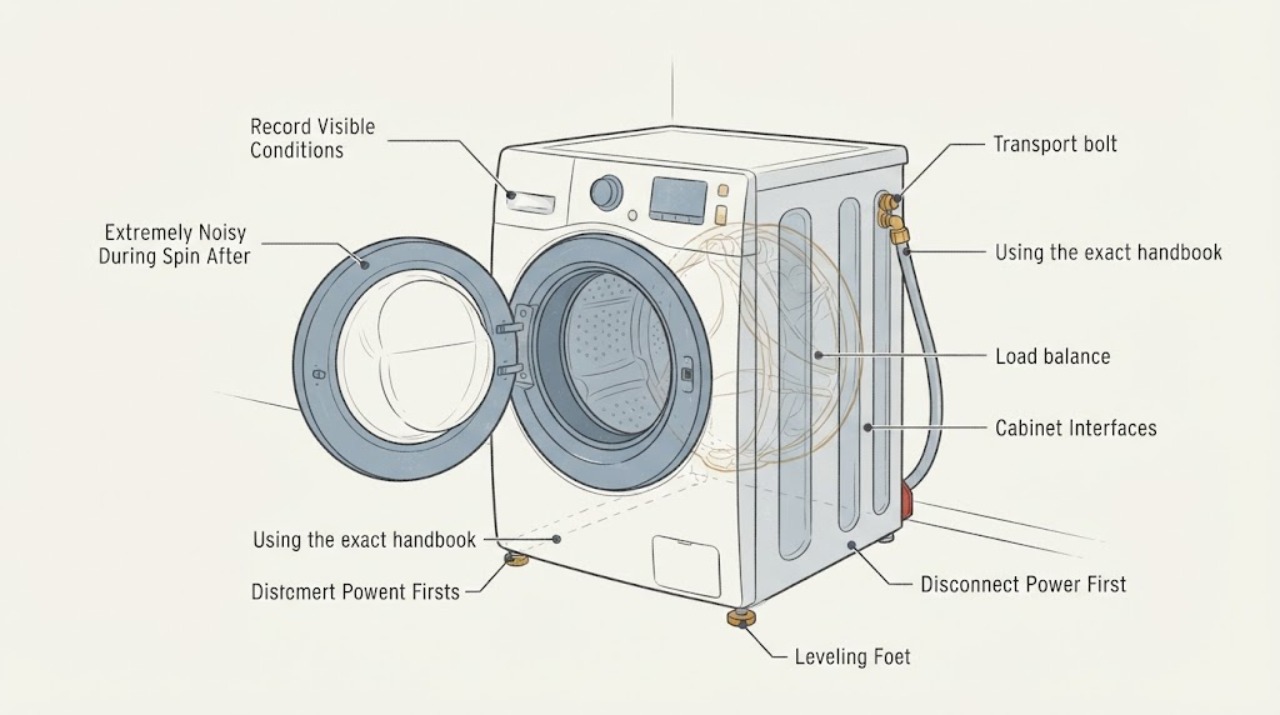
For a Hotpoint WMXTF942G that became extremely loud during spin after being moved into a cellar, stop repeated high-speed tests and start with the move and installation history. Hotpoint says a noisy or unstable washer on first use can result from protective transport brackets or bolts left in place; excessive vibration can also come from an unbalanced load, feet that were not adjusted, or the machine being trapped against walls or cabinets. Check only with the washer stopped and unplugged: confirm the transport restraints were removed according to the exact handbook, verify the machine is stable on a solid floor without forcing it, and compare an ordinary mixed load rather than a single heavy item. A one-off imbalance can be corrected by redistributing laundry, but a bang or grind that persists empty, visible movement, a leak, a damaged hose or cord, or noise that began after a difficult move needs qualified service. Do not drag or tilt the heavy washer, run repeated spin cycles, open the cabinet, or assume the bearings, motor, or shock absorbers are defective from sound alone.
Before you begin
Safety first
- Owner checks are limited to switching off and unplugging the washer, closing accessible water taps, reading the exact installation instructions, looking for an accessible retained transport restraint or external contact, recording load/drain behavior, and documenting noise from a stationary safe position. Do not move or tilt the heavy machine, remove panels, reach into the drum or suspension, perform live electrical tests, or work on water/drain connections in a wet area.
Work through in order
Diagnostic checks
Use only checks that match the exact appliance or system and its official guide.
-
Check 1
Stop the cycle, wait for the drum to stop, switch the washer off, unplug it from the mains, and close the water taps. Before touching hoses or any restraint, record whether the loudness began immediately after the move, whether the appliance walks or only transmits vibration into the floor, and whether there was a hard impact, leak, or damaged cable during handling. Do not run another high-speed spin to reproduce the symptom.
Expected result: The noise began on the first cycle after the cellar move; the cabinet moves; the floor or nearby structure vibrates; or the washer has a leak, damaged hose, damaged cord, scraping, or a visible impact mark.
Next step: Leave the washer unplugged and do the stationary external and installation checks below. If there is water, cord/hose damage, structural instability, or a heavy impact concern, arrange qualified service or an installer inspection without another spin test.
Stop if: Do not pull, tilt, lift, or place hands under the washer; stop completely for an active leak, exposed wiring, burning smell, or a damaged mains lead.
Why this matters
Why: A new post-move onset makes installation, transport-restraint, floor, clearance, or handling damage more important than a gradual bearing diagnosis. Movement or damage can create a safety and water-risk boundary even if the drum still turns.
-
Check 2
Using the exact WMXTF942G handbook or Hotpoint's model lookup, check the installation section for every protective bracket, transit bolt, plastic spacer, or packing piece and confirm that the machine is in its normal operating configuration. Inspect only the accessible exterior for an obviously retained restraint or packing material; do not remove a restraint by guesswork, and keep any removed transport hardware for a future move.
Expected result: The handbook confirms all restraints are removed; a bolt/bracket or packing piece remains; the model identity is incomplete; or the rear/underside cannot be checked without moving the heavy appliance.
Next step: If a restraint is clearly present and the exact handbook gives a safe removal procedure, have the installer or a suitably capable person complete that procedure with the appliance stable and disconnected. Otherwise stop and request Hotpoint/qualified service rather than dragging or dismantling the machine.
Stop if: Do not run the washer with a restraint installed, remove cabinet panels, reach through the rear, or improvise with tools while the appliance is connected.
Why this matters
Why: Hotpoint specifically says transport brackets or bolts left in place can make a new washer noisy and unstable. If the exact model instructions cannot be matched, the restraint state is unresolved; a similar-looking bolt or a partial removal is not proof that the drum is released correctly.
-
Check 3
With the appliance still stopped and unplugged, check whether it sits firmly on a solid floor and whether any side, top, rear, drain hose, or water hose is visibly trapped against a wall or cabinet. Look at the accessible feet and floor contact without dragging the machine. Do not try to correct level by rocking, lifting, or turning a foot that is inaccessible.
Expected result: The washer rocks, a foot is visibly not bearing, the floor is uneven or flexible, or the cabinet/hoses contact a wall or cabinet; alternatively, it is stable with clearances and no visible contact.
Next step: Remove only an obvious loose external contact and follow the exact handbook's leveling instructions through the installer or qualified service if access is difficult. Do not move a full-size washer alone. If stable and clear, continue to the load and drain observations.
Stop if: Stop if leveling would require moving the washer, disconnecting water or drain plumbing, lifting it, or working near a wet electrical connection.
Why this matters
Why: Hotpoint identifies unadjusted feet, the machine being trapped between cabinets or walls, and installation issues as causes of excessive vibration/noise. A rigid cellar floor may transmit vibration but does not by itself prove an internal defect; a stable, clear installation shifts attention to load behavior or service.
-
Check 4
After the installation and safety state are resolved, compare the symptom only under normal use: note whether the drum is empty, has one heavy absorbent item, or has a mixed load of small and large items; check whether water drained normally and whether the washer repeatedly redistributes the load before spin. Do not use an intentionally overloaded or single-heavy load as a stress test.
Expected result: The noise occurs only with a single heavy or tangled load; the machine tries to redistribute or reduces/abandons spin; water remains in the drum; or the same noise occurs with a balanced ordinary load.
Next step: For a load-specific imbalance, stop, redistribute small and large garments, and use the appropriate normal programme. For residual water, check only the accessible drain route described by the handbook. If the noise persists empty or with an ordinary balanced load, stop testing and arrange service.
Stop if: Do not open the pump housing, reach into a moving drum, force a spin, or continue if the washer walks, bangs the wall, leaks, or produces metal-on-metal grinding.
Why this matters
Why: Hotpoint says the washer attempts to redistribute an unbalanced load and may reduce or abort spin to limit vibration. Drainage problems can prevent proper spin, while persistent noise with a normal load or empty drum is less consistent with a simple load imbalance and still does not identify a bearing or suspension part.
-
Check 5
Prepare an exact-model service record: photograph the rating label, record the WMXTF942G model and serial, installation/move date, cellar floor and clearance conditions, whether all transit hardware was removed, load type, drain result, and the noise's character and timing. If safe, record audio from a stationary position during ordinary operation only; do not stand over, hold, or touch the washer while it spins.
Expected result: The noise remains extreme after safe installation/load checks; it is present with an empty drum; the washer moves or strikes its surroundings; or it is accompanied by leaks, scraping, smell, electrical symptoms, or abnormal drum behavior.
Next step: Stop further spin testing and request Hotpoint or qualified appliance service. Tell the provider that the issue began after a cellar move and whether transport restraints, level, floor, load, and drainage were checked.
Stop if: Stop using the washer for visible structural damage, active leaking, exposed or damaged wiring, burning odor, smoke, repeated electrical trips, violent movement, or persistent metal grinding.
Why this matters
Why: Hotpoint's public guidance routes unresolved noise, instability, and component concerns to its model/manual and repair paths. A precise record helps a technician separate installation and load causes from suspension, motor, drum, or other internal inspection without the owner naming a part.
Use your observations
Decision map
Find the observation that best matches what you see, then follow the next safe action.
-
PATH 01Next step
What you see
The noise started on the first use after the move and a transit bolt, protective bracket, or packing piece remains or cannot be ruled out from the exact handbook.
Do this next
Keep the washer disconnected and have the exact restraint-removal procedure completed by the installer or qualified service. Do not substitute a similar model's bolt layout.
Why this path and its safety boundary
Why it matters: This pattern favors incomplete installation or transport restraint over a proven bearing failure. Running high-speed cycles in that state can increase vibration and damage risk.
-
PATH 02Next step
What you see
The washer rocks, contacts a wall/cabinet, has a visibly unsupported foot, or the cellar floor transmits a strong vibration, while no internal noise has been safely established.
Do this next
Remove only obvious loose external contact and use the exact installation procedure or an installer/service technician for leveling. Do not drag or tilt the appliance yourself.
Why this path and its safety boundary
Why it matters: The accessible evidence favors leveling, clearance, or structural resonance. A hard cellar floor can amplify vibration, but it does not prove that the machine itself is damaged.
-
PATH 03Next step
What you see
The sound appears only with a single heavy/tangled load, and the washer otherwise redistributes or limits spin without leaks or violent movement.
Do this next
Stop, redistribute a mixed load, and use the normal programme. If the same noise occurs with an ordinary balanced load or empty drum, arrange service.
Why this path and its safety boundary
Why it matters: This is more consistent with load imbalance than with a confirmed internal part failure. Hotpoint describes redistribution and reduced/aborted spin as an anti-vibration response.
-
PATH 04Next step
What you see
The noise persists with an empty or ordinary balanced load, or the drum produces scraping, repeated hard impacts, abnormal movement, or a new leak after the move.
Do this next
Stop repeated spin tests, unplug the washer, and request exact-model appliance service with the move history and recording. Do not open the cabinet or order a guessed part.
Why this path and its safety boundary
Why it matters: A simple load explanation is less likely, but the observation still cannot identify a bearing, shock absorber, motor, drum, or other part without inspection. Handling or installation damage also remains possible.
-
PATH 05Next step
What you see
There is active water, a damaged hose or cord, exposed wiring, burning odor, smoke, repeated electrical tripping, or violent movement toward the cellar wall or edge.
Do this next
Do not run the washer. From a dry, safe position, isolate the accessible water supply and electrical circuit if needed, then arrange qualified appliance service; involve a qualified electrician or plumber for a building-side supply/drain concern.
Why this path and its safety boundary
Why it matters: This is an immediate water, electrical, or physical-safety boundary, not a noise troubleshooting case.
Helpful context
Understand the symptom
A cellar move changes the diagnostic priority. The same machine can sound very different on a rigid or resonant floor, and a difficult move can leave transport hardware, feet, hoses, or cabinet clearances wrong. The useful question is not simply whether it is loud, but whether the noise is tied to one load, remains with an empty drum, causes the cabinet to move, or appeared together with scraping, leaks, or damage.
The public Hotpoint materials identify the WMXTF 942 family and provide the route to the matching handbook and repair service, but they do not authorize a user to dismantle the cabinet or identify a bearing from a recording. Use the complete rating-label model and serial information when checking the manual or requesting service; do not substitute a similar WMXTF model's internal parts or bolt layout.
Only after diagnosis
Potential parts
- model-specific suspension, drum-support, motor, or transport-hardware component
Consider any internal component only after a qualified inspection finds persistent noise with correct transport-restraint removal, level/clearance, drainage, and balanced-load conditions. The noise and a difficult move do not identify a particular part.
Confirm the complete WMXTF942G model/serial and market, and use Hotpoint's exact fit information. Do not transfer a part or bolt arrangement from another WMXTF model.
When checks do not resolve it
Need a professional?
Use Hotpoint's official manual/service route or a qualified appliance technician for unresolved extreme spin noise, noise with an empty drum, post-move damage concerns, persistent instability, or any inspection requiring internal access. Escalate promptly for water, electrical, burning, violent movement, or structural hazards.
Safety scope: Owner checks are limited to switching off and unplugging the washer, closing accessible water taps, reading the exact installation instructions, looking for an accessible retained transport restraint or external contact, recording load/drain behavior, and documenting noise from a stationary safe position. Do not move or tilt the heavy machine, remove panels, reach into the drum or suspension, perform live electrical tests, or work on water/drain connections in a wet area.
Have this ready
- Provide WMXTF942G and serial details, market, purchase/installation date, move route and cellar floor conditions, whether transport hardware was removed, level/clearance findings, load and drain result, noise timing/character, and any leak, impact, smell, or electrical symptom.
Common questions
FAQ
Could the transport bolts still be installed even though the washer was moved into the cellar?
Yes, it must be checked against the exact installation instructions. Hotpoint specifically lists protective transportation brackets or bolts left in place as a possible cause of first-use noise and instability. Do not run another spin or remove hardware by guesswork if the model instructions cannot be matched.
Is the cellar floor itself the fault?
Not necessarily. A floor can transmit or amplify vibration, but Hotpoint also lists leveling, clearances, and load balance. Check stability and visible contact without dragging the washer; persistent noise on a stable installation needs service rather than a floor-only assumption.
Does loud spin noise mean the bearings need replacement?
No. A sound does not identify a bearing. First resolve transport-restraint, level, floor/clearance, load, and drainage questions; if the noise remains with an empty or balanced load, give the exact model and move history to a qualified technician.
Read the exact guide
Official sources
- Freestanding Washing Machine Hotpoint WMXTF 942G UK.RHotpoint UK Appliances Limited · Opened official Hotpoint product page for the WMXTF 942G family; used to anchor the product family and official service/manual route, not to assert an internal diagnosis.
- Get Hotpoint Appliance Manuals - Quick & Easy DownloadsHotpoint UK Appliances Limited · Opened official manual-lookup page; used to route the user to the exact handbook because restraint and leveling layouts vary by model.
- Washing Machine Troubleshooting - Quick fixes & TipsHotpoint UK Appliances Limited · Opened official Hotpoint guidance used for transport-restraint, leveling/clearance, unbalanced-load, drainage, noise, safety, and repair-boundary decisions; exact model instructions still control.
Community feedback
Share a repair observation
Share a plain-text repair observation. Accepted observations are published automatically; this page may take a moment to update.