
On this page
Start here
Quick answer
If your Hotpoint is a top-load washer with an agitator or infusor, first confirm that the lid is closed and that the washer has finished filling; some models wait about 20–30 seconds before engaging the drive. A quiet washer may still be agitating, so mark one item, run a brief wash portion, and check whether the item moved. If the washer fills but still does not agitate, check the outlet, plug, cycle or soak setting, and any lid probe or magnet that is visibly missing or damaged. Only perform the six-lid-lift motor reset if the exact model is identified as a GE/Hotpoint Hydrowave washer. If agitation does not return or stops again, leave the washer off and arrange qualified service.
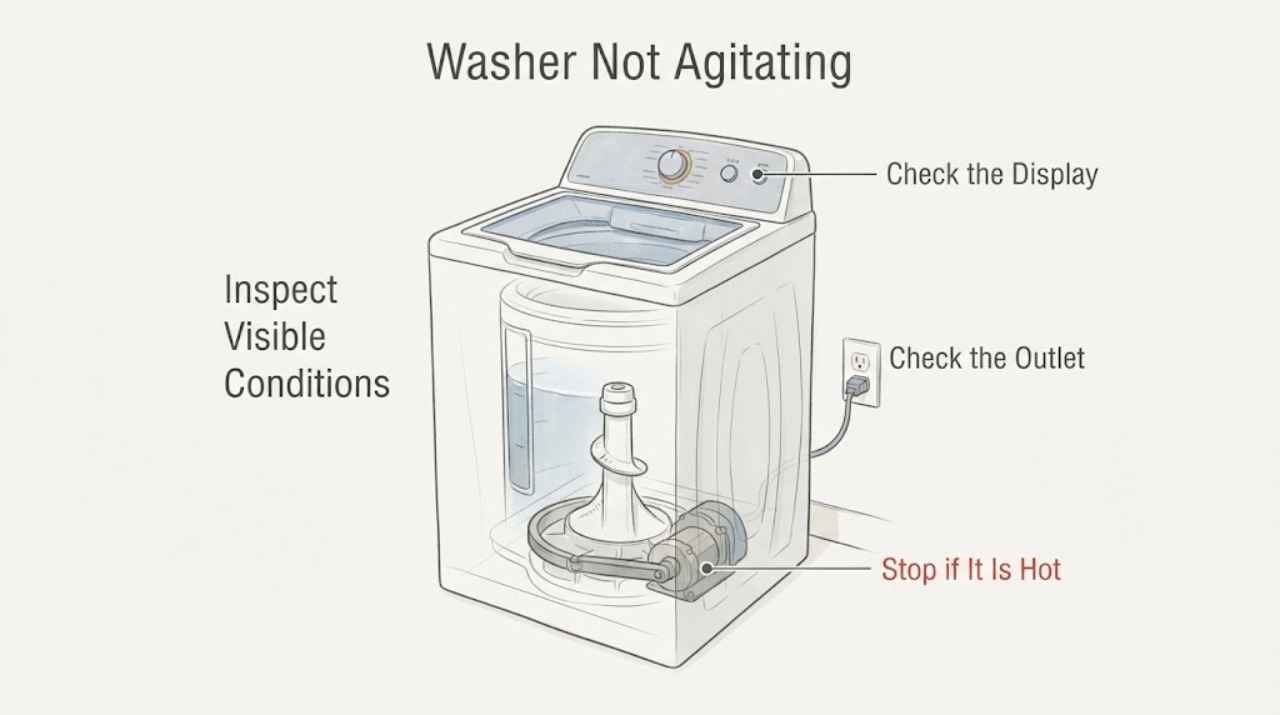
Work through in order
Diagnostic checks
Use only checks that match the exact appliance or system and its official guide.
-
Check 1
Identify the full Hotpoint model and confirm that it is a top-load washer with an agitator or infusor. Place one item of clothing in the tub, note its position, close the lid, and observe the wash for one or two minutes after filling.
Expected result: The item moves, the machine is quiet but the item does not move, the washer is still filling, or the appliance is not a top-load agitator model.
Next step: If the item moves, the agitator is functioning. If the washer is still filling, allow the model's normal fill phase to finish; if the item does not move after the fill stops, continue with the lid, power, and cycle checks.
Stop if: Do not reach into the tub while it is moving, hold or bypass the lid switch, or run this test if there is smoke, a burning odor, exposed wiring, a leak near electrics, or a repeated breaker trip.
Why this matters
Why: GE says newer washers may agitate quietly, and it uses movement of a clothing marker to verify agitation. A washer that is still filling or uses another wash design needs a different model-specific path.
-
Check 2
With the washer stopped, verify that the lid closes fully, the Start/Stop or Pause control was not left active, the timer knob is not pushed in, the selected cycle is not in a soak phase, and any speed selector is fully set.
Expected result: The lid or control state was incorrect, the washer resumes after correction, or the washer still fills but does not agitate.
Next step: Correct one visible control or lid condition and make one supervised test. If the lid closes but the washer still will not agitate, inspect only for a visibly missing or damaged lid probe or magnet and then continue to the power and model-specific branch.
Stop if: Do not tape, press, short, or otherwise defeat the lid safety system, and do not remove a switch or control panel.
Why this matters
Why: GE identifies an open lid, an accidentally stopped or paused cycle, a soak selection, and a speed selector between settings as possible reasons for absent agitation.
-
Check 3
Check the dedicated outlet, plug, and household breaker or fuse from a dry, safe position. If the exact model is identified as a Hydrowave top-load washer, follow the documented one-minute unplug and six-lid-lift reset; otherwise do not use that sequence.
Expected result: The outlet or protective device is faulty, the qualified Hydrowave reset restores agitation, or the washer remains unable to agitate.
Next step: Have a qualified electrician correct a faulty circuit. For a qualifying model, run one small empty test after the reset. If agitation remains absent or fails again, arrange qualified washer service.
Stop if: Do not repeatedly reset a breaker, use an extension cord, open the cabinet, or apply the Hydrowave reset to an unconfirmed model.
Why this matters
Why: GE links a no-agitation condition with power disruption and documents the reset only for Hydrowave models. Power restoration or a reset does not identify an internal failed part.
-
Check 4
If the exact model's documentation permits it and no hazard is present, run one small supervised wash test after the external checks. Observe whether the washer fills, agitates, drains, and spins, and whether any error or flashing pattern appears.
Expected result: Only agitation is absent, the washer also will not spin or drain, the cycle returns a fault indication, or the small test completes normally.
Next step: If any phase remains abnormal or the fault returns, stop use and provide the phase-by-phase result and model to service. Use the washer normally only after a complete normal test with no warning signs.
Stop if: Do not run repeated tests, operate with a damaged lid or cord, or continue if the tub binds, the motor only hums, the washer leaks, or it smells hot or burnt.
Why this matters
Why: Agitation alone points to a different service path from a common power, lid, motor, or control condition affecting several phases. A completed small test supports a temporary state or load-related event but does not prove a permanent repair.
-
Check 5
Prepare a service record with the full model and serial information, top-load design, whether the washer filled, lid response, clothing-movement result, cycle setting, outlet and breaker result, reset eligibility and result, and whether drain or spin also failed.
Expected result: The fault is persistent, returns after a reset, occurs only on one cycle, or cannot be reproduced safely.
Next step: Leave the washer off and contact the Hotpoint/GE support route or a qualified appliance technician. Request diagnosis before ordering an agitator, coupler, motor, belt, control, or lid switch.
Stop if: Do not open the cabinet, test energized wiring, bypass the lid, or remove the agitator to search for a cause.
Why this matters
Why: These observations separate a normal quiet or delayed phase from a repeatable drive or control failure, but they cannot identify a replacement component without model-specific diagnosis.
Use your observations
Decision map
Find the observation that best matches what you see, then follow the next safe action.
-
PATH 01Next step
What you see
The washer is a top-load agitator or infusor model, the clothing marker moves after the fill phase, and there is no warning or abnormal sound.
Do this next
Use the exact model's normal cycle guidance and monitor the load. Arrange service only if the clothing remains stationary on later cycles or another phase becomes abnormal.
Why this path and its safety boundary
Why it matters: The agitator is working even if the newer washer's motion is quieter or less forceful than expected by sound alone.
-
PATH 02Next step
What you see
The washer fills, the lid is closed, the cycle is not paused or soaking, and the clothing marker does not move after the normal post-fill delay.
Do this next
Check the outlet and lid hardware externally. Use the Hydrowave reset only after confirming the exact system; if agitation remains absent, leave the washer off and arrange service.
Why this path and its safety boundary
Why it matters: The problem is a genuine no-agitation symptom rather than a quiet or still-filling phase. A lid-safety, power, motor, drive, or control condition is possible.
-
PATH 03Next step
What you see
The washer qualifies for Hydrowave, agitation returns after the documented reset, but the problem returns after a few loads or the washer also loses spin.
Do this next
Stop repeated resets and schedule qualified service with the reset result, number of loads before recurrence, and affected cycle phases.
Why this path and its safety boundary
Why it matters: The reset may have cleared a motor state caused by a power disruption, imbalance, or similar event, but recurrence means the underlying problem remains unresolved.
-
PATH 04Next step
What you see
The lid probe or magnet is visibly missing or damaged, the motor only hums, the tub binds, a fault pattern returns, or smoke, burning odor, leakage, sparks, or repeated breaker trips occur.
Do this next
Stop using the washer and isolate power only from a dry, safe position when necessary. Arrange qualified Hotpoint/GE appliance service, or electrical service for the circuit, before reuse.
Why this path and its safety boundary
Why it matters: The condition needs model-specific appliance or electrical diagnosis and may be a safety issue. The symptom alone does not identify an agitator or motor part.
Helpful context
Understand the symptom
Make sure the washer is actually failing to agitate
Hotpoint has more than one washer design, and this guidance is for a top-load model with an agitator or infusor. GE's support instructions note that newer top-load washers can agitate more quietly than older machines. Place one new item of clothing in the tub, note its position, close the lid, let the washer run for a minute or two, and check whether the item moved. Do not use an open-lid test as proof of a fault: the lid safety system prevents agitation on many top-load models.
Check the fill, lid, and cycle state
A top-load washer may fill before it begins the wash motion. GE says some newer models take about 20–30 seconds after the water stops before engaging the drive. Confirm that the lid is fully closed, the Start/Stop or Pause control was not pressed, and the timer is not pushed in. Check that the cycle is not in a soak period and that any speed selector is fully at a setting. Do not defeat the lid switch or reach into a moving tub.
Use the Hydrowave reset only when the model qualifies
GE documents a motor reset for top-load washers equipped with its Hydrowave system, not as a universal Hotpoint washer procedure. The documented sequence is to unplug for one minute, plug the washer back in, then lift and lower the lid six times within 12 seconds, starting within 30 seconds and raising the lid at least 2 inches each time. Confirm the exact model's system before using that sequence. Test the result with a small empty wash as the GE guidance describes; if agitation does not return or fails again, stop and arrange service.
Do not infer an agitator part from the symptom
A washer that fills but does not move the load can have a lid-safety, control, motor, drive, or agitator-related problem, and the exact design determines the diagnosis. A reset that temporarily restores motion does not prove that a motor or drive part is defective. Hotpoint directs US appliance questions to the GE Appliances support route, where the model and serial information can be matched to the correct documentation. Keep the washer out of service when the fault returns instead of ordering a coupler, belt, motor, or control from the symptom alone.
When checks do not resolve it
Need a professional?
Arrange qualified Hotpoint/GE appliance service when a top-load washer fills but does not agitate after the normal delay and external checks, when agitation returns only temporarily after a qualifying reset, or when the lid, motor, drive, control, drain, or spin system needs diagnosis. Use a qualified electrician for a faulty circuit. Stop immediately for smoke, burning odor, sparks, leakage near electrical parts, a damaged cord, severe binding, or repeated breaker trips. Do not bypass the lid safety, open the cabinet, or order an agitator, coupler, motor, belt, or control from the symptom alone.
Common questions
FAQ
Why is my Hotpoint washer not agitating?
First confirm that it is a top-load washer with an agitator or infusor and use clothing movement to verify the symptom. Check the closed lid, post-fill delay, cycle or soak setting, outlet, and visible lid probe or magnet. Only use the six-lid-lift reset if the exact model is a Hydrowave washer; persistent or recurring failure needs service.
Can a Hotpoint washer be too quiet to tell whether it is agitating?
Yes, newer top-load designs can operate quietly. Mark one item, close the lid, let the washer run for a minute or two after filling, and check whether the item moved. Do not open the lid and infer failure from silence alone.
Does the six-lid-lift motor reset work on every Hotpoint washer?
No. GE documents that sequence for top-load washers equipped with the Hydrowave system. Confirm the exact model before using it. If agitation does not return or fails again after a few loads, schedule qualified service instead of repeating the reset.
Read the exact guide
Official sources
- Appliance Support - HotpointHotpoint · Opened official Hotpoint support page; it states that US appliance questions are directed to the GE Appliances Answer Center, while other regions may use a different support route.
- Top Load Washer - Hydrowave Motor ResetGE Appliances · Opened official GE Appliances guidance and restricted to top-load washers equipped with Hydrowave; it is not a universal Hotpoint washer reset.
- Top Load Washer - Fills But Will Not AgitateGE Appliances · Opened official GE Appliances guidance; Hotpoint's US support page directs appliance questions to the GE Appliances Answer Center. Exact Hotpoint model documentation controls other designs or procedures.
Community feedback
Share a repair observation
Share a plain-text repair observation. Accepted observations are published automatically; this page may take a moment to update.