
On this page
Start here
Quick answer
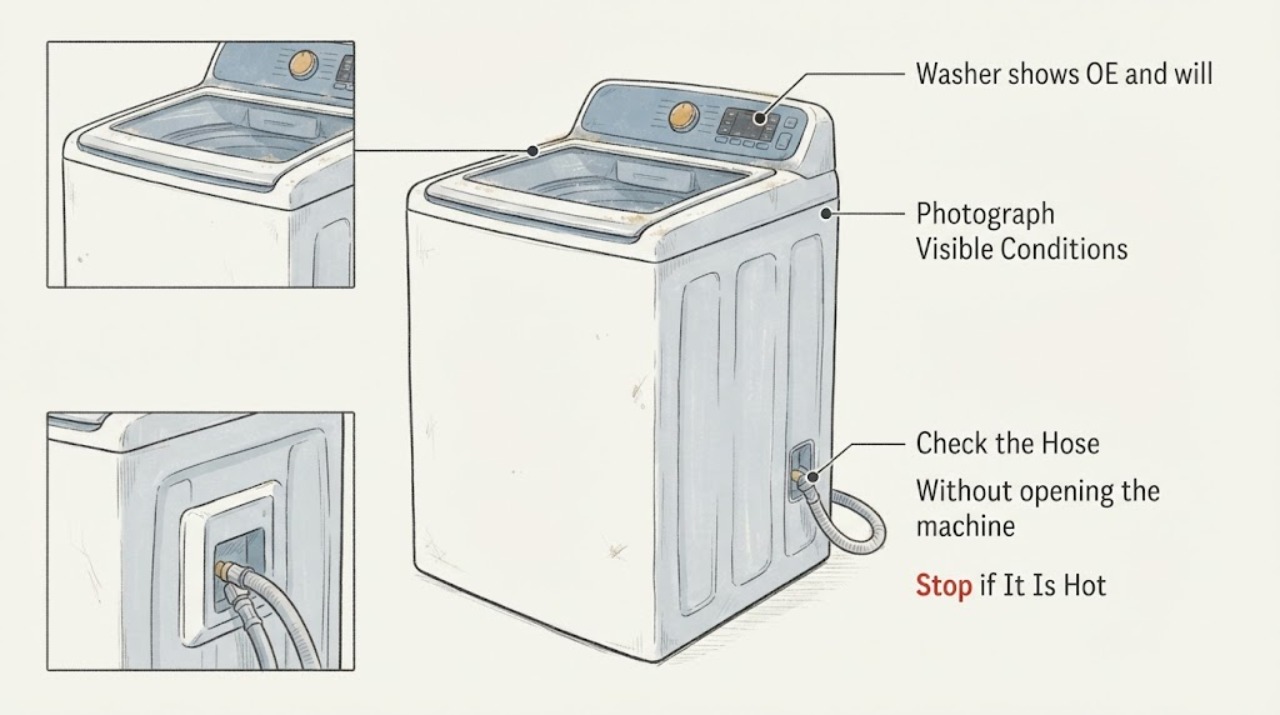
Do not assume that a Kenmore 796.2927200 that has been stored for ten years needs a drive part just because it will not agitate. First record the complete rating-plate identity, the exact display (OE or another two-character code), whether water remains in the tub, and whether the machine ever reaches a wash motion. LG's official top-load reference describes OE as a drainage issue on the LG systems covered by that reference and lists a kinked, clogged, or frozen drain path as a first check, but it also warns that codes vary by model; the exact Kenmore mapping and suffix should therefore be confirmed before treating OE as a Kenmore diagnosis. The LG recall notice lists Kenmore Elite 29272 among recalled top-load families and requires serial-range confirmation, so excessive shaking or cabinet movement is a stop-use issue rather than a reason to keep testing. Use only dry, external checks of the drain path, supply, lid, load, and level. Do not enter service mode, open the cabinet, bypass the lid safety, or run repeated full-water cycles.
Work through in order
Diagnostic checks
Use only checks that match the exact appliance or system and its official guide.
-
Check 1
From a dry, safe position, photograph or transcribe the rating plate, including the complete model and serial, and write the display exactly as shown. Record whether the tub is empty, contains standing water, or is merely wet, and whether the no-agitation report occurred before or after any drain attempt.
Expected result: The plate reads Kenmore 796.2927200 with a serial that can be checked, or the suffix/serial is unreadable; the display is exactly OE, a different code, or no code; the tub has water or is empty.
Next step: Keep the washer off while documenting the identity and display. Use the exact Kenmore/Sears record or qualified service to confirm the code and serial coverage; do not substitute an LG code table as a complete Kenmore manual.
Stop if: Stop if reading the plate would require moving the washer, if the floor or plug is wet, or if there is corrosion, exposed wire, smoke, burning odor, or a hot connection.
Why this matters
Why: The exact identity and serial determine whether the LG-published Kenmore Elite 29272 recall family is even relevant. A stored washer with water remaining has a different first decision from an empty tub that never moves, and an unreadable code cannot safely be expanded into a platform-specific meaning.
-
Check 2
With the washer de-energized and water shutoffs reachable without standing in water, inspect only the visible drain hose, its connection, and the household standpipe or drain opening. Look for a sharp kink, crushing, freezing, a loose connection, or a backed-up standpipe; do not disconnect a pressurized hose or reach behind a machine that must be moved.
Expected result: Water remains in the tub and the drain hose or household drain is visibly restricted, the household drain is backed up, or the visible drain route is open and dry.
Next step: For a visible routing problem, correct only the model-authorized external position after water and power are safely isolated; use a plumber for a backed-up household drain. If the route is clear or the source is internal, leave the washer off and arrange model-specific appliance service.
Stop if: Stop for trapped water that cannot be safely contained, a leak near electrical parts, a cracked hose, a drain connection that must be disassembled, or any need to tip or open the cabinet.
Why this matters
Why: LG's official top-load guidance places an OE indication in the drainage path and specifically names a kinked, clogged, or frozen hose and a standpipe problem as external checks. A clear-looking hose does not prove that an internal pump or control is good, and a no-water tub does not prove the drive is bad.
-
Check 3
Without opening the machine or bypassing its lid safety, inspect the lid and visible strike area for a displaced object or damage, and note whether the lid can close normally. Also note whether the washer is visibly rocking, leaning, or sitting on a damaged floor; do not place hands in the basket or approach it while energized.
Expected result: The lid cannot close normally, the visible strike or hinge area is damaged, the cabinet rocks or has shifted, or the lid and cabinet look intact and stable.
Next step: Remove only a loose visible obstruction with power off; do not force the lid or defeat its interlock. If the cabinet has moved or shakes excessively, stop use, preserve the model and serial, and check the official recall/service route before any further operation.
Stop if: Stop immediately for violent shaking, a loose-looking tub, a lid that opens during motion, exposed wiring, or a need to remove a panel or test the interlock electrically.
Why this matters
Why: A lid or safety-state problem can prevent the washer from entering or continuing motion, while an unstable cabinet can turn a wash or spin event into a safety hazard. These observations do not identify a lid lock, drive, or suspension part, especially after long storage.
-
Check 4
After the machine is off, dry, stable, and not under a recall or visible-damage stop, inspect the supply taps and the visible hot and cold hoses for closed taps, severe kinks, cracking, corrosion, or evidence of a slow storage leak. Do not loosen a hose, clean an inaccessible inlet screen, or run a full tub merely to test water entry.
Expected result: A tap is closed, a hose is kinked or visibly deteriorated, there is corrosion or a leak, or the visible supply path is intact but the prior cycle never reached a normal fill or wash stage.
Next step: Keep a damaged or leaking supply path out of use and have the hose or plumbing assessed. If the external supply is intact but filling or progression remains abnormal, give service the sequence, code, model, serial, and storage history instead of changing a valve or other part speculatively.
Stop if: Stop for active dripping, corrosion at an electrical connection, a wet floor, an inaccessible shutoff, or any request to work on a pressurized or energized component.
Why this matters
Why: Aged or restricted supply can prevent the sequence from reaching agitation, but it is not an explanation for every OE display. Visible deterioration after storage raises a leak and electrical-safety concern; an intact external path leaves the inlet valve, sensing, control, and mechanical paths unresolved.
-
Check 5
Use the already observed symptoms to separate a drain-stage stop from a genuine no-agitation condition: write whether the tub filled, whether it drained, whether any motion was seen, whether a load was present, and whether the unit has been moved or stored in a damp area. Do not perform a service-mode check or repeat a full-water cycle.
Expected result: OE appears with standing water or an incomplete drain; the tub is empty but the lid/level and supply observations are abnormal; or the tub is empty, stable, externally intact, and still never agitates.
Next step: Use the first matching branch below and provide the technician the exact timeline. For an unexplained no-agitation condition, arrange qualified service with the complete identity; do not keep running loads to make the diagnosis appear.
Stop if: Stop all user diagnosis when the next step would involve the cabinet, motor, pump, lid-lock wiring, live measurements, forced agitation, or repeated full-water operation.
Why this matters
Why: An OE-plus-standing-water pattern keeps the drain path first. A no-fill or lid/installation pattern points to a sequence or safety condition. An empty, stable washer that still will not agitate after long storage leaves internal drive, sensing, control, or mechanical deterioration possible, but the opened evidence does not identify one failed part.
Use your observations
Decision map
Find the observation that best matches what you see, then follow the next safe action.
-
PATH 01Next step
What you see
The display is exactly OE and water remains in the tub, or the drain hose/standpipe is visibly kinked, frozen, loose, or backed up.
Do this next
Keep the washer off, correct only a safe external routing issue or call a plumber for the household drain, then arrange model-specific service if the route is clear or OE returns. Do not enter service mode or dismantle the pump path.
Why this path and its safety boundary
Why it matters: The first decision is an incomplete drain, consistent with the OE scope in LG's top-load reference; this does not prove a failed pump or authorize a Kenmore part replacement.
-
PATH 02Next step
What you see
The tub is empty but the machine never reaches wash motion, and the visible lid, supply hoses, floor, and cabinet are abnormal or the code is not actually OE.
Do this next
Record the code character by character and ask Kenmore/Sears service to use the 796.2927200 identity. Do not apply another brand's reset sequence, bypass the lid, or replace an inlet or lid component from a generic chart.
Why this path and its safety boundary
Why it matters: A fill, lid/safety, installation, or different-code branch is more plausible than a proven agitation-drive failure. The exact display and model suffix remain decisive.
-
PATH 03Next step
What you see
The tub is empty, the external drain and supply path is intact, the lid closes normally, the cabinet is stable, and the stored washer still will not agitate.
Do this next
Leave the washer out of service and request qualified appliance diagnosis using the complete model, serial, exact code, prior storage conditions, and the no-motion timeline. Do not buy a motor, transmission, pump, or lid lock solely from the symptom.
Why this path and its safety boundary
Why it matters: An internal drive, sensing, control, or mechanical condition is possible, but the opened official material does not distinguish one component for this exact Kenmore identity. Ten years in storage is context, not proof of a seized part.
-
PATH 04Next step
What you see
The rating plate identifies the 29272 family or the washer shows excessive shaking, cabinet movement, a loose-looking drum, or damage after a stored-unit restart.
Do this next
Stop use immediately, keep people clear, and verify the model and serial through the official recall/service route. Do not run another load to see whether the shaking repeats or attempt a structural repair yourself.
Why this path and its safety boundary
Why it matters: LG's official recall notice identifies Kenmore Elite 29272 among recalled top-load models and says excessive shaking can create injury and property risk, but serial range still controls applicability.
When checks do not resolve it
Need a professional?
Request qualified Kenmore/Sears or appliance service when OE returns after safe external drain observations, the washer does not reach agitation with no clear external cause, the code or full suffix is uncertain, or any internal inspection would be required. Provide the complete 796.2927200 model and serial, exact display, tub water status, fill/drain timeline, lid and cabinet observations, storage history, and any shaking or damage. Do not approve a pump, drive, valve, or lid-lock replacement from the code or symptom alone.
Common questions
FAQ
Does OE prove that the Kenmore drain pump is bad?
No. LG's top-load reference places OE in the drainage path and starts with external hose and standpipe checks, while warning that codes vary by model. A clear visible hose does not identify an internal pump, control, or pressure problem, and the exact Kenmore 796.2927200 mapping was not established by the opened official sources.
Should I run a large load to see whether the washer starts agitating?
No. After ten years in storage, a wet floor, aged hose, corrosion, unstable cabinet, or excessive shaking can turn a test into a water or injury hazard. Record the sequence and use dry external observations; arrange service if the tub remains empty and stable but never reaches agitation.
Is Kenmore 796.2927200 automatically covered by the LG 29272 recall?
The opened LG notice lists Kenmore Elite model 29272 and specific serial ranges, not a blanket statement for every similar-looking model number. Read the complete rating plate and serial and verify eligibility through the official recall route before treating it as covered.
Read the exact guide
Official sources
- LG Washer - Troubleshooting Washing Machine Drum Not Spinning | LG USA SupportLG Electronics USA Support · General LG washer troubleshooting used only for external load and stability observations while keeping the Kenmore identity boundary explicit.
- LG Public Notice: LG Recalls Top-Loading Washing Machines Due to Risk of Injury | LG USALG Electronics USA · The notice names Kenmore Elite 29272, not every 796-series suffix; the submitted Kenmore 796.2927200 must be checked against the rating-plate serial range before recall applicability is claimed.
- LG Top Load Washer Error Code List | LG USA SupportLG Electronics USA Support · LG top-load platform guidance only; the page warns that displayed codes may vary by product model, so OE is used here as a bounded comparison rather than an unqualified Kenmore definition.
Community feedback
Share a repair observation
Share a plain-text repair observation. Accepted observations are published automatically; this page may take a moment to update.