
On this page
Start here
Quick answer
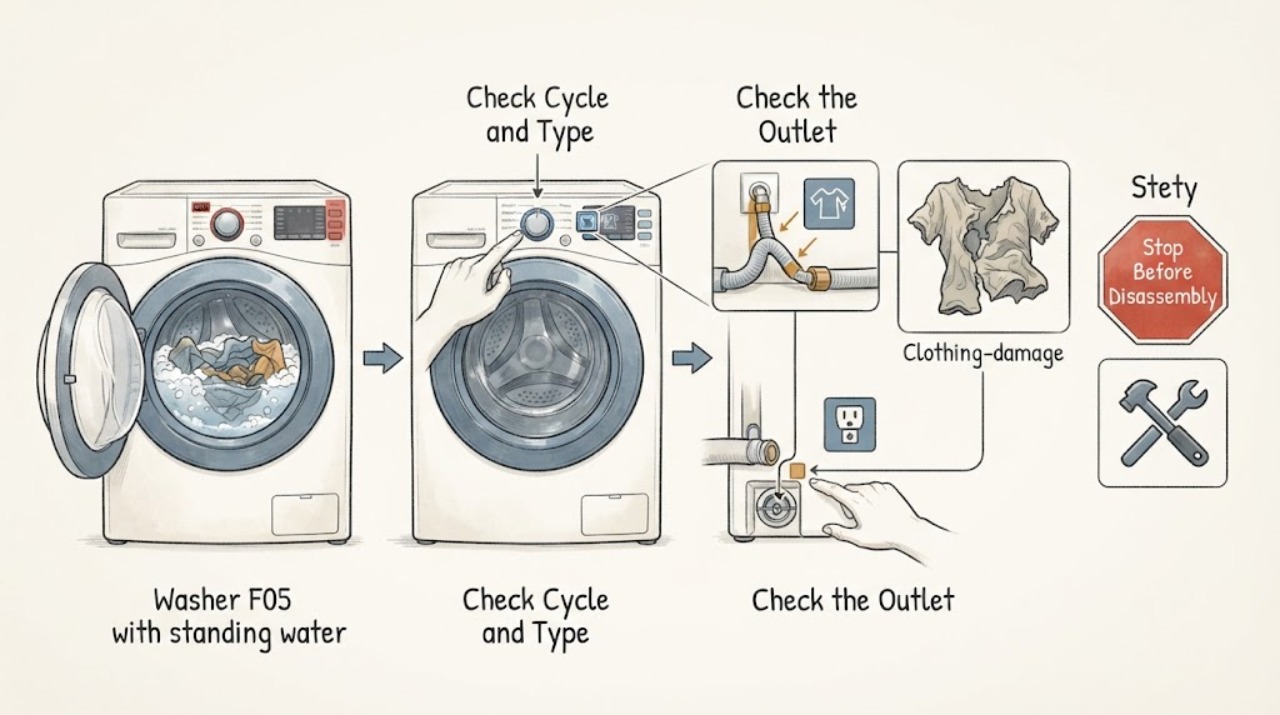
Hotpoint's opened F05 guidance is a UK washing-machine guide: it describes F05 as a waste-pipe blockage or pump issue when the door stays locked or water remains in the drum, and tells the owner to check only the model-approved pump filter, waste hose, and under-sink plumbing before service. It does not explain torn clothing, so treat the two complaints as separate tracks. First stop if water is near electrics, the floor is flooding, there is smoke, a burning smell, sparks, a hot plug, severe movement, or a repeated breaker trip. From a dry, stationary machine, photograph the full F05 display or light pattern and locate the model/industrial code; Hotpoint says models vary. Then inspect the visible drain route and the accessible door-seal and drum opening for a snag, split, sharp edge, foreign object, or loose material without opening the cabinet. A torn seal or object can require immediate appliance service even if the drain issue is only a hose blockage. Do not use F05 to name a pump, seal, bearing, or other part, and do not decide repair versus replacement until a technician has separated the confirmed causes and safety condition.
Work through in order
Diagnostic checks
Use only checks that match the exact appliance or system and its official guide.
-
Check 1
Leave the machine still and photograph the complete F05 display or every flashing light, then photograph the rating plate without removing panels. Record the market if known, model or industrial code, washer or washer-dryer type, selected programme, stage, door state, water level, and when the clothing damage was first noticed.
Expected result: The display is a confirmed F05, a light sequence, or an ambiguous partial code; the model is known, incomplete, or unavailable; water remains or the drum is empty; and the damage is a snag, hole, cut, pulled thread, or unknown pattern.
Next step: Use the exact manual for the confirmed model and region. If the code or model cannot be confirmed, keep the evidence and arrange service rather than applying another Hotpoint model's procedure.
Why this matters
Why: Hotpoint's UK guide distinguishes F05 from other codes and repeatedly warns that models vary. A precise identity and timeline are needed to keep a drain indication from being incorrectly used to explain fabric damage.
-
Check 2
If there is standing water near the plug, outlet, controls, or floor, active leakage, smoke, burning odor, sparks, a hot connection, severe movement, or a repeated breaker trip, stop using the washer. Isolate power or water only from a dry, safe location and do not force the door or reach into the drum.
Expected result: Any electrical, flood, heat, smoke, odor, spark, shock, severe-impact, or locked-door-with-water hazard is present, or the appliance and floor are dry and stable.
Next step: For a hazard, leave the washer isolated and arrange qualified appliance, electrical, plumbing, or emergency help as appropriate. Continue only with dry external observations when no stop condition is present.
Why this matters
Why: The immediate risk is shock, fire, scalding, or water damage; it overrides the normal F05 hose/filter decision and the question of whether the garment damage is mechanical.
-
Check 3
From a dry position, inspect the visible drain hose and nearby plumbing without pulling the appliance or loosening a wet connection. Look for a kink, crush point, obstruction, incorrect standpipe placement, or wastewater backing up at the standpipe, sink, or floor drain.
Expected result: The hose is visibly kinked or blocked, the household drain backs up, the visible route is normal, or the suspected restriction is hidden behind the washer.
Next step: Correct only a plainly visible hose position that the exact manual permits. Use plumbing service for a household backup and appliance service for a hidden, damaged, inaccessible, or normal-looking route with retained water.
Why this matters
Why: Hotpoint links F05 to a waste-pipe blockage or pump issue and separately advises checking the drain hose and under-sink plumbing. An external restriction can explain retained water without proving a pump failure; a normal visible route leaves an internal path or other condition unresolved.
-
Check 4
With the drum completely still and the washer dry, inspect only the accessible door-seal surface, drum lip, and visible opening for a cut, split, loose edge, sharp exposed contact, trapped zipper or wire, or other foreign material. Compare the damaged garment's location and shape with what is visible; do not remove panels or reach into hidden spaces.
Expected result: The seal is visibly torn or displaced, a sharp or loose object is visible, the garment damage has a repeated snag pattern, or the seal and accessible opening look intact with no matching contact point.
Next step: Keep the washer out of service for a torn seal, sharp contact, loose material, or recurring garment damage and arrange appliance inspection. Do not order a generic seal or continue washing damaged garments based on appearance alone.
Why this matters
Why: A visible seal tear or object creates a separate leak or fabric-snag path. Hotpoint's official seal information says splits and tears can cause leaks, but an intact visible area does not rule out a hidden internal contact or a non-appliance textile cause.
-
Check 5
Review the damaged load and the cycle record without starting another cycle: note whether one garment, a zip or hook, a very small or bulky load, or a particular programme was involved, and whether F05 occurred before the damage, after it, or independently. Keep the damaged garment and photograph both sides of each tear.
Expected result: Damage repeats on one garment or programme, several fabrics show similar cuts or pulled threads, the damage is isolated and consistent with a garment fastener, or the drainage fault occurred at a different time.
Next step: Give the photographs and timeline to service. Do not run a sacrificial load to reproduce the tear, and do not use the washer if a sharp contact or active drain fault remains.
Why this matters
Why: A repeatable contact pattern raises the priority of a drum/seal inspection, while an isolated fastener-related snag or a separate timeline does not make F05 the cause. F05 still requires its own water-path decision.
-
Check 6
For the repair-or-replace decision, prepare a neutral service record: full model and region, age if known, F05 history, standing-water location, drain-route findings, exact garment damage, seal/drum observations, leaks, abnormal sound, movement, smoke, odor, or power events. Do not select a pump, seal, drum, or replacement machine from the code alone.
Expected result: The issue is limited to an obvious external drain obstruction, a visible clothing-snag hazard, recurring F05 with a clear drain route, two unrelated faults, or no reliable cause yet.
Next step: Use plumbing service for a household drain backup and qualified appliance service for an internal drain, seal, drum, interlock, or control assessment. Decide repair versus replacement only after the technician separates the faults and states the safety condition.
Why this matters
Why: The official guidance supports different service paths for waste plumbing, pump/drain behavior, and damaged seals. Without a confirmed cause and repair scope, a replacement recommendation or part choice would be speculation.
Use your observations
Decision map
Find the observation that best matches what you see, then follow the next safe action.
-
PATH 01Next step
What you see
F05 is confirmed, water remains, and the visible hose or household drain is kinked, incorrectly positioned, or backing up, while no clothing-snag hazard is visible.
Do this next
Keep the washer off, correct only an obvious manual-authorized hose position, or call a plumber for a household backup. Arrange appliance service if water remains after the route is clear.
Why this path and its safety boundary
Why it matters: The external waste route is more likely than a confirmed pump failure, and the clothing complaint remains a separate unresolved observation.
-
PATH 02Next step
What you see
F05 is confirmed but the visible drain route is normal, water remains or returns, and the exact model manual's accessible filter path is absent, unclear, or unsafe to reach.
Do this next
Stop user troubleshooting and arrange qualified appliance service with the code, model photo, water level, and drain timing. Do not force a door, open a flooded filter, or dismantle the pump.
Why this path and its safety boundary
Why it matters: Hotpoint's public guide does not establish which internal drain arrangement this unidentified machine uses. A pump or hidden blockage is possible, but the code does not prove which component failed.
-
PATH 03Next step
What you see
The seal or drum opening has a visible cut, sharp contact, loose material, repeated snag pattern, or a leak, whether or not F05 is also present.
Do this next
Keep the washer out of service and arrange appliance inspection. Preserve the damaged clothing and photographs; do not continue washing to see whether the tear repeats.
Why this path and its safety boundary
Why it matters: This is an independent clothing-damage and possible leak path. Hotpoint confirms that seal splits or tears can cause leaks, but it does not identify a universal seal part or prove the drain code caused the damage.
-
PATH 04Next step
What you see
F05 and the clothing damage occur on different dates or cycles, the seal and accessible drum opening look intact, and there is no active leak or standing water.
Do this next
Keep separate timelines and photographs for service. Do not make a repair-or-replace decision until each recurring symptom has a confirmed cause.
Why this path and its safety boundary
Why it matters: The two reports should not be collapsed into one fault. The drain issue can be handled through the F05 water-path branch, while the garment issue needs its own load/fastener and professional mechanical assessment if it recurs.
-
PATH 05Next step
What you see
There is flooding, water near electrical parts, smoke, burning smell, sparks, shock, a hot plug, severe movement or impact, exposed damage, or repeated breaker operation.
Do this next
Keep clear, isolate power or water only from a dry safe location, and arrange appropriate qualified or emergency help. Do not restart the washer for diagnosis.
Why this path and its safety boundary
Why it matters: The immediate risk is more important than the F05 interpretation or repair economics.
Helpful context
Understand the symptom
The model is missing, and Hotpoint's official error-code pages are UK guidance rather than a universal code table for every market or generation. Confirm the rating-plate model or industrial code and the complete display before applying the F05 entry. On that UK guide, F05 is associated with water remaining in the drum and a waste-pipe blockage or pump issue; it is not a diagnosis of why fabric was torn.
Keep the drainage and clothing-damage questions separate. Standing water can be caused by the visible hose, under-sink plumbing, or a model-specific filter path. Torn fabric calls for a stationary external inspection of the door seal, drum opening, and any obvious foreign material or sharp contact point. Hotpoint's parts information confirms that a door-seal split or tear can cause leaks, but it does not identify a seal as the cause of every torn garment.
Repair-versus-replace is not answerable from F05 plus a clothing complaint. Record the model, age if known, code history, water location, exact fabric damage, and any visible leak or mechanical damage. Let a qualified appliance technician determine whether there are one or two repairable faults; stop immediately for electrical, flooding, burning, or severe-motion hazards.
When checks do not resolve it
Need a professional?
Arrange qualified appliance service when F05 returns, water remains after the exact model's permitted external hose/plumbing checks, the model or code cannot be confirmed, the seal or drum opening is damaged, clothing continues to tear, or the washer shows abnormal movement or cannot complete a programme. Use plumbing service when the standpipe, sink, or household drain backs up. Stop immediately for flooding, wet electrical areas, smoke, burning odor, sparks, shock, a hot plug, severe impact, or repeated breaker operation; isolate power or water only from a dry, safe location. Do not force a locked door, open a flooded filter, remove panels, enter service mode, bypass a lock, perform live checks, or run a sacrificial load to reproduce clothing damage. Repair-versus-replace requires a confirmed diagnosis and written scope; F05 and torn clothing alone do not support a price or replacement conclusion.
Common questions
FAQ
Does Hotpoint F05 explain clothing being torn?
Not by itself. Hotpoint's UK F05 entry concerns water remaining in the drum and a waste-pipe blockage or pump issue. Torn fabric needs a separate stationary inspection of the accessible seal, drum lip, fasteners, and visible foreign material; a code cannot identify the snagging part.
What can I check for F05 without opening the washer?
Confirm the exact model and display, then from a dry position look for an obvious kink or blockage in the visible drain hose and a backup at the standpipe or sink. Follow the exact manual before an accessible filter step. If water remains or the route is hidden or clear, arrange service rather than forcing the door or dismantling the pump.
Should I repair or replace the Hotpoint washer?
Not from F05 and one torn garment alone. Document the model, age if known, separate symptom timelines, water and leak evidence, and any visible seal or drum damage. A technician should confirm whether there is one drain fault, one clothing-contact fault, or two unrelated faults before a repair scope is compared with replacement.
Read the exact guide
Official sources
- Washing Machine Error Codes Troubleshooting GuideHotpoint UK · Opened Hotpoint UK's official washing-machine code guide. It identifies F05 as a waste-pipe blockage or pump issue when water remains, but the page is a UK guide and does not establish an unidentified machine's exact platform or part.
- Washing Machine Troubleshooting - Quick fixes & TipsHotpoint UK · Opened Hotpoint UK's official troubleshooting page. It provides external checks such as visible hose/plumbing and door-seal inspection, and says error messages should be interpreted using the exact user manual; it is not an exact manual for the unidentified washer.
- Washing Machine Door Seal J00137302Hotpoint UK · Opened an official Hotpoint UK door-seal product page only for the general safety observation that seal splits, tears, and wear can cause leaks. It is not a part-fit claim for the unidentified washer and does not say every torn garment is caused by a seal.
- Hotpoint Service Washing Machine RepairHotpoint UK · Opened the official Hotpoint UK washing-machine service page. It is region-specific guidance; it says models vary and includes F05, visible drain-path, and service boundaries, but it is not a manual for an unidentified model.
Community feedback
Share a repair observation
Share a plain-text repair observation. Accepted observations are published automatically; this page may take a moment to update.