
On this page
Start here
Quick answer
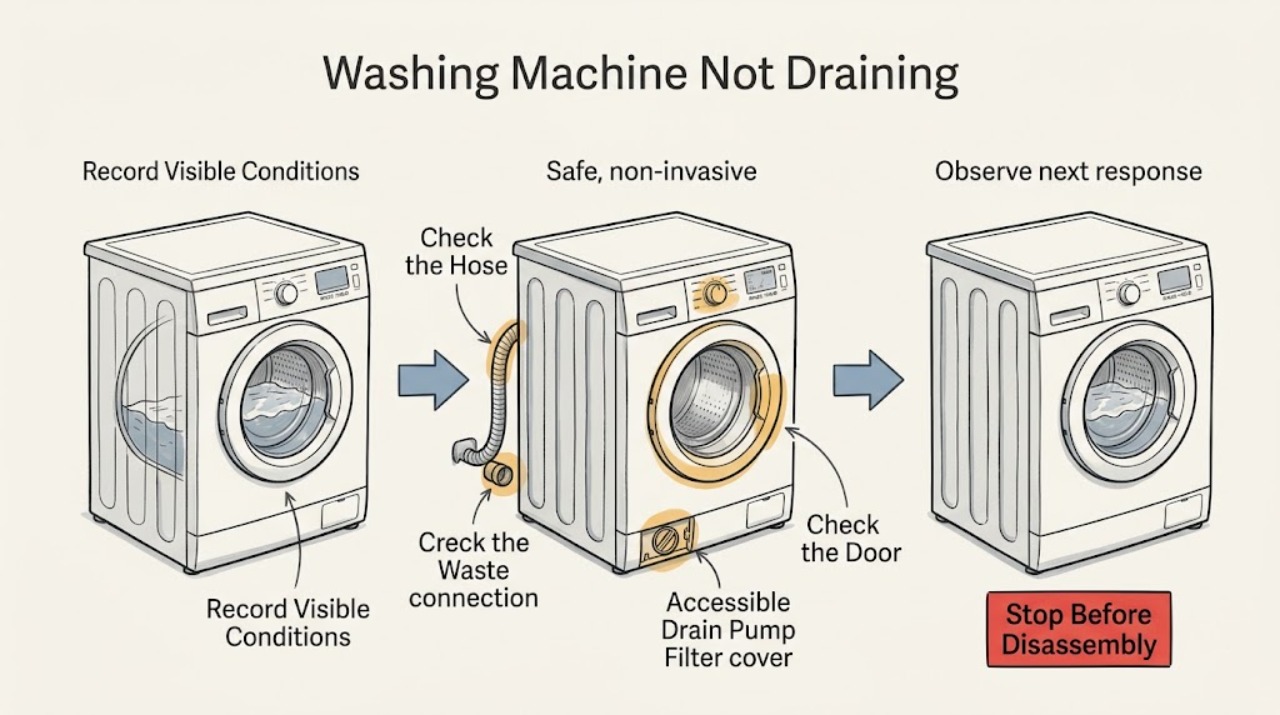
If a Hotpoint washing machine is not draining, stop the cycle and keep clear of the water until it is safe to work around. Note whether water remains in the drum, whether the pump hums, and any displayed code or flashing lights. With the appliance unplugged and the water cool, check the drain hose for a kink or blockage, the under-sink waste connection for a blockage, and—only if your model provides a user-accessible filter—the pump-filter area according to its manual. A Rinse Hold or Crease Care option can deliberately leave laundry in final-rinse water. If the hose and accessible filter path are clear but water remains, an F05-type waste-pipe or pump fault, a locked door, a leak, or an internal pump problem needs model-specific service; do not force the door or work on the pump while connected to power.
Work through in order
Diagnostic checks
Use only checks that match the exact appliance or system and its official guide.
-
Check 1
Stop the cycle, keep the door closed if water is high, and record the water level, whether the drum is locked, whether the pump makes a hum or remains silent, and every code or flashing-light pattern. If safe and dry around the plug, switch the washer off and unplug it before touching hoses or an accessible filter.
Expected result: A full drum with a locked door and an F05-type code or a simultaneous wash, rinse, and spin light pattern points toward a waste-pipe, filter, or pump path; a small amount of water with Rinse Hold or Crease Care selected points toward a setting.
Next step: If water is hot, leaking toward electrics, or the door will not release normally, stop and use the service boundary. Otherwise continue with the external drain checks.
Why this matters
Why: The symptom determines whether to check a setting first or treat the appliance as a blocked-drain condition. Hotpoint says model indicator patterns vary, so record the exact display rather than guessing a code.
-
Check 2
Inspect the drain hose from the back of the washer to the standpipe or sink connection without disconnecting a hose that is under pressure. Look for a kink, crush point, blockage, or an installation that pushes the hose too far into a standpipe; if it drains under a sink, look at the waste connection for visible blockage.
Expected result: A sharply bent hose, a crushed section, a blocked sink connection, or a hose inserted more than about four inches into a standpipe is an external restriction. A clear hose and clear visible connection do not rule out a pump-filter or internal fault.
Next step: Reposition only a safe, accessible hose to its manual-specified route, then use a drain or spin-only program once. If it still leaves water, unplug again before the next check.
Why this matters
Why: Correcting an external routing problem can restore draining without replacing a component. If the route is already clear, continue to the model-approved filter check instead of repeatedly starting a full cycle.
-
Check 3
Check whether Rinse Hold or Crease Care is selected, and check that the selected program is actually at its drain or final-spin stage. Do not force the door; wait for the drum to stop and for the machine to release the lock normally.
Expected result: If the only issue is laundry held in final-rinse water and the option is lit, cancel the hold or select the model's drain or spin function. If the option is off and the drum remains full, the symptom is not explained by Rinse Hold alone.
Next step: Run the correct drain or spin function once after the setting is corrected. If water does not move or the door remains locked, stop repeating cycles and follow the filter and service paths.
Why this matters
Why: A retained rinse can be an intentional program state, while a full drum after a drain command indicates a restriction, pump problem, or control fault that needs the next diagnostic branch.
-
Check 4
If the model manual identifies a user-accessible pump filter, unplug the washer, protect the floor with towels or a shallow container, and inspect the filter area exactly as the manual directs. Remove only visible debris that the manual permits a user to remove; do not reach past the filter or disassemble the pump.
Expected result: Lint, fabric, coins, or another small obstruction at an accessible filter can explain a hum with little or no water flow. A clean filter, a seized-looking impeller, water escaping uncontrollably, or no safe filter access means the cause is not resolved by this check.
Next step: Refit the filter and its cover fully before any test. If the filter cannot be safely refitted, water leaks, or the pump remains blocked, leave the washer unplugged and request qualified service.
Why this matters
Why: Hotpoint treats pump-filter checks as model-dependent. A clear user-accessible filter moves suspicion toward the drain hose, pump, wiring, or control system rather than just more cleaning.
-
Check 5
With the external path and any user-accessible filter checked, run one short drain or spin-only test only when the floor, plug, hoses, filter cover, and door area are dry and secure. Stay nearby and listen without opening panels.
Expected result: A steady pump sound with a strong water flow indicates the restriction was corrected. A hum with no flow suggests a remaining blockage or pump problem; silence with a drain code suggests a control, wiring, or pump-power issue; a new leak or abnormal noise is a stop condition.
Next step: If the test fails, record the sound, code, water level, and model number for service. Do not continue cycling a full machine or bypass the door lock.
Why this matters
Why: The result separates a restored drain path from a fault that requires internal testing. It does not justify live electrical measurements or replacing a pump without model confirmation.
-
Check 6
Compare the result with Hotpoint's model-specific fault guidance and the exact user manual, especially for F05, door-lock, or multiple-flashing-light indications. Perform at most one safe power reset only after the water is controlled and the appliance is dry; do not reset repeatedly to hide a recurring fault.
Expected result: If the same drain code, locked door, or full drum returns after the hose and permitted filter checks, the washer has an unresolved drain-path, pump, wiring, or control fault. If a breaker trips, smoke or burning odor appears, or water reaches electrics, stop immediately.
Next step: Leave the appliance isolated and arrange qualified appliance service. Provide the model/industrial code, exact code or light pattern, water level, pump sound, hose route, filter result, and what happened during the single test.
Why this matters
Why: A recurring fault is a service boundary rather than evidence that another cycle will fix the washer. Hotpoint's F05 guidance specifically directs service when the accessible waste and filter checks do not clear the problem.
Use your observations
Decision map
Find the observation that best matches what you see, then follow the next safe action.
-
PATH 01Next step
What you see
The washer holds only the final rinse and Rinse Hold or Crease Care is selected.
Do this next
Cancel the hold or choose the manual-specified drain or spin function once; if water remains, treat it as a drain fault.
-
PATH 02Next step
What you see
The drain hose is kinked, crushed, blocked, or inserted too far into a standpipe.
Do this next
Correct the safe external routing using the manual, then run one drain or spin-only test. Escalate if the drum still will not empty.
-
PATH 03Next step
What you see
The hose is clear but the under-sink waste connection is blocked.
Do this next
Have the household waste connection cleared without operating the washer into a blocked outlet, then retest once when dry and safe.
-
PATH 04Next step
What you see
A model-approved accessible pump filter contains debris.
Do this next
Clean and refit it exactly as the manual directs; if it is clean, damaged, unsafe to access, or still will not drain, request service.
-
PATH 05Next step
What you see
The pump hums without flow, remains silent with a drain code, or the F05-type fault returns.
Do this next
Stop further cycles and arrange qualified service for the pump, wiring, or control diagnosis; do not test live or bypass the lock.
-
PATH 06Next step
What you see
There is a hot-water burn risk, leak toward electrics, burning smell, smoke, spark, damaged cord, abnormal heat, or a repeated breaker trip.
Do this next
Stop immediately. From a safe, dry position isolate power only if it can be done without contact with water or damage, keep clear, and use qualified or emergency help as appropriate.
Helpful context
Understand the symptom
Start with the water level and the exact end-of-cycle symptom
A washer that leaves a small amount of water because Rinse Hold or Crease Care is selected is different from one that stops with a full drum and a drain fault. The pump sound, the location of any water, and the indicator pattern help separate a setting or plumbing problem from a pump-path problem. Hotpoint notes that models vary, so use the manual for the exact filter access and indicator-code meaning.
Protect the floor and the appliance before checking the drain path
Do not reach into standing water near an electrical connection. If water is hot, leaking toward the plug, or the appliance has a burning smell, smoke, sparks, or a repeatedly tripping breaker, stop and arrange qualified help. Do not force a locked door or run the washer with a removed filter, loose hose, or open panel.
When checks do not resolve it
Need a professional?
Call qualified appliance service when the washer remains full after the hose, waste connection, and model-approved filter checks, or when an F05-type drain fault returns., Stop immediately for smoke, burning or electrical odor, sparks, a hot or damaged cord, water reaching the plug or controls, a repeated breaker trip, or an uncontrollable leak., Do not force the door, bypass the door lock, remove internal panels, or test the pump or wiring while the appliance is energized., If the water may be hot, wait for it to cool or use qualified help; do not open a filter or hose connection into an uncontrolled flow.
Common questions
FAQ
Why is my Hotpoint washing machine full of water at the end of the cycle?
First check whether Rinse Hold or Crease Care is selected. If not, inspect the safe external hose and waste route and then the model-approved pump filter. A recurring full drum or F05-type fault points to service rather than repeated cycles.
Can a kinked drain hose stop a Hotpoint washer from emptying?
Yes. Hotpoint specifically advises checking that the drain hose is not blocked, kinked, bent, crushed, or positioned incorrectly. Correct only the accessible routing described by the manual, then test once.
How do I check the pump filter on a Hotpoint washing machine?
Only some models provide a user-accessible filter. Unplug the washer, protect the floor, and follow that model's manual. Do not reach into the pump, remove panels, or continue if water flow is uncontrolled or the filter cannot be refitted safely.
What does an F05-type Hotpoint washing-machine fault mean?
Hotpoint describes F05 as a waste-pipe blockage or pump issue, often associated with water remaining in the drum or a door that will not open. Check the permitted filter, waste hose, and under-sink plumbing; if the fault remains, arrange service.
Why does the pump hum but the water does not drain?
A hum with no flow is consistent with a remaining restriction or pump problem, but it is not a reason to open the pump or test it live. Stop after the safe hose and user-accessible filter checks and provide the sound and code to a technician.
Is it safe to force open a locked Hotpoint washer door?
No. A locked door can indicate water remains in the drum or a door-lock fault. Do not force or bypass it; isolate the appliance safely and use the manual or qualified service, especially if water is hot or near electrics.
Read the exact guide
Official sources
- Washer Dryer Troubleshooting & Repair ServiceHotpoint · Hotpoint washer dryers and shared washing-machine drain, standpipe, Rinse Hold, filter and flashing-light guidance
- Washing Machine Troubleshooting - Quick fixes & Tips - Hotpoint - HotpointHotpoint · Hotpoint washing machines, drain hose, waste connection, Rinse Hold, pump-filter and indicator troubleshooting
- Hotpoint Service Washing Machine RepairHotpoint · Hotpoint washing machine service, F05 waste-pipe blockage or pump issue, door-lock faults and safe troubleshooting boundary
Community feedback
Share a repair observation
Share a plain-text repair observation. Accepted observations are published automatically; this page may take a moment to update.