
On this page
Start here
Quick answer
A standard Hotpoint washing machine does not have a burner ignition step, so “not igniting” usually means that it will not start, fill, agitate, or spin. First identify which stage is missing: a blank display or no response suggests power or controls; a lit display with no water suggests the supply, inlet path, lid or door condition, or a model-specific timeout; filling without movement points to a start, lid/door, motor, or control issue. Check only the plug, household breaker, cycle controls, Start/Pause control, lid or door closure, water valves, hose kinks, and visible display messages. Unplug the washer before cleaning or maintenance, do not open the cabinet or reach into a moving tub, and do not keep resetting a fault. If you actually smell gas or fuel, see smoke, sparking, a damaged cord, leaking water near electrical parts, or a burning odor, stop using it and arrange appropriate emergency or qualified appliance service.
Before you begin
Safety first
- This article supports external controls, ordinary plug and breaker observation, model-approved Start/Pause and lid/door checks, visible water-valve and hose checks, and safe recording of cycle behavior. A qualified professional must handle cabinet access, lid/door interlocks, inlet valves, motors, pumps, controls, wiring, energized testing, and any electrical or water hazard.
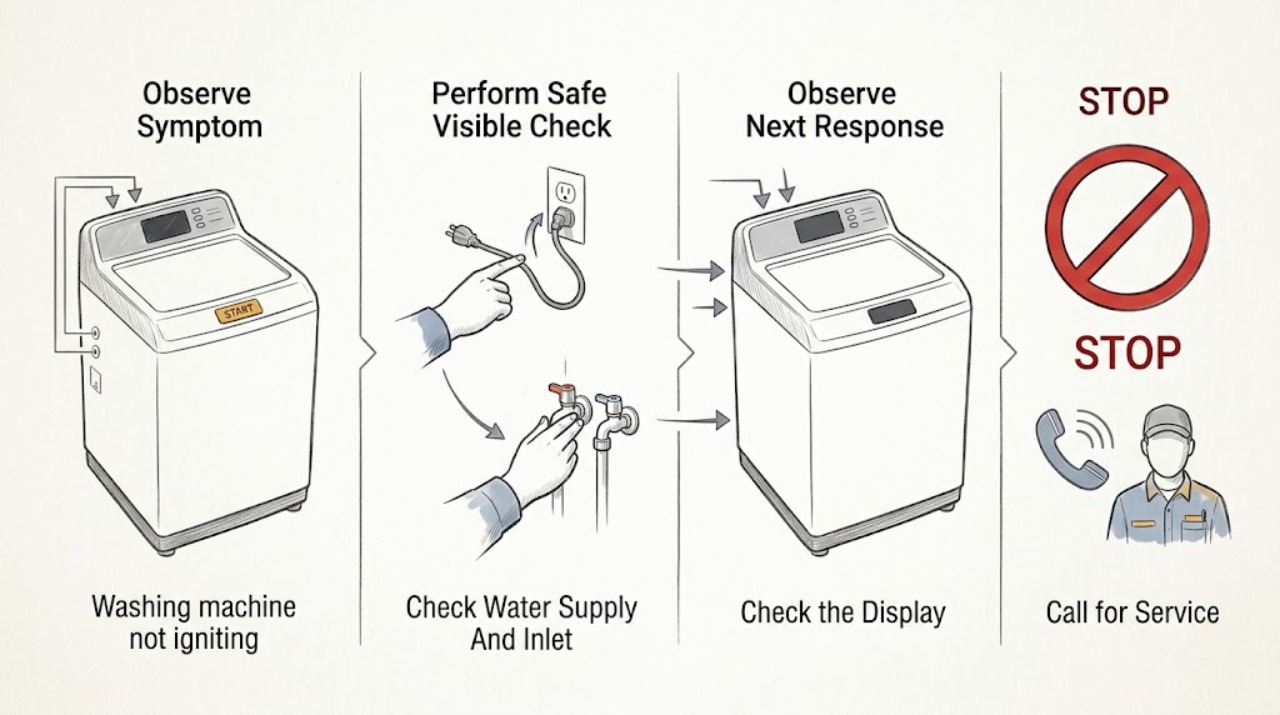
Work through in order
Diagnostic checks
Use only checks that match the exact appliance or system and its official guide.
-
Check 1
Stand clear of the washer and note the exact response after selecting a cycle and pressing Start: whether the display lights, a lock indicator appears, water enters, the motor moves the basket, and the cycle remains running. Record any displayed code and the Hotpoint model from the rating label without opening the cabinet.
Expected result: There are no lights or sounds, the display responds but there is no fill, the washer fills but does not move, the basket moves and then stops, a lid/door or error message appears, or there is smoke, sparking, burning odor, damaged cord, or water near electrical parts.
Next step: Stop and disconnect or leave the washer off for any electrical or water hazard, then arrange appropriate qualified service. Otherwise use the observed stage to perform only the matching external checks below.
Stop if: Stop immediately for smoke, sparking, burning odor, a damaged cord or plug, exposed wiring, active leaking near electrical parts, or a tub that will not stop moving.
Why this matters
Why: “Not igniting” is not a washer ignition diagnosis. The missing stage separates power/control, fill, lid/door interlock, motor, pump, and model-specific fault paths. Smoke, sparking, burning, damaged wiring, or water near electrical parts is a safety event.
-
Check 2
Check that the washer plug is fully seated in its ordinary outlet, the labeled household breaker or fuse is on, the cycle selector is set to a valid cycle, and Start/Pause has been pressed after the lid or door is closed. If the breaker trips again, do not keep resetting it.
Expected result: The outlet or breaker is dead, the controls were not set or Start was not pressed, the lid/door indicator does not confirm closure, the display returns but the washer remains silent, or the breaker trips again.
Next step: Correct only the clearly wrong external setting or closure and try one normal start. If the outlet is dead, the lid/door indication fails, the washer remains silent, or the breaker trips again, leave it off and arrange qualified appliance service.
Stop if: Do not use an extension cord as a workaround, open the console, bypass the lid/door lock, probe the outlet or wiring, or repeatedly reset a breaker.
Why this matters
Why: Hotpoint/GE washer guidance lists loss of power, controls not set, an open lid, and a paused cycle as no-operation causes. A repeated breaker trip or a correct external setup with no response points to an electrical, lock, control, or motor fault rather than ignition.
-
Check 3
If the display and Start response are normal but the washer does not fill, confirm both hot and cold supply valves are open as required by the model, inspect the external inlet hoses for kinks, and check that the washer is not in a visible fill timeout or water-supply message. Disconnect power before any screen cleaning and follow the exact model instructions.
Expected result: A valve is closed, a hose is kinked, water pressure is obviously absent, a water-supply or fill message appears, the model has accessible clogged inlet screens, or the external supply looks normal but no water enters.
Next step: Open only a clearly closed supply valve and straighten an accessible kink. If screen cleaning is permitted by the exact manual, unplug first and follow it; otherwise leave the washer off and arrange service when no-fill persists.
Stop if: Do not remove hoses while pressurized, work on internal valves, run the washer with a leak, or clean screens without disconnecting power and following model-specific instructions.
Why this matters
Why: GE Appliances lists closed valves, hose or inlet restrictions, low pressure, and model-specific fill timeouts as no-fill possibilities. Normal external supply with no fill shifts attention to the inlet valve, control, lock, or wiring and cannot identify a part by symptom alone.
-
Check 4
With the washer stopped, close the lid or door fully and confirm the selected cycle is not paused or canceled. For a top-load model, note whether the lid indicator changes; for a front-load model, note the door-lock message. Do not force the lock or reach into the tub.
Expected result: The lid or door does not latch or indicate closed, a pause or cancellation message remains, the washer starts only after Start/Pause is pressed again, or the closure and cycle state are normal but the motor or fill stage still does not begin.
Next step: Close the lid/door and resume once if the displayed instructions permit it. If the indicator does not respond, the lock is damaged, or the washer still fails to start, stop and arrange service rather than defeating the interlock.
Stop if: Do not bypass or manually defeat a lid/door lock, reach into a moving tub, or operate a washer with a broken latch, door, lid, or safety indicator.
Why this matters
Why: A lid/door safety state or paused cycle can prevent a washer from starting even when the display is lit. If closure and controls are normal but the machine remains in the same stage, the lock, control, motor, or water path needs model-specific diagnosis.
-
Check 5
If the washer fills but does not agitate or spin, or it stops mid-cycle, record whether the pump ran, whether the basket was overloaded or unbalanced, whether a lid/door message or code appeared, and whether the motor sounds or remains silent. Keep hands out of the tub and do not remove panels.
Expected result: The washer pauses normally, reports an unbalanced load, pumps but does not spin, hums without movement, stops with a code, or remains silent after the fill and closure checks.
Next step: Follow the exact model's displayed pause, balance, or Drain & Spin instruction only when it is an ordinary user control. If the symptom returns, the motor does not move, or service requires cabinet access, leave the washer off and provide the recorded sequence to a qualified technician.
Stop if: Do not reach into a moving tub, manually advance a control against the model instructions, open the cabinet, test live wiring, or keep running a washer that hums, leaks, overheats, or trips power.
Why this matters
Why: GE Appliances documents normal pauses, lid-related stops, unbalanced loads, loss of power, and motor or service conditions as separate no-spin paths. A hum, no movement, recurring fault, or correct fill with no agitation is not an ignition problem and may involve motor, drive, pump, lock, or controls.
Use your observations
Decision map
Find the observation that best matches what you see, then follow the next safe action.
-
PATH 01Next step
What you see
The washer has no display or response, the outlet or breaker is not supplying power, or the breaker trips again after one safe check.
Do this next
Leave the appliance off and have the outlet, cord, power entry, and washer controls checked by an appropriately qualified professional. Do not treat this as a failed ignition component or continue resetting power.
-
PATH 02Next step
What you see
The control responds and Start is accepted, but no water enters; a valve is closed, an inlet hose is kinked, a water-supply message appears, or external supply appears normal.
Do this next
Correct only a clearly closed valve or accessible kink. Follow the exact model's powered-off inlet-screen procedure if applicable; otherwise arrange service for an inlet valve, screen, pressure, lock, control, or wiring diagnosis.
-
PATH 03Next step
What you see
The washer fills, the lid or door is closed, and the cycle does not agitate or spin, or the motor hums without movement.
Do this next
Record the sound, stage, load condition, and any code, then stop if it repeats. A motor, drive, pump, lock, or control diagnosis requires the exact Hotpoint model and service access; “not igniting” does not select the part.
-
PATH 04Next step
What you see
A lid/door indicator, pause, cancellation, balance, or other model-specific message appears, or the washer stops after the lid/door was opened.
Do this next
Use only the displayed or exact owner-manual resume instruction once. If the indicator will not clear, the lock is damaged, or the fault recurs, keep the washer off and arrange qualified service without bypassing the interlock.
-
PATH 05Next step
What you see
Smoke, sparking, burning odor, damaged cord, exposed wiring, active water near electrical parts, a tub that will not stop, or overheating is present.
Do this next
Stop using the washer and disconnect power only from a safe, dry position if that can be done without contact with water or damaged equipment. Arrange emergency or qualified appliance/electrical service as appropriate; do not restart for testing.
Helpful context
Understand the symptom
Translate “not igniting” into the missing washer stage
Hotpoint washing machines use electrical controls, water valves, and a motor rather than a furnace-style ignition sequence. The useful question is what happens after Start: no lights or sounds, a lit display with no fill, filling without agitation, or a later stop. Keep the wording in the service request if it is what the user sees, but describe the observable stage and any code rather than guessing that an igniter exists. Hotpoint models and controls vary, so the model manual governs a particular message or procedure.
Start with external controls and the lid or door
GE Appliances' Hotpoint/washer support points to power, cycle controls, the Start or Pause state, and a closed lid for basic operation. Confirm the washer is securely connected to a working outlet, the labeled breaker is on, the selected cycle is valid, and Start has been pressed after closing the lid or door. Do not remove panels, defeat a lid lock, or reach inside while the basket is moving.
A no-fill symptom is different from a motor symptom
If the display responds but water never enters, verify that both supply valves are open and the inlet hoses are not kinked. GE Appliances also lists low water pressure or clogged inlet screens as possibilities on some electronic models. If the washer fills but never agitates or spins, stop treating it as an ignition problem and record the stage, lid/door indication, load state, and any code for model-specific service guidance.
Electrical, motor, lock, and control diagnosis is service work
A washer that remains unresponsive after an external power and control check, trips the breaker, stops with a fault, or has a failed lid/door lock, motor, pump, wiring, or control may need diagnosis beyond the owner checks. Disconnect power before any cleaning or maintenance, and do not select a replacement part from the phrase “not igniting.” The exact Hotpoint model and symptom stage determine the compatible repair.
Safety boundary
Stop conditions
- Stop for smoke, sparking, burning odor, a damaged cord or plug, exposed wiring, overheating, or active water near electrical equipment; disconnect power only from a safe, dry position and arrange appropriate help.
- Do not reach into a moving tub, defeat a lid or door lock, remove cabinet panels, test live wiring, or operate a washer that is damaged, leaking, or partially disassembled.
- Do not repeatedly reset a breaker, restart a recurring error, or keep operating when the motor hums without movement, the tub will not stop, or water continues to enter unexpectedly.
- Do not assume a Hotpoint washing machine has a burner or ignition component. Use the missing operating stage and exact model documentation to describe the fault.
- Do not choose a control, lid lock, inlet valve, motor, pump, wiring, or other part from “not igniting” alone; confirm the exact model and qualified diagnosis first.
Only after diagnosis
Potential parts
- washer inlet valve or inlet screen
Consider only after the model-specific diagnosis confirms a no-fill condition that persists with open valves and clear external hoses and identifies the inlet path as faulty.
Confirm the exact Hotpoint model, region, valve configuration, and service diagnosis before ordering; disconnect power and water before permitted maintenance. - washer lid or door lock
Consider only when the exact model reports a closure or lock failure and external closure does not restore the cycle; never bypass the interlock.
Verify the exact Hotpoint model and lock design before ordering; installation and safety testing require qualified service. - washer drive motor or motor control
Consider only after service confirms that the washer fills and the correct lid or door state is present but the motor does not move or produces a repeatable motor fault.
Motor and control parts vary by model and cycle system; do not infer fit from a no-movement symptom or select by appearance. - washer electronic control
Consider only after qualified diagnosis rules out power, controls, water supply, lock, motor, and pump causes and identifies a control fault.
Confirm the exact Hotpoint model, software or configuration requirements, and technician diagnosis before ordering; internal electrical work is not a user check.
When checks do not resolve it
Need a professional?
Arrange qualified appliance service when the washer remains unresponsive after one external power and control check, does not fill with both valves open and hoses clear, fails to start with a confirmed lid or door closure, fills but will not agitate or spin, repeats a code or lockout, trips the breaker, leaks near electrical parts, or requires cabinet, lock, motor, pump, control, or wiring access. Escalate immediately for smoke, sparking, burning odor, damaged cord, overheating, or water contacting electrical equipment.
Safety scope: This article supports external controls, ordinary plug and breaker observation, model-approved Start/Pause and lid/door checks, visible water-valve and hose checks, and safe recording of cycle behavior. A qualified professional must handle cabinet access, lid/door interlocks, inlet valves, motors, pumps, controls, wiring, energized testing, and any electrical or water hazard.
Common questions
FAQ
Do Hotpoint washing machines have an ignition system?
A standard washing machine does not use a burner-style ignition step. If “not igniting” means the washer will not start, fill, agitate, or spin, describe that missing stage and any code instead of looking for an igniter.
What should I check first if my Hotpoint washer will not start?
Check the plug and labeled breaker, cycle selection, Start/Pause state, and closed lid or door. If the display remains blank, the lid or door will not confirm closed, or the breaker trips again, leave the washer off and arrange service.
Why does my Hotpoint washer have lights but no water?
Confirm the required hot and cold valves are open and the external inlet hoses are not kinked. A water-supply message, timeout, low pressure, or clogged inlet screen can also matter on some models; use the exact manual and disconnect power before permitted screen maintenance.
What if my Hotpoint washer fills but does not move?
Record whether the lid or door locks, whether the pump runs, whether the motor hums, and whether a code or balance message appears. A filled tub with no agitation or spin is a motor, drive, pump, lock, or control branch, not proof of an ignition failure.
Can I bypass the Hotpoint washer lid or door lock?
No. The lock is a safety interlock. Do not defeat it or reach into a moving tub; if the washer will not recognize a closed lid or door after an ordinary closure check, arrange qualified service.
When should I stop using a Hotpoint washing machine?
Stop for smoke, sparking, burning odor, a damaged cord, exposed wiring, overheating, a tub that will not stop, or water near electrical equipment. Disconnect power only from a safe, dry position when possible and arrange appropriate emergency or qualified service.
Read the exact guide
Official sources
- Top Load Washer - No FillGE Appliances · GE Appliances support article for applicable top-load washer designs; exact Hotpoint model, region, controls, and owner manual govern a particular washer.
- Top Load Washer - Does Not SpinGE Appliances · GE Appliances support article for applicable top-load washer designs; front-load and model-specific behavior may differ.
- Hotpoint Products Outside the USGE Appliances · GE Appliances states it sells Hotpoint products in the Americas and distinguishes those products from European Hotpoint products owned by Whirlpool; confirm the product's region before applying support guidance.
- Hotpoint & You,Hotpoint / GE Appliances · Opened Hotpoint owner manual for a specific older washer model; use the current model's manual for model-specific controls, codes, and procedures.
Community feedback
Share a repair observation
Share a plain-text repair observation. Accepted observations are published automatically; this page may take a moment to update.