
On this page
Start here
Quick answer
When a Hotpoint washing machine will not spin, first check whether the program is holding the load in rinse, whether the door is locked, and whether water remains in the drum. Hotpoint says its washers may abort spin when a load remains unbalanced, and a blocked drain path can also prevent a spin cycle. Redistribute the load, confirm the selected speed and options, and inspect only the model-approved accessible filter or drain path with power isolated and no trapped water risk. If the machine bangs violently, leaks, smells hot, sparks, repeatedly trips the breaker, or still will not spin with a balanced load and clear drain, stop using it and arrange qualified service.
Before you begin
Safety first
- Owner checks stop at observing the program, redistributing a load, checking external hoses and door closure, following a model-approved accessible filter procedure, and confirming external installation. No cabinet, live electrical, interlock bypass, drive, bearing, or suspension work is included.
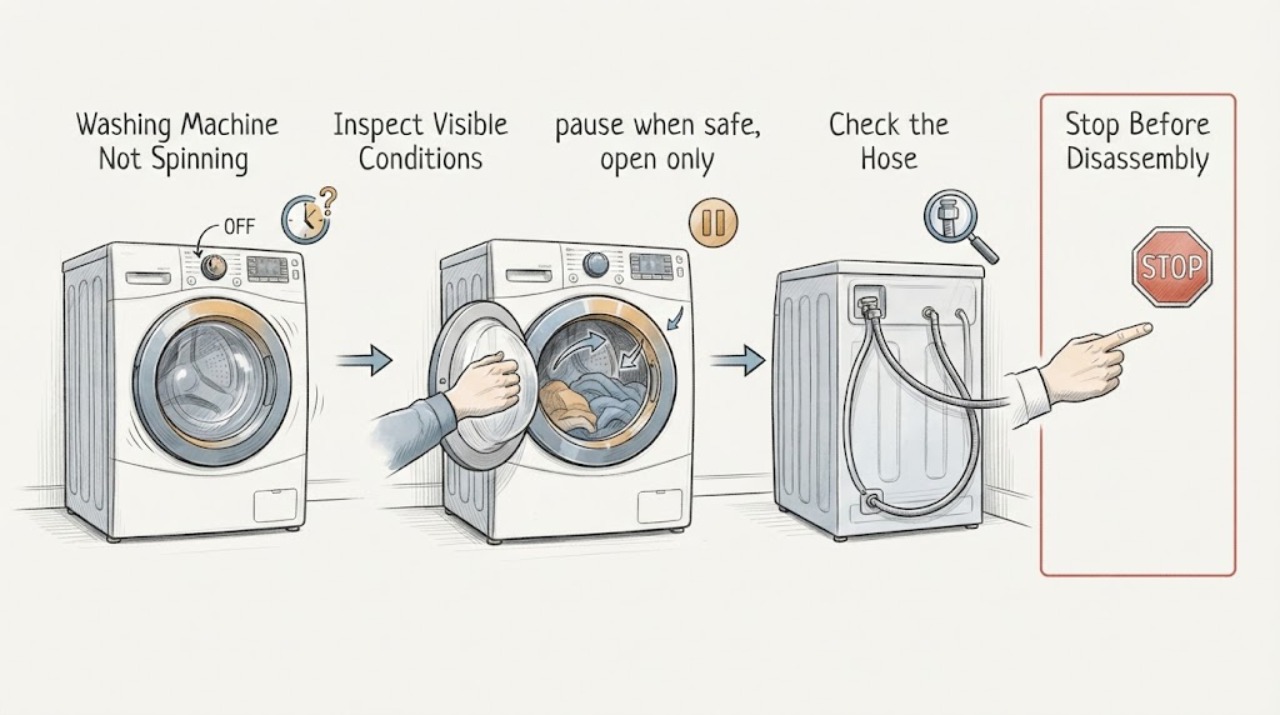
Work through in order
Diagnostic checks
Use only checks that match the exact appliance or system and its official guide.
-
Check 1
Record the selected program, spin-speed setting, and any Rinse Hold, Crease Care, or similar option light. Press Pause once and observe whether the machine has water in the drum, whether the door is locked, and whether the drum ever tries to accelerate.
Expected result: The program is holding water by design, the drum is full of water, the door will not lock, or the machine reaches spin and then stops.
Next step: Use the exact model manual to cancel a hold option only once. Do not force the door or continue if water is trapped, a fault light returns, or the machine shows a leak or electrical warning.
Why this matters
Why: A selected hold option can explain a stationary, wet load. Water remaining points to drainage. A door-lock issue can prevent spin from starting, while an aborted acceleration points toward balance, drain, or a detected fault.
-
Check 2
If the machine stops as spin begins, pause when safe, open only when the lock releases normally, and redistribute the clothes evenly. Remove a single heavy item or balance the load according to the model manual, then select one suitable spin test.
Expected result: The washer spins after redistribution, fails only with a particular load, or still aborts with a small balanced load.
Next step: Do not repeat high-speed cycles when the cabinet moves or bangs. If a balanced load still will not spin, stop use and document the load, speed, and movement for service.
Why this matters
Why: A change with the load supports Hotpoint's unbalanced-load branch. Persistent failure with a balanced load suggests a drain, door, suspension, speed-control, or other fault rather than a loading problem.
-
Check 3
Check whether water remains in the drum. With power isolated and the floor dry, inspect the outside of the drain hose for a kink or crushing and compare its route with the model manual. If the manual describes an accessible pump filter, follow only that procedure and prepare for residual water.
Expected result: Water remains and the drain hose or filter path is restricted, the pump makes an unusual sound, or the drain path looks clear.
Next step: Do not force a filter cap, reach into a pump, or open a locked door. Stop if water moves toward electrical parts or the manual does not cover the access; arrange qualified service.
Why this matters
Why: Hotpoint links failure to empty with a blocked or kinked drain path and notes that a blocked pump filter can stop normal operation. A clear external path with persistent water or pump noise needs service.
-
Check 4
Inspect the door edge and seal from the outside for a garment or debris preventing closure. Confirm the door closes firmly and the lock indication appears before the selected spin, without pushing or bypassing the lock.
Expected result: The door locks normally, a visible obstruction is present, or the door remains unlocked or the machine reports a door fault.
Next step: Remove only a loose external obstruction while the machine is off. If the lock, seal, or alignment is damaged, stop use and request service.
Why this matters
Why: A washer may refuse to spin when it cannot verify a safe closed door. A visible obstruction is a user-level finding; a recurring lock fault is not a reason to defeat the interlock.
-
Check 5
Read every flashing light, tap symbol, or error message exactly and record when it appears: at start, after filling, during drain, or as spin begins. Compare it with the exact Hotpoint manual or official model guide.
Expected result: The indication is identified as a hold, unbalanced load, drain blockage, door issue, or another model-specific fault; or it is not listed.
Next step: Perform only the documented user step once. If the code or lights return, or the machine still will not spin, stop and give the technician the model, indication, program, and water status.
Why this matters
Why: Hotpoint notes that light patterns and error meanings vary by model. A recognized user-level indication can select a safe branch, while an unknown or returning indication should be treated as unresolved.
-
Check 6
If the washer is new or was moved, confirm from the outside and the manual that transport brackets or bolts were removed and that the appliance is level and supported on all feet. Do not remove panels or run a high-speed test on an unstable machine.
Expected result: A transport restraint remains, the cabinet rocks or contacts a wall, or installation is correct but the no-spin condition remains.
Next step: Correct an obvious external installation issue only as the manual directs, then make one supervised test. If movement or no-spin continues, stop use and arrange service.
Why this matters
Why: Incorrect first-use installation can create severe vibration and prevent a safe spin. Correct installation with persistent no-spin points to balance detection, drain, lock, suspension, drive, or control diagnosis.
Use your observations
Decision map
Find the observation that best matches what you see, then follow the next safe action.
-
PATH 01Next step
What you see
Rinse Hold, Crease Care, or another hold option is active and water remains in the drum.
Do this next
Use the exact manual to cancel or complete the hold option once. If the machine does not drain or the option returns, stop and request service.
-
PATH 02Next step
What you see
The washer reaches spin but aborts with a heavy or uneven load.
Do this next
Redistribute the load according to the manual and try one suitable spin. Persistent instability with a balanced load needs service.
-
PATH 03Next step
What you see
Water remains in the drum or the pump and drain path are noisy.
Do this next
Check external hose routing and the model-approved accessible filter procedure with power isolated. Stop for trapped water, leakage, or a persistent pump symptom.
-
PATH 04Next step
What you see
The door does not lock or a door indication appears before spin.
Do this next
Check only for a visible obstruction and use the exact manual. Never bypass or force the lock; arrange service if the fault remains.
-
PATH 05Next step
What you see
A code or light pattern returns after its one documented user step.
Do this next
Stop use and provide the exact model, code or lights, selected program, and water status to a qualified technician.
-
PATH 06Next step
What you see
The machine bangs violently, walks, leaks, smells hot, smokes, sparks, or trips the breaker again.
Do this next
Stop immediately and keep people away. Isolate power only from a safe, dry position and arrange qualified electrical or appliance service; do not restart to reproduce the symptom.
Helpful context
Understand the symptom
Separate a held rinse from a failed spin
A washer can appear not to spin because it is intentionally holding water under a rinse-hold or crease-care option, because it cannot drain, because the door is not in its safe locked state, or because its balance protection has stopped high-speed rotation. Note the selected program, option lights, water level, and whether the drum attempts to accelerate. That information is more useful than repeatedly pressing Start.
Check the simple decision points in order
Hotpoint's support guidance recommends redistributing an unbalanced load, checking the drainage system, and consulting the manual because light patterns and controls vary. A first-use or recently moved machine also needs the transport restraints and leveling checked. Keep all inspections external or model-approved and user-accessible; belts, bearings, suspension, motors, and wiring are service work.
Stop when water or electricity makes the check unsafe
Unplug before a permitted filter inspection, and do not force a door that is locked with water inside. Stop for leakage toward electrical parts, smoke, burning smell, sparks, a hot cord or outlet, violent movement, or a repeated breaker trip. A persistent no-spin fault after safe checks needs a qualified technician rather than a guessed motor or belt.
Safety boundary
Stop conditions
- Stop immediately for smoke, burning smell, sparks, a hot cord or outlet, repeated breaker trips, violent movement, or water approaching electrical parts.
- Stop for a door that will not close or unlock normally, a damaged door seal, trapped water, a persistent leak, or a loose-feeling drum.
- Do not bypass the door lock, reach into trapped water, force a filter cap, remove panels, or work on the motor, belt, bearings, suspension, wiring, or drive system.
- Do not keep repeating high-speed cycles. Arrange qualified service when a balanced load, correct program, clear external drain route, and model-approved checks do not restore spin.
Only after diagnosis
Potential parts
- washing machine drain pump or pump filter
Consider this category only when water remains or the drain stage is noisy and a qualified diagnosis confirms a pump or filter-path fault after external checks.
Confirm the complete model and user-accessible design before selecting a part; no-spin alone does not prove pump failure. - washing machine door-lock assembly
Consider this category only when the door closes correctly but a qualified diagnosis confirms the lock prevents the spin sequence.
Verify the exact model and never bypass the interlock to test the machine. - washing machine suspension component
Consider this category only when installation and load checks are correct but persistent spin instability is confirmed by a qualified inspection.
Suspension parts are model-specific; verify fit through approved service information. - washing machine drive belt or motor component
Consider this category only when the drum will not accelerate and a technician confirms a drive-related fault after ruling out hold, load, door, and drain causes.
This is an internal repair boundary; do not select a drive part from a no-spin symptom alone.
When checks do not resolve it
Need a professional?
Arrange qualified Hotpoint appliance service when the washer will not spin after the hold-option, door, load, drain, and installation checks, when an error returns, or when a motor, belt, bearing, suspension, or control fault is suspected. Seek urgent electrical help for smoke, sparks, burning, or unsafe water contact with electrics.
Safety scope: Owner checks stop at observing the program, redistributing a load, checking external hoses and door closure, following a model-approved accessible filter procedure, and confirming external installation. No cabinet, live electrical, interlock bypass, drive, bearing, or suspension work is included.
Common questions
FAQ
Why is my Hotpoint washing machine not spinning but still full of water?
A drain hose, pump, or filter-path problem may leave water in the drum, and a hold option can also intentionally retain water. Check the exact manual's user-level drain guidance and stop if water is trapped or approaches electrical parts.
Can an unbalanced load stop a Hotpoint washer from spinning?
Yes. Hotpoint says the washer may redistribute an unbalanced load and abort spin if it remains unstable. Redistribute the load once; persistent banging or no-spin with a balanced load needs service.
Could Rinse Hold be why my Hotpoint washer will not spin?
Yes, a rinse-hold or similar option can keep clothes in water instead of completing the final spin. Check the selected options and use the exact manual to cancel or complete the hold once.
What if the Hotpoint door will not lock before spin?
Check only for a visible garment or debris at the door edge and do not force or bypass the lock. A recurring lock indication or door fault requires qualified service.
Should I replace the belt or motor because my Hotpoint washer will not spin?
No. The program, load balance, drain path, door lock, suspension, drive, and controls can all produce a no-spin symptom. A technician should confirm the exact model and failed component before any internal repair.
Read the exact guide
Official sources
- Hotpoint Service Washing Machine Repair - HotpointHotpoint · Hotpoint washing-machine repair advice for no-spin, drain, rinse-hold, error-code, and service conditions
- Hotpoint Service Help and Advice - HotpointHotpoint · Hotpoint owner help, manuals, installation guidance, and service pathways
- Washing Machine Troubleshooting - Quick fixes & Tips - Hotpoint - HotpointHotpoint · Hotpoint washing-machine troubleshooting for no-spin symptoms, unbalanced loads, drain paths, door closure, error indications, and safe escalation
Community feedback
Share a repair observation
Share a plain-text repair observation. Accepted observations are published automatically; this page may take a moment to update.