
On this page
Start here
Quick answer
To troubleshoot a ice maker that is frost buildup, first identify the exact stage and accompanying signs, then make only the safe external checks supported by the owner guidance. Stop for hazards or recurrence and arrange qualified service.
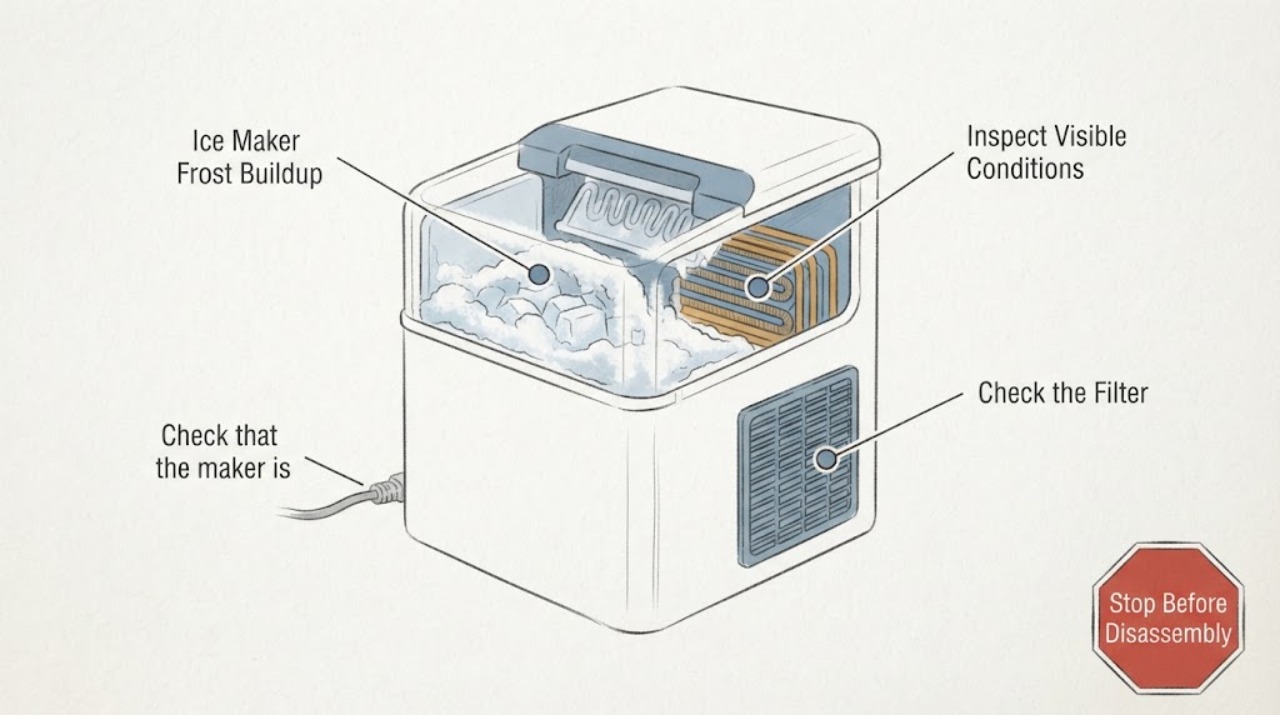
Work through in order
Diagnostic checks
Use only checks that match the exact appliance or system and its official guide.
-
Check 1
Observe whether the ice maker is frost buildup in the bin, chute, fill area, or drain, and note the ice level, water path, and any clumping.
Expected result: The fault is isolated to dispensing, filling, harvesting, draining, or the whole maker.
Next step: Record the model and use its manual for the matching check.
Why this matters
Why: The symptom location selects a bin, arm, filter, water-line, drain, or control path; it does not prove a failed part.
-
Check 2
Check that the maker is enabled, the bin is seated, and the arm or sensor area is free of packed ice, without using sharp tools or forcing the mechanism.
Expected result: The maker is off, the bin or arm is blocked, or these areas are clear.
Next step: Correct only the documented setting or use a blunt tool if the manual permits it.
Why this matters
Why: A disabled setting, mis-seated bin, or jam can stop ice production or dispensing; persistent failure needs service.
-
Check 3
Inspect the accessible water filter, valve, supply line, and drain or chute for correct seating, a kink, leak, or ice obstruction.
Expected result: A filter, line, valve, chute, or drain issue is visible, or the path appears normal.
Next step: Shut off water for an active leak and arrange service for a hidden or recurring restriction.
Why this matters
Why: Water restriction or an ice blockage can cause filling, leaking, dispensing, or draining symptoms.
-
Check 4
Check the freezer or ice compartment temperature indication and any warning without repeatedly power-cycling the refrigerator.
Expected result: A warning or warm compartment is present, or conditions appear normal.
Next step: Protect food and arrange qualified service for persistent ice-maker failure.
Why this matters
Why: Temperature and warnings help service distinguish environmental and control conditions from a mechanism fault.
Use your observations
Decision map
Find the observation that best matches what you see, then follow the next safe action.
-
PATH 01Next step
What you see
The ice maker is frost buildup only during a specific function or load
Do this next
Follow the exact owner manual for that condition and monitor only when safe.
Why this path and its safety boundary
Why it matters: A function-specific or load-dependent pattern narrows the safe check but does not prove a failed component.
-
PATH 02Next step
What you see
The ice maker remains frost buildup after the accessible checks
Do this next
Stop testing and arrange qualified service.
Why this path and its safety boundary
Why it matters: The symptom is not resolved by an external condition and needs model-specific diagnosis.
-
PATH 03Next step
What you see
The symptom includes smoke, burning odor, gas odor, exposed wiring, water near electrics, a safety alarm, or a repeat breaker trip
Do this next
Arrange qualified service if the ice maker remains frost buildup after the safe external checks, if a control or cord is damaged, or if the symptom returns. Do not open the housing, bypass an interlock, or work on energized, gas, sealed, or refrigerant components.
Why this path and its safety boundary
Why it matters: The condition is unsafe to continue testing.
Helpful context
Understand the symptom
The useful decision for a ice maker that is frost buildup is to separate an accessible loading, setting, assembly, airflow, or supply condition from a symptom that needs model-specific service. Observe each result before choosing the next safe step.
When checks do not resolve it
Need a professional?
Arrange qualified service if the ice maker remains frost buildup after the safe external checks, if a control or cord is damaged, or if the symptom returns. Do not open the housing, bypass an interlock, or work on energized, gas, sealed, or refrigerant components.
Common questions
FAQ
Can I keep using the ice maker while it is frost buildup?
Arrange qualified service if the ice maker remains frost buildup after the safe external checks, if a control or cord is damaged, or if the symptom returns. Do not open the housing, bypass an interlock, or work on energized, gas, sealed, or refrigerant components.
Read the exact guide
Official sources
- Ice maker troubleshooting: how to fix an ice makerWhirlpool · Whirlpool ice maker troubleshooting, water line, filter, bin, arm, leaks, dispensing, and service guidance
Community feedback
Share a repair observation
Share a plain-text repair observation. Accepted observations are published automatically; this page may take a moment to update.