
On this page
Start here
Quick answer
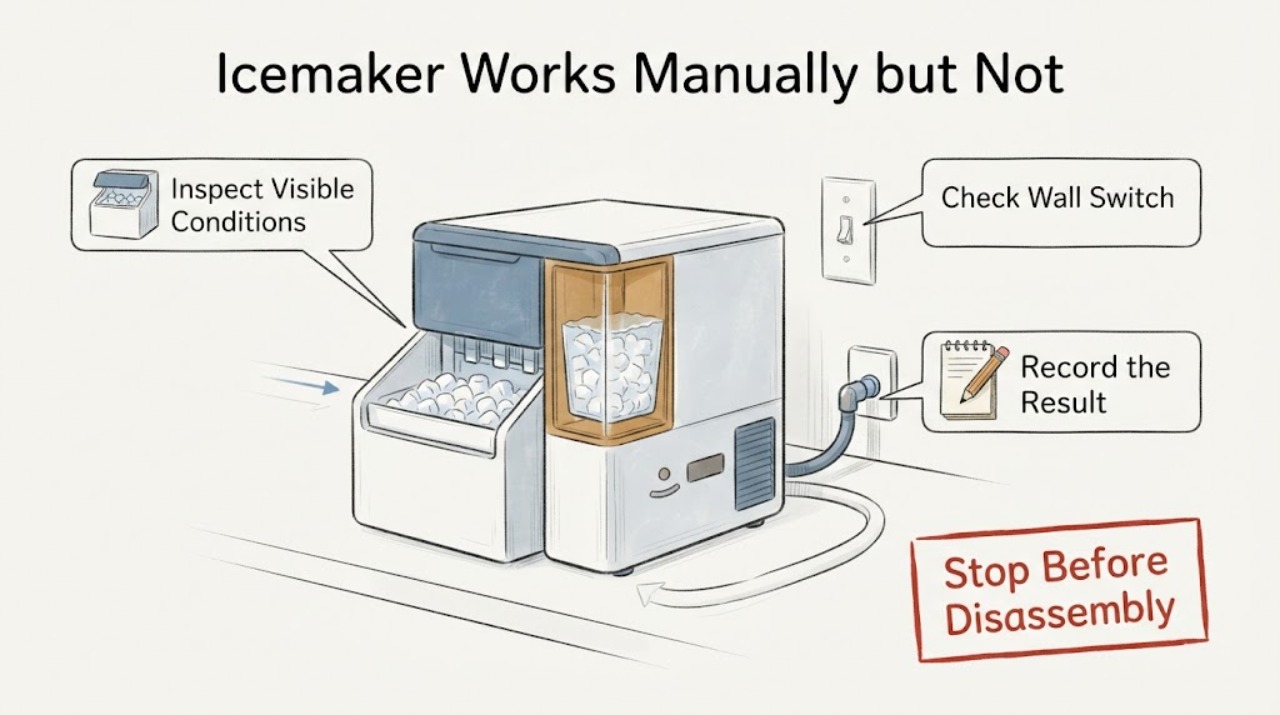
A manual harvest or test that moves the ice maker does not prove that the normal automatic cycle, temperature sensing, shutoff control or water fill is working. First identify what “manual” means: whether cubes actually released, whether the mold refilled, and whether the next automatic cycle stopped. Then verify from the exact refrigerator manual that the ice maker is enabled and that its arm, switch, bin or display control is in the production position; controls differ by model, so do not force an arm or guess a button sequence. Check the freezer temperature display, door closure, visible water line and external shutoff valve, and any model-approved filter status. If the automatic cycle still does not harvest or refill, or there is a leak, stuck ice, visible damage or an error indication, keep the ice maker off and arrange model-specific service.
Work through in order
Diagnostic checks
Use only checks that match the exact appliance or system and its official guide.
-
Check 1
Write down exactly what the manual action did without repeating it unnecessarily: did the ejector move, did cubes fall, did the mold receive water, and did the storage bin or shutoff arm change position? Observe one normal production interval from outside the mechanism if the appliance is safe to operate.
Expected result: The manual action moves the mechanism but the mold never refills, or it produces one batch and then stops during normal operation.
Next step: Continue with the model-matched on/off, temperature, water-supply and bin checks below. Do not declare a motor, thermostat, sensor or valve defective from this observation alone.
Why this matters
Why: Movement alone shows only that the mechanism moved at that moment; it does not establish that the automatic sensor, shutoff logic or water-fill step is working.
-
Check 2
Use the exact model manual to locate the ice-maker status control, switch, display setting, shutoff arm and bin position. Check that production is enabled and that a full bin or raised arm is not commanding an automatic stop; handle only accessible controls and do not force the arm or remove a part that the manual does not identify as user-removable.
Expected result: The ice maker is off, an Ice Off indicator is lit, the shutoff arm is raised, or the bin is not seated as the manual requires.
Next step: Restore the model-approved production position, seat the bin as instructed, and allow the appliance's documented production period. If the control is already correct or the symptom returns, stop changing settings and continue to service escalation.
Why this matters
Why: The automatic cycle may be intentionally disabled or seeing a full/mispositioned storage condition; this does not prove a failed part.
-
Check 3
Check the freezer temperature display and the door or ice-maker compartment seal from outside. Compare the reading with the exact manual rather than applying another brand's threshold, and look for a door that remains ajar, a bucket that is not fully seated or obvious frost that prevents closure.
Expected result: The freezer is warmer than the model's specified ice-making range, the door or bucket does not seal, or the ice maker is exposed to obvious warm-air entry.
Next step: Correct only the accessible closure or setting identified by the manual, keep the door closed, and allow the specified stabilization period. If the temperature cannot be maintained, address the refrigerator cooling problem before diagnosing the ice maker.
Why this matters
Why: The ice maker may not reach the temperature needed to start or complete automatic production; a manual movement does not rule out a temperature or sealing cause.
-
Check 4
Inspect the external water supply path without disconnecting it: confirm the accessible shutoff valve is open, the visible line is not kinked, and the model-approved filter is seated and within its service interval. If the refrigerator has a water dispenser, observe whether it delivers water normally; do not remove tubing or test internal pressure without the model instructions and appropriate professional help.
Expected result: The valve is closed, the line is kinked, the filter is not seated or overdue, the dispenser has no water, or the ice maker's mold remains dry after a correctly documented cycle.
Next step: Restore only the accessible valve/line/filter condition allowed by the manual, then monitor one normal cycle. If water does not return, there is a leak, or the filter/line requires disassembly, keep the ice maker off and arrange service or a qualified plumber as appropriate.
Why this matters
Why: An external water-supply restriction can prevent the automatic fill even when the ejector can move manually; this observation does not identify the restricted component.
-
Check 5
Look at the accessible ice bucket and ejector area for a clump, a cube wedged in the release path, an overfilled bin or visible damage. Do not pry on the mechanism, apply heat, or reach into a moving or powered ice maker.
Expected result: Ice is clumped or blocking the bucket/ejector path, or the bucket cannot be removed as the manual describes.
Next step: Follow only the exact manual's safe bucket-removal and ice-handling instructions. If the bucket is frozen in place, the ice maker is frozen over, or the obstruction returns, leave it off and request service rather than forcing it.
Why this matters
Why: A storage or release obstruction can make automatic production stop even though a prior manual action appeared to work; a stuck bucket can also indicate a condition requiring service.
Use your observations
Decision map
Find the observation that best matches what you see, then follow the next safe action.
-
PATH 01Next step
What you see
The ice maker is off, the shutoff arm is raised by a full or misseated bin, or the model display shows Ice Off.
Do this next
Use the exact model manual to enable production and seat the bin. Wait for the documented cycle time; if it stops again with an empty, correctly seated bin, continue to the temperature and water checks.
Why this path and its safety boundary
Why it matters: The automatic cycle is disabled or receiving a normal shutoff signal; manual movement does not override that control state.
-
PATH 02Next step
What you see
The freezer is too warm for the exact model, the door does not seal, or the ice-maker compartment has obvious frost or warm-air entry.
Do this next
Correct the accessible temperature or closure issue using the model manual and allow the specified stabilization time. Seek refrigerator service if the freezer cannot hold the required temperature.
Why this path and its safety boundary
Why it matters: The ice maker may be unable to freeze or complete its automatic cycle; the manual action does not rule out a temperature or sealing problem.
-
PATH 03Next step
What you see
The ice maker is enabled and cold enough, the bin is seated, but the mold remains dry or the dispenser and visible water supply are not delivering water.
Do this next
Check only the accessible valve, visible line and model-approved filter. If the issue remains, keep the ice maker off and arrange appliance or plumbing service without disconnecting internal tubing.
Why this path and its safety boundary
Why it matters: The automatic fill path is not confirmed, while a manual harvest only established movement; the cause could be upstream water supply or an internal appliance issue.
-
PATH 04Next step
What you see
The bucket is frozen in place, ice maker damage or leakage is visible, an error indication remains, or the correct model-specific test gives no response.
Do this next
Turn the ice maker off using the model-approved control, protect the floor and food from leaks, and request qualified service. Do not bypass the shutoff or open the ice-maker housing.
Why this path and its safety boundary
Why it matters: Further force, heat, repeated testing or guessed part replacement could damage the appliance or create a water/electrical hazard.
Helpful context
Understand the symptom
“Works manually” can describe several different observations: a model-specific test cycle, a hand-advanced ejector, or cubes that were released once after a reset. Those observations are useful, but they do not prove that the automatic timing, shutoff sensing, freezer temperature or water fill is correct. The next decision is whether a complete automatic cycle releases and refills normally.
No brand, model or refrigerator configuration was supplied. The manufacturer pages used here show why controls and thresholds must be matched to the appliance: Whirlpool, GE and Samsung describe different control layouts and model-specific instructions. Use them for the general decision points, but use the actual owner's manual before touching an arm, button, bin or filter.
When checks do not resolve it
Need a professional?
Arrange appliance service when the ice maker remains enabled and cold enough but does not complete an automatic harvest/fill cycle, or when a model-specific test gives no response. Use plumbing help for an unresolved external water-supply problem, and stop using the ice maker for any leak, visible damage, frozen-in-place bucket or persistent error.
Common questions
FAQ
If the ice maker works in a manual test, does that prove the motor is good?
No. It shows that the mechanism moved during that test, but automatic production also depends on the enabled control state, freezer temperature, shutoff sensing, water fill and release path. Record whether the mold refilled and whether a later automatic cycle completed before drawing a conclusion.
Can the ice maker be turned on with a generic arm or button instruction?
No. Whirlpool and GE both describe model-dependent switches or controls, and Whirlpool says to use the owner's manual. Identify the appliance first and do not force an arm or use another brand's button sequence.
What if the ejector moves but no water enters the mold?
Check only the accessible water valve, visible line, model-approved filter and dispenser behavior. A dry mold after a correct cycle points to an unconfirmed fill-path problem, not a proven valve or control failure; use service if the external checks do not resolve it.
Should I force out a bucket that is frozen in place?
No. Samsung's support guidance says not to force a stuck bucket or use a hair dryer, and directs the user to service when the ice maker is frozen over or cannot be safely removed. Keep it off and avoid further force.
Read the exact guide
Official sources
- Refrigerator - Icemaker Not Producing IceGE Appliances · GE-specific troubleshooting used for general decision categories only; the temperature figures and controls are not transferred to an unidentified appliance.
- How to Turn the Ice Maker On and OffWhirlpool Product Help · Whirlpool-specific examples used only to show why the unknown appliance's control and arm must be matched to its own manual; not a claim about every brand.
- What to do when my refrigerator does not make ice properly?Samsung Support · Samsung general guidance explicitly says to check the model manual; it is not used to assign controls, thresholds or parts to an unidentified appliance.
Community feedback
Share a repair observation
Share a plain-text repair observation. Accepted observations are published automatically; this page may take a moment to update.