
On this page
Start here
Quick answer
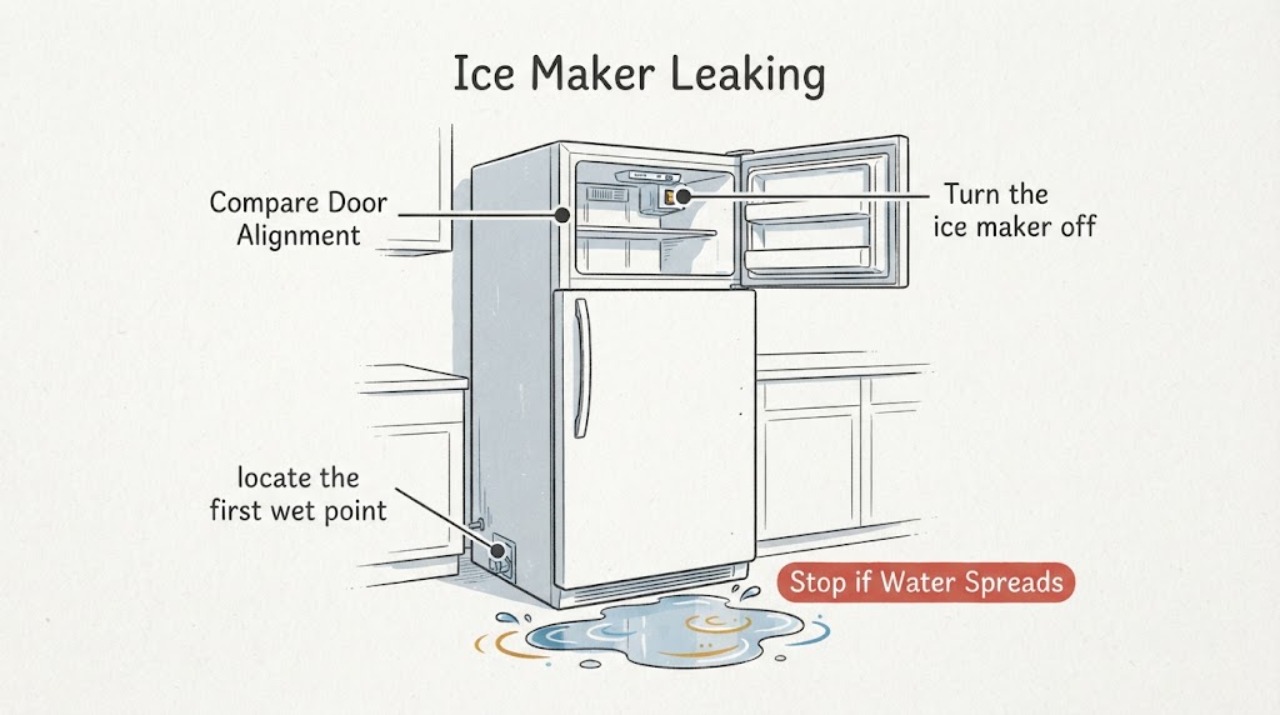
When an ice maker leaks, turn it off and keep water away from electricity, then locate the first wet point: reservoir or drain, hose connection, or fill/ice area. GE and Whirlpool identify loose drain parts, misaligned or damaged hoses, an unlevel unit, and a blocked household drain as distinct possibilities, so the source location determines the next safe check.
Work through in order
Diagnostic checks
Use only checks that match the exact appliance or system and its official guide.
-
Check 1
Turn the ice maker off and look from a dry position at the floor, plug, reservoir, and rear connections.
Expected result: Water is pooling near electrics, spraying, or flooding continues after shutoff.
Next step: Close the water supply and isolate power only from a dry normal disconnect; arrange qualified help.
Stop if: Stop if there is a safety hazard or internal access would be required.
Why this matters
Why: This is a flooding/electrical hazard before it is a leak-location check.
-
Check 2
With power off, locate the first wet point: drain cap/reservoir, drain tube, water fitting, or fill/ice area.
Expected result: The leak begins at a drain, connection, hose, or ice-making area.
Next step: Use the matching model manual and do not loosen a pressurized connection.
Stop if: Stop if there is a safety hazard or internal access would be required.
Why this matters
Why: Each location has a different cause; moving the unit first can hide the source.
-
Check 3
Inspect only visible drain alignment, hose kinks/cracks, clamps, and whether the unit is level.
Expected result: A tube is displaced, a clamp/connection is loose, a hose is damaged, or the unit is unlevel.
Next step: Correct only a plainly visible safe position; use service/plumbing help for damaged or pressurized lines.
Stop if: Stop if there is a safety hazard or internal access would be required.
Why this matters
Why: These installation conditions can cause leaking or poor drainage.
-
Check 4
After water is contained, watch one short fill or harvest cycle from outside.
Expected result: The leak returns, the source is inside, or the household drain backs up.
Next step: Leave it off and arrange appliance service or qualified plumbing help.
Stop if: Stop if there is a safety hazard or internal access would be required.
Why this matters
Why: A recurring/internal leak needs appliance diagnosis; a backed-up household drain is plumbing work.
Use your observations
Decision map
Find the observation that best matches what you see, then follow the next safe action.
-
PATH 01Next step
What you see
Water begins at the reservoir or drain cap
Do this next
Verify seating only as the manual permits; service if it persists.
Why this path and its safety boundary
Why it matters: A drain seal or reservoir condition is more likely than a fill leak.
-
PATH 02Next step
What you see
Water begins at a hose fitting or damaged supply line
Do this next
Close the water supply and have it repaired safely.
Why this path and its safety boundary
Why it matters: The connection or tubing is the likely source.
-
PATH 03Next step
What you see
Water appears during fill near the ice area
Do this next
Keep the unit off and arrange service if it repeats.
Why this path and its safety boundary
Why it matters: Fill alignment or an internal valve condition is possible.
Helpful context
Understand the symptom
How to read the result
When an ice maker leaks, turn it off and keep water away from electricity, then locate the first wet point: reservoir or drain, hose connection, or fill/ice area. GE and Whirlpool identify loose drain parts, misaligned or damaged hoses, an unlevel unit, and a blocked household drain as distinct possibilities, so the source location determines the next safe check.
When checks do not resolve it
Need a professional?
Use appliance service for recurring/internal leaks and qualified plumbing help for a blocked household drain. Seek urgent help for flooding or water near electricity.
Common questions
FAQ
Should I keep making ice while it leaks?
No. Stop the ice maker and contain water before locating the source.
What if the household drain backs up?
Use qualified plumbing help; appliance service cannot correct an external drain restriction.
Read the exact guide
Official sources
- Leaking from Behind - Freestanding Ice Maker - Product HelpWhirlpool · freestanding ice maker leaks
- Ice Maker - LeakingGE Appliances · stand-alone ice maker leaking
Community feedback
Share a repair observation
Share a plain-text repair observation. Accepted observations are published automatically; this page may take a moment to update.