
On this page
Start here
Quick answer
An ice maker that is not making ice should be checked in this order: confirm it is enabled, verify the freezer is cold enough, then check the water line and filter. Use the model manual for the exact control or reset location. If water supply and controls are correct but no harvest or fill occurs, arrange service instead of forcing the mechanism.
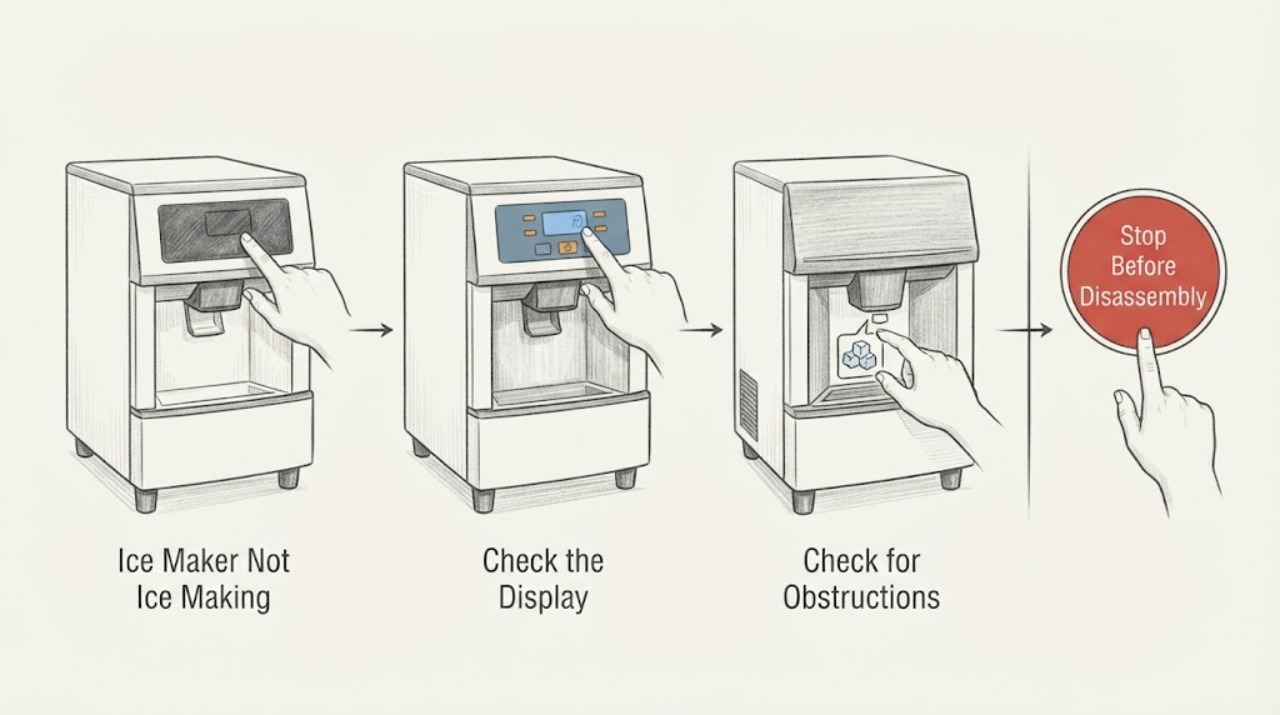
Work through in order
Diagnostic checks
Use only checks that match the exact appliance or system and its official guide.
-
Check 1
Inspect the ice maker control, shutoff arm, or display setting without removing covers. Confirm the ice maker is enabled and that the bin is seated correctly and not packed against the mechanism.
Expected result: The control is off, the arm is raised, the bin is mis-seated, or the control and bin look normal.
Next step: Enable the control or reseat the bin according to the model manual, then allow the appliance time to resume production.
Why this matters
Why: An off control, raised arm, or blocked bin can intentionally pause ice production; a normal setting moves the diagnosis to temperature and water delivery.
-
Check 2
Read the freezer temperature display if present and check that vents are not blocked by food. Do not change the setting abruptly; use the range in the owner manual.
Expected result: The freezer is warmer than the model’s ice-making requirement, or it is cold and airflow is clear.
Next step: Restore normal airflow and allow the freezer to stabilize; continue to the water check if it is already cold.
Why this matters
Why: Insufficient cold or blocked airflow can prevent a harvest cycle. A cold, clear compartment makes a water path, filter, or ice-maker control issue more likely.
-
Check 3
Look at the refrigerator water supply line and valve for a kink or closed valve. If the water filter was recently changed, confirm it is fully seated and sealed; do not bypass a filter unless the model instructions allow that test.
Expected result: The line is kinked, the valve is closed, the filter is loose, or water delivery appears normal.
Next step: Correct only the accessible kink or valve position and reseat the filter per the manual; request service if production does not return.
Why this matters
Why: A restricted line or mis-seated filter can stop the fill stream. Normal external water delivery points toward an inlet valve, sensor, or ice-maker mechanism that requires service.
Use your observations
Decision map
Find the observation that best matches what you see, then follow the next safe action.
-
PATH 01Next step
What you see
The control or shutoff arm was off or the bin was not seated
Do this next
Restore the documented on position and wait for a normal harvest cycle.
Why this path and its safety boundary
Why it matters: The ice maker was being held in an intentional pause state.
-
PATH 02Next step
What you see
The freezer is warm or its vents are blocked
Do this next
Restore clear airflow and stable temperature before judging the ice maker.
Why this path and its safety boundary
Why it matters: Cold or airflow conditions may be preventing the ice maker from completing its cycle.
-
PATH 03Next step
What you see
The control, temperature, water line, and filter are normal but no ice is made
Do this next
Stop forcing the arm or valve and arrange model-specific appliance service.
Why this path and its safety boundary
Why it matters: The fault is more likely in the fill, sensing, or harvest mechanism.
Helpful context
Understand the symptom
Ice production depends on both the cold compartment and a water-fill path. A frozen bin or an inactive control can look like a failed ice maker, while a mis-seated filter can reduce or stop water flow.
The exact temperature range and reset method vary by model. Follow the model manual where it differs from this symptom-level sequence.
When checks do not resolve it
Need a professional?
If the safe external checks do not restore normal operation, arrange qualified appliance service using the complete model information.
Common questions
FAQ
Does a missing model number make this impossible to troubleshoot?
No. The control, temperature, visible line, and filter checks are useful at symptom level. Use the complete model number for the reset position and exact temperature guidance.
Why does the ice maker buzz but make no ice?
A buzz with no ice can occur when the maker is enabled but water delivery is restricted. Check the valve, kinked line, and filter seating; do not keep it enabled if it has no water supply.
Read the exact guide
Official sources
- Ice Maker Not Working - TroubleshootingWhirlpool · refrigerator ice maker not making ice
Community feedback
Share a repair observation
Share a plain-text repair observation. Accepted observations are published automatically; this page may take a moment to update.