
On this page
Start here
Quick answer
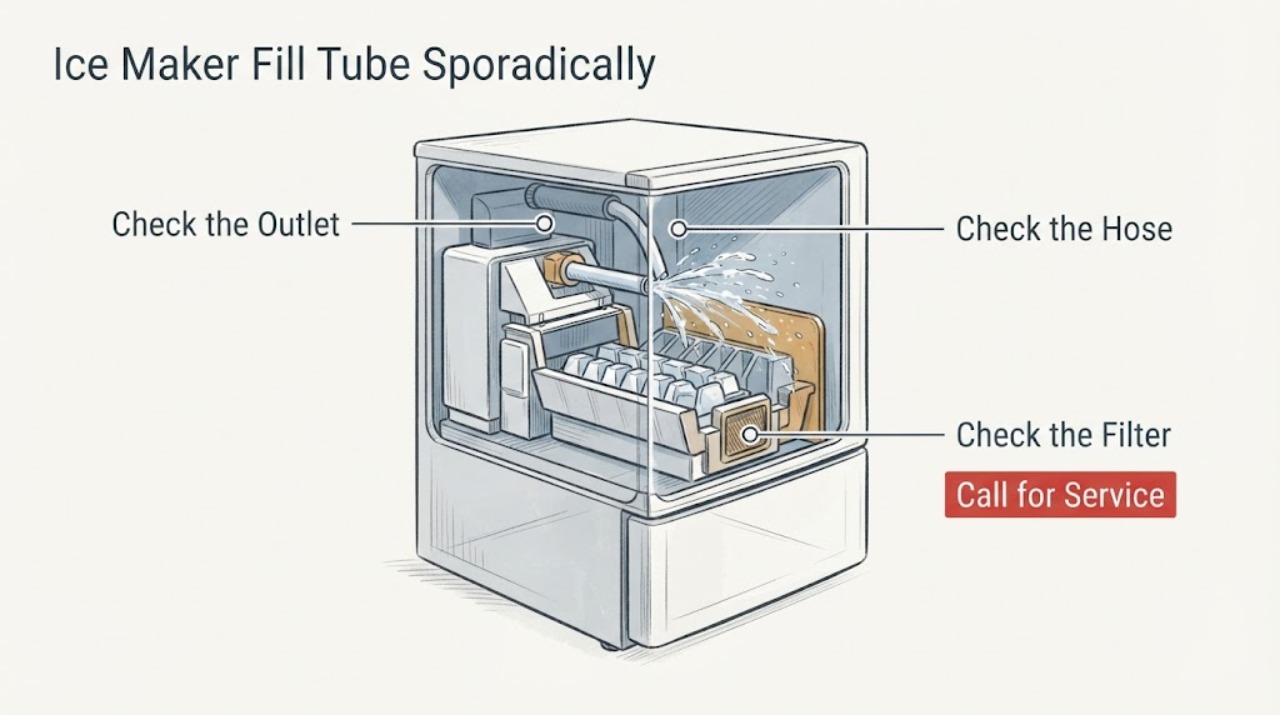
Treat intermittent water spurting from an ice-maker fill tube as an active leak until the water and electrical risks are controlled. From a dry, safe position, close the appliance's water shutoff and disconnect power only if you can do so without touching wet electrical parts. Do not keep cycling the ice maker or guess at a water valve. Once dry and isolated, identify whether this is a refrigerator ice maker or a freestanding ice maker, document the exact model, and inspect only accessible line, connector, fill-tube-extension, clamp, and filter conditions allowed by that model's instructions.
Work through in order
Diagnostic checks
Use only checks that match the exact appliance or system and its official guide.
-
Check 1
From a dry position, stop the ice maker and close the nearest accessible water shutoff. If water is near a plug, outlet, cord, controls, or wiring, do not touch the wet area; disconnect power only if the plug or breaker can be reached without contact with water. Do not press a test button or repeatedly cycle the ice maker.
Expected result: The spray stops when the water supply is closed, water continues despite the shutoff, or water has reached electrical parts or an inaccessible space.
Next step: Keep the water and power off, dry only surfaces that can be reached safely, and arrange appliance service or a qualified plumber for a valve that will not isolate, an inaccessible leak, or any electrical exposure.
Why this matters
Why: Stopping with the supply valve points to a pressurized water path; continued water or water near electrical parts is an isolation and service problem, not a safe valve diagnosis.
-
Check 2
With water off and power isolated, identify the equipment from its model label and note whether it is a refrigerator ice maker or a freestanding ice maker. Locate only the visible water path: household supply connection, rear tubing, fill-tube extension or plug, filter connection, and—on a freestanding unit—the drain hose and clamps.
Expected result: The model identifies a refrigerator ice maker, a freestanding ice maker, or the appliance type/model cannot be confirmed.
Next step: Use the exact model manual before removing an ice bucket, fill-tube cover, filter, hose, or clamp. If the model cannot be confirmed, limit the work to isolation and visual documentation.
Why this matters
Why: The same symptom has different water paths and owner-access boundaries. GE documents a refrigerator fill-tube extension, while Whirlpool's freestanding unit uses separate supply and drain connections.
-
Check 3
Inspect the dry, accessible tubing and fittings for a crack, kink, gap, loose connector, displaced fill-tube extension, damaged clamp, or filter connection. Do not pull tubing, force a coupler, use pliers, or tighten a valve or clamp unless the exact model instructions explicitly permit that action and the supply remains isolated.
Expected result: Water marks or a visible gap are at the household line, a fitting, the fill-tube extension, a filter connection, or a freestanding drain/supply connection; alternatively, the visible path is dry and intact.
Next step: Photograph the location and keep the water off. Replace or reconnect only with the exact model's documented procedure; otherwise arrange qualified service rather than tightening by guesswork.
Why this matters
Why: A visible connection or tubing defect gives the service provider a location to address, but the observation does not prove that a water valve or ice-maker component failed. A dry external path keeps an internal or intermittent fault unresolved.
-
Check 4
Record whether the spurting occurred only during an ice-making fill, also occurred at the dispenser, appeared after a filter change or water-line work, and whether the fill tube is visibly iced, displaced, or blocked. Do not thaw an inaccessible tube with a heat gun, pierce ice, or restore water just to reproduce the spray.
Expected result: The dispenser also leaks, the event followed water-line or filter work, only the ice-maker fill path is involved, or the tube is inaccessible or visibly frozen.
Next step: Give the model, water-off result, leak location, filter/line history, and photos to qualified appliance service. Have a technician handle a frozen or inaccessible fill tube and any internal valve or control diagnosis.
Why this matters
Why: The pattern helps the technician distinguish the shared supply path from the ice-maker fill path and identify installation or model-specific access questions; it does not establish a failed inlet valve or pressure value.
Use your observations
Decision map
Find the observation that best matches what you see, then follow the next safe action.
-
PATH 01Next step
What you see
Water reaches a receptacle, cord, controls, wiring, or an inaccessible cabinet area, or the supply cannot be shut off safely.
Do this next
Do not touch the wet area or restore power. Keep people away and obtain qualified appliance service or plumbing help; use emergency assistance for an immediate flooding or electrical hazard.
Why this path and its safety boundary
Why it matters: The leak has crossed the owner visual-check boundary and presents combined water and electrical risk.
-
PATH 02Next step
What you see
Closing the accessible water shutoff stops the spurting, and a dry visual inspection finds a cracked tube, loose connection, gap, displaced extension, or damaged clamp.
Do this next
Leave the water off, preserve the model and leak-location information, and follow only the exact model's documented connection procedure or arrange qualified service.
Why this path and its safety boundary
Why it matters: The visible supply or fill path is implicated, but the specific failed part is not proven by the symptom alone.
-
PATH 03Next step
What you see
The refrigerator's visible fill tube or extension is inaccessible, frozen, or dry while the symptom recurs only during ice-maker fills.
Do this next
Keep water and power isolated and arrange model-specific service. Do not pry, pierce, heat, or remove the ice maker to test the tube without the exact manual and appropriate training.
Why this path and its safety boundary
Why it matters: The ice-maker fill path remains unresolved; GE says verifying a frozen fill tube requires ice-maker removal and should be checked by a service technician.
-
PATH 04Next step
What you see
The unit is freestanding and the leak is at a supply connection, hose clamp, drain alignment, or damaged household line.
Do this next
Keep the supply closed, use the exact freestanding model manual, and have a qualified appliance technician or plumber address the connection or drain condition.
Why this path and its safety boundary
Why it matters: Whirlpool's freestanding ice-maker guidance treats those as separate installation and plumbing checks rather than a refrigerator fill-tube diagnosis.
Helpful context
Understand the symptom
Control the leak before diagnosing the tube
Sporadic spurting can wet the freezer, cabinet, floor, or electrical area. The first decision is not whether the inlet valve is bad; it is whether water can be safely stopped. Keep the ice maker out of operation, close the accessible water shutoff, and disconnect power only from a dry, safe position. If water has reached a receptacle, wiring, controls, or an inaccessible cabinet area, use qualified service rather than reaching behind the appliance.
The appliance type changes the safe check
A refrigerator ice maker may have a fill-tube extension behind the ice maker and a household water line at the rear. A freestanding ice maker can instead have supply-line connections, hose clamps, and a drain hose. Whirlpool's freestanding-ice-maker guidance is not a refrigerator procedure, so use it only to show why the exact model and architecture must be identified before touching a connection.
When checks do not resolve it
Need a professional?
Arrange qualified service or plumbing help for water near electrical parts, an inaccessible or continuing leak, a shutoff that will not isolate water, a frozen or displaced fill tube, a damaged line or connector, or recurrence after the exact model's documented external checks.
Have this ready
- Provide the full model and serial, refrigerator versus freestanding architecture, water-off result, exact spray location, whether the dispenser also leaks, filter or water-line work immediately before the event, and photos taken with the appliance isolated.
Common questions
FAQ
Should I keep running the ice maker to see when it sprays?
No. Isolate the water and power first. Repeated fill cycles can spread water into electrical or cabinet areas and do not identify whether the cause is the fill tube, a connection, a valve, or the supply line.
Can I tighten the fill-tube clamp myself?
Only if the exact model instructions identify that clamp as owner-accessible and specify the procedure. GE shows a clamp arrangement for a particular refrigerator family, while other refrigerators and freestanding ice makers use different layouts. Do not use pliers or force a fitting from the symptom alone.
Does water spurting prove the inlet valve is bad?
No. Official guidance keeps the supply line, fittings, fill-tube extension, filter or installation, drain conditions, and valve in scope. The symptom alone cannot identify the failed component or justify ordering a part.
Read the exact guide
Official sources
- Refrigerator Fill Tube Clamp LocationGE Appliances · Applies to the GE refrigerator configuration shown on the support page; not a cross-brand or freestanding-ice-maker procedure.
- Refrigerator - Icemaker Does Not Fill With WaterGE Appliances · Applies to GE refrigerator ice makers; exact fill-tube access is model-specific.
- Refrigerator and Freezer Troubleshooting and SupportGE Appliances · Official GE refrigerator-family guidance; exact model access and component layout remain model-specific.
- Connect and install the water line to your Samsung refrigeratorSamsung · Official Samsung refrigerator guidance used for general water-line safety boundaries; exact tubing and connection layout varies by model.
- Leaking from Behind - Freestanding Ice MakerWhirlpool Product Help · Applies only to the Whirlpool freestanding ice-maker configuration described on the page; it is included to distinguish that architecture from a refrigerator ice maker.
Community feedback
Share a repair observation
Share a plain-text repair observation. Accepted observations are published automatically; this page may take a moment to update.