
On this page
Start here
Quick answer
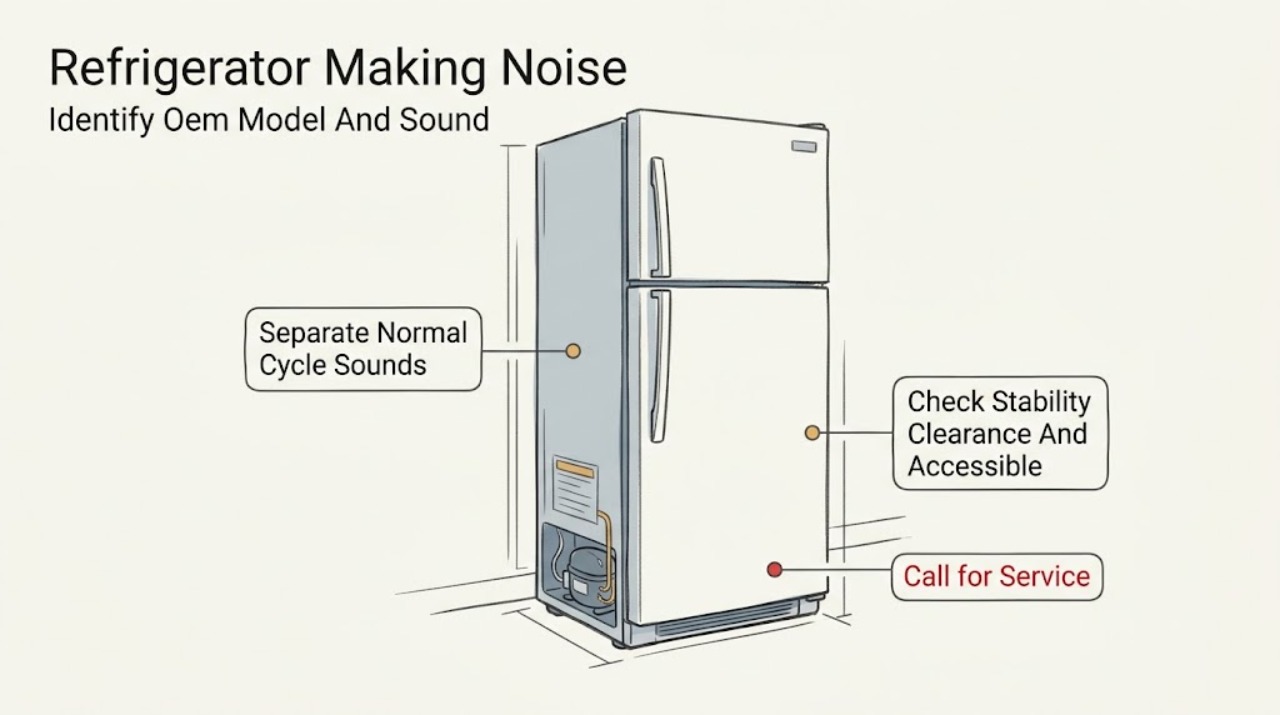
First record where and when the sound occurs: at compressor start, during cooling, when a door or ice-maker function operates, during defrost, or continuously while the cabinet vibrates. IKEA’s official refrigerator guidance identifies brief humming or buzzing, refrigerant rippling, compressor or thermostat clicking, popping, hissing, gurgling, sizzling, water running, and ice-maker sounds as potentially normal on applicable models. Vibration, scraping that follows frost, or rattling from a loose item or water line needs an external check of stability, clearance, doors, and accessible contents. IKEA sells appliances made by different manufacturers, so read the rating plate and use the exact manual; do not assume an IKEA model has the same fan, ice-maker, or defrost layout as another. Stop for burning odor, smoke, sparks, a hot cord, water near electrical parts, or a grinding sound that persists, and arrange qualified service before opening panels.
Before you begin
Safety first
- The owner checks only model identity, sound timing, accessible contents, visible frost, door closure, stability, and clearance. Power is disconnected before moving or leveling, and internal electrical, fan, compressor, defrost, water-line, and refrigerant work belongs to qualified service.
Work through in order
Diagnostic checks
Use only checks that match the exact appliance or system and its official guide.
-
Check 1
Without moving the refrigerator, photograph the rating plate and record the manufacturer, model, serial number, and market. From a safe position, note the sound’s location and timing: cabinet side or rear, inside freezer, on top, at a door, at compressor start, during defrost, or when an ice or water function operates.
Expected result: The OEM/model is known or unknown; the sound is brief or continuous; it follows a cooling, defrost, door, or ice-maker event; or it is accompanied by warmth, frost, water, odor, or a power symptom.
Next step: Find the exact manual and use the symptom branch below. Keep doors closed and protect food if cooling is affected. Do not move the unit or remove a panel to locate the sound.
Stop if: Stop immediately for smoke, burning odor, sparks, a hot or damaged cord/plug, water near electrical parts, or a breaker trip.
Why this matters
Why: IKEA refrigerators use multiple OEM and product architectures. Timing can match a normal compressor, fan, refrigerant, defrost, or ice-maker event, but the same label can also describe a vibration, frost contact, loose item, or internal fault. A sound alone cannot select a component.
-
Check 2
Compare the recorded pattern with the exact manual. A brief hum or buzz at compressor/fan start, refrigerant rippling or hissing during cooling, a thermostat/compressor click, popping during initial cool-down, or gurgling/sizzling/water running during defrost may be listed as normal; ice-maker noises apply only when the model has an ice maker.
Expected result: The sound matches a documented cycle and stops or changes with that cycle; the sound is new, harsh, continuous, or not described by the manual; or the model documentation is unavailable or mismatched.
Next step: Monitor a documented normal sound without dismantling the appliance. If the manual is mismatched or the noise remains unexplained, use IKEA or the named OEM support route with the model and recording; continue only with safe external checks.
Stop if: Do not touch a fan, compressor, water valve, wiring, refrigerant line, or defrost heater to confirm the sound.
Why this matters
Why: A documented, cycle-linked sound is less likely to be a fault. A sound that does not match the exact model, has changed in character, or persists outside the expected event should not be dismissed as normal just because another IKEA manual lists a similar sound.
-
Check 3
From outside the cabinet, check whether the refrigerator is stable on the floor, is contacting a wall or furniture, has an item on top that can rattle, or has an accessible shelf, bin, or door package touching another part. Do not reach behind the refrigerator. If leveling or moving is required, follow the exact manual with power disconnected and use adequate help.
Expected result: The cabinet rocks or contacts another surface; a shelf, bin, package, top item, or visible water line is vibrating; the door is blocked; or the external installation and accessible contents are clear.
Next step: Remove only an accessible loose item or package and maintain the manual’s clearance. If stability cannot be corrected without moving the appliance, arrange qualified help rather than pulling it alone.
Stop if: Do not tilt, drag, or open the rear of the refrigerator while connected; stop if the appliance could tip or a water/electrical connection may be strained.
Why this matters
Why: IKEA guidance links vibration to an unsteady appliance and rattling/banging to water lines or items on top or in the cabinet. A clear, stable installation makes an internal fan, compressor, defrost, or sealed-system issue more plausible, but does not identify one.
-
Check 4
Inspect only visible frost, door or drawer closure, gasket contact, and the time relationship between scraping and fan operation. If the exact manual calls for manual defrost, disconnect power, protect the floor and food, and follow that manual; do not use a knife, hair dryer, heat gun, or other tool on ice.
Expected result: Scraping follows visible frost or an open door; the door/gasket does not seal; the model requires manual defrost; or no visible frost/door condition explains the sound.
Next step: Correct only an accessible door obstruction and use the exact manual’s safe defrost method. Allow the interior to dry before restart. Arrange service for recurring frost, a damaged seal, or any need to access a fan or hidden evaporator.
Stop if: Never chip, puncture, scrape, or heat the liner, coil, or ice; do not pour water into the cabinet.
Why this matters
Why: IKEA explains that excessive condensation and ice can cause a freezer fan to refreeze or strike icicles, while door sealing and frequent opening can increase frost. A scrape without frost, a scrape that persists after the documented defrost, or a sound with poor cooling needs service assessment.
-
Check 5
If the noise remains after safe external corrections, record a short audio/video from a dry safe position together with the model, sound location, cycle timing, temperature/cooling behavior, frost, water, and any odor or power event. Do not reproduce the noise by opening doors, removing covers, or repeatedly cycling power.
Expected result: The sound is persistent or worsening; cooling is poor; the fan appears to scrape; the compressor repeatedly clicks without normal cooling; water or electrical symptoms are present; or the sound stopped after an external correction.
Next step: Leave the appliance off for an electrical or water hazard and contact IKEA or the named OEM/qualified appliance service with the rating-plate information. If the sound resolved, monitor for recurrence without dismantling the appliance.
Stop if: Do not open panels, perform live tests, handle refrigerant, touch moving parts, bypass a control, or replace a part based on sound alone.
Why this matters
Why: Persistent scraping, repeated start attempts, or noise with poor cooling can involve a fan, compressor/start component, defrost system, water/ice mechanism, control, or sealed system. External observations cannot distinguish those parts safely. Electrical, water, smoke, or burning symptoms override noise diagnosis.
Use your observations
Decision map
Find the observation that best matches what you see, then follow the next safe action.
-
PATH 01Next step
What you see
The sound is brief and repeats at a documented compressor, fan, refrigerant, thermostat, defrost, or ice-maker event, with normal cooling and no hazard.
Do this next
Monitor the timing and use the exact manual. Seek service if the sound becomes continuous, harsh, changes character, affects cooling, or is accompanied by odor, water, or electrical symptoms.
Why this path and its safety boundary
Why it matters: The pattern is more consistent with normal operating sound on the matching model than with a failed part. IKEA’s lists are model-specific and do not make every sound normal on every refrigerator.
-
PATH 02Next step
What you see
The noise changes when an accessible item is removed, the cabinet is stabilized, or the refrigerator is no longer touching a wall or furniture.
Do this next
Leave the unit stable and maintain the model’s clearance; use qualified help if leveling or moving is necessary. Escalate if the noise persists with a stable, clear installation.
Why this path and its safety boundary
Why it matters: Installation resonance, a loose shelf/bin/package, or an accessible water-line or top item is more likely than a sealed-system fault.
-
PATH 03Safety boundary
What you see
A scraping sound occurs in or near the freezer and visible frost or an open-door history is present, especially when a fan would run.
Do this next
Follow only the exact manual’s powered-off defrost instructions and dry the interior before restart. If scraping returns, persists without visible frost, or cooling is poor, arrange service rather than reaching the fan.
Why this path and its safety boundary
Why it matters: IKEA identifies frost or refrozen condensation contacting a fan as one possible mechanism. A manual-defrost procedure and its safety limits are model-specific.
Safety stop: Do not use sharp or high-heat tools or remove a fan cover.
-
PATH 04Next step
What you see
The refrigerator is warm, the compressor clicks or starts repeatedly, a fan sound is abnormal, or the noise continues outside a documented cycle.
Do this next
Keep the doors closed, protect food, and arrange qualified service using the exact OEM/model information. Do not keep restarting or open the cabinet to listen closer.
Why this path and its safety boundary
Why it matters: An internal fan, compressor/start circuit, defrost system, sensor/control, or sealed-system issue is possible; the sound pattern cannot safely identify which component.
-
PATH 05Safety boundary
What you see
Noise is accompanied by smoke, burning odor, sparks, a hot/damaged cord or plug, water near electrical parts, or repeated breaker trips.
Do this next
Do not touch or move the refrigerator. If safe from a dry position, isolate power using the household safety procedure; otherwise leave it alone and obtain qualified electrical/emergency help. Contact IKEA or the named OEM for appliance service.
Why this path and its safety boundary
Why it matters: Fire, shock, or water/electrical risk overrides any attempt to classify the sound as normal.
Safety stop: Do not restore power, repeatedly reset a breaker, test energized wiring, or open the cabinet.
Helpful context
Understand the symptom
IKEA is a product identity, not one refrigerator architecture
IKEA’s US support page says some appliances are made by external vendors such as Whirlpool, Faber, or Electrolux, while other products are IKEA products such as TILLREDA. The rating plate and exact manual therefore matter more than the IKEA name alone. An ice-maker buzz, a water-line rattle, or a fan scrape should be considered only if that feature exists on the identified model.
Sound timing is more useful than volume alone
A short click at compressor start, a hum while cooling, a gurgle during defrost, or a brief ice-maker sound can be normal on a matching model. A sound that begins after leveling changes, follows a door being left open, scrapes in step with a fan, or continues with poor cooling deserves a different path. Record the timing and location before moving anything.
Only external, model-appropriate checks belong here
You may inspect accessible items on top of the cabinet, door bins, shelf contact, visible frost, and whether the refrigerator is stable and has reasonable clearance. Power must be disconnected before moving or leveling an appliance, and the manual must govern any defrost. Do not remove a rear cover, touch a fan, enter the sealed system, or make an energized electrical measurement.
Normal sound does not excuse a safety symptom
IKEA’s manuals distinguish normal refrigerant, fan, compressor, defrost, and ice-maker sounds from an appliance that has an electrical or mechanical hazard. Burning odor, smoke, sparks, a hot or damaged cord, water near electrical parts, or a persistent harsh scrape changes the priority to stop-use and service. Do not keep cycling the appliance to reproduce the noise.
Safety boundary
Stop conditions
- Stop and isolate the appliance for smoke, burning odor, sparks, a hot or damaged cord/plug, water near electrical parts, or repeated breaker trips.
- Do not remove rear or control panels, perform live electrical tests, touch fans or compressor parts, handle refrigerant, or bypass protection.
- Do not scrape, puncture, chip, or heat frost or ice; use only the exact model manual’s powered-off defrost instructions.
- Do not pull, tilt, or drag an appliance alone to locate a noise; obtain qualified help if leveling or access requires moving it.
Only after diagnosis
Potential parts
- model-specific leveling foot or door gasket
Consider only if the exact manual and service assessment confirm instability or a damaged seal that explains vibration or prolonged operation.
IKEA refrigerator models and OEMs differ; confirm the rating-plate model and manufacturer before ordering. - model-specific fan, ice-maker, or water-line component
Consider only when a qualified technician identifies the matching component after correlating the sound with the model’s feature and cycle.
An ice-maker or water-line part is irrelevant to models without that feature, and a fan noise does not identify a compatible assembly. - model-specific compressor, defrost, control, or sealed-system component
Consider only after qualified diagnosis confirms the internal source and repairability for the exact OEM/model.
IKEA uses multiple OEMs and architectures; do not choose an internal or refrigerant component by sound, dimensions, or brand alone.
When checks do not resolve it
Need a professional?
Arrange qualified appliance service when the noise is persistent, worsening, unexplained by the exact model manual, accompanied by poor cooling, repeated compressor starts, recurring scraping after a manual-approved defrost, or requires internal access. Contact IKEA or the named OEM after reading the rating plate because IKEA appliances can use different manufacturers and architectures. Seek qualified electrical help immediately for smoke, sparks, burning odor, hot/damaged power equipment, water near electricity, or repeated trips.
Safety scope: The owner checks only model identity, sound timing, accessible contents, visible frost, door closure, stability, and clearance. Power is disconnected before moving or leveling, and internal electrical, fan, compressor, defrost, water-line, and refrigerant work belongs to qualified service.
Common questions
FAQ
Is humming or clicking normal on an IKEA refrigerator?
It can be. IKEA’s official guidance describes humming/buzzing from fan or compressor operation and clicking from compressors, thermostats, or other components switching as normal on applicable models. Match the exact model manual and escalate if the sound is persistent, harsh, affects cooling, or includes a safety symptom.
Why is my IKEA refrigerator scraping?
If the sound comes from the freezer and visible frost or a door-left-open history is present, IKEA says refrozen condensation can cause a fan to strike ice. Use only the exact model’s powered-off defrost procedure; do not reach the fan or scrape the ice.
What causes vibration or rattling on an IKEA refrigerator?
Check from outside for an unstable cabinet, contact with a wall or furniture, loose accessible items, items on top, or a visible water line that is vibrating. IKEA’s model-specific manual links these patterns to vibration or rattling; moving or leveling should be done with power disconnected and adequate help.
Why does my IKEA refrigerator make gurgling or sizzling sounds?
IKEA documents refrigerant movement, defrost water, and water dripping on a defrost heater as possible normal sounds on matching models. If the noise is new, continuous, accompanied by poor cooling, or not described in the exact manual, arrange service instead of opening the cabinet.
Who should repair an IKEA refrigerator made by another company?
Read the rating plate first. IKEA says appliances made by external vendors such as Whirlpool, Faber, or Electrolux should be directed to that manufacturer, while IKEA-made products follow IKEA Customer Service. Keep the IKEA order or receipt and the model and serial information ready.
Read the exact guide
Official sources
- What can I do if my appliance isn’t working as it should?IKEA United States · Official IKEA US support guidance; routes vary by market and the rating-plate manufacturer.
- TILLREDA refrigerator, freestanding/white, 2 cu.ftIKEA United States · Exact IKEA TILLREDA product page; it demonstrates a different IKEA architecture and is not universal to larger models.
- NUTID French Door Refrigerator Owner’s ManualIKEA United States · NUTID French-door refrigerator manual; sound explanations and feature details must not be generalized to every IKEA refrigerator.
- My fridge and freezer are making an unusual/weird sound, what is the reason?IKEA Sweden · Official IKEA support article; use feature and defrost details only where the exact model matches.
Community feedback
Share a repair observation
Share a plain-text repair observation. Accepted observations are published automatically; this page may take a moment to update.