
On this page
Start here
Quick answer
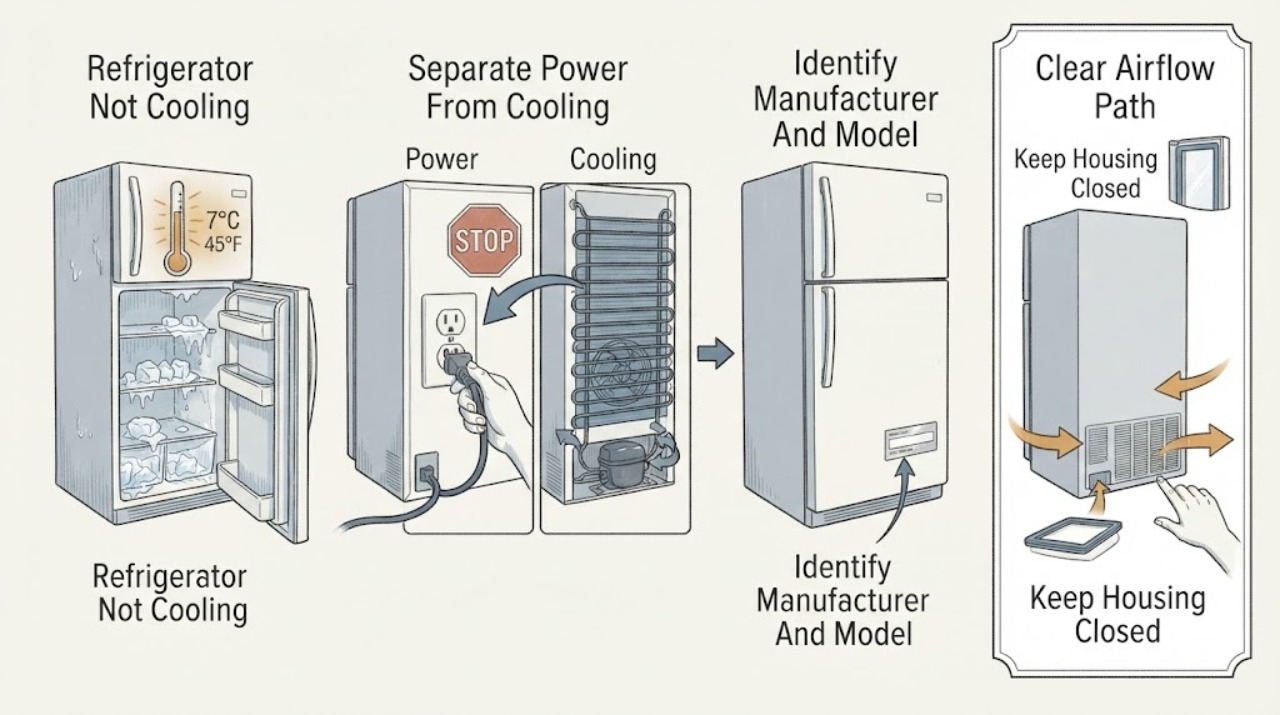
First separate “not cooling” from “not turning on.” Check from a safe, dry position whether the interior light, display, or other normal indicator is present; do not open covers or perform live tests. IKEA sells refrigerators made by IKEA and external vendors, with different controls and manuals, so record the IKEA article number, manufacturer, model, and serial number before applying a reset or temperature instruction. If powered, confirm that cooling has not been switched off, the temperature setting is appropriate, the door closes airtight, packages do not block vents, the cabinet has required ventilation, and hot food or a large fresh load has had time to cool. IKEA guidance gives broad targets of 37–41°F for a refrigerator and 0–5°F for a freezer, while model manuals can differ; wait the manual’s stabilization period between adjustments. Frost that blocks airflow, a warm compartment despite a solid ice bank, or a no-frost unit that repeatedly ices over needs model-specific service rather than repeated defrosting. If the appliance is completely dark, the plug/socket or supply is hot or damaged, a breaker trips, there is smoke, burning odor, water near electrical parts, or cooling does not return after the documented external checks, leave it out of service and route it through IKEA or the actual manufacturer. Do not bypass a control, use an extension lead as a test, remove panels, or diagnose a compressor, fan, sensor, board, or sealed system from the symptom alone.
Before you begin
Safety first
- The owner may perform dry visible checks of power indicators, model identity, door/airflow/loading, settings, thermometer, and a manual-approved natural defrost. Qualified service must handle concealed drains, panels, fans, heaters, sensors, controls, wiring, compressors, refrigerant circuits, live diagnosis, and integrated-appliance movement.
Work through in order
Diagnostic checks
Use only checks that match the exact appliance or system and its official guide.
-
Check 1
From a safe, dry position, note whether the interior light, display, alarm, or other normal indicator works. Do not remove covers, touch wiring, or use another outlet or an extension lead as a test.
Expected result: The appliance is completely dark; the display/light works but the cabinet is warm; a protective device has tripped; or the plug/socket is hot, wet, scorched, or damaged.
Next step: For a safe, normal supply, follow the exact model's power instructions. For any damage, heat, water, smoke, odor, or repeated trip, keep the appliance isolated and obtain qualified electrical/appliance help.
Stop if: Do not reset protection repeatedly, pull a plug from a damaged or wet socket, reconnect to reproduce the fault, or open the electrical compartment.
Why this matters
Why: A dark appliance belongs first to a supply or no-start path, while a powered but warm appliance supports cooling, setting, airflow, or refrigeration diagnosis. Heat, water, damage, or repeated trips are safety escalations.
-
Check 2
Record the IKEA article number, exact model, serial number, and manufacturer from an accessible rating plate, receipt, manual, or existing photograph. Determine whether the product is an IKEA-made unit or an external-vendor appliance and retrieve its matching manual.
Expected result: All identifiers are available; only a product name is known; the label requires moving an integrated unit; or the documentation identifies a particular control/defrost architecture.
Next step: Use the matching manual and route unresolved faults to IKEA or the listed manufacturer. If identity is uncertain, limit the work to visible checks and do not copy instructions from another model.
Stop if: Stop if identification requires pulling out the appliance, removing trim/panels, touching a cord, or entering a wet or damaged area.
Why this matters
Why: Different IKEA appliance families can use different cooling controls, alarm behavior, defrost systems, and service ownership. A product name alone cannot select a repair or reset.
-
Check 3
Check that the door closes tightly and the accessible gasket contacts the cabinet. Move food away from the door path, rear wall, and visible vents; leave room for air circulation; cool hot food before loading; and confirm a freestanding unit has required exterior ventilation.
Expected result: The door is obstructed or ajar; gasket contact is uneven or damaged; vents are covered; the cabinet is overcrowded; hot food was recently added; or the visible closure and airflow are normal.
Next step: Correct only visible loading, closure, and ventilation conditions, then keep doors closed for the manual's recovery period. Arrange service if the gasket cannot seal or cooling remains poor.
Stop if: Do not remove doors, adjust concealed hinges, pull an integrated unit, dismantle a vent, or continue if water reaches electrical parts.
Why this matters
Why: Warm-air entry, restricted circulation, a warm load, or poor ventilation can delay cooling without identifying a failed component. A normal external check makes a setting, frost, sensor, fan, or sealed-system issue more likely only when the cabinet remains warm.
-
Check 4
Compare the cooling-on state, thermostat, fast-cool/fast-freeze, vacation, and alarm settings with the exact manual. If available, place an appliance thermometer correctly and wait the documented stabilization period before recording refrigerator and freezer temperatures.
Expected result: Cooling is switched off; a special mode is active; the setting is too warm or unknown; temperature is within the manual's range; or the cabinet remains warm despite a correct setting.
Next step: Restore only documented settings and wait between adjustments. If temperature does not recover, retain the readings and use the model-specific service route.
Stop if: Do not enter service mode, bridge controls, test voltage, remove sensors, or use the coldest setting as a forced repair.
Why this matters
Why: A control state or recent installation/load can account for temporary warmth. Persistent warmth after a correct setting and adequate wait makes airflow, frost, sensor, fan, compressor, or sealed-system service more likely, but not a specific part.
-
Check 5
Observe whether frost blocks a visible air path, whether ice or water is on the refrigerator rear wall, and whether the accessible condensation drain appears blocked. Only if the exact manual permits it, perform a natural defrost with power disconnected from a dry position, collect meltwater, and dry the cabinet before restart.
Expected result: There is no frost; a light accessible layer is present on a manual-defrost model; a no-frost unit has a solid bank; the rear drain is visibly obstructed; or ice is behind an interior cover.
Next step: Follow only the model manual for a permitted defrost or accessible drain clean. For rapid recurrence, hidden ice, persistent warmth, or water near electrics, keep the unit out of service and arrange qualified repair.
Stop if: Do not use sharp tools, boiling water, flame, hair dryer, wire behind a liner, panel removal, or live testing.
Why this matters
Why: A manual-defrost maintenance layer or accessible drain condition may affect cooling. A solid no-frost bank or concealed ice points toward an internal airflow/defrost fault and should not be treated with repeated owner defrosts.
Use your observations
Decision map
Find the observation that best matches what you see, then follow the next safe action.
-
PATH 01Safety boundary
What you see
The refrigerator is dark, a protective device has tripped, or the plug/socket/cord is hot, wet, scorched, damaged, smoking, or associated with a burning odor.
Do this next
Keep clear and isolate power only from a dry safe position; obtain qualified electrical help and appliance service as appropriate. Do not reconnect to test cooling.
Why this path and its safety boundary
Why it matters: This is a power or electrical safety branch, not a cooling-setting problem.
Safety stop: Do not use an extension lead, repeatedly reset protection, touch wet/damaged equipment, or open the electrical area.
-
PATH 02Safety boundary
What you see
The light/display works, the appliance was newly installed or heavily loaded with warm food, and there is no abnormal frost, odor, damage, or hazard.
Do this next
Keep the doors closed, use the manual's normal setting, protect perishable food, and reassess after the documented stabilization period with a thermometer if available.
Why this path and its safety boundary
Why it matters: Recovery time is more likely than a failed cooling component; IKEA manuals describe waiting for the cabinet to cool and warn that a colder setting does not accelerate that process.
Safety stop: Escalate if the appliance remains warm after the wait, the temperature is unsafe, or any electrical/water hazard appears; do not force-cool with repeated setting changes.
-
PATH 03Safety boundary
What you see
The cabinet is powered but a door is not airtight, packages cover vents or block closure, food touches the rear wall, ventilation is obstructed, or a large hot load was added.
Do this next
Correct the visible condition, close the door, and allow the manual's recovery period. If the gasket, hinge, ventilation, or temperature remains abnormal, use the exact service route.
Why this path and its safety boundary
Why it matters: Warm-air entry, restricted cold-air circulation, installation ventilation, or load recovery is more likely than an immediately proven compressor fault.
Safety stop: Do not pull an integrated unit, alter concealed installation, or continue if the cabinet or floor is wet near electrical parts.
-
PATH 04Safety boundary
What you see
Frost blocks a visible air path or a manual-defrost freezer has a substantial accessible layer, while the model manual permits defrosting and no hazard is present.
Do this next
Follow the manual's natural-defrost procedure, disconnect power, dry completely, and allow the documented recovery period. Monitor whether cooling returns and frost remains controlled.
Why this path and its safety boundary
Why it matters: Frost may be restricting circulation or the model may need routine defrosting; this is conditional on the exact architecture.
Safety stop: Do not chip ice, apply high heat, remove liners, or repeatedly hand-defrost a no-frost model.
-
PATH 05Safety boundary
What you see
The refrigerator is powered, doors/vents/settings/load are normal, but temperature remains high after stabilization; a no-frost unit has a recurring solid ice bank; or ice is behind a cover.
Do this next
Keep the appliance out of service as appropriate, protect food, and contact IKEA or the external manufacturer named on the rating plate with model, temperature history, photos, and checks performed.
Why this path and its safety boundary
Why it matters: An internal fan, defrost, sensor, control, compressor, or sealed-system fault is more likely, but the symptom cannot select a part and the OEM must be confirmed.
Safety stop: Do not remove panels, enter service mode, test live circuits, replace a fan/heater/board/compressor, or recharge refrigerant.
Helpful context
Understand the symptom
Confirm that cooling—not power—is the problem
A refrigerator with no light, no display, and no motor sound belongs first in a power/no-start assessment. If the light or display works but food is warm, the cooling system may be off, set incorrectly, overloaded, obstructed, or unable to maintain temperature. Do not confuse a warm water dispenser or an ice-maker delay with a warm cabinet. Keep the door closed while observing, protect perishable food, and do not use another outlet or an extension cord as an experiment.
IKEA model identity changes the safe answer
IKEA's support material distinguishes IKEA-manufactured appliances from units made by external vendors, and the product range includes different controls, cooling features, and defrost architectures. Locate the article number, model, serial number, and manufacturer from an accessible label or paperwork. An example NUTID manual uses a 37°F refrigerator and 0°F freezer recommendation and a 24-hour stabilization period, while those values and controls must not be copied onto an unrelated IKEA model.
Start with closure, load, vents, and ventilation
Check that the door closes completely and its gasket contacts the cabinet, then move packages away from the door path and visible vents. Leave enough space for air circulation, keep hot food and uncovered evaporating liquids out until cooled or covered, and ensure a freestanding unit has the ventilation required by its installation instructions. These conditions can make a powered refrigerator appear not to cool without proving a failed compressor or fan.
Check settings and measure patiently
Compare the temperature control, cooling-off state, fast-cool or fast-freeze mode, and any alarm with the exact manual. IKEA's NUTID guidance says a colder setting does not cool compartments faster and advises waiting between adjustments; a new installation or large warm load also needs recovery time. Use an appliance thermometer if available and record the temperature after the manual's wait period, rather than judging by one warm item or repeated door openings.
Treat frost as a result, not an automatic cure
A freezer frost layer can restrict cold-air circulation, while refrigerator rear-wall water or ice can involve food contact or the defrost drain. Follow the exact model manual for any permitted defrost. Some IKEA models are manual-defrost and others use automatic/no-frost systems; do not hand-defrost a no-frost cabinet repeatedly or remove an interior liner. Never chip ice with a sharp tool, use a flame or high heat, or work around wet electrics.
Escalate with evidence and the correct owner
If the appliance stays warm after the documented external checks and stabilization period, preserve the model information, temperature history, settings, frost pattern, and any alarm. IKEA says the next step depends on who manufactured the appliance: use IKEA support for an IKEA-made product and the listed manufacturer or authorized service route for an external-vendor product. Internal fans, sensors, boards, compressors, refrigerant circuits, and live electrical work require qualified service.
Safety boundary
Stop conditions
- Do not use an extension lead or another outlet as a cooling test, repeatedly reset protection, or reconnect a dark or damaged appliance.
- Do not remove panels or liners, enter service mode, test live circuits, bypass controls or safety devices, or diagnose a compressor, fan, sensor, board, or sealed system from warmth alone.
- Only defrost when the exact IKEA/OEM manual permits it; disconnect power from a dry safe position, collect water, and dry the cabinet before restart.
- Do not chip ice with knives or picks, use flame, boiling water, hair dryers, or high heat; IKEA warns sharp tools can damage the internal lining.
- Stop for smoke, sparks, burning odor, heat, water near electrical parts, damaged insulation, or repeated protective-device trips; keep the unit out of service and get qualified help.
Only after diagnosis
Potential parts
- door gasket
Consider only if the exact OEM/model documentation or a technician confirms a damaged gasket after visible closure obstructions and cleaning are ruled out.
IKEA refrigerators may use different manufacturers; verify the complete article/model number and OEM fitment before ordering. - evaporator or circulation fan
Consider only after model-specific diagnosis confirms an internal fan fault when external loading, vents, and frost conditions are normal.
Confirm the OEM, exact model, electrical specification, and technician diagnosis; no universal IKEA fan is implied. - defrost system component
Consider only when a qualified diagnosis identifies a defrost heater, sensor, or related component in a model that has that system; warmth or frost alone does not select a part.
Use the exact OEM/model and authorized fit information; do not substitute components across IKEA appliance families.
When checks do not resolve it
Need a professional?
Arrange IKEA or manufacturer-authorized service when the OEM/model is unknown, the refrigerator remains warm after visible closure, airflow, settings, and manual stabilization checks, a no-frost unit has a solid or recurring ice bank, frost or a drain is concealed, the door cannot seal, an alarm persists, or an internal fan, sensor, control, compressor, or sealed-system problem is suspected. Stop immediately for smoke, sparks, burning odor, heat, water near electrical parts, a damaged cord/socket, or repeated protective-device trips; isolate only from a dry safe position and obtain qualified or emergency help as appropriate. The owner may record identity, observe indicators, correct visible loading/closure/ventilation, follow the exact manual for settings and a permitted natural defrost, and measure temperature. Cabinet access, live testing, refrigerant work, component replacement, and movement of an integrated unit require qualified service.
Safety scope: The owner may perform dry visible checks of power indicators, model identity, door/airflow/loading, settings, thermometer, and a manual-approved natural defrost. Qualified service must handle concealed drains, panels, fans, heaters, sensors, controls, wiring, compressors, refrigerant circuits, live diagnosis, and integrated-appliance movement.
Common questions
FAQ
Why is my IKEA refrigerator not cooling?
First determine whether it has power. If the light/display works, check cooling-on state, temperature setting, door seal, blocked vents, loading, ventilation, and the model's recovery period. Frost or a no-frost ice bank can restrict airflow, but persistent warmth after external checks may require OEM-specific service.
Are IKEA refrigerators all made the same way?
No. IKEA says appliances sold through IKEA may be IKEA-made or made by external vendors, and the range includes different cooling and defrost features. Record the article number, manufacturer, model, and serial number, then use the matching manual rather than another IKEA product's procedure.
What should I check if the IKEA refrigerator has power but is warm?
Check that cooling is enabled, the control is set correctly, the door closes airtight, food does not block vents or touch the rear wall, the cabinet has ventilation, and a recent installation or warm load has had time to recover. Change settings only as the exact manual directs and wait between adjustments.
Can blocked vents or a door gap make an IKEA refrigerator stop cooling?
Yes. IKEA manuals identify incomplete door closure, blocked vents, warm food loads, and poor air circulation as possible reasons for excessive temperature. Correct only visible obstructions and closure issues; if the gasket cannot seal or temperature stays high, arrange model-specific service.
Should I defrost an IKEA refrigerator that is not cooling?
Only if the exact manual permits it. IKEA sells manual-, low-, and no-frost designs. A permitted natural defrost requires safe power isolation, meltwater collection, and complete drying; do not use sharp tools, high heat, or repeated hand-defrosting as a cure for a no-frost ice bank.
When does an IKEA refrigerator not cooling need a technician?
Use IKEA or the actual manufacturer when the OEM/model is unknown, the appliance stays warm after documented checks and stabilization, a no-frost unit repeatedly ices over, frost is concealed, an alarm persists, or an internal fan, sensor, control, compressor, or sealed-system fault is suspected. Stop for smoke, heat, burning odor, sparks, water near electrics, damaged wiring, or repeated trips.
Read the exact guide
Official sources
- FÄRSKHET Bottom-Freezer Refrigerator ManualIKEA United States · Opened official IKEA FÄRSKHET manual; used as a separate model example for temperature/airflow/frost/drain checks and service escalation. It is not treated as universal IKEA architecture.
- LIMITED WARRANTY – TERMS AND CONDITIONSIKEA United States · Opened official IKEA appliance warranty PDF; used for ventilation, keeping the condensation drain clear, cooling food before loading, avoiding sharp defrost tools, and recording the article number/manual for service.
- Refrigerator buying guide: what to knowIKEA United States · Opened official IKEA refrigerator guide; used for general door, temperature, frost, no-frost/low-frost, and fan-cooling principles, not for assigning an internal fault to an unspecified model.
- NUTID S25 Side-by-Side Refrigerator Use and Care GuideIKEA United States · Opened official IKEA NUTID manual; used as a model-specific example for no-power versus warm-cabinet branches, 24-hour recovery, vents, door closure, warm loads, controls, and electrical safety. Its procedures are not generalized to other IKEA models.
- What can I do if my appliance isn’t working as it should?IKEA United States · Opened official IKEA support article; used to establish that IKEA appliances may be IKEA-made or externally manufactured and that manufacturer/model/serial information is needed for the correct support route.
- What spare parts can I get from IKEA and how much do they cost?IKEA United States · Opened official IKEA spare-parts article; used to establish that refrigerator/freezer parts and external-brand appliance support depend on the rating-plate manufacturer/model and authorized service information.
- TILLREDA refrigerator, freestanding/white, 2 cu.ftIKEA United States · Opened official IKEA TILLREDA product page; used only as a concrete example that this named model is manual defrost and has product-specific care instructions. It is not generalized to other IKEA refrigerators.
Community feedback
Share a repair observation
Share a plain-text repair observation. Accepted observations are published automatically; this page may take a moment to update.