
On this page
Start here
Quick answer
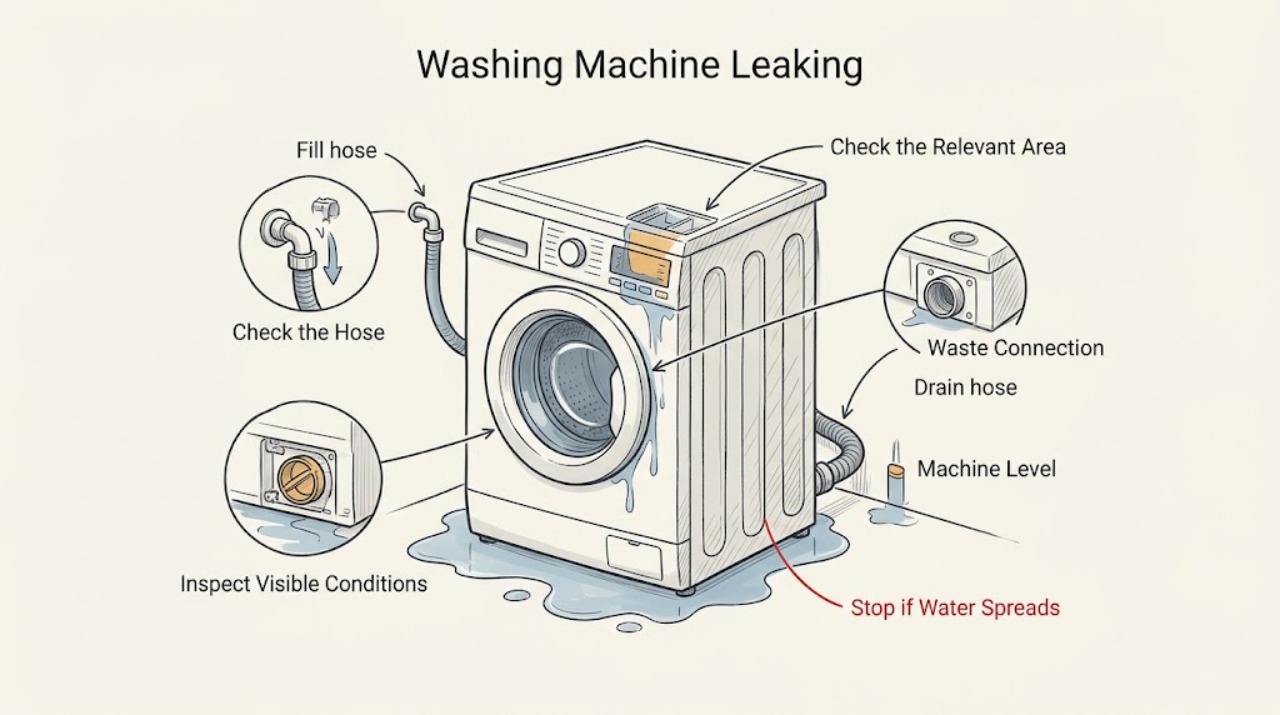
Stop the cycle, keep people away from the water, and turn off the water tap. Unplug the machine only from a dry, safe position and never reach through standing water or touch wet electrical parts. Note when the leak appears and where the first wet point is: a leak before or during filling usually starts at the fill hose, tap connection, dispenser, water pressure, or an internal inlet path; a leak around the front during washing points toward the door seal, an obstructed or overfilled dispenser, excess foam, or a door/load issue; a leak during pump-out points toward the drain hose, pump-filter area, waste pipe, or under-sink connection. Indesit also notes that water left from factory testing can appear during first use, but a continuing leak still needs inspection. Check only accessible hose connections, the detergent drawer, door seal, drain hose, and sink/standpipe connection. Do not pull the machine across a wet floor, remove pressurised hoses, force the door, open panels, or run repeated tests. Treat water near electrics, hot water, strong vibration, smoke, burning smell, damaged wiring, or a recurring leak as an immediate stop condition and arrange qualified service.
Work through in order
Diagnostic checks
Use only checks that match the exact appliance or system and its official guide.
-
Check 1
Stop the cycle and record whether the leak started before the machine filled, during filling, while washing, during drain or spin, or after the cycle. From a dry, safe position, turn off the external water tap. Note whether the first wet point is at the rear hose, detergent drawer, front door seal, underneath, drain hose, pump-filter cover, or under-sink/standpipe connection.
Expected result: Timing separates a fill-side leak from a wash-side splash or seal leak and from an outlet or pump-out leak. Water appearing immediately at a hose connection is a different branch from water appearing only when the pump runs.
Next step: Keep the machine off and follow only the branch matching the first wet point. If the first source cannot be seen safely, do not move the machine or run another cycle.
Why this matters
Why: Indesit recommends checking fill and drain hoses, mains plumbing, the dispenser, and the drain connection; location and timing make those checks useful without dismantling the appliance.
-
Check 2
With the machine stopped and the area dry, inspect both ends of the accessible fill hose and the nearby tap or plumbing connection for looseness, a split, a kink, or water tracking down from above. Inspect the accessible drain hose and its connection for a crack, disconnection, crushing, or water appearing only during pump-out. Do not disconnect a pressurised hose or pull the appliance across water.
Expected result: A wet fill-hose nut or tap connection that leaks while filling points to the inlet side. A rear drain hose or waste connection that wets only during pump-out points to the outlet side. A dry external connection with water emerging from inside the cabinet requires service.
Next step: If a connection is visibly loose and can be made safe without removing a pressurised line, stop water and have it corrected according to the manual. If a hose is split, the connection remains wet, or the source is internal, leave the machine unused and arrange service.
Why this matters
Why: Indesit specifically directs users to check fill-hose connections at the machine and tap, drain-hose condition, and mains plumbing, while keeping internal leaks in the professional branch.
-
Check 3
Inspect the detergent dispenser and the accessible housing with the machine off. Look for caked detergent, a blocked channel, overflow marks, an overfilled compartment, or water running over the drawer. Check that the drawer closes and that the appliance is level without reaching underneath a wet machine or adjusting feet while it is unstable.
Expected result: A leak from the drawer during filling can be related to residue or blockage, excessive water pressure, overfilling, or a machine that is not level. A clean drawer with water emerging elsewhere points away from the dispenser branch.
Next step: Clean only the accessible drawer as the manual allows, dry it, and do not mix cleaning chemicals. If water still overflows, pressure is uncertain, the drawer is cracked, or levelling requires moving an appliance on a wet floor, arrange service.
Why this matters
Why: Indesit links detergent-dispenser leaks with excessive water pressure and levelling and recommends cleaning a blocked dispenser with hot soapy water; model instructions determine safe removal.
-
Check 4
With the door open and the drum empty, inspect the visible door seal for a tear, split, trapped object, heavy residue, or deformation. Check that no garment is trapped across the seal and that the door closes normally; do not force the door or attempt to remove a seal clamp. If the leak begins at the front only after the drum starts moving, note that timing.
Expected result: A damaged or obstructed seal, or a garment caught in it, can allow water to escape from the front during washing. A front leak that begins during fill or foam production without seal damage can instead be a dispenser, dose, or pressure branch.
Next step: Remove only an obvious loose item without tools and keep the machine off. If the seal is torn, deformed, or still leaks, arrange qualified service and do not continue washing.
Why this matters
Why: The door seal is a user-visible boundary, but its replacement and any internal clamp or front-panel work are model-specific repairs.
-
Check 5
If water remains in the drum or the leak appears during drain or spin, check the model manual to see whether the pump filter is user-accessible. Only with power isolated safely, the water cool, and a towel/container positioned away from electrical parts, inspect the accessible filter cover and drain hose for a blockage; do not force a cap or reach into standing water. Also check the sink waste connection or standpipe for an external blockage or displaced hose.
Expected result: A blocked filter, kinked drain hose, or blocked under-sink connection can leave water inside and cause overflow or a pump-out leak. A filter cover that leaks, a pump that runs without moving water, or water emerging from the cabinet is an escalation branch.
Next step: Clear only an obvious accessible obstruction exactly as the manual allows, refit the cover without force, and keep the appliance off if water, electricity, or the filter is unsafe to access. Arrange service for a recurring leak or residual water.
Why this matters
Why: Indesit lists pump-filter, waste-hose, and under-sink blockages for residual water and says unresolved cases may indicate pump failure; access differs by model.
-
Check 6
Do not run repeated cycles to reproduce the leak. Record the model number, programme, load, water temperature, detergent amount, first wet location, timing, hose and drawer results, door-seal condition, drain/filter observation, any error code or flashing lights, and whether the machine was recently installed or moved. If there was violent vibration or a new abnormal noise, record that too.
Expected result: A first-use dampness that does not recur may be residual test water, while a repeat leak, code, pump issue, unbalanced movement, or leak from inside the cabinet is an unresolved fault. A leak that returns immediately after a safe external correction means the correction did not address the source.
Next step: Keep the machine out of use until the cause is confirmed. Give the complete record to qualified service rather than replacing a valve, seal, pump, hose, or other part without model-specific identification.
Why this matters
Why: Indesit says first-use water can remain from factory testing, but it also directs repeated hose, dispenser, drain, and internal problems to the manual or service; all models vary.
Use your observations
Decision map
Find the observation that best matches what you see, then follow the next safe action.
-
PATH 01Next step
What you see
The leak begins during filling at the fill hose, tap, or mains-plumbing connection.
Do this next
Keep the water tap off and correct only an obvious, safe external connection issue. Do not disconnect a pressurised hose; arrange service for a split hose, persistent leak, or internal water path.
-
PATH 02Next step
What you see
Water runs from the detergent drawer while filling, or the drawer overflows.
Do this next
Stop water, clean the accessible drawer and housing as the manual allows, check that the appliance is stable and level, and arrange service if overflow persists or pressure is uncertain.
-
PATH 03Next step
What you see
The leak appears at the front during washing and the door seal has a tear, trapped object, or deformation.
Do this next
Leave the machine unused. Remove only an obvious loose item without tools; do not force the door or dismantle the seal. Arrange a model-specific repair.
-
PATH 04Next step
What you see
The leak starts during drain or spin, water remains in the drum, or the drain hose, pump-filter area, sink connection, or standpipe is wet.
Do this next
With power isolated safely and water cool, inspect only the accessible drain path described by the manual. Clear an obvious obstruction without force; arrange service for a recurring leak, pump fault, inaccessible filter, or internal water.
-
PATH 05Next step
What you see
The machine leaked during first use but no wet point is visible and the leak does not recur after the water is stopped.
Do this next
Do not assume it is safe: check the external connections and manual, dry the area, and arrange service if any further leak appears or the source cannot be identified.
-
PATH 06Next step
What you see
Water reaches electrical parts, the floor is flooded, the water is hot, the machine shakes violently, smoke or burning smell appears, wiring is damaged, the breaker trips, or the leak returns immediately.
Do this next
Stop immediately. Do not touch wet electrical parts, pull a plug while standing in water, force the door, or run another cycle. Leave the area safe, isolate water or power only when safely reachable, and obtain qualified or emergency help.
Helpful context
Understand the symptom
Use the leak's timing to narrow the source
A wet floor does not prove that the leak began at the floor. Dry the accessible area only when it is safe, place a dry towel or absorbent material where it cannot touch electrics, and observe the first wet component rather than moving the machine. Water at the rear while filling suggests an inlet or plumbing connection; water at the front during the wash suggests a door seal or dispenser; water during drain or spin suggests the outlet path or pump area. Model layout and access vary.
Stop before water and electricity become a combined hazard
Turn off the water supply and stop the programme. Disconnect power only if the plug and floor are dry and safely reachable without stepping in water; otherwise keep clear and call a qualified professional. Do not open a filter or hose while the drum contains hot water, do not force a locked door, and stop for a leak near a socket, smoke, burning smell, sparks, damaged cord, violent shaking, or a leak that returns immediately.
When checks do not resolve it
Need a professional?
Arrange qualified appliance service when the leak comes from inside the cabinet, a pump or valve, a damaged door seal, a cracked drawer, or any connection that remains wet after a safe external check., Keep the machine out of use for residual water, a recurring error, a drain or pump problem, a leak that returns immediately, or a leak whose first source cannot be identified., Stop immediately for standing water near electrical parts, hot water, violent vibration, smoke, burning smell, sparks, damaged wiring or cord, or a breaker that trips again. Isolate power only from a dry, safe position., Do not remove pressurised hoses, open panels, force the door, remove a filter cap against resistance, or replace an inlet valve, pump, seal, hose, or control without model-specific qualified service.
Common questions
FAQ
Why is my Indesit washing machine leaking from the back?
First note whether water appears during filling or pump-out. Check only accessible fill and drain hose connections for a kink, split, loose connection, or leak. Keep the tap off and arrange service for a damaged hose or water emerging from inside the cabinet.
Why is water coming from the Indesit detergent drawer?
Indesit links dispenser leaks with residue or blockage, excessive water pressure, and an appliance that is not levelled. Stop the water, clean the accessible drawer as the manual allows, and arrange service if it still overflows or pressure is uncertain.
Can a damaged door seal make an Indesit washer leak?
Yes. Inspect the visible seal for a split, trapped item, or deformation with the machine off and empty. Do not force the door or remove the seal clamp; keep the machine unused and arrange a model-specific repair if the seal is damaged or the leak persists.
Why does my washing machine leak during drain or spin?
A blocked pump filter, kinked drain hose, blocked waste connection, or pump problem can leave water in the drum or cause an outlet leak. Check only the accessible path described by the manual with power safely isolated and water cool; arrange service for recurring or internal faults.
Is water during the first Indesit wash always a fault?
Indesit notes that water remaining from factory testing can appear during first use. Still check the hoses, plumbing, dispenser, and drain connection, and stop using the machine if the leak repeats or its source is not clear.
What should I do if water is near the washing machine plug?
Stop the cycle and turn off the water. Do not touch wet electrical parts or pull a plug while standing in water. Isolate power only from a dry, safe position; keep the machine out of use and obtain qualified help.
Read the exact guide
Official sources
- Indesit Washing Machines TroubleshootingIndesit Service · Indesit washing-machine leaks, fill and drain hoses, detergent dispenser, pressure, levelling, first-use water, vibration, and plumbing checks
- What do your washing machine error codes mean?Indesit Service · Indesit washing-machine pump-filter, waste-pipe, door-lock, control, and residual-water error branches
Community feedback
Share a repair observation
Share a plain-text repair observation. Accepted observations are published automatically; this page may take a moment to update.