
On this page
Start here
Quick answer
First stop the Indesit washer if the noise comes with a leak, violent movement, metal-on-metal grinding, burning or electrical odor, smoke, sparks, or repeated breaker trips. When the area is dry and the machine is safely off, record whether the sound occurs while filling, washing, draining, or spinning. A first-use or post-move knocking problem points first to transport hardware and leveling; a spin-only thump points to load balance or feet; a drain-stage hum can be the pump; and a rattle may be an external hose or loose object. Check the exact model handbook before any model-specific step. Persistent harsh noise, drum movement, or a noise that remains after safe external checks needs qualified service rather than repeated test cycles.
Work through in order
Diagnostic checks
Use only checks that match the exact appliance or system and its official guide.
-
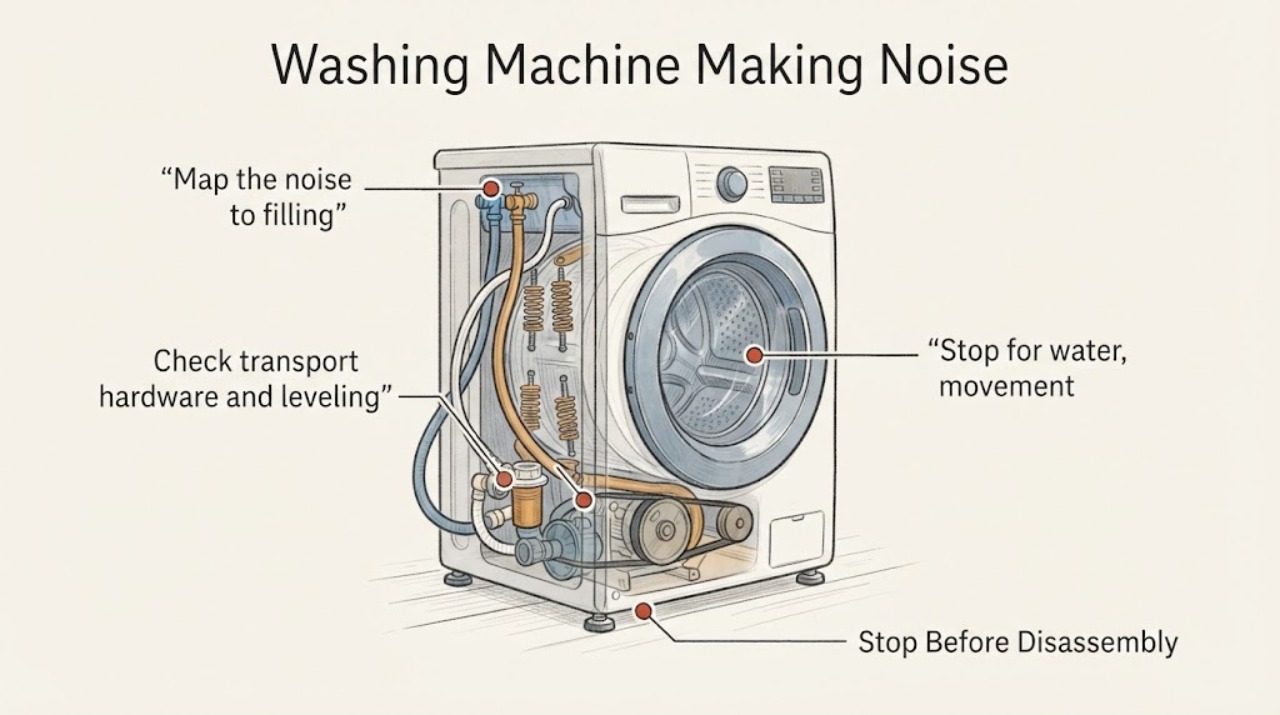
Stop for water, movement, or electrical danger
Stop the programme immediately if the washer is leaking, walking or striking the cabinet violently, producing metal-on-metal scraping, or giving off a burning or electrical odor. If there is smoke, a spark, a hot connection, or a repeated breaker trip, keep clear and disconnect power only from a dry, safe location; do not restart it to compare the sound.
Expected result: There is an active leak, violent movement, smoke, spark, burning odor, hot connection, or repeated trip; or the washer is stopped and there is no immediate hazard.
Next step: For smoke, fire, sparks, or dangerous electrical conditions, leave the area when appropriate and obtain emergency help from a safe location. Otherwise keep the washer off, protect the floor from water, and arrange qualified appliance service before further operation.
Why this matters
Why: An active water, fire, or electrical symptom changes this from a routine noise check to a stop-use and service path. Continuing to run can worsen a mechanical or electrical fault.
-
Map the noise to filling, wash, drain, or spin
With the washer safely stopped, note the exact moment the noise starts and ends: as water enters, during wash or agitation, when the pump drains, or during high-speed spin. Record the sound type, whether it changes with water level or speed, whether it is one click or continuous, and whether the cabinet moves.
Expected result: The noise is limited to filling, wash movement, draining, or spin; it occurs in more than one stage; or it continues with an empty drum.
Next step: Use the exact Indesit model handbook for the recorded stage and symptom. Do not identify a failed part solely from a generic noise label.
Why this matters
Why: A fill-stage knock suggests hose movement or an item touching the cabinet; wash-stage noise can follow the load or drive movement; a drain hum can be pump operation; and spin-only thumping makes balance or leveling more likely. A harsh sound with an empty drum needs a service assessment.
-
Check transport hardware and leveling after installation or a move
If the noise began on first use or after the washer was moved, compare the rear of the machine with the Indesit installation instructions and confirm that the specified protective brackets or transport bolts were removed. With the appliance empty and stopped, check that it stands firmly and that the feet are adjusted as the handbook describes; do not tip a heavy appliance without suitable help.
Expected result: Transport hardware remains fitted, the cabinet rocks, a foot is not firmly supported, or the machine is stable with the specified hardware removed.
Next step: Correct only the accessible installation issue using the exact model instructions. If the noise remains, or if moving the appliance is unsafe, stop and arrange installation or appliance service.
Why this matters
Why: Indesit identifies retained transport hardware and installation instability as causes to investigate when a machine is noisy or unstable at first use. A stable installation does not rule out an internal fault.
-
Redistribute a spin load only after the drum stops
If the sound is a thump with shaking during spin, wait until the drum is fully stopped, then spread items evenly and remove an excessive or single bulky load. Check the cycle guidance for the model and do not put hands into a moving drum. If the washer repeatedly attempts to correct balance or bangs the cabinet, do not keep running it.
Expected result: The noise disappears with an evenly distributed normal load, or it returns with ordinary loads and a stable machine.
Next step: Use the correct load and cycle only if the washer is otherwise safe and quiet. If banging returns, keep it off and provide the service technician the load, speed, and movement pattern.
Why this matters
Why: Indesit identifies an unbalanced load as a cause of spin problems, and manufacturer guidance links uneven loading and an unlevel washer with tub movement and noise. Recurrence with normal loads shifts concern to installation, suspension, drive, or another model-specific fault.
-
Inspect visible hoses, surroundings, and safe drain clues
With the machine off and cool, look behind and around it without opening the cabinet. Check whether the inlet or drain hose can strike the cabinet, whether an object is leaning against the washer, and whether the drain path shows a visible kink or blockage. If water remains, do not open a filter or drain fitting until the model handbook explains how to contain the water and power is safely isolated.
Expected result: A hose or nearby object can contact the cabinet, the accessible drain path is kinked or obstructed, or the outside looks clear but the noise occurs during drain.
Next step: Secure or move only an accessible external item and follow the exact model procedure for a drain or pump-filter check. If water cannot be contained safely, the pump hums without draining, or the sound persists, arrange service.
Why this matters
Why: Hoses and nearby objects can create rattling or knocking independent of a failed washer component. Indesit also uses drain symptoms and waste-path checks as troubleshooting clues; a clear visible hose does not prove that the pump or internal path is clear.
-
Escalate persistent rumble, scrape, or drum looseness
After safe external checks, compare the symptom with an empty, unpowered drum only by observation; do not force it, remove panels, or test exposed wiring. Note whether the harsh noise remains, whether the drum appears loose or rubs, whether draining is slow, and whether there is a leak or repeated error indication.
Expected result: A harsh rumble or scrape remains with an empty drum, the drum has unusual movement, a leak is present, or the washer repeatedly stops or reports a fault.
Next step: Keep the washer out of service and arrange qualified repair. Provide the model number, noise recording, cycle stage, load, installation history, water symptoms, and any displayed code; do not continue test cycles.
Why this matters
Why: Persistent empty-drum noise or looseness cannot be safely assigned to a bearing, suspension, pump, belt, motor, or control without model-specific diagnosis. Water and electrical symptoms raise the service priority.
Use your observations
Decision map
Find the observation that best matches what you see, then follow the next safe action.
-
PATH 01Next step
What you see
The noise began on first use or after the washer was moved, and the cabinet is unstable.
Do this next
Keep it stopped and check transport hardware and leveling against the exact Indesit installation instructions; arrange help if moving the appliance is unsafe.
-
PATH 02Next step
What you see
A knock or thump occurs mainly during spin and changes with the load.
Do this next
After the drum stops, redistribute the load and confirm firm, level support. Stop and arrange service if the washer bangs again with an ordinary load.
-
PATH 03Next step
What you see
The noise occurs when water enters or the machine vibrates against a visible hose or nearby object.
Do this next
With the machine stopped, secure or move only the accessible hose or object and follow the model handbook; do not open the cabinet.
-
PATH 04Next step
What you see
A hum occurs during drain, water drains slowly, or a drain-related light or code appears.
Do this next
Check the visible hose and use the model-specific pump or filter procedure only if water can be contained safely and power is isolated; otherwise call service.
-
PATH 05Next step
What you see
A harsh scrape or rumble continues with an empty drum, or the drum is loose, leaking, or repeatedly stops.
Do this next
Keep the washer out of service and arrange qualified diagnosis rather than choosing a bearing, motor, pump, or suspension part from the sound alone.
-
PATH 06Next step
What you see
There is smoke, a spark, a burning or electrical odor, a hot connection, violent movement, an active leak near electricity, or a repeated breaker trip.
Do this next
Stop using the washer, keep clear, and obtain emergency or qualified help from a safe location as appropriate. Do not restart it or perform live testing.
Helpful context
Understand the symptom
The cycle stage is the first useful clue
Do not treat every washer noise as the same fault. Note whether it happens as water enters, during wash movement, while water leaves, or only at high spin. Then describe the sound as a click, hum, rattle, thump, scrape, or harsh rumble and say whether the whole cabinet moves. Indesit notes that model indicators and procedures differ, so use the model number to select the matching handbook.
Safe external checks can narrow the path
With the washer stopped, unplugged only when it is safe and the floor is dry, and no moving parts accessible, check the load, feet, visible hoses, and obvious objects around the cabinet. Do not remove panels, reach into a moving drum, or perform live electrical work. A persistent grinding sound, drum looseness, leak, or electrical symptom is a service boundary.
Safety boundary
Stop conditions
- Stop immediately for smoke, sparks, a burning or electrical odor, a hot plug or connection, repeated breaker trips, or a leak near electrical equipment.
- Stop for violent walking, cabinet strikes, metal-on-metal scraping, unusual drum looseness, or a noise that remains with an empty drum.
- Do not reach into a moving drum, tip a heavy appliance without suitable help, remove panels, open exposed wiring, or perform live electrical tests.
- If water remains in the washer, do not open a filter or drain fitting until the exact model instructions explain safe water containment and power is isolated.
Only after diagnosis
Potential parts
- leveling foot or installation hardware
Relevant only when the model instructions and inspection confirm an installation or retained-transport-hardware issue.
Confirm the complete model and manufacturer fit information before ordering anything. - suspension or shock-absorber assembly
Consider only after qualified diagnosis links repeated spin movement or banging to the suspension system rather than load balance or leveling.
Do not infer fit or failure from noise alone. - drain pump or pump-filter housing
Relevant only when model-specific diagnosis confirms a drain-stage obstruction or pump fault after safe drain-path checks.
Water containment and electrical isolation are required; confirm the exact model. - drum bearing, drive, or motor component
Relevant only when qualified diagnosis identifies persistent empty-drum rumble, scraping, or drive behavior that is not explained by installation or load.
Internal repair requires qualified service and exact model confirmation.
When checks do not resolve it
Need a professional?
Arrange qualified appliance service when the noise persists after safe load, hose, and installation checks; returns with ordinary loads; occurs with an empty drum; is accompanied by drum looseness, a leak, slow draining, repeated stops, or a fault indication; or requires panels, internal parts, electrical diagnosis, or work around water and power. Use an emergency route for smoke, fire, sparks, or dangerous electrical conditions.
Common questions
FAQ
Why is my Indesit washing machine making a knocking noise?
If it began on first use or after a move, check transport hardware and leveling against the exact Indesit instructions. If it occurs mainly during spin, stop the drum and redistribute the load. Visible hoses or nearby objects can also knock against the cabinet. Persistent banging with a normal load needs service.
Is a humming sound during drain normal?
A pump can hum during drain, but a hum with slow or failed draining, a drain indicator, water left in the drum, or a new harsh sound needs the model-specific drain checks and possibly service. Do not open a filter until water can be contained safely and power is isolated.
Should I remove the transit bolts if the washer is noisy?
If the noise started on first use or after installation, use the exact Indesit installation instructions to confirm that the specified transport hardware was removed. Do not guess at hardware or move a heavy appliance without suitable help.
What does a grinding or rumbling sound mean?
The sound alone cannot identify a bearing, suspension, pump, drive, or motor fault. If a harsh sound continues with an empty drum, the drum feels loose, or there is a leak or repeated stopping, keep the washer off and arrange qualified diagnosis.
When should I stop using the Indesit washer immediately?
Stop for smoke, sparks, a burning or electrical odor, repeated breaker trips, a leak near electrical equipment, violent movement, metal-on-metal scraping, unusual drum looseness, or a noise that remains with an empty drum. Do not run another test cycle or perform live electrical work.
Read the exact guide
Official sources
- Indesit | Washing Machine Faq | Indesit ServiceIndesit Service · Indesit washing-machine troubleshooting for noise or instability, imbalance, leaks, drains, and model-specific guidance
- Humming or Whirling - Noise - Product Help | WhirlpoolWhirlpool Product Help · Manufacturer examples for washer motor sounds during wash or spin and pump hum during drain
- Indesit | Washer Dryer Faq | Indesit ServiceIndesit Service · Indesit washer and washer-dryer troubleshooting for imbalance, drains, leaks, and noisy or unstable installation
- Knocking or Thumping - Noise - Product Help | WhirlpoolWhirlpool Product Help · Manufacturer examples for washer knocking by cycle stage, hoses, unbalanced loads, and leveling
- How to Videos - Washing Machines | Indesit ServiceIndesit Service · Indesit washing-machine maintenance index for unstable or wobbling machines, transit bolts, drain and pump problems, and model-number lookup
Community feedback
Share a repair observation
Share a plain-text repair observation. Accepted observations are published automatically; this page may take a moment to update.