
On this page
Start here
Quick answer
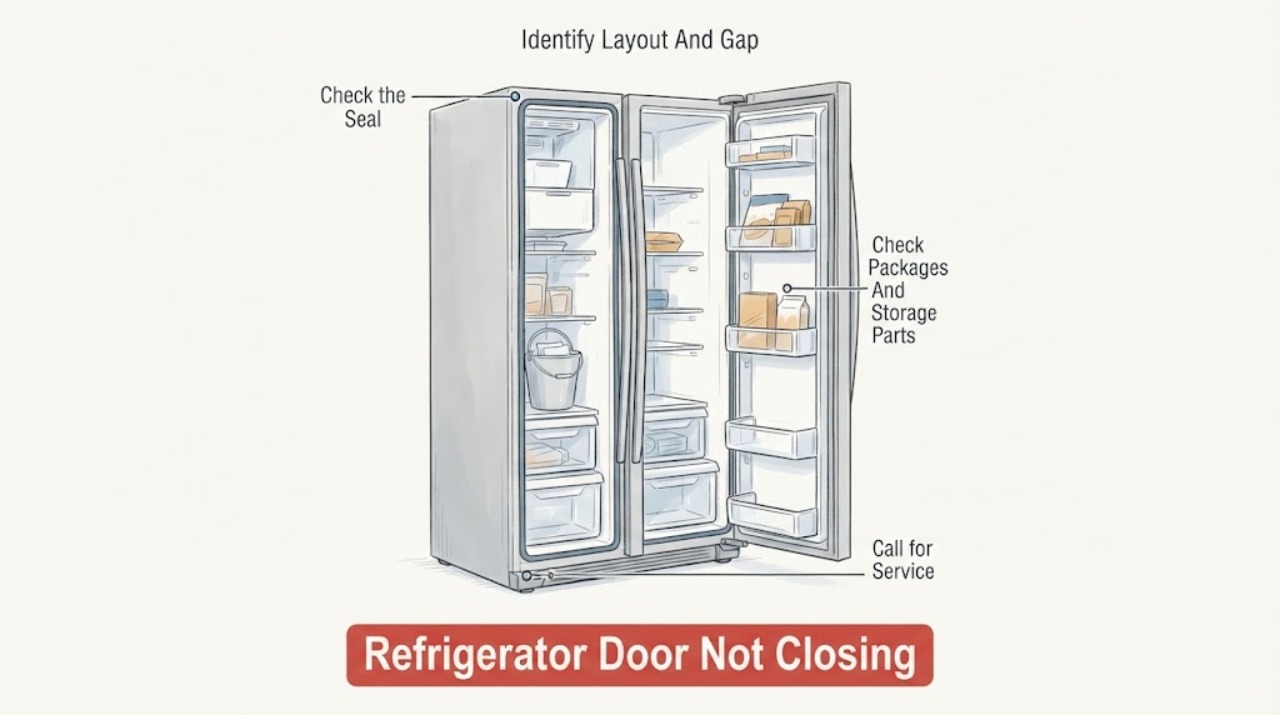
Start with the obstruction, not the hinge. Inglis’s official Canadian troubleshooting guide says a refrigerator door that will not close completely may be blocked by food packages, an out-of-position ice bin or bucket, pans, shelves, bins, or baskets; it also directs you to clean sticking gaskets, check whether the refrigerator wobbles, and consider whether doors were removed and replaced incorrectly during installation. Remove or reseat only accessible items, clean the gasket with the model’s care instructions, and check stability without lifting or pulling out the cabinet. If the door still springs open, sits crooked, has a torn gasket, or requires hinge adjustment or door removal, arrange qualified service. Keep the door closed as far as possible to protect food, and stop for a damaged cord, exposed wiring, leaking refrigerant or water near electrics, a falling door, or an unstable cabinet.
Before you begin
Safety first
- The user may rearrange accessible contents, reseat storage parts, clean the gasket as directed, and inspect visible stability. Qualified personnel must handle door removal, hinge alignment, heavy-appliance movement, water-line disconnection, cabinet repair, and any electrical work.
Work through in order
Diagnostic checks
Use only checks that match the exact appliance or system and its official guide.
-
Check 1
Read the model label from a safe position and identify whether the Inglis refrigerator is side-by-side or top-mount. With the door empty of loose items, observe where closure stops: at a package or shelf, at the hinge side, at the latch side, or around a continuous gasket gap.
Expected result: A specific item blocks one point; the door is visibly sagging or crooked; the gasket does not touch the cabinet around part of its perimeter; or the obstruction is not visible.
Next step: Use the matching obstruction, gasket, stability, or installation branch. Photograph the model label and gap if service may be needed; do not remove the door to investigate.
Stop if: Stop for an unstable cabinet, a door that may fall, damaged hinges, exposed wiring, a strained water line, or any need to lift or pull out the refrigerator.
Why this matters
Why: The closing mechanism differs by refrigerator layout. A local stop suggests an item or bin; a crooked door suggests alignment or hinge service; a perimeter gap suggests gasket or leveling; an unexplained stop needs the exact manual rather than a guessed adjustment.
-
Check 2
Open the affected compartment and inspect food packages, door bins, crisper cover, pans, shelves, drawers, and baskets. For a model with an interior ice bin or freezer-door ice bucket, confirm it is pushed fully in, straight, level where applicable, and latched as the exact Use and Care Guide shows.
Expected result: A package protrudes, a shelf or drawer is not fully seated, the ice bin or bucket is crooked or out of position, or all storage parts are correctly seated but the door still stops.
Next step: Rearrange or reseat only accessible items, then close the door gently and check the seal. Do not force an ice bucket, remove a door-mounted assembly, or use a tool to clear an obstruction.
Stop if: Stop if a bin, shelf, drawer, or ice bucket is cracked, frozen in place, sharp, leaking, or requires force or disassembly to remove.
Why this matters
Why: Inglis lists these accessible storage items as direct causes of incomplete closure. If all parts are seated and the door still stops at the same point, an item is less likely and gasket, alignment, leveling, or hinge condition becomes more likely.
-
Check 3
With the door open, inspect the full gasket and the cabinet surface it meets. Look for food residue, stickiness, a folded or displaced section, a tear, hardened area, or a gap that remains after the door is gently pushed closed. Clean only as the exact model’s care instructions permit and dry the sealing surfaces.
Expected result: The gasket is dirty or sticky and closure improves after cleaning; it is displaced, torn, hardened, or visibly misshapen; or it is clean and contacts the cabinet evenly.
Next step: Allow the gasket and contact surface to dry, close the door, and check for an even seal. Arrange service for a torn or permanently deformed gasket, or for a clean gasket that still does not seal.
Stop if: Do not use solvents, sharp tools, heat guns, adhesives, or improvised spacers on the gasket; stop if cleaning reveals exposed wiring, water near electrical parts, or a damaged door edge.
Why this matters
Why: Inglis specifically directs owners to clean sticking gaskets. Improvement after cleaning supports gasket resistance; damage or a persistent gap makes gasket replacement, alignment, or cabinet service more likely and cannot be solved by forcing the door.
-
Check 4
From the front and sides, check whether the refrigerator rocks, leans, or has visibly uneven support. Inspect only visible clearance and whether the door became misaligned after delivery or installation. Do not pull out the cabinet, turn leveling feet by guesswork, or remove hinge covers.
Expected result: The cabinet wobbles or leans; the door was recently removed or installed; the cabinet is stable and the door is still crooked; or the refrigerator is stable and alignment looks normal.
Next step: Use the exact Use and Care or installation guide for any permitted leveling step. Have a second person or qualified installer handle movement or door alignment; if there is no visible installation cause, arrange service.
Stop if: Stop for a rocking or tipping cabinet, a damaged floor or bracket, a water or ice line under tension, a door that may fall, or any need to lift, tilt, or pull out the appliance.
Why this matters
Why: Inglis says an unstable refrigerator should be leveled according to the model guide and that doors removed during installation may not have been replaced correctly. A stable cabinet with persistent crooked closure makes hinge, door, or cabinet diagnosis more likely.
-
Check 5
After reseating accessible items and cleaning the gasket, close the door gently and observe whether it stays closed and the gasket contacts evenly. Check that the refrigerator is not warming from a prolonged open door, but do not keep it running with a large gap or damaged seal while waiting for a repair.
Expected result: The door now closes and seals evenly; it closes but springs open or leaves a gap; it remains crooked or cannot latch; or closure is accompanied by a leak, unusual heat, odor, smoke, or electrical symptom.
Next step: Monitor temperature and condensation after a successful repairable check. For persistent closure failure, provide the model, layout, gap location, photos, and checks to Inglis support or a qualified technician; isolate power when safe for electrical hazards.
Stop if: Stop immediately for smoke, sparks, burning odor, exposed wiring, a hot or damaged cord, water near electrics, a falling door, or an unstable cabinet.
Why this matters
Why: A restored even seal supports an obstruction or gasket-surface issue. A persistent gap, spring-open door, or crooked closure points to gasket, hinge, leveling, door, or installation service. Safety symptoms override further door adjustment.
Use your observations
Decision map
Find the observation that best matches what you see, then follow the next safe action.
-
PATH 01Safety boundary
What you see
The door stops at one point and a package, shelf, drawer, bin, basket, crisper cover, ice bin, or ice bucket is proud of its intended position.
Do this next
Rearrange or reseat the item without force, then close the door gently and verify an even gasket contact. Replace or service a cracked or stuck component rather than modifying it.
Why this path and its safety boundary
Why it matters: An accessible storage obstruction is more likely than a failed hinge or cabinet. Inglis lists these items as causes of a door that will not close completely.
Safety stop: Do not force an ice bucket, remove a door-mounted assembly, or reach into a frozen or sharp obstruction.
-
PATH 02Safety boundary
What you see
The cabinet contents are clear but the gasket is sticky, dirty, folded, torn, misshapen, or leaves a continuous or localized gap when the door is closed.
Do this next
Clean and dry the gasket using the exact care instructions. Arrange a model-matched gasket or service for damage, displacement, or a gap that remains after cleaning.
Why this path and its safety boundary
Why it matters: Gasket resistance or sealing damage is more likely than an internal cooling fault. Inglis directs owners to clean sticking gaskets and to obtain qualified help when a seal does not seal around the door.
Safety stop: Do not glue, heat, puncture, stretch, or shim the gasket; stop if the door edge or cabinet is damaged.
-
PATH 03Safety boundary
What you see
The refrigerator rocks or leans, or the door became crooked after the doors were removed or the appliance was installed.
Do this next
Follow the exact manual and use qualified help for leveling, door alignment, or movement. Do not adjust hinges or remove the door based on a generic diagram.
Why this path and its safety boundary
Why it matters: Leveling or installation alignment is more likely. Inglis says to level an unstable refrigerator using the model guide and to use qualified service when doors were not correctly replaced after installation.
Safety stop: Stop for a tipping cabinet, damaged hinge, strained water line, or any need to lift, tilt, or pull out the refrigerator.
-
PATH 04Safety boundary
What you see
Accessible items are correctly seated, the gasket is clean, and the cabinet appears stable, but the door remains crooked, springs open, or fails to meet the cabinet.
Do this next
Arrange qualified Inglis or refrigerator service with the model, layout, gap location, installation history, and photos. Keep the door closed as far as possible and protect food if temperature is rising.
Why this path and its safety boundary
Why it matters: A hinge, door alignment, damaged cabinet, or model-specific installation issue is more likely. The official Inglis guide does not justify a universal hinge adjustment or replacement procedure.
Safety stop: Do not force the door, bend hinges, remove panels, or support the door with improvised hardware.
-
PATH 05Safety boundary
What you see
Closure trouble is accompanied by a falling or unstable door, exposed wiring, water near electrical parts, smoke, burning odor, sparks, abnormal heat, or a damaged cord.
Do this next
Stop, keep people away, close the water supply if a visible water leak requires it, and disconnect power only when safe. Arrange qualified service and do not restart to test.
Why this path and its safety boundary
Why it matters: The immediate risk is mechanical or electrical safety, not refrigerator door adjustment. Continued operation may cause injury, food loss, or further damage.
Safety stop: Do not touch wet electrical parts, remove covers, perform live tests, or lift the door or cabinet.
Helpful context
Understand the symptom
The closing symptom usually starts inside the cabinet
An Inglis refrigerator door can stop short because a package, drawer, shelf, ice bin, or bucket is proud of its intended position. The side-by-side and top-mount sections of Inglis’s guide do not use exactly the same ice-storage arrangement, so identify the layout before applying a check. Observe whether the door is blocked at one spot, sits unevenly, or closes but fails to seal around the gasket.
A gasket, level, and hinge problem leave different clues
A sticky gasket can resist closure even when nothing is visibly blocking the door. A wobbling or unlevel cabinet can change how the door sits, while a door that became crooked after installation may need the doors replaced or aligned under the exact manual. Cleaning or reseating an accessible item is a user check; hinge, alignment, door removal, and cabinet movement are not safe guesses for every model.
Protect the cold seal while you investigate
A door that remains open lets warm air in and can cause temperature fluctuation, moisture, or frost. Repack the compartment so the door can rest closed while you identify the cause. Do not force the door against a drawer or ice bucket, and do not remove a heavy door or pull out an integrated or tightly installed refrigerator to reach the hinge area.
When to stop at the cabinet and call for help
If accessible obstructions, gasket cleaning, and a visible stability check do not restore closure, the likely decision moves toward alignment, hinge, gasket, cabinet, or installation service. Contact Inglis support or a qualified refrigerator technician with the model and a description of where the gap occurs. Stop immediately for a falling door, exposed wiring, a damaged cord, water near electrics, smoke, burning odor, or an unstable cabinet.
Safety boundary
Stop conditions
- Stop and disconnect power when safe for smoke, sparks, flame, burning odor, abnormal heat, water near electrical parts, exposed wiring, or a hot or damaged cord.
- Keep people away from a falling, sagging, or unstable door or cabinet; do not lift or brace it with improvised hardware.
- Do not force packages, ice buckets, drawers, or shelves; do not bend hinges, pierce gaskets, or use adhesives or heat.
- Do not pull out, tilt, lift, or level a heavy, integrated, or water-connected refrigerator alone.
- If the door still fails to close after safe accessible checks, arrange qualified service rather than removing the door or adjusting internal hardware.
Only after diagnosis
Potential parts
- model-matched door gasket, shelf, bin, crisper cover, drawer, ice bin, or ice bucket
Consider only when inspection confirms a damaged or missing accessible part and the exact model guide or parts lookup identifies it as the cause of the closure problem.
Side-by-side and top-mount Inglis layouts use different storage parts. Confirm the exact model and fit information before ordering. - model-matched hinge, hinge bushing, door support, leveling component, or cabinet alignment hardware
Consider only after qualified diagnosis confirms that a damaged hinge, support, leveling component, or alignment part—not an obstruction or gasket—is preventing closure.
Door weight, hinge geometry, and installation differ by model. Do not remove the door or order hardware by appearance alone.
When checks do not resolve it
Need a professional?
Arrange Inglis or qualified refrigerator service when accessible food and storage obstructions are cleared, the gasket is clean, and the cabinet is visibly stable but the door still will not close or seal; also call for a torn gasket, crooked door, hinge or alignment problem, door removal after installation, damaged ice-bin hardware, or a cabinet that needs leveling or movement. Stop and disconnect power when safe for smoke, sparks, burning odor, abnormal heat, exposed wiring, water near electrical parts, a hot or damaged cord, a falling door, or an unstable cabinet. The user may rearrange packages, reseat accessible shelves, bins, drawers, and model-appropriate ice storage, clean the gasket as directed, and inspect visible stability. Door removal, hinge alignment, leveling of a heavy appliance, cabinet movement, and electrical or water-line work belong to qualified personnel.
Safety scope: The user may rearrange accessible contents, reseat storage parts, clean the gasket as directed, and inspect visible stability. Qualified personnel must handle door removal, hinge alignment, heavy-appliance movement, water-line disconnection, cabinet repair, and any electrical work.
Common questions
FAQ
Why will my Inglis refrigerator door not close completely?
Check for a package, shelf, drawer, bin, basket, crisper cover, or model-specific ice bin or bucket blocking it. Then clean a sticking gasket and inspect visible stability. If the door remains crooked or leaves a gap, arrange model-specific service.
Can an out-of-position ice bin keep an Inglis door open?
Yes, on models with an interior ice bin or freezer-door ice bucket. Inglis says to push the interior bin fully in and to ensure the door bucket is level and correctly aligned where applicable. Use the exact Use and Care Guide for your layout.
How do I fix a sticking Inglis refrigerator gasket?
Clean the gasket and the surface it meets using the exact model’s care instructions, then dry it and check whether the door seals evenly. A torn, misshapen, displaced, or still-gaping gasket needs a model-matched part or qualified service; do not glue or heat it.
Could an unlevel Inglis refrigerator cause the door not to close?
It can. Inglis directs owners to level a wobbling or unstable refrigerator according to the Use and Care Guide. Do not lift, tilt, pull out, or adjust a heavy or water-connected refrigerator alone; use qualified help for movement or alignment.
When should I call for an Inglis refrigerator door repair?
Call when packages and storage parts are clear, the gasket is clean, and the cabinet is stable but the door remains crooked, springs open, or fails to seal. Call immediately for a falling door, exposed wiring, water near electrics, smoke, burning odor, abnormal heat, or a damaged cord.
Read the exact guide
Official sources
- About Inglis - Inglis Home AppliancesInglis Home Appliances / Whirlpool Canada LP · Official Inglis Canada brand page; it establishes the brand and regional support context, not a model-specific repair procedure.
- Customer Care - Inglis Home AppliancesInglis Home Appliances / Whirlpool Canada LP · Official Inglis Canada support hub; exact refrigerator instructions remain model-specific.
- Contact Us - Inglis Home AppliancesInglis Home Appliances / Whirlpool Canada LP · Official Inglis Canada customer-care page; support availability and service process are regional.
- Troubleshooting - Inglis Home AppliancesInglis Home Appliances / Whirlpool Canada LP · Official Inglis Canada troubleshooting page; refrigerator layout, ice-storage design, door hardware, and leveling procedure vary by exact model.
Community feedback
Share a repair observation
Share a plain-text repair observation. Accepted observations are published automatically; this page may take a moment to update.