
On this page
Start here
Quick answer
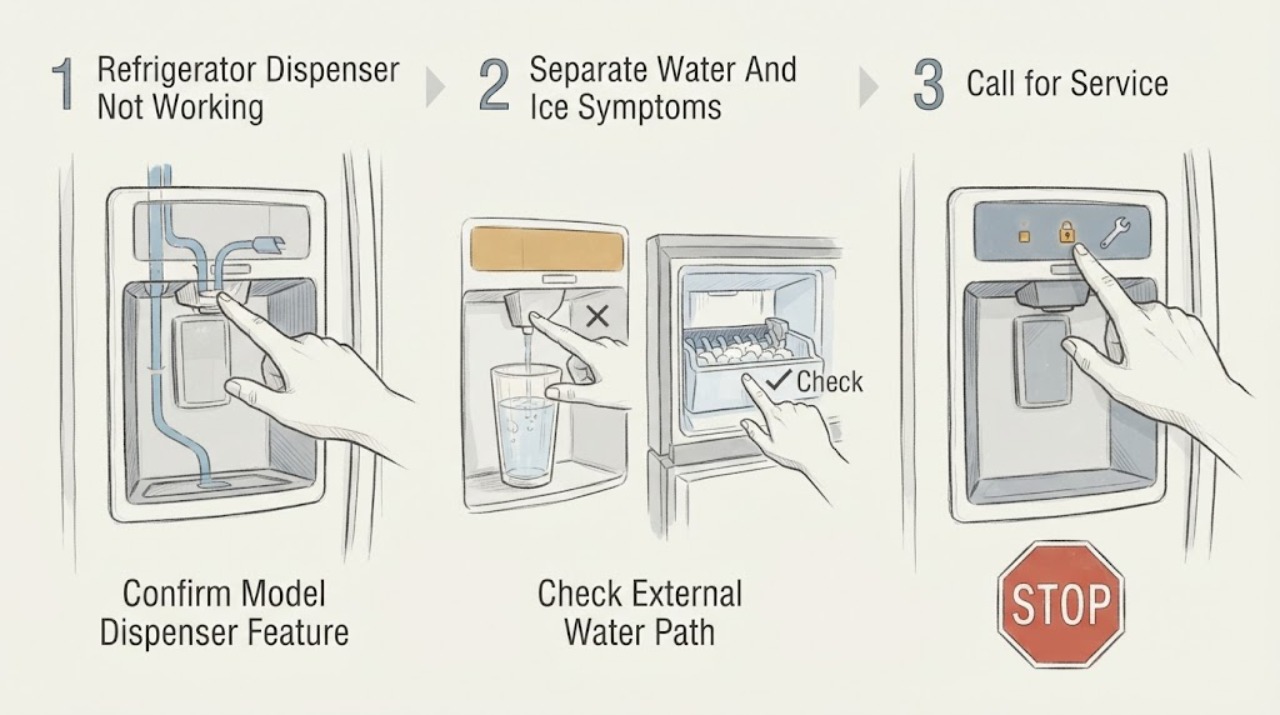
First confirm from the exact Inglis model's product documentation or Use & Care Guide that it has the dispenser you are testing. Inglis's official Canadian troubleshooting page places ice and water dispenser guidance under Side-by-Side Refrigerators and repeatedly qualifies ice-bin, filter, switch, and shutoff-arm details as model-dependent; a top-mount or non-dispenser refrigerator cannot be diagnosed as a failed through-door dispenser. Then separate the symptom: water absent, ice absent, ice made but not delivered, or both. For water, check only from outside that the supply is connected, the shutoff valve is open, the visible line is not kinked, and the exact manual's filter is correctly installed. For ice, check the freezer door, correctly seated bin or bucket, ice type, frozen clumps, chute, and whether the dispenser was held too long. Inglis says a newly filled water system may need flushing, air can cause temporary drips, and a newly installed or recently emptied ice maker may need documented time before output returns. Use the exact manual for any lock or control. Stop for a leak near electrical parts, damaged cord, smoke, burning odor, repeated breaker trips, or any need to open the door or dispenser enclosure; internal valve, motor, switch, wiring, and control diagnosis belongs to qualified service.
Before you begin
Safety first
- The owner may identify the model and confirmed dispenser, observe water versus ice symptoms, check visible door/bin/chute/supply conditions, and perform only the exact manual's external filter or flush step. Qualified personnel must handle internal valves, filter heads, switches, motors, wiring, controls, water-line repairs, live testing, and part replacement.
Work through in order
Diagnostic checks
Use only checks that match the exact appliance or system and its official guide.
-
Check 1
Read the model and serial plate inside the refrigerator and compare the exact Inglis model with its Use & Care Guide. Confirm whether the documented architecture has a water dispenser, an ice dispenser, both, an interior ice bin, or no dispenser, and record the country of purchase.
Expected result: The manual confirms the dispenser; it documents a different dispenser layout; it shows no dispenser; or the model cannot be matched.
Next step: Continue only with checks written for the confirmed architecture. If the model or feature is uncertain, obtain the correct manual or contact Inglis support before opening anything.
Stop if: Do not retrofit a dispenser, connect an unverified water line, or order a dispenser part without the complete model number.
Why this matters
Why: Inglis's official page has separate Side-by-Side and Top-Mount families and qualifies several dispenser components as present only on some models. A missing feature is not a failed dispenser, and a door bucket procedure cannot be transferred to an interior-bin model.
-
Check 2
From outside the appliance, test the documented water and ice controls separately. Note whether the panel or lever responds, whether water flows, whether cubes are visible in the bin, whether ice is made but not delivered, and whether the freezer door closes completely.
Expected result: Water is absent; cubes are absent; cubes are present but do not exit; both functions are absent; the control is locked/unresponsive; or the freezer door is open or blocked.
Next step: Follow the water branch for water-only failure, the bin/chute branch for ice-only delivery failure, and the exact manual's ice-maker branch when the bin is empty. Correct only visible door or control conditions documented for that model.
Stop if: Do not reach into the auger or chute, bypass a door switch, or repeatedly hold a lever while the motor stalls.
Why this matters
Why: Water delivery, ice production, and ice delivery use overlapping but different components. Cubes in the bin with no delivery is not proof of an ice-maker failure; no cubes may require the ice-maker and freezer checks rather than a dispenser repair.
-
Check 3
For a confirmed water-dispenser model, check only the visible water shutoff and source connection, look for a kink in the accessible line, and inspect or reseat the user-accessible filter exactly as the model guide directs. If the system is newly installed, perform only the manual's initial fill and flush procedure.
Expected result: The shutoff is closed; the source is disconnected; the line is kinked; the filter is clogged or not seated; the system has air after installation; or all visible conditions are normal.
Next step: Correct only the documented external condition, complete the exact model's flush, and retest briefly. If flow remains absent or weak, arrange qualified service or plumbing help as appropriate.
Stop if: Do not disconnect a pressurized line, force a filter, bypass filtration, test a valve live, or continue when water is near electrical parts.
Why this matters
Why: Inglis identifies the supply, shutoff, line, filter, and initial air in the system as separate causes of no or weak water delivery. A normal external path makes an internal valve, filter head, door switch, or control issue more likely, but does not identify a part.
-
Check 4
For a confirmed ice-dispenser model, verify the freezer door and bin or bucket are correctly seated. From the opening only, look for wrong cubes, clumping, ice around the auger, or a chute obstruction; use a plastic utensil only where the exact guide permits it. If crushed mode stalls and the manual supports it, stop and test cubed mode instead.
Expected result: The door is open; the bin is misaligned; ice is clumped or melted around the auger; the chute is blocked; crushed mode stalls; the bin is empty; or all visible conditions are normal.
Next step: Correct only the visible, manual-approved condition and retest briefly. If the bin is empty, follow the exact ice-maker section; if cubes remain inaccessible or delivery still fails, arrange service.
Stop if: Do not chip ice with metal or sharp tools, force the auger or bucket, reach into moving parts, or dismantle the chute.
Why this matters
Why: Inglis's official guidance links delivery failure to door closure, bin/bucket fit, ice type, clumping, auger-area melt, chute obstruction, crushed-ice stalling, and prolonged lever use. An empty bin is an ice-production symptom, not necessarily a dispenser-motor fault.
-
Check 5
If the exact architecture is confirmed and external door, control, bin, chute, water-supply, filter, and model-authorized flush checks do not restore dispensing, stop and prepare a service report with model, serial, country, dispenser type, symptom split, and any leak or alarm details.
Expected result: Dispensing returns after a documented correction; water remains absent; cubes remain in the bin but do not deliver; both systems are dead; a motor stalls; or there is a leak, smoke, burning odor, damaged cord, exposed wiring, or repeated breaker trip.
Next step: Contact Inglis support or the responsible service provider with the model and serial details. Keep the appliance or water supply off when a hazard is present and do not recreate the fault for the technician.
Stop if: Stop immediately for uncontrolled water, water near electrical components, smoke, sparks, burning odor, a hot/damaged plug or cord, exposed wiring, repeated trips, or any need to open the dispenser or control enclosure.
Why this matters
Why: Persistent failure may involve an internal valve, filter head, door switch, auger motor, actuator, control, wiring, or water line. No single dispenser symptom proves which part has failed, and internal electrical or water work can be hazardous.
Use your observations
Decision map
Find the observation that best matches what you see, then follow the next safe action.
-
PATH 01Safety boundary
What you see
The exact Use & Care Guide does not document the tested dispenser, or the model cannot be matched.
Do this next
Stop this workflow, locate the exact manual or contact Inglis with the model and serial number, and use only the architecture it confirms.
Why this path and its safety boundary
Why it matters: Inglis's official support page distinguishes refrigerator families and says several dispenser parts or controls are present only on some models. The absence of a documented feature is not a repair failure.
Safety stop: Do not add plumbing, retrofit a dispenser, or use a different Inglis model's part or test procedure.
-
PATH 02Safety boundary
What you see
The model has a water dispenser, but the visible shutoff/source, line, filter, or newly filled system condition is abnormal while ice-delivery observations are separate.
Do this next
Perform only the exact guide's external correction or flush, then retest briefly. Escalate a normal external path with persistent no flow.
Why this path and its safety boundary
Why it matters: The official Inglis guide identifies initial filling and air, supply connection, shutoff, kinked line, and filter condition as water-side causes. This pattern does not prove an internal valve failure.
Safety stop: Do not disconnect tubing, force the filter, or continue if water reaches electrical components.
-
PATH 03Safety boundary
What you see
The confirmed model has cubes in the correctly seated bin or bucket, but the dispenser does not deliver them; the door, clumping, chute, ice type, or lever timing shows an abnormality.
Do this next
Correct only the visible condition the exact guide permits, then retest briefly. Persistent delivery failure needs qualified service.
Why this path and its safety boundary
Why it matters: This favors the bin, auger, chute, ice type, control, or door-switch side rather than ice production. Inglis documents different interior-bin and door-bucket arrangements.
Safety stop: Do not force or dismantle the auger, bucket, chute, or door switch, and never use a sharp object to clear ice.
-
PATH 04Safety boundary
What you see
The confirmed dispenser architecture is normal externally, but water or ice still will not dispense, both functions are unresponsive, or a leak/electrical hazard is present.
Do this next
Use Inglis customer care or the responsible service route with the model, serial, country, exact dispenser symptom, and completed safe checks. Isolate water or power when a hazard is present.
Why this path and its safety boundary
Why it matters: An internal valve, filter head, switch, motor, actuator, control, wiring, or water-line fault is possible. The official page directs service when the listed external causes do not resolve the symptom.
Safety stop: Do not open panels, perform live tests, bypass a door or control interlock, or order a generic dispenser part.
Helpful context
Understand the symptom
Confirm the dispenser exists on this Inglis model
Do not assume that the Inglis name means every refrigerator has a through-door dispenser. The opened official Inglis page separates Side-by-Side Refrigerators from Top-Mount Refrigerators and includes separate ice-dispenser and water-dispenser troubleshooting under the side-by-side family. It also says that an interior ice bin, door ice bucket, filter, shutoff arm, and ice-maker switch are present only on some models. Check the exact model and serial plate, then use the matching Use & Care Guide to identify whether the appliance has a water dispenser, an ice dispenser, both, or no dispenser. If there is no documented dispenser, this page's repair path does not apply.
Separate water delivery from ice delivery
Pressing the water lever and pressing the ice control test different paths. Record whether the panel responds, whether water flows, whether cubes are visible in the bin, and whether the freezer door closes completely. No water with no ice may point to the supply, filter, or a shared control path; cubes in the bin with no delivery points to the bucket, auger, chute, or dispenser control instead. A refrigerator without a documented ice bucket or water line cannot have that particular delivery fault. Do not reach into a moving auger or bypass a door switch.
Safe external checks for the water dispenser
On a model documented to have a water dispenser, Inglis says the system may need to be filled the first time it is used and recommends dispensing and discarding the manual's specified flush volume. The same official guidance calls out an unopened or disconnected supply, a clogged or incorrectly installed shutoff connection, a kinked line, and a clogged or incorrectly installed filter. Inspect only the visible supply connection and a user-accessible filter where the exact manual allows it. Do not disconnect tubing, force a filter housing, or test an inlet valve while powered. A drip after installation can reflect air in the lines, but uncontrolled water or water near electrical components is a stop condition.
Safe external checks for the ice dispenser
If cubes are present, confirm the freezer door is fully closed and the ice bin or door bucket is level, aligned, and snapped into the position described by the model's guide. Inglis warns that wrong ice, frozen clumps, melted ice around the auger, and ice in the delivery chute can stop delivery; it recommends a plastic utensil for an accessible chute or ejector obstruction and warns against sharp objects. If crushed ice stalls, the official guidance says to stop, select cubed ice, and test only as the manual describes. A dispenser arm held too long may need the model's documented motor reset interval. Do not force the bucket, auger, ejector, chute door, or dispenser arm.
When no dispensing is an internal fault
If the exact model has the feature, the door and bin are correctly positioned, the visible supply and filter checks are normal, and water or ice still will not dispense, the remaining possibilities may include an internal valve, filter head, door switch, auger motor, chute actuator, control, wiring, or water line. The symptom alone cannot identify a compatible replacement. Inglis's official customer-care pages provide the model-and-serial support route; use it rather than applying another refrigerator's manual, pressure value, wiring test, or part. Protect food and stop the appliance when a leak, electrical hazard, or damaged hardware is present.
Safety boundary
Stop conditions
- Stop using the dispenser and isolate water or power for uncontrolled water, water near electrical components, smoke, sparks, burning odor, exposed wiring, a hot or damaged cord or plug, or repeated breaker trips.
- Do not perform live electrical tests or bypass a freezer-door switch, dispenser interlock, control lock, or motor protection.
- Do not disconnect a pressurized water line, force a filter, valve, bin, bucket, auger, ejector, chute, or dispenser lever, or reach into moving parts.
- Use only a plastic utensil where the exact manual permits clearing an accessible ice obstruction; never chip ice with a sharp or metal tool and never open the dispenser enclosure.
- Do not transfer an ice-bin, door-bucket, filter, flush volume, pressure value, reset interval, wiring test, or part fit from another Inglis model or another country.
Only after diagnosis
Potential parts
- Inglis refrigerator water filter or filter-head component
Consider only when the exact model documents a filter and qualified diagnosis confirms restriction, damage, or a filter-head fault after safe external seating checks. No water alone does not identify this part.
Filter format, head, connection, and installation differ by model and market. Verify the complete model and serial information before ordering. - Inglis refrigerator water inlet valve or dispenser water component
Consider only for a confirmed plumbed dispenser model after qualified diagnosis identifies an internal valve or water-path problem with the visible supply path clear.
Valve connectors, tubing, pressure arrangement, and mounting are model-specific. Do not substitute a generic valve or test it live. - Inglis ice dispenser auger motor, chute, or door-switch component
Consider only when the exact model has an ice dispenser, cubes are present, external bin/chute checks are normal, and qualified diagnosis identifies a delivery-side component.
Interior-bin and door-bucket systems use different interfaces. Confirm the exact model, bin style, connector, and manual before any replacement. - Inglis refrigerator dispenser control or wiring component
Consider only after qualified diagnosis of a confirmed dispenser model shows an internal control, switch, or wiring fault; the symptom does not select a board.
Control and switch assemblies are model- and region-specific and may involve door interlocks. Internal electrical work requires qualified service.
When checks do not resolve it
Need a professional?
Arrange qualified Inglis or Whirlpool-authorized service when the exact model confirms a dispenser but safe external door, bin, chute, water-supply, filter, control, and model-authorized flush checks do not restore output; when water remains absent, cubes remain trapped, both functions fail, a motor or valve may be involved, or the manual directs service. Stop immediately for water near electrical parts, smoke, sparks, burning odor, damaged power hardware, repeated trips, exposed wiring, or any need to open the dispenser or control enclosure.
Safety scope: The owner may identify the model and confirmed dispenser, observe water versus ice symptoms, check visible door/bin/chute/supply conditions, and perform only the exact manual's external filter or flush step. Qualified personnel must handle internal valves, filter heads, switches, motors, wiring, controls, water-line repairs, live testing, and part replacement.
Common questions
FAQ
Does every Inglis refrigerator have an ice or water dispenser?
No. Inglis's official troubleshooting page separates Side-by-Side and Top-Mount refrigerator families and qualifies several ice-bin, filter, switch, and shutoff-arm details as applying only to some models. Confirm the exact model's Use & Care Guide before treating a missing feature as a failure.
What should I check when an Inglis water dispenser does not work?
On a model documented to have a water dispenser, check the visible water connection and shutoff, look for a kink in the accessible line, and check the model-authorized filter installation. A newly installed system may need its documented fill and flush. If those checks are normal, call service rather than disconnecting tubing or testing an internal valve.
Why are there ice cubes in my Inglis refrigerator but none come out?
Check the freezer door, the correctly seated interior bin or door bucket, clumped or melted ice around the auger, wrong ice, and a blocked chute. Inglis advises using a plastic utensil where permitted and warns against sharp objects. If the bin is empty, troubleshoot ice production instead of the delivery path.
Why does my Inglis dispenser drip after installation or filter work?
Inglis says air in a water-filtration line can cause temporary dripping and that additional flushing may help; its page describes normal use clearing air over a model-dependent period. Follow the exact manual and stop if water is uncontrolled or reaches electrical components.
When should I call for Inglis refrigerator dispenser service?
Call when the confirmed model's safe external door, bin, chute, water-supply, filter, and model-authorized flush checks do not restore output, or when an internal valve, switch, motor, control, wiring, or water line may be involved. Provide the model and serial number. Stop immediately for leaks near electrics, smoke, sparks, burning odor, damaged power hardware, exposed wiring, or repeated breaker trips.
Read the exact guide
Official sources
- Product Registration - Inglis Home AppliancesInglis Home Appliances / Whirlpool Canada LP · Official Canadian Inglis support page; the refrigerator serial plate location and contact route may differ by model or region.
- Troubleshooting - Inglis Home AppliancesInglis Home Appliances / Whirlpool Canada LP · Official Canadian Inglis customer-care guidance organized under Side-by-Side and Top-Mount Refrigerators; dispenser components and controls are model-dependent, so use the exact Inglis manual for the appliance.
- Customer Care - Inglis Home AppliancesInglis Home Appliances / Whirlpool Canada LP · Official Canadian Inglis customer-care landing page; service availability and contact details are country and model dependent.
Community feedback
Share a repair observation
Share a plain-text repair observation. Accepted observations are published automatically; this page may take a moment to update.