
On this page
Start here
Quick answer
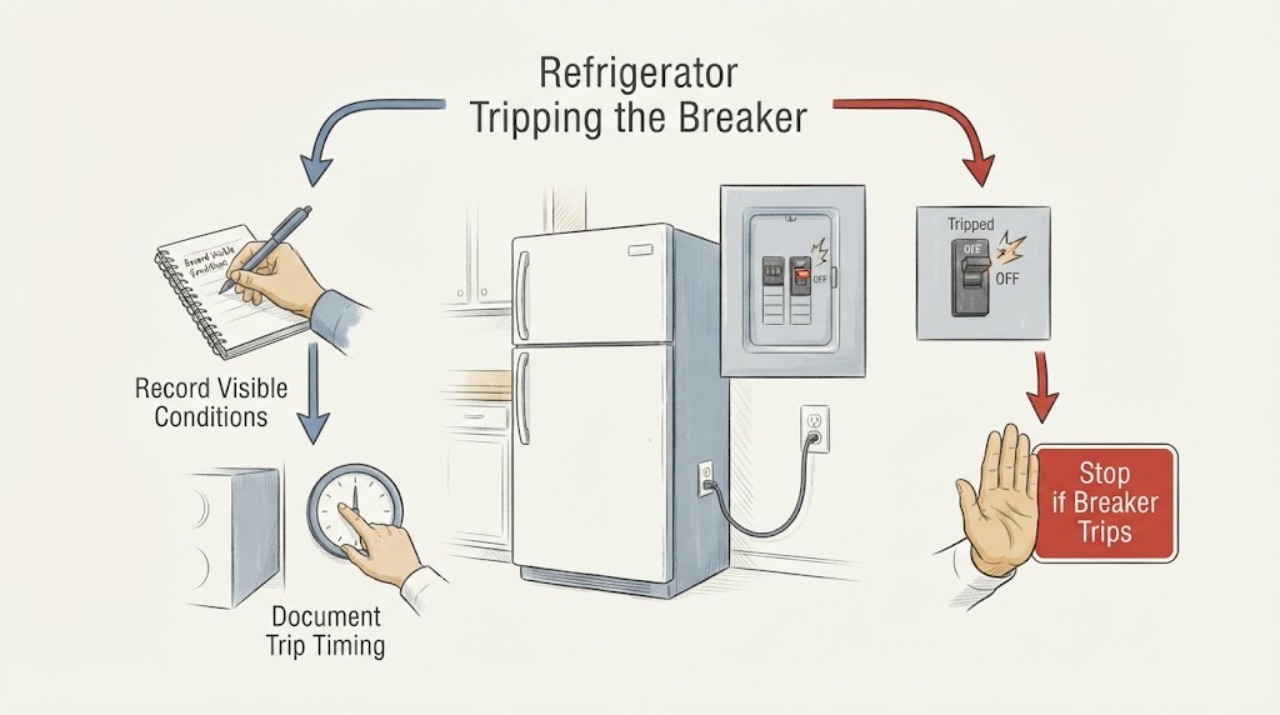
Treat a tripped breaker as a safety event, not as a reset-and-retry diagnosis. Leave the Inglis refrigerator off and do not repeatedly reset the breaker or GFCI, install a larger fuse or breaker, use an extension cord, bypass grounding, or perform a live electrical test. From a dry, safe position, record whether other appliances lost power, whether the refrigerator has a damaged or hot plug/socket, and whether the trip followed a compressor start, defrost period, ice-maker or water-system activity, moving, or cleaning. Inglis troubleshooting covers grounded power, breaker or fuse checks, automatic defrost behavior, controls, condenser and door-seal conditions, and optional water/ice systems; Whirlpool's manufacturer-group power guidance calls for a grounded 15- or 20-amp supply on a separate circuit with no extension cord, but the exact model and installation manual control. If there is smoke, sparking, burning odor, heat damage, water near electrical parts, a damaged cord or receptacle, or another trip, keep the refrigerator disconnected and contact a qualified electrician and/or authorized appliance service. Do not remove the rear cover, pull out an integrated unit, open the electrical box, probe wiring, or replace a compressor, relay, board, cord, or breaker from this symptom alone.
Before you begin
Safety first
- The owner may stop use, keep clear of hazards, record the model and event history, and inspect only dry visible conditions without moving or opening the appliance. A qualified electrician must assess the breaker, GFCI, receptacle, grounding, branch circuit, and any live supply. An authorized appliance professional must handle internal cord routing, compressor-start parts, defrost circuitry, controls, wiring, water valves, and concealed components.
Work through in order
Diagnostic checks
Use only checks that match the exact appliance or system and its official guide.
-
Check 1
Stop using the refrigerator after the trip. From a dry, safe position, look for smoke, sparks, a burning or electrical odor, a hot or discolored plug or receptacle, a damaged cord, water near electrical hardware, or exposed wiring. If the refrigerator is wet or the room is unsafe, keep clear and use emergency help as appropriate; isolate power only when it can be done without touching a hazard.
Expected result: There is a visible hazard; the plug, cord, or receptacle is hot or damaged; water is near the electrical connection; or there are no visible hazard signs.
Next step: For any hazard, leave the refrigerator disconnected and arrange qualified electrical service; also arrange appliance service if the refrigerator itself may be involved. If no hazard is visible, continue only with non-contact documentation below.
Stop if: Do not touch wet, hot, loose, scorched, sparking, or damaged hardware; do not open a cover or restore power to see whether the symptom returns.
Why this matters
Why: Smoke, sparking, heat damage, burning odor, water near electrics, or damaged insulation can indicate an immediate fire or shock risk. No visible sign does not make a repeated breaker trip safe to reproduce.
-
Check 2
Without resetting the device or using test equipment, record which protective device opened and whether nearby lights, outlets, or other appliances also lost power. Note the refrigerator's exact model and whether it is top-mount, side-by-side, refrigerator-only, or another configuration; photograph labels only from a safe dry position.
Expected result: Only the refrigerator circuit appears affected; several loads are out; the protective device is unidentified; or the model and installation arrangement are known or unknown.
Next step: Give the circuit scope, model, and installation details to a qualified electrician or appliance technician. Do not change the breaker rating or transfer the refrigerator to another circuit as a test.
Stop if: Do not remove a panel, open an outlet or breaker box, bypass a GFCI, alter grounding, or touch a suspected energized part.
Why this matters
Why: A refrigerator-only symptom can still be an appliance or dedicated-circuit fault, while several affected loads make a branch-circuit or supply problem more plausible. Inglis troubleshooting and Whirlpool power guidance require model and installation context rather than a universal refrigerator diagnosis.
-
Check 3
Write down the last normal use and the event immediately before the trip: compressor or fan start, a defrost interval, door opening, cleaning or moving, ice harvest/fill, dispenser or water-valve use, or an unrelated household load. Use existing observations or a service history; do not reconnect the refrigerator to recreate the event.
Expected result: The trip was immediate on start; it occurred after the refrigerator had been running; it followed ice/water activity; it followed moving or cleaning; or the timing is unknown.
Next step: Keep the refrigerator off and provide the timing and feature list to service. If water or ice activity preceded the trip, leave any accessible water shutoff closed only when safe and do not disassemble a valve or line.
Stop if: Do not cycle the compressor, ice maker, dispenser, defrost, or water valve for a test; do not reach behind the cabinet or work on concealed plumbing or wiring.
Why this matters
Why: Timing can help separate a load-start, defrost, optional water/ice, cord/receptacle, or building-circuit history for the technician, but it cannot prove which component failed. Inglis treats water/ice features and defrost behavior as conditional on the refrigerator layout.
-
Check 4
From outside the appliance, compare the visible power arrangement with the exact Inglis installation manual: grounded three-prong connection, no extension cord or power strip, adequate clearance, and no obvious crushed cord or moisture. Inspect only what is accessible without moving the refrigerator or removing a cover; do not infer the correct breaker size from a generic article.
Expected result: The connection is visibly correct and dry; an extension cord or power strip is present; the cord is pinched/damaged; the refrigerator is hard-wired or integrated; or the arrangement cannot be verified without moving or opening something.
Next step: Leave the refrigerator off and have a qualified electrician correct or assess the supply arrangement. If the visible installation is normal but the trip recurs, arrange appliance diagnosis as well.
Stop if: Do not use another outlet, add an extension lead, move an integrated unit, change protection, or open the rear electrical area.
Why this matters
Why: Whirlpool's official power guidance recommends a grounded dedicated circuit and no extension cord, while exact ratings and connection details remain model and installation dependent. A damaged or inaccessible arrangement requires professional assessment, not a user substitution test.
-
Check 5
Prepare a service handoff with the model and serial information, refrigerator layout, circuit scope, trip timing, visible cord/receptacle condition, water/ice features, recent moving or cleaning, temperatures, and any odor or noise. Keep the refrigerator disconnected whenever the breaker trip is unexplained or recurring.
Expected result: The trip was isolated and has not recurred; the protective device opened again; the refrigerator cannot be safely isolated; or the refrigerator remains off with no visible hazard.
Next step: Contact Inglis Customer Care or an authorized appliance professional for model-specific support, and use a qualified electrician when the receptacle, branch circuit, breaker, grounding, or other loads are implicated. Follow the technician's safe temporary food-storage guidance while the unit is off.
Stop if: Do not reset repeatedly, use a higher-rated protective device, run without grounding, perform live measurements, or reconnect to reproduce the fault.
Why this matters
Why: A single unexplained trip still needs context; a recurrence, a hot/damaged connection, or a refrigerator-specific trigger supports prompt electrical and appliance diagnosis. The symptom does not select a safe replacement part.
Use your observations
Decision map
Find the observation that best matches what you see, then follow the next safe action.
-
PATH 01Safety boundary
What you see
Smoke, sparks, burning odor, a hot or scorched plug/receptacle, damaged cord, water near electrical parts, or exposed wiring is present.
Do this next
Keep people away, leave the refrigerator and circuit off, and contact appropriate emergency or qualified electrical help. Arrange appliance service after the electrical area is safe.
Why this path and its safety boundary
Why it matters: This is an immediate electrical or fire-risk pattern, regardless of whether the original trip came from the refrigerator or the building supply.
Safety stop: Do not touch the hardware, move the refrigerator, use water on an electrical fire, reset protection, or investigate behind panels.
-
PATH 02Safety boundary
What you see
The trip removed power from other lights or outlets, or the breaker/GFCI opens with unrelated loads as well as the refrigerator.
Do this next
Leave the affected circuit as found and have a qualified electrician assess it. Do not borrow another circuit, increase its rating, or perform a live test to isolate the refrigerator.
Why this path and its safety boundary
Why it matters: A branch-circuit, receptacle, grounding, overload, or protective-device issue becomes more plausible; the refrigerator may not be the root cause.
Safety stop: Stop if the panel, receptacle, cord, or wiring is hot, wet, loose, damaged, or smells burned.
-
PATH 03Safety boundary
What you see
Only the refrigerator circuit trips again, or the trip history consistently follows compressor start, a defrost interval, or an optional ice/water event.
Do this next
Keep the refrigerator disconnected and arrange both appliance diagnosis and electrical assessment as appropriate. Tell the professionals the exact model, configuration, and trigger history.
Why this path and its safety boundary
Why it matters: A refrigerator load, cord/receptacle, dedicated circuit, compressor-start path, defrost circuit, control, or optional water/ice component may be involved. Timing narrows the service investigation but does not identify a part.
Safety stop: Do not reconnect, reset, move the unit, disable the ice maker, or open panels merely to see whether the pattern repeats.
-
PATH 04Safety boundary
What you see
There is no visible hazard, no other load is known to be affected, and the cause and timing of one trip are unclear.
Do this next
Do not repeatedly restore power. Contact Inglis or qualified service, provide the model and event history, and follow their safe instructions before any return to use.
Why this path and its safety boundary
Why it matters: The absence of a visible hazard does not establish that the appliance or circuit is sound; a one-time event still needs a record and model-specific review.
Safety stop: Stop immediately if any odor, heat, moisture, damage, or further trip appears.
Helpful context
Understand the symptom
A breaker trip is different from a refrigerator that simply stops
A cold refrigerator, a normal defrost pause, and a protective device that opens are different observations. Inglis explains that its refrigerator troubleshooting varies by layout and includes ordinary defrost, control, door, condenser, and water/ice checks. None of those checks makes a recurring trip safe to reproduce. Leave the appliance and the affected circuit in the state that is safest, and write down what happened before anyone changes the installation.
Use timing and scope to help the professional, not to run a test
The useful distinction is whether only the refrigerator circuit is affected and when the trip occurred. A trip as the compressor starts, after a defrost interval, or during an ice-maker or water-system event can point a technician toward different appliance or installation paths, but timing alone does not identify a failed part. If lights or other outlets are also affected, the building circuit may be involved. Do not move the refrigerator to another outlet or add a temporary lead to compare results; give the electrician the circuit history instead.
Inglis models and optional systems are not interchangeable
Inglis publishes separate top-mount and side-by-side refrigerator troubleshooting sections. Some models have a connected water line, filter, dispenser, or automatic ice maker; others do not. The matching model manual, rating label, and installation arrangement are therefore more useful than a generic part list. A service professional should confirm the supply circuit, cord and receptacle, compressor-start components, defrost circuit, controls, and any fitted water or ice system before selecting a repair.
When checks do not resolve it
Need a professional?
Safety scope: The owner may stop use, keep clear of hazards, record the model and event history, and inspect only dry visible conditions without moving or opening the appliance. A qualified electrician must assess the breaker, GFCI, receptacle, grounding, branch circuit, and any live supply. An authorized appliance professional must handle internal cord routing, compressor-start parts, defrost circuitry, controls, wiring, water valves, and concealed components.
Common questions
FAQ
Should I keep resetting the breaker if the Inglis refrigerator trips it?
No. Leave the refrigerator and affected circuit off and do not repeatedly reset a breaker, GFCI, or fuse. Record the event and arrange qualified electrical and appliance diagnosis, especially if it happens again.
Can I install a larger breaker or use an extension cord for the refrigerator?
No. Do not increase the protective-device rating, bypass grounding, use an extension cord or power strip, or move the refrigerator to another outlet as a test. Whirlpool's official guidance calls for a grounded separate circuit with no extension cord; a qualified electrician must assess the installation.
Does a breaker trip always mean the Inglis refrigerator is defective?
No. The branch circuit, receptacle, grounding, protective device, cord, refrigerator load, or an optional water/ice system may be involved. If other lights or appliances also lost power, tell an electrician; if only the refrigerator circuit recurs, involve appliance service as well.
What if the trip happened when the ice maker or water dispenser was operating?
Keep the refrigerator off and report that timing. Inglis treats water lines, filters, dispensers, and ice makers as configuration-dependent features. Do not disconnect a hidden line, open a valve, or reconnect the unit to recreate the event.
Could an automatic defrost pause cause the breaker to trip?
A normal defrost pause and a protective device opening are not the same symptom. Inglis documents defrost behavior as part of refrigerator operation, but a trip should not be reproduced; leave the unit off and give the timing to a qualified professional.
What should I tell the Inglis technician or electrician?
Provide the exact model and configuration, the affected protective device, whether other loads lost power, the timing relative to compressor/defrost/ice/water activity, visible cord or receptacle condition, any odor or heat, and whether the trip recurred. Keep the refrigerator disconnected while an unexplained trip is unresolved.
Read the exact guide
Official sources
- Checking the Power SupplyWhirlpool Product Help · Opened official Whirlpool Product Help page; used for the grounded 15/20-amp separate-circuit and no-extension guidance, plus the boundary to an electrician when protection continues to open. Exact Inglis model and local installation requirements still control.
- Tripping Breaker - RefrigeratorWhirlpool Product Help · Opened official Whirlpool Product Help page; used as manufacturer-group guidance for treating repeated refrigerator breaker trips as a power/service issue and for the dedicated-circuit/no-extension boundary, without assuming an exact Inglis model.
- Customer CareInglis Home Appliances · Opened official Inglis customer-care page; used to route an unresolved or unsafe refrigerator electrical problem to the brand's support and service paths.
- TroubleshootingInglis Home Appliances · Opened official Inglis troubleshooting page; used for the model/configuration distinction, grounded power and breaker observations, normal defrost context, motor/door/condenser context, optional water/ice systems, and technician boundaries.
Community feedback
Share a repair observation
Share a plain-text repair observation. Accepted observations are published automatically; this page may take a moment to update.