
On this page
Start here
Quick answer
An unpleasant smell from an Insignia freezer is most often a spoiled or leaking food package, residue on the interior or gasket, or an odor absorbed after a thaw. Do not taste questionable food or treat smell alone as proof that food is safe. First keep the door closed as much as possible, separate and discard spoiled or questionable items, and note whether the odor is inside the cabinet or comes from the plug, cord, or outside of the freezer. If the smell is burning, electrical, solvent-like, or accompanied by smoke, unusual heat, sparks, a damaged cord, or loss of cooling, stop using the freezer and arrange qualified service. For an interior food odor, disconnect power only from a safe, dry position when cleaning requires it, wash removable parts and the interior including the gasket, rinse and sanitize according to the product instructions, dry thoroughly, and air the cabinet. Persistent odor after safe cleaning can indicate residue in an inaccessible area or another appliance fault; do not remove panels or spray into the cabinet.
Before you begin
Safety first
- Do not remove the freezer cabinet or rear cover, puncture the liner, probe live wiring, handle refrigerant, spray cleaner into vents or electrical areas, or use heat, knives, solvents, or mixed chemicals. Disconnect power only from a safe, dry position before accessible cleaning.
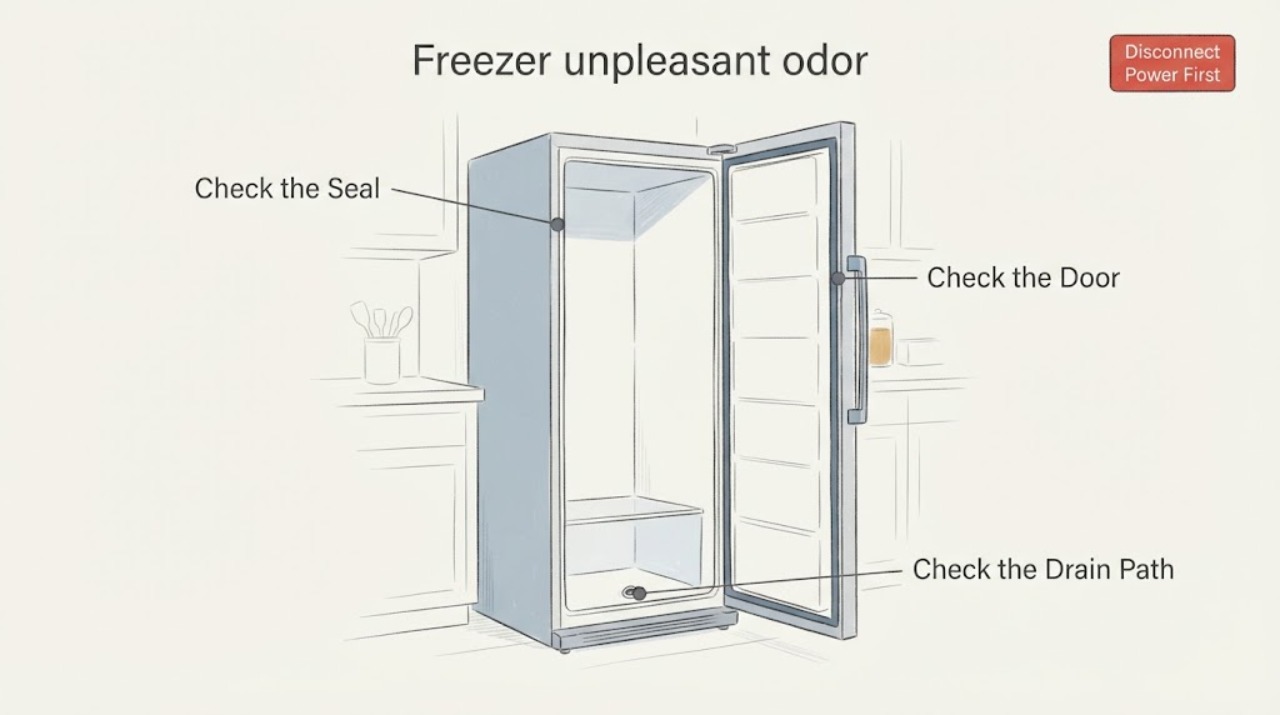
Work through in order
Diagnostic checks
Use only checks that match the exact appliance or system and its official guide.
-
Check 1
With the door open for as little time as possible, identify whether the smell is strongest around one food package, a leaking container, the basket or shelf, the door gasket, or the cabinet air. Then check from outside whether the smell is instead strongest at the rear, plug, cord, or outlet. Do not pull the freezer out if doing so would strain the cord or expose a wet electrical area.
Expected result: The odor is clearly inside near food or residue, is present throughout the cabinet after a thaw, or is strongest outside near the electrical or compressor area.
Next step: For an interior odor, continue with food protection and cleaning. For an external hazardous odor, keep the freezer off, disconnect power only from a safe dry position, and arrange qualified appliance or electrical service.
Stop if: Stop immediately for smoke, sparks, a hot or damaged plug or cord, burning insulation, water near electrical parts, or an active leak. Do not run another test to reproduce the smell.
Why this matters
Why: An interior, localized smell makes food or accessible residue the first decision path. A whole-cabinet smell after warming can reflect spoiled food or liquid contamination. An external burning, solvent-like, or electrical smell is not a cleaning problem and cannot be diagnosed safely by odor alone.
-
Check 2
Before removing food, note whether the freezer is still cold, whether packages are hard frozen or partly thawed, and whether there was a recent outage, door left ajar, or visible leaking package. Keep the door closed while making this short check; do not taste food to decide whether it is safe.
Expected result: Food is hard frozen and the cabinet is holding temperature, or food is thawed, warm, leaking, visibly spoiled, or the temperature history is unknown.
Next step: Remove and discard spoiled or questionable food and contain any leak. Move vulnerable food to a known-safe cold location if the freezer is warming, then clean only after the food decision is complete.
Stop if: Do not taste, cook, refreeze, or give away questionable food as a test. If the cabinet cannot maintain cold, arrange service after protecting the food.
Why this matters
Why: A cold, stable freezer makes an isolated package or residue more likely. Thawing, an unknown temperature history, or visible spoilage creates a food-safety decision separate from deodorizing; masking the odor does not make questionable food safe.
-
Check 3
If the odor is inside and power must be off for cleaning, move food first, switch the freezer off, and unplug it only from a safe, dry position. Remove accessible shelves, baskets, and trays. Wash those parts with hot water and detergent, then wash the interior, door, and gasket with hot water and baking soda. Rinse and sanitize only according to the cleaner's and the exact model's instructions; never mix cleaning chemicals.
Expected result: The odor source or residue is removed, the gasket and interior can be cleaned without cabinet disassembly, or residue has entered an inaccessible liner, drain, vent, or panel area.
Next step: Dry all accessible surfaces thoroughly and continue with ventilation. If cleaning would require removing a panel, piercing the liner, reaching wiring, or accessing the sealed system, stop and arrange qualified service.
Stop if: Do not use gasoline, solvents, abrasive tools, heat, knives, or sprays into vents or electrical areas. Do not mix bleach, vinegar, ammonia, or other cleaners.
Why this matters
Why: The USDA procedure specifically includes removable parts, the interior, door, and gasket, followed by rinsing with a sanitizing solution. A smell that remains in an inaccessible area is not evidence that more aggressive chemicals or panel removal will solve it.
-
Check 4
After the interior is rinsed and dry, leave the door open for about 15 minutes in a safe, ventilated area, then check whether the odor is reduced before returning food. If an exact Insignia manual allows a deodorizing material, use only that documented method; otherwise use a shallow container of baking soda or another product only as directed by its manufacturer and keep it away from food contact.
Expected result: The odor clears or is substantially reduced, or it remains after the food, removable parts, interior, door, and gasket have been cleaned and aired.
Next step: Return food only after the freezer is dry and operating normally. If the smell persists, document when it occurs and where it is strongest, keep the appliance out of service if cooling or electrical behavior is abnormal, and arrange Insignia or qualified appliance service.
Stop if: Do not mask a burning, chemical, or electrical smell with deodorizer, and do not restart the freezer with liquid cleaner, loose absorbent material, or wet surfaces inside.
Why this matters
Why: Improvement after cleaning supports food or accessible residue as the immediate source. Persistent odor after repeated safe cleaning can mean contamination in a hidden area, an absorbed odor, or a separate appliance condition; it does not identify a replacement part.
-
Check 5
Before returning the freezer to normal use, verify from outside that the cord and plug are dry and undamaged, the outlet is not hot, the cabinet is cooling normally, and no new odor appears when the unit runs. Record the exact Insignia model and market, the odor description, where it was strongest, any food or thaw event, and what cleaning was performed.
Expected result: The freezer is cold and quiet with no hazardous smell, or the odor returns during operation, cooling is poor, the cabinet becomes unusually hot, or electrical symptoms appear.
Next step: Use the exact Insignia support or manual for the model and provide the recorded observations. Keep the freezer disconnected and protect the food if any hazardous smell, warming, repeated breaker trip, or damaged electrical component appears.
Stop if: Do not remove the rear cover, test live wiring, puncture the liner, handle refrigerant, or keep operating the freezer to see whether a burning or chemical smell goes away.
Why this matters
Why: A clean interior with normal cooling and no recurring odor supports a resolved food-residue problem. An odor that returns only during operation, or any cooling or electrical abnormality, needs a model-specific professional assessment rather than a guessed compressor, refrigerant, sensor, or control replacement.
Use your observations
Decision map
Find the observation that best matches what you see, then follow the next safe action.
-
PATH 01Next step
What you see
The smell is inside the cabinet, a package or residue is found, the freezer stayed cold, and no electrical or burning warning is present.
Do this next
Discard spoiled or questionable food, clean the removable parts, interior, door, and gasket using the safe procedure, dry and air the cabinet, then confirm normal cooling before restocking.
Why this path and its safety boundary
Why it matters: Food or accessible residue is more likely than an internal mechanical failure, and the problem is primarily a food-protection and cleaning decision.
-
PATH 02Next step
What you see
The freezer warmed, food is thawed or questionable, there was a long outage or open door, or the temperature history is unknown.
Do this next
Do not taste the food. Discard spoiled or questionable items, move vulnerable food to a known-safe cold location, keep the freezer closed, and arrange service if it does not hold temperature.
Why this path and its safety boundary
Why it matters: Food safety is the immediate decision; odor removal cannot establish that food is safe and a freezer that is warming may have a separate cooling fault.
-
PATH 03Next step
What you see
The smell is strongest at the cord, outlet, rear, or cabinet exterior, or there is smoke, a spark, abnormal heat, a damaged cord, or repeated breaker activity.
Do this next
Stop using the freezer and disconnect power only from a safe dry position. Keep clear of water or damaged wiring and arrange qualified appliance or electrical service; use emergency help for an active fire or immediate danger.
Why this path and its safety boundary
Why it matters: This is an electrical, fire, or appliance-safety boundary, not an interior deodorizing problem. The odor does not prove a particular part or refrigerant condition.
-
PATH 04Next step
What you see
Food and accessible surfaces are clean and dry, but the odor persists or returns when the freezer runs, especially with weak cooling or a smell from a hidden area.
Do this next
Stop repeated cleaning and do not remove panels or order a part. Provide the exact Insignia model, market, odor location, temperature trend, and cleaning history to qualified service for inspection.
Why this path and its safety boundary
Why it matters: A hidden contamination or separate appliance fault remains possible, but the symptom alone cannot distinguish insulation, drain, fan, compressor, refrigerant, or control causes.
Helpful context
Understand the symptom
Why the odor location matters
A smell inside the storage space points first to food, packaging, spills, the gasket, or residue left after a temperature event. A smell that is strongest at the rear, outlet, cord, or compressor area is a different safety path. Odor alone cannot identify a refrigerant leak, compressor fault, or safe food condition, so the first decision is where the smell originates and whether the freezer is still holding temperature.
Protect the food before deodorizing
Cleaning can wait; a warming freezer cannot. Keep the door closed while deciding what to do. If food has thawed or the freezer is no longer maintaining cold, move it to a known-safe cold location when practical and evaluate each item without tasting it. The USDA guidance is to dispose of spoiled or questionable food rather than trying to rescue it by masking the smell.
When checks do not resolve it
Need a professional?
Contact Insignia support or qualified appliance service for persistent or recurring odor after safe cleaning, an odor from a hidden area or during operation, poor cooling, a damaged gasket or liner, or any electrical, smoke, burning, water, or repeated-breaker symptom.
Safety scope: Do not remove the freezer cabinet or rear cover, puncture the liner, probe live wiring, handle refrigerant, spray cleaner into vents or electrical areas, or use heat, knives, solvents, or mixed chemicals. Disconnect power only from a safe, dry position before accessible cleaning.
Have this ready
- Provide the exact model and market, odor description, whether it is inside or outside, any outage or thaw event, food condition, temperature trend, photos of residue or damage, and the cleaning steps already completed.
Common questions
FAQ
Can an unpleasant smell in my Insignia freezer prove that the food is unsafe?
No. Smell alone cannot certify food safety. Do not taste questionable food; discard food that is spoiled or questionable, especially after a thaw or unknown temperature event, and evaluate the appliance's cooling separately.
How should I clean an Insignia freezer that smells like spoiled food?
After protecting or discarding the food and disconnecting power safely if cleaning requires it, remove accessible shelves, baskets, and trays. Wash them with hot water and detergent, wash the interior, door, and gasket with hot water and baking soda, rinse and sanitize according to the cleaner and model instructions, dry, and air the cabinet. Do not mix chemicals or remove panels.
What if the smell is burning or comes from the back of the freezer?
Stop using the freezer. If it is safe to do so, disconnect power from a dry position, keep away from smoke, sparks, water, and damaged wiring, protect the food from warming, and arrange qualified appliance or electrical service. Do not cover the smell with deodorizer or run another test.
Why does the freezer still smell after cleaning?
Odor may remain in an inaccessible or absorbed area, or the smell may not be coming from the food compartment. Stop repeated cleaning, record where and when the smell returns, and arrange service if it returns during operation, cooling is poor, or access would require removing a panel or reaching the sealed system.
Read the exact guide
Official sources
- Removing Odors from Refrigerators and FreezersU.S. Department of Agriculture, Food Safety and Inspection Service · USDA FSIS publication opened on an official county-government document host; it applies to household refrigerators and freezers generally and is not a model-specific Insignia repair manual.
Community feedback
Share a repair observation
Share a plain-text repair observation. Accepted observations are published automatically; this page may take a moment to update.