
On this page
Start here
Quick answer
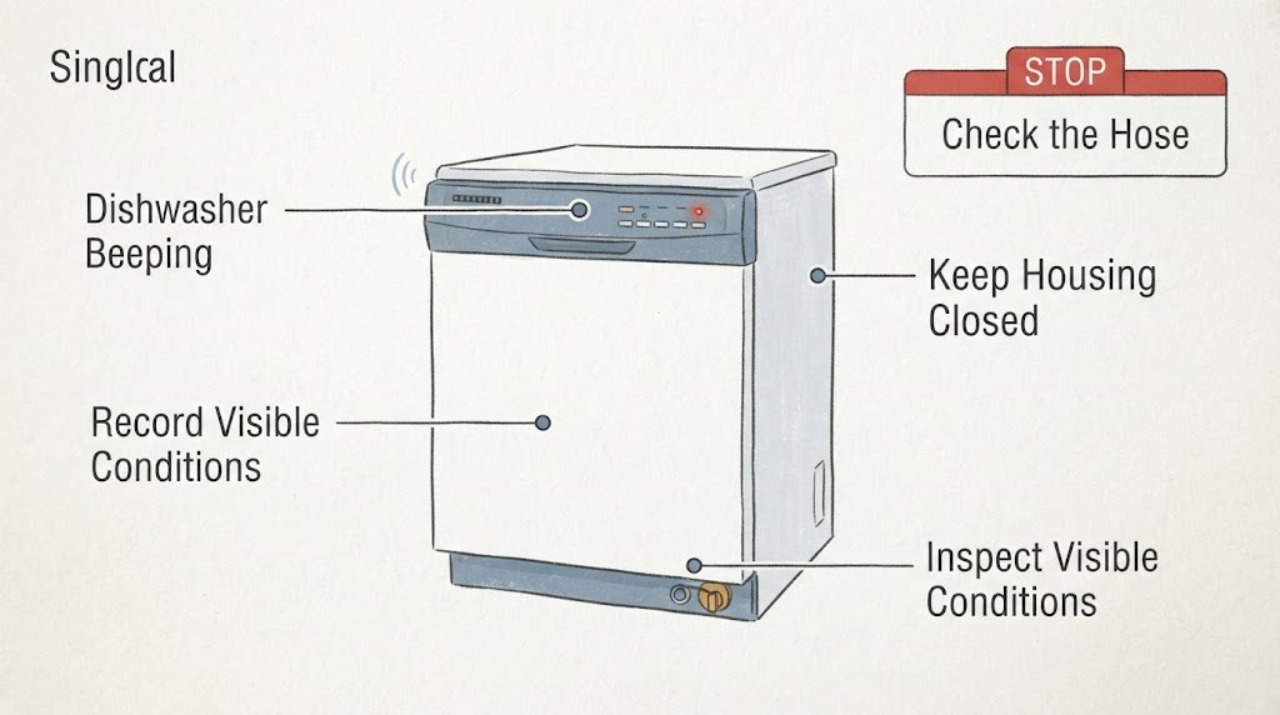
A JennAir JDPSG244LS2 that beeps is not automatically reporting a failed part. First record whether the sound is a single end-of-cycle signal or a repeating pattern, and check whether the Clean or another status light is flashing. JennAir says a flashing Clean light uses two groups of flashes: the first group is the Function number, the second is the Error number, with a short pause between them and a longer pause before repetition. Record the complete pattern and use the exact model documentation. If beeping repeats with a flashing light, the dishwasher stops mid-cycle, a leak or water alert appears, or water reaches an electrical connection, stop using it and arrange qualified service rather than replacing a part from the sound alone.
Work through in order
Diagnostic checks
Use only checks that match the exact appliance or system and its official guide.
-
Check 1
Do not press buttons repeatedly. From a dry position, note whether the sound is one brief beep at the end of a completed cycle, a repeating beep while the cycle is stopped, or a beep that returns immediately after a button press. Record the cycle phase, display text, and every illuminated or flashing light, and keep the full model suffix JDPSG244LS2 available.
Expected result: The beep occurs only when a cycle ends and no light flashes, or it repeats during an unfinished cycle or with a light/display indication.
Next step: If it is only a completion signal and the dishwasher otherwise works normally, monitor it and confirm the signal behavior in the exact manual. If it repeats or the cycle does not complete, continue with the light-pattern check and keep the model information with the notes.
Stop if: Do not repeatedly restart a stopped cycle just to reproduce the sound, enter diagnostics, or remove a control panel.
Why this matters
Why: A completion signal or a normal control acknowledgment has a different meaning from a repeating alert. JennAir's product help sends beeping/flashing cases to model-specific documentation, so timing and the complete light pattern are needed before interpreting it.
-
Check 2
If the Clean light is flashing, watch one complete repetition without touching the controls. Count the first group of rapid flashes, the short pause, the second group, and the longer pause before it repeats. Write the result as F followed by the first count and E followed by the second count, such as F7-E1 only when the observed counts actually match.
Expected result: There are two repeatable flash groups separated by a short pause, or the light pattern is irregular, only one group, or too fast to count reliably.
Next step: Use the exact JDPSG244LS2 documentation or JennAir support route with the complete recorded pattern. If the pattern cannot be counted, photograph or describe the sequence and arrange model-specific service rather than guessing a code.
Stop if: Do not clear a recurring pattern, bypass a control lock, or order a part because a code appears to resemble a component fault.
Why this matters
Why: JennAir defines the two groups as Function and Error numbers. An unrepeatable pattern cannot be safely decoded, and a code read from a different light or model should not be transferred to this dishwasher.
-
Check 3
Compare the sound with the cycle stage without deliberately running another cycle. JennAir identifies fill whoosh or hum, spray-arm swishing, drain-pump hum or a brief gurgle, and a detergent-dispenser snap as possible normal sounds. Note whether the beep is separate from those sounds or occurs with a failure to fill, wash, drain, or finish.
Expected result: Only the expected water, pump, spray, or dispenser sounds are present and the cycle completes, or the beep is new, repetitive, and paired with a stopped or incomplete cycle.
Next step: For normal operation, use the dishwasher according to its exact manual. For a repeating beep or incomplete cycle, leave it unused until the recorded light/display pattern is checked or qualified service is arranged.
Stop if: Do not remove the filter, pump cover, or control panel merely to chase a beep, and do not treat a louder normal hum as proof of a failed part.
Why this matters
Why: Normal operating sounds support routine operation; a new repeating beep combined with a cycle interruption points to an alert state that needs the model's error guidance rather than a noise-based part diagnosis.
-
Check 4
From a safe, dry position, check for a visible leak, standing water near the appliance or electrical connection, a water or leak alert, smoke, burning odor, sparking, or a breaker that trips when the dishwasher operates. Do not pull out the built-in unit or open a panel to look for the source.
Expected result: The beep is accompanied by water or a leak alert, water near electrics, an electrical warning, or no physical hazard is visible.
Next step: If the area is dry and no hazard is present, use the recorded pattern with the exact manual or service route. If a leak or electrical hazard is present, stop the cycle and isolate water and power only from a safe, dry, accessible point, then arrange qualified appliance or electrical service.
Stop if: Do not touch wet wiring, reset a tripped breaker to repeat the fault, run another cycle to test a leak, or operate with covers removed.
Why this matters
Why: The JDPSG244LS product-family page says its Waterlock Leak Detection System can drain the tub and alert when a problem is detected. A physical water or electrical hazard takes priority over interpreting the beep pattern.
Use your observations
Decision map
Find the observation that best matches what you see, then follow the next safe action.
-
PATH 01Next step
What you see
The dishwasher gives one brief signal at the end of a completed cycle, no light flashes, and cleaning, draining, and door operation remain normal.
Do this next
Confirm the signal behavior in the exact JDPSG244LS2 manual and continue normal use while monitoring for a change in timing, lights, or cycle completion.
Why this path and its safety boundary
Why it matters: This pattern is consistent with a completion signal or normal control feedback, not enough evidence for a failed part.
-
PATH 02Next step
What you see
The beep repeats and the Clean light flashes in two repeatable groups separated by a pause.
Do this next
Record the complete F-E pattern, exact model suffix, display state, and cycle phase, then compare only with the matching JennAir documentation or provide it to qualified service.
Why this path and its safety boundary
Why it matters: JennAir defines the first group as the Function number and the second as the Error number. The pattern narrows the documentation or service route, but it does not by itself prove which component failed.
-
PATH 03Next step
What you see
The beep repeats while the cycle is incomplete, the light pattern cannot be read reliably, or the dishwasher stops responding normally.
Do this next
Stop repeated attempts, keep the model and symptom notes, and use JennAir's model-specific manual or arrange qualified appliance service.
Why this path and its safety boundary
Why it matters: The sound is an unresolved control or cycle-status alert. Without a reliable model-matched code, a pump, valve, latch, control, or other part cannot be identified from the beep alone.
-
PATH 04Next step
What you see
Beeping occurs with a leak or water alert, water near an electrical connection, smoke, burning odor, sparking, or a repeated breaker trip.
Do this next
Stop using the dishwasher. From a safe, dry position only, isolate the accessible water supply and power, and contact qualified appliance service; use qualified electrical help when the circuit or wiring is involved.
Why this path and its safety boundary
Why it matters: A physical water or electrical hazard overrides sound and code interpretation. JennAir identifies Waterlock leak detection as an alerting and draining feature for the product family.
Helpful context
Understand the symptom
What the beep can and cannot tell you
A beep by itself does not identify a pump, valve, control, or other replacement part. The useful distinction is timing and what the controls show. JennAir's JDPSG244LS product-family information lists an End of Cycle Signal, while its product help treats beeping and flashing as an error-status path that should be matched to the model documentation. Record the sound pattern before trying to clear it.
Why the Clean light matters
If the Clean light flashes, JennAir says to count the first rapid group, wait for the short pause, count the second rapid group, and then watch for the longer pause before the pattern repeats. The first group is the Function number and the second is the Error number. For example, seven flashes, a pause, one flash, and a repeat is read as F7-E1. Treat that as a recorded diagnostic pattern, not as proof that a particular part has failed.
Beeping versus normal operating noise
JennAir describes a gentle fill hum or whoosh, spray-arm swishing, a drain-pump hum, an occasional sink-drain gurgle, and a detergent-dispenser snap as possible normal cycle sounds. A brief signal at completion with no flashing light or change in cleaning performance is different from a beep that repeats, accompanies a flashing control, or occurs with an unfinished cycle.
When checks do not resolve it
Need a professional?
Arrange JennAir or qualified appliance service when the beep repeats, the cycle stops or will not finish, the F-E light pattern is recurring or cannot be matched to the exact JDPSG244LS2 documentation, or the dishwasher has a leak, water alert, control failure, smoke, burning odor, sparking, or a breaker problem. Provide the exact model and serial information, beep timing, display text, complete light sequence, cycle phase, and any safe photographs. Do not order a pump, valve, latch, control, or other part from the sound alone.
Common questions
FAQ
Is one beep from a JennAir dishwasher always an error?
No. The JDPSG244LS product-family information lists an End of Cycle Signal, and JennAir also documents separate beeping and flashing error-status behavior. A brief completion signal with no flashing light or cycle problem has a different meaning from a repeating beep during an unfinished cycle.
How do I read a flashing Clean light with the beeping?
Count the first rapid group, wait for the short pause, count the second rapid group, and wait for the longer pause before the pattern repeats. JennAir defines the first group as the Function number and the second as the Error number. Record the pattern and confirm it against the exact model documentation.
Should I replace a part because my JennAir dishwasher is beeping?
No. A beep does not identify a failed part. First distinguish a completion signal from a repeating alert and record any model-matched F-E pattern. If the beep repeats or the cycle is incomplete, use JennAir's exact manual or qualified service before selecting a component.
Read the exact guide
Official sources
- Clean Light Flashing - DishwasherJennAir Product Help · JennAir dishwasher Clean-light flashing sequence and service guidance.
- Normal Dishwasher Sounds and Noise - Product Help | JennAirJennAir Product Help · JennAir dishwasher normal cycle sound and noise guidance.
- Beeping/FlashingJennAir Product Help · JennAir dishwasher beeping and flashing-light support, including direction to use model-specific manuals and service.
- Home - Product Help | JennAirJennAir Product Help · JennAir Product Help model lookup for JDPSG244LS2 dishwasher owners seeking matching manuals and troubleshooting resources.
- Pocket-Handle 24" Built-In Dishwasher, 39 dBAJennAir · JennAir JDPSG244LS dishwasher product-family specifications, including End of Cycle Signal and Waterlock Leak Detection System.
Community feedback
Share a repair observation
Share a plain-text repair observation. Accepted observations are published automatically; this page may take a moment to update.