
On this page
Start here
Quick answer
A JennAir dishwasher rattle is first classified by cycle phase and load. JennAir says rushing water, hums, swishing, drain gurgles, and dispenser clicks can be normal, while lightweight items can rattle when they move. Note whether the sound changes after securing the load, inspect only accessible spray-arm and filter areas when the dishwasher is off, and check for rocking or loose mounting. Persistent empty-rack rattling, grinding, leaks, burning odor, or error codes needs qualified service.
Work through in order
Diagnostic checks
Use only checks that match the exact appliance or system and its official guide.
-
Check 1
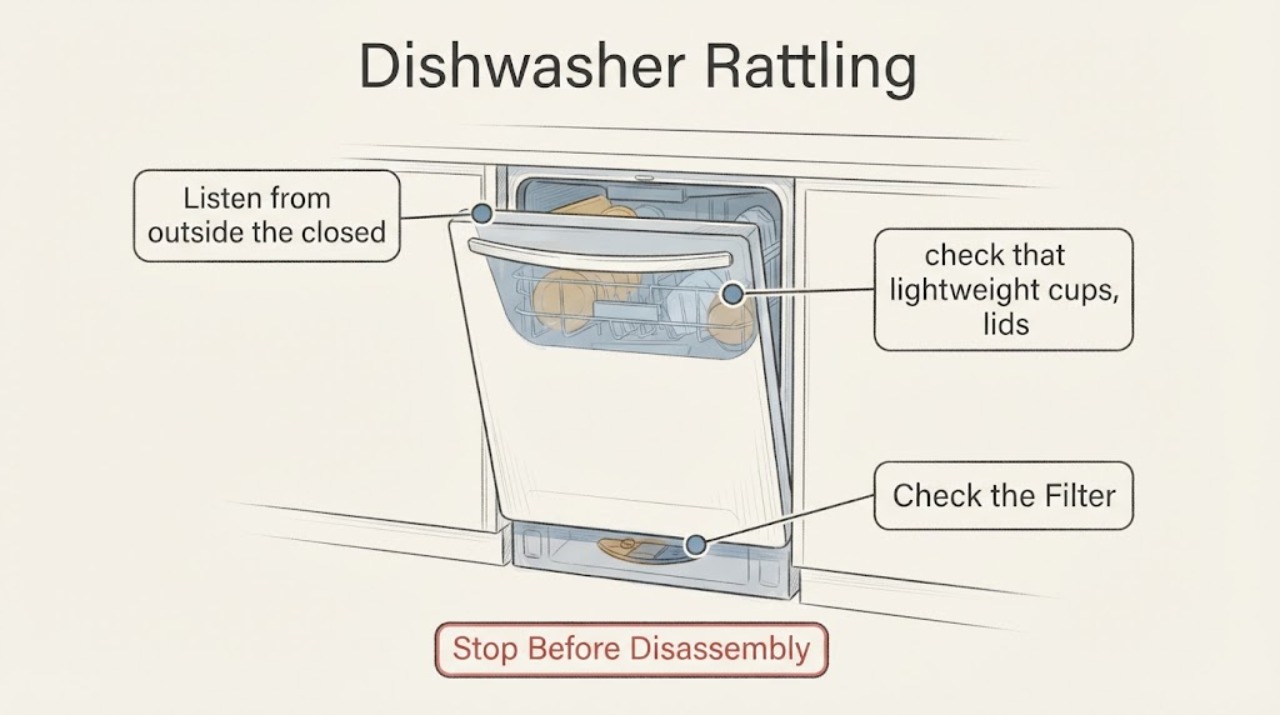
Listen from outside the closed dishwasher and note when the rattle occurs: filling, washing, draining, drying, or only when a particular load is present.
Expected result: The sound is a brief hum, swish, gurgle, dispenser click, or a sharp rattle tied to dishes or utensils.
Next step: Pause only using the normal control if safe, secure the load after the cycle, and continue with rack and spray-arm checks.
Why this matters
Why: JennAir maps several hums, swishes, clicks, and gurgles to normal cycle phases; loose lightweight items can rattle during washing.
-
Check 2
After the cycle and with the dishwasher safe to open, check that lightweight cups, lids, and utensils are separated and that no item contacts a spray arm.
Expected result: The rattle changes with load arrangement, or it continues with an empty rack.
Next step: Rearrange the load and rotate the spray arm by hand only when the dishwasher is off and safe; do not force it.
Why this matters
Why: A load-dependent change supports dish contact or spray-arm interference; an empty-rack rattle points toward installation or mechanical service.
-
Check 3
Check visible filter and spray-arm debris and whether the unit rocks or transmits vibration into the cabinets.
Expected result: Filters or spray arms are dirty, the unit is not level or securely mounted, or visible parts are clear.
Next step: Clean only user-accessible parts per the manual; arrange service for a rocking, loose, or persistently rattling unit.
Why this matters
Why: JennAir identifies maintenance and installation as factors that can amplify sound and affect water flow.
-
Check 4
Record whether the rattle is accompanied by leaking, grinding, failure to drain, a burning smell, or an error code.
Expected result: Rattling is isolated and load-dependent, or abnormal noise occurs with a functional or safety symptom.
Next step: Stop using the dishwasher and arrange qualified service for grinding, leakage, electrical odor, repeated errors, or persistent empty-rack noise.
Why this matters
Why: An isolated load rattle is different from a mechanical or pump fault with other symptoms.
Use your observations
Decision map
Find the observation that best matches what you see, then follow the next safe action.
-
PATH 01Next step
What you see
Rattle occurs only with lightweight dishes or utensils and disappears after rearrangement.
Do this next
Secure the load and monitor the next cycle.
Why this path and its safety boundary
Why it matters: Dish contact or movement is more likely than an internal fault.
-
PATH 02Next step
What you see
Rattle occurs with an empty dishwasher or the unit rocks or is loose in the cabinet.
Do this next
Keep use limited and arrange qualified dishwasher service.
Why this path and its safety boundary
Why it matters: Installation, leveling, mounting, pump, or motor issues are possible.
-
PATH 03Next step
What you see
Rattle is accompanied by grinding, leaking, burning odor, an error, or failure to drain.
Do this next
Stop using the dishwasher and arrange qualified service.
Why this path and its safety boundary
Why it matters: The sound is not explained by normal cycle acoustics alone.
Helpful context
Understand the symptom
A JennAir dishwasher rattle is first classified by cycle phase and load. JennAir says rushing water, hums, swishing, drain gurgles, and dispenser clicks can be normal, while lightweight items can rattle when they move. Note whether the sound changes after securing the load, inspect only accessible spray-arm and filter areas when the dishwasher is off, and check for rocking or loose mounting. Persistent empty-rack rattling, grinding, leaks, burning odor, or error codes needs qualified service.
When checks do not resolve it
Need a professional?
Provide the exact model and the observed pattern to the manufacturer or a qualified technician.
Common questions
FAQ
What should I do first?
A JennAir dishwasher rattle is first classified by cycle phase and load. JennAir says rushing water, hums, swishing, drain gurgles, and dispenser clicks can be normal, while lightweight items can rattle when they move. Note whether the sound changes after securing the load, inspect only accessible spray-arm and filter areas when the dishwasher is off, and check for rocking or loose mounting. Persistent empty-rack rattling, grinding, leaks, burning odor, or error codes needs qualified service.
Read the exact guide
Official sources
- Normal Dishwasher Sounds and NoiseJennAir · JennAir dishwasher rattling and normal dishwasher sounds
Community feedback
Share a repair observation
Share a plain-text repair observation. Accepted observations are published automatically; this page may take a moment to update.